2 layers144.8 × 88.9 mm

 iorodeo/potentiostat57
Rodeostat design files, software and firmware
Multiplexer is an open-source printed circuit board by iorodeo, from the iorodeo/potentiostat repository on GitHub, published under the CC-BY-4.0 licence. It is a 2-layer board of 82.6 × 88.9 mm with 26 parts on 34 nets, routed with 422 tracks and 33 vias.
Its parts include 12 capacitors, 5 connectors, 4 ICs and 1 switch.
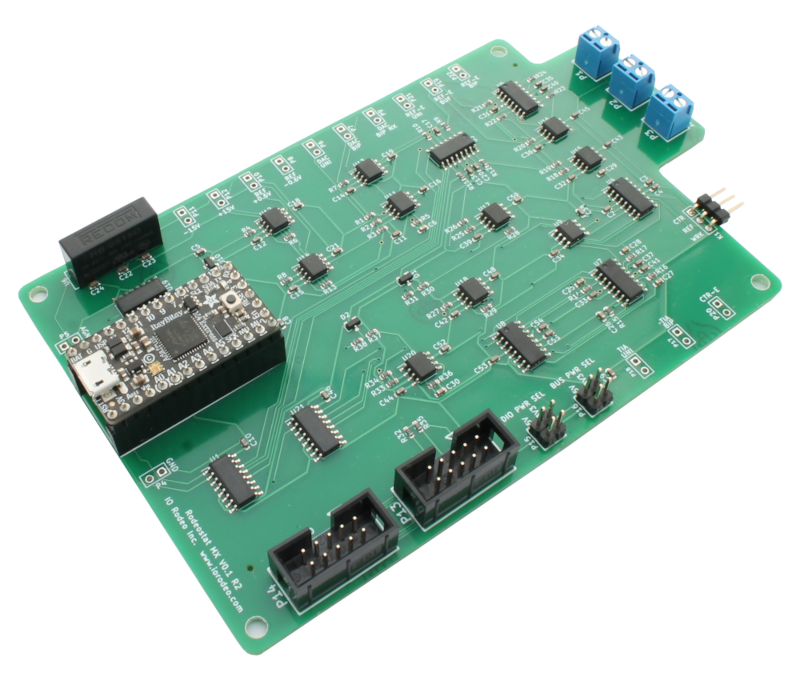
Hardware design, firmware and software for IO Rodeo's Rodeostat Potentiostat.
| Qty | Value | Footprint | References |
|---|---|---|---|
| 12 | 0.1uF | Capacitor_SMD:C_0603_1608Metric | C1, C2, C3, C4, C5, C6, C7, C8, C9, C10, C11, C12 |
| 4 | DG411xY | Package_SO:SOIC-16_3.9x9.9mm_P1.27mm | U1, U2, U3, U4 |
| 4 | VAL** | 4-40 | 4-40, M1, M2, M3 |
| 3 | CONN_5X2 | 5x2_shrd_header:5X2_SHRD_HEADER | P1, P2, P5 |
| 2 | CONN_2 | Connector_PinHeader_2.54mm:PinHeader_1x02_P2.54mm_Vertical | P3, P4 |
| 1 | CONN_3 | Connector_PinHeader_2.54mm:PinHeader_1x03_P2.54mm_Vertical | K1 |


hackclub/OnBoard
💡 Join 1,000 teenagers and make your first PCB with a $100 grant!


harbaum/galagino
A Galaga, Pac-Man and Donkey Kong arcade emulator for the ESP32

Luos-io/luos_engine
Open-source and real-time orchestrator for cyber-physical-systems, to easily design, test and deploy embedded applications and digital twins.

google/walt
A device for measuring latency of physical sensors and outputs on phones and computers

It measures 82.6 × 88.9 mm and has 2 copper layers, 1.6 mm thick.
26 parts. The full list of its parts is on this page, with links to each part's symbol and footprint where PCBKit's library has them.
From the iorodeo/potentiostat repository on GitHub, at the commit this page was made from: the board is hardware/pcbs/multiplexer_v0p3/multiplexer.kicad_pcb. PCBKit opens the board in the browser, with nothing to install.
Its repository publishes it under the CC-BY-4.0 licence: you may reuse it on that licence's terms (keep the author's notice, and for a copyleft licence share your changes alike).