2 layers73.7 × 92.1 mm
Erun2backup
immonel/e-runout
This project is used to measure electrical runout by comparing measurements from touching probe sensors and Eddy current probes simultaneously.
21 parts

 immonel/e-runout
This project is used to measure electrical runout by comparing measurements from touching probe sensors and Eddy current probes simultaneously.
Erun2 is an open-source printed circuit board by immonel, from the immonel/e-runout repository on GitHub. It is a 2-layer board of 121.3 × 120.9 mm with 38 parts on 103 nets, routed with 483 tracks and 32 vias.
It is built around the MCP3301-CI/P and MC3486N. Its parts include 12 capacitors, 10 connectors, 7 ICs, 6 resistors and 1 switch. It belongs with the sensors and measurement boards and the NXP (LPC, Kinetis, i.MX RT) boards of this library.


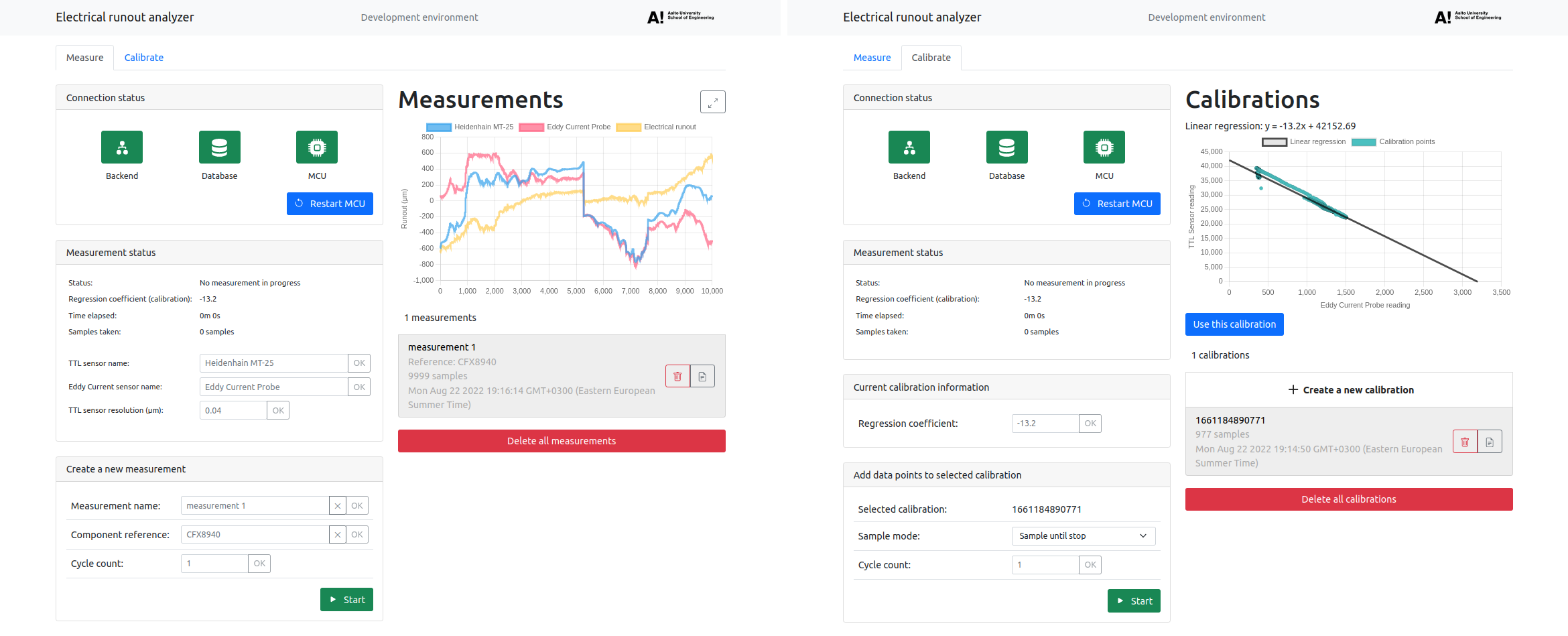
This project is used to measure electrical runout by comparing measurements from touching probe sensors and Eddy current probes simultaneously.
Technologies and frameworks used in the project include Docker, React, Redux, Bootstrap, Node.js, Express, MongoDB and Socket.IO.
client/
Frontend React app code
documentation/
Documentation files
hardware/
PCB schematics
mongodb/
MongoDB init scripts
server/
Backend Node.js app code
teensy/
Teensy microcontroller C++ code
$ mv .example.env .env$ docker-compose upNOTE: Please keep in mind that buiding the erunout Docker image on Raspberry Pi will take a LONG time (~1h).
The application creates a Wi-Fi access point with environment variables SSID and PASSPHRASE given in the .env file.
IP address for the application is 10.0.10.1 by default and can be accessed after connecting to the WLAN network.
TODO: WAN access is currently not working on the wireless access point$ mv .env.example .env$ docker-compose -f docker-compose.dev.yml upserver folder):server $ npm install
server $ npm run devclient folder):client $ npm install
client $ npm startlocalhost:3001. The backend server is accessible from localhost:3000 and the database admin interface from localhost:8081.| Qty | Value | Footprint | References |
|---|---|---|---|
| 8 | 0.1μF | Capacitor_SMD:C_0603_1608Metric | C1, C3, C5, C6, C7, C8, C11, C12 |
| 5 | Conn_01x02_Female | Connector_PinHeader_2.54mm:PinHeader_1x02_P2.54mm_Vertical | J4, J5, J6, J7, J8 |
| 4 | 1μF | Capacitor_SMD:C_0603_1608Metric | C2, C4, C9, C10 |
| 2 | 250Ω | Resistor_SMD:R_0603_1608Metric | R3, R4 |
| 2 | Conn_01x03_Female | Connector_PinHeader_2.54mm:PinHeader_1x03_P2.54mm_Vertical | J9, J10 |
| 2 | MC3486N | Package_SO:SOIC-16_4.55x10.3mm_P1.27mm | U2, U3 |
| 2 | TXB0108PWR | TXB0108PWR:SOP65P640X120-20N | U4, U5 |
| 1 | 1kΩ | Resistor_SMD:R_0603_1608Metric | R2 |
| 1 | 2,4kΩ | Resistor_SMD:R_0603_1608Metric | R6 |
| 1 | 20kΩ | Resistor_SMD:R_0603_1608Metric | R1 |
| 1 | 9,1kΩ | Resistor_SMD:R_0603_1608Metric | R5 |
| 1 | Conn_Coaxial | Connector_Coaxial:SMA_Amphenol_132134-16_Vertical | J1 |
| 1 | HEIDENHAIN_MT25_TTL | Connector_Dsub:DSUB-15_Female_Horizontal_P2.77x2.84mm_EdgePinOffset7.70mm_Housed_MountingHolesOffset9.12mm | J2 |
| 1 | MCP3301 | Package_SO:SOIC-8_3.9x4.9mm_P1.27mm | U1 |
| 1 | SW_DP3T | SW_DP3T:SW_DP3T | SW1 |
| 1 | SolderJumper_3_Open | Jumper:SolderJumper-3_P1.3mm_Open_Pad1.0x1.5mm_NumberLabels | JP1 |
| 1 | TPS793475-EP | Package_TO_SOT_SMD:SOT-23-5 | U7 |
| 1 | TRIGGER_TTL | Connector_Dsub:DSUB-15_Female_Horizontal_P2.77x2.84mm_EdgePinOffset7.70mm_Housed_MountingHolesOffset9.12mm | J3 |
| 1 | Teensy4.0 | teensy:Teensy40 | U6 |
The 37 most common of 38 parts.
It measures 121.3 × 120.9 mm and has 2 copper layers, 1.6 mm thick.
38 parts, built around the MCP3301-CI/P and MC3486N. The full list of its parts is on this page, with links to each part's symbol and footprint where PCBKit's library has them.
From the immonel/e-runout repository on GitHub, at the commit this page was made from: the board is hardware/erun/erun2.kicad_pcb and its schematic hardware/erun/erun2.kicad_sch. PCBKit opens the board in the browser, with nothing to install.
Its repository states no licence, so its author keeps all rights: ask immonel before reusing the design.
immonel/e-runout
This project is used to measure electrical runout by comparing measurements from touching probe sensors and Eddy current probes simultaneously.

immonel/e-runout
This project is used to measure electrical runout by comparing measurements from touching probe sensors and Eddy current probes simultaneously.

hmerrett/pico506-pcb
A dedicated PCB for the Pico506 ST-506/MFM/RLL hard drive emulator: two-layer, 138 × 74 mm, all through-hole, with real card-edge tabs so it plugs into a period ST-506 control/data cable pair the same way an ST-225 does.


Jan-IngenHousz-Institute/spectrometer-C12666MA
Repository for the fw and analysis developed during the internship of Kjell Tolsma.

jdeguire/pjcontroller
Hardware and software for controlling your homebuilt video-beaming creation.


joeycastillo/The-Open-Book
For details on how to build, test and use Open Book, I've made documentation available here.


hackclub/OnBoard
💡 Join 1,000 teenagers and make your first PCB with a $100 grant!