Skip to the content
2 layers101.6 × 55.9 mmOutput register, the printed circuit board in 3D

Output register

ifilot/sap-smd2

Modular 8-bit computer built with TTL logic units to create a "Simple as Possible" system

Size
101.6 × 55.9 mm
Copper layers
2
Thickness
1.6 mm
Parts
30
Nets
69
Pads
222
Tracks, vias
793, 58
Pours
2
Routed
Yes
KiCad
KiCad 8.0 (file 20240108)
Created
14 Jan 2025
Updated
26 Jan 2025

Overview

Output register is an open-source printed circuit board by ifilot, from the ifilot/sap-smd repository on GitHub, published under the CERN-OHL-S-2.0 licence. It is a 2-layer board of 101.6 × 55.9 mm with 30 parts on 69 nets, routed with 793 tracks and 58 vias.

It is built around the 74HC00D, 74HC139D and 74HC161S, with the 74HC273D among its other parts. Its parts include 10 ICs, 8 capacitors, 3 resistors, 2 connectors and 1 diode. It belongs with the retro computing and games boards of this library.

Main components

4

README

README.md

Modular 8-bit "Simple as Possible" TTL-Logics Computer

Work in Progress CERN-OHL

This project showcases the design and construction of a modular 8-bit computer built with TTL logic units. The core principle behind the project is to create a "Simple as Possible" system, focusing on simplicity, modularity, and compactness.

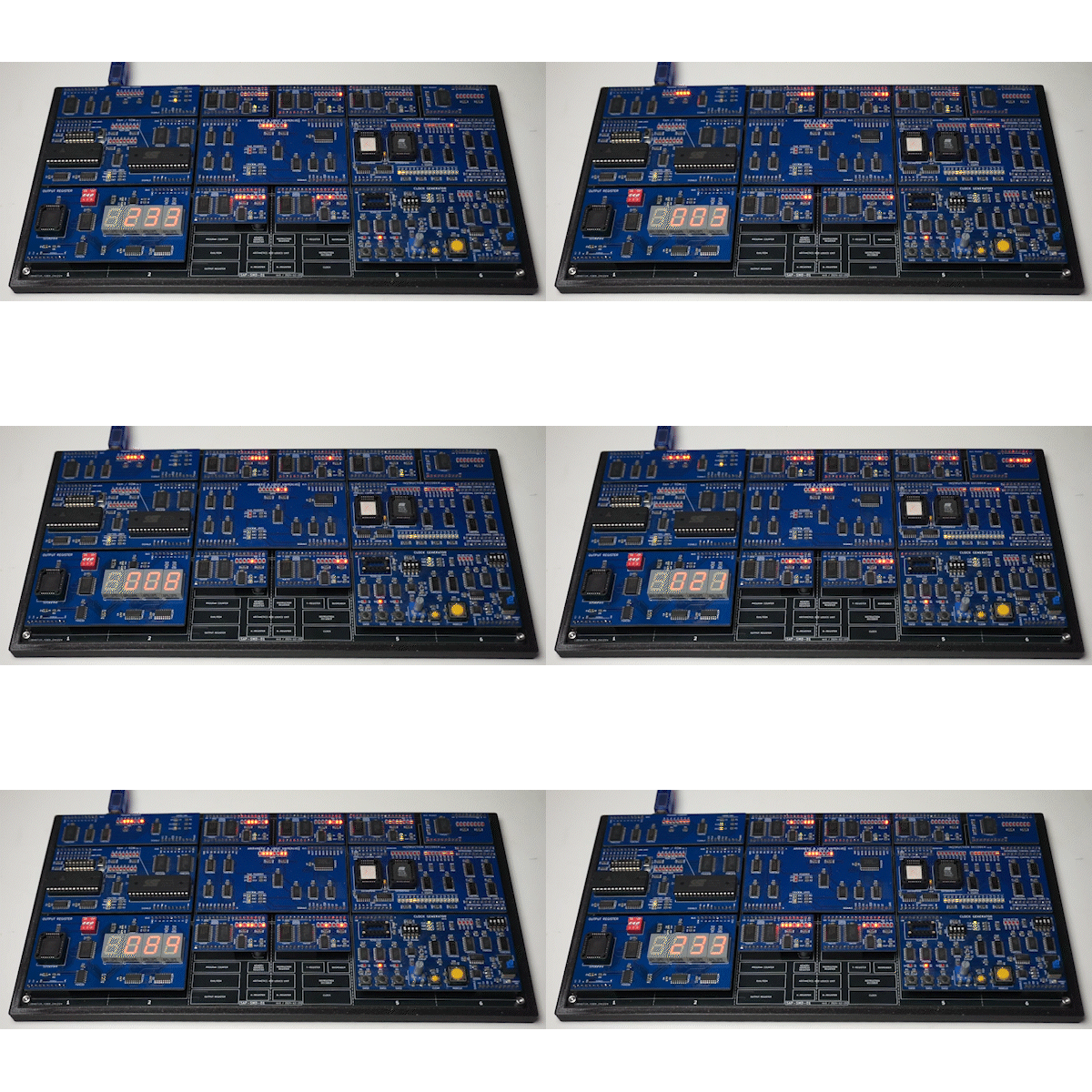
SAP-SMD demo

Key Features

  • TTL Logic-Based Design: The computer is built using traditional TTL (Transistor-Transistor Logic) components, adhering to a fundamental, hands-on approach to computing.
  • Modular Architecture: Designed for modularity, each functional unit (ALU, registers, memory, control logic, etc.) is implemented as a separate module, allowing for easy debugging, customization, and scalability.
  • Compact Form Factor: By predominantly using SMD (Surface-Mount Device) components, the overall size of the computer is significantly reduced compared to traditional through-hole designs, making it more efficient and portable.
  • Educational Value: Serves as an excellent learning resource for understanding the basic principles of digital logic, computer architecture, and how these concepts come together to form a functional computing system.
  • Customization Potential: The modular approach allows users to experiment with different configurations and expand the system to suit specific needs or projects.

Technical specifications

  • 8 bit program counter
  • 256 bytes of RAM and 256 bytes of program ROM
  • 256 configurable programs via a dip switch
  • Three general-purpose register: A, B and T
  • Simple ALU allowing for addition and subtraction
  • EEPROM-configurable instruction decoder
  • Custom assembly language including Python-based assembler

Goals of the Project

The project aims to:

  1. Simplify Complexity: Break down the workings of a computer into comprehensible modules without unnecessary abstraction.
  2. Promote Learning: Provide an accessible platform for enthusiasts, educators, and students to explore computer design.
  3. Encourage Miniaturization: Demonstrate how SMD components can be used effectively in hobbyist and educational projects to save space while maintaining functionality.

Why SMD Components?

SMD components offer several advantages:

  • Space Efficiency: Significantly smaller than through-hole components, enabling more compact designs.
  • Modern Availability: Easier to source and more reflective of contemporary electronics practices.
  • Scalability: Allows for a more complex system without requiring excessive physical space.

Who Is This For?

This project is ideal for:

  • Hobbyists and Makers interested in retrocomputing and hardware design.
  • Students and Educators looking for hands-on experience with digital logic and computing fundamentals.
  • Researchers and Enthusiasts exploring minimalist computing and modular design approaches.

Getting Started

  1. Clone the Repository: Download the files and schematics from this repository.
  2. Review the Documentation: Detailed explanations and schematics for each module are available in the docs directory.
  3. Assemble and Test: Follow the provided instructions to assemble and test the modules step-by-step.
  4. Customize: Modify or expand the design to suit your needs or explore specific areas of interest.

Contributing

Contributions to this project are welcome! If you have ideas for improvements, additional features, or alternative designs, feel free to fork the repository and submit a pull request.

Parts

30
QtyValueFootprintReferences
6CCapacitor_SMD:C_0805_2012MetricC1, C2, C3, C4, C5, C6
4D168KDisplay_7Segment:D1X8KU5, U6, U7, U10
210nFCapacitor_SMD:C_0805_2012MetricC7, C8
2220Resistor_SMD:R_Array_Convex_4x0603RN2, RN3
110kResistor_SMD:R_Array_Convex_4x0603RN1
11kResistor_SMD:R_0805_2012MetricR2
1330Resistor_SMD:R_0805_2012MetricR1
147kResistor_SMD:R_0805_2012MetricR3
174HC00Package_SO:SO-14_3.9x8.65mm_P1.27mmU1
174HC139Package_SO:SO-16_3.9x9.9mm_P1.27mmU2
174HC161Package_SO:SO-16_3.9x9.9mm_P1.27mmU9
174HC273Package_SO:SOIC-20W_7.5x12.8mm_P1.27mmU3
1BUSConnector_PinHeader_2.54mm:PinHeader_1x10_P2.54mm_VerticalJ2
1CPTestPoint:TestPoint_THTPad_D2.0mm_Drill1.0mmTP2
1GNDTestPoint:TestPoint_THTPad_D2.0mm_Drill1.0mmTP1
1INLED_SMD:LED_0805_2012MetricD1
1LM555xMPackage_SO:SOIC-8_3.9x4.9mm_P1.27mmU8
1SIGNALSConnector_PinHeader_2.54mm:PinHeader_1x10_P2.54mm_VerticalJ1
1SST39SF040Package_LCC:PLCC-32_THT-SocketU4
1SW_DIP_x03Button_Switch_THT:SW_DIP_SPSTx03_Slide_9.78x9.8mm_W7.62mm_P2.54mmSW1

More from ifilot/sap-smd

10
  • 2 layers101.6 × 55.9 mmClock, the printed circuit board in 3D

    Clock

    ifilot/sap-smd

    Modular 8-bit computer built with TTL logic units to create a "Simple as Possible" system

    72 parts2CERN-OHL-S-2.0
  • 2 layers101.6 × 55.9 mmInstruction decoder, the printed circuit board in 3D

    Instruction decoder

    ifilot/sap-smd

    Modular 8-bit computer built with TTL logic units to create a "Simple as Possible" system

    68 parts2CERN-OHL-S-2.0
  • 2 layers101.6 × 55.9 mmAlu advanced, the printed circuit board in 3D

    Alu advanced

    ifilot/sap-smd

    Modular 8-bit computer built with TTL logic units to create a "Simple as Possible" system

    51 parts2CERN-OHL-S-2.0
  • 2 layers101.6 × 55.9 mmRamrom, the printed circuit board in 3D

    Ramrom

    ifilot/sap-smd

    Modular 8-bit computer built with TTL logic units to create a "Simple as Possible" system

    48 parts2CERN-OHL-S-2.0
  • 2 layers101.6 × 55.9 mmAlu, the printed circuit board in 3D

    Alu

    ifilot/sap-smd

    Modular 8-bit computer built with TTL logic units to create a "Simple as Possible" system

    42 parts2CERN-OHL-S-2.0
  • 2 layers319.9 × 154.4 mmBp leanplate, the printed circuit board in 3D

    Bp leanplate

    ifilot/sap-smd

    Modular 8-bit computer built with TTL logic units to create a "Simple as Possible" system

    29 parts2CERN-OHL-S-2.0
  • 2 layers101.6 × 27.9 mmProgram counter, the printed circuit board in 3D

    Program counter

    ifilot/sap-smd

    Modular 8-bit computer built with TTL logic units to create a "Simple as Possible" system

    26 parts2CERN-OHL-S-2.0
  • 2 layers101.6 × 27.9 mmGeneral purpose registers, the printed circuit board in 3D

    General purpose registers

    ifilot/sap-smd

    Modular 8-bit computer built with TTL logic units to create a "Simple as Possible" system

    23 parts2CERN-OHL-S-2.0
  • 2 layers48.3 × 27.9 mmBusreader, the printed circuit board in 3D

    Busreader

    ifilot/sap-smd

    Modular 8-bit computer built with TTL logic units to create a "Simple as Possible" system

    16 parts2CERN-OHL-S-2.0
  • 2 layers101.6 × 55.9 mmLcd display, the printed circuit board in 3D

    Lcd display

    ifilot/sap-smd

    Modular 8-bit computer built with TTL logic units to create a "Simple as Possible" system

    12 parts2CERN-OHL-S-2.0

Similar boards

  • 2 layers209 × 175 mmExcalibur64, the printed circuit board in 3D

    Excalibur64

    Cptscorcher/Excallibur-64

    A reimagining of the seminal Excalibur 64 Computer

    126 partsGPL-3.0
  • 4 layers100 × 100 mmEth, the printed circuit board in 3D

    Eth

    imihajlow/ccpu

    A 8-bit computer made of 74xx series logic gates and memory ICs.

    101 parts145
  • 2 layers208 × 110 mm8 16 computer 2, the printed circuit board in 3D

    8 16 computer 2

    halfburnttoast/TCPU816-v1

    Version 1.1 of my 8-bit, TTL computer.

    120 parts21
  • 2 layers178 × 711 mmMSAP-2 rev.A SMD, the printed circuit board in 3D

    MSAP-2 rev.A SMD

    mehrantsi/MSAP-2

    An 8-bit computer. Successor to MSAP-1

    658 parts13MIT
  • 4 layers304.5 × 217.2 mmLatest Full Backplane, the printed circuit board in 3D

    Latest Full Backplane

    Trilobyte-CPU/8-bit-computer

    A DIY 8-bit computer built mostly with discrete logic chips

    478 parts2
  • 2 layers234 × 100 mmV2b, the printed circuit board in 3D

    V2b

    KITTY-6502/hardware

    the KITTY is a 65c02 homebrew kit microcomputer designed around text mode graphics and cartridge media. It is fully open source, and uses exclusively in-production parts.

    147 parts
  • 2 layers90 × 56.8 mmV0c, the printed circuit board in 3D

    V0c

    smaldragon/BNUY-ROM

    A famicom discrete logic mapper

    37 parts3Unlicense
  • 2 layers210 × 170 mmTB04addr8bit ctrl, the printed circuit board in 3D

    TB04addr8bit ctrl

    Myuu1967/TB-04

    4bitCPU(TB-04)に関するリポジトリです

    102 parts

Questions

How big is the Output register PCB?

It measures 101.6 × 55.9 mm and has 2 copper layers, 1.6 mm thick.

What parts does the Output register use?

30 parts, built around the 74HC00D, 74HC139D, 74HC161S and 74HC273D. The full list of its parts is on this page, with links to each part's symbol and footprint where PCBKit's library has them.

Where can I download the Output register KiCad files?

From the ifilot/sap-smd repository on GitHub, at the commit this page was made from: the board is pcb/components/output_register/output_register.kicad_pcb and its schematic pcb/backplates/bp-leanplate/bp-leanplate.kicad_sch. PCBKit opens the board in the browser, with nothing to install.

Can I use the Output register design in my own project?

Its repository publishes it under the CERN-OHL-S-2.0 licence: you may reuse it on that licence's terms (keep the author's notice, and for a copyleft licence share your changes alike).