4 layers54 × 34 mm
Neurband main
jlcjak/neurband
Open, minimal sEMG wristband like the Meta Neural Band: 8-ch ADS1298 + nRF52832 BLE, dry gold electrodes on a flex, 3D-printed band. KiCad, FreeCAD, Zephyr, Python, simulations.
63 parts46
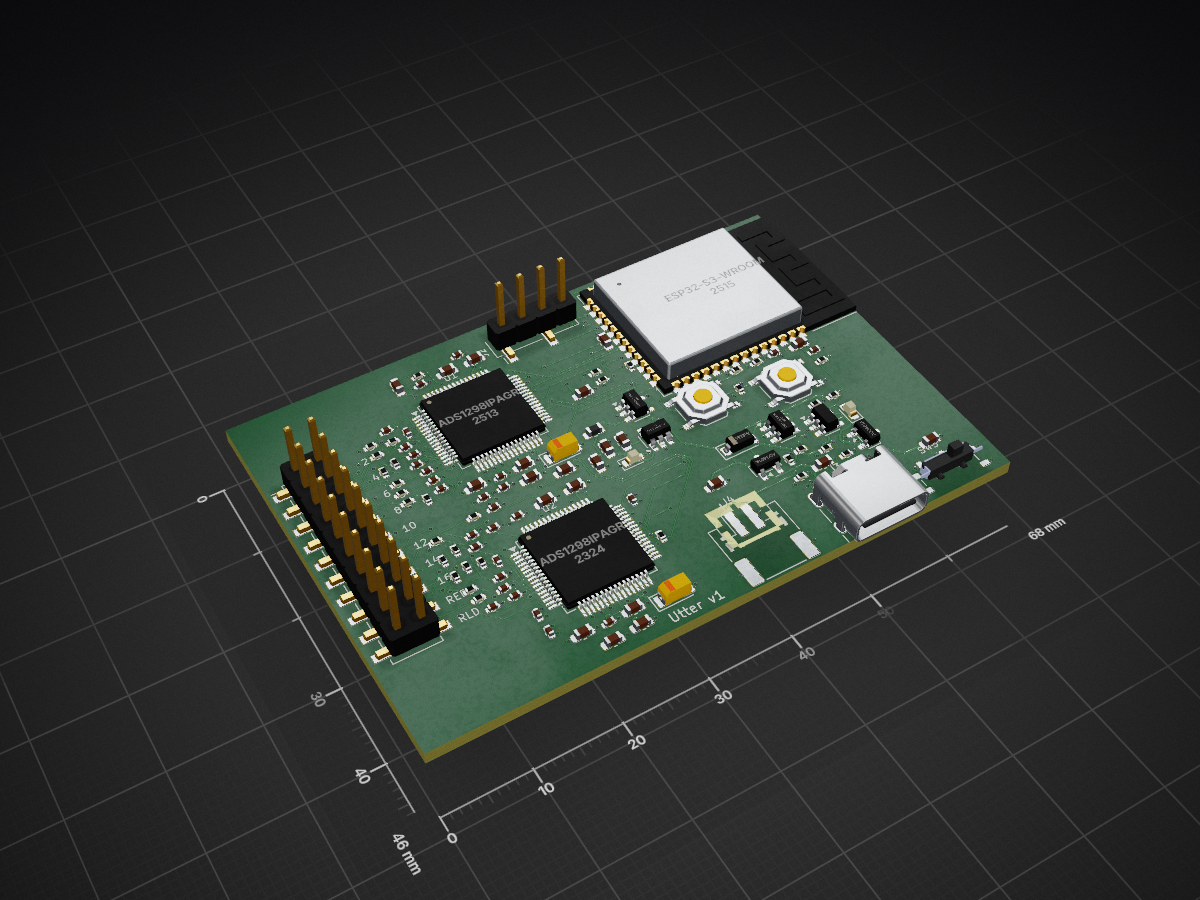
 IFAKA/utter
Utter: covert silent-speech text input from surface EMG (open-source ALS voice)
Utter is an open-source printed circuit board by IFAKA, from the IFAKA/utter repository on GitHub. It is a 4-layer board of 68 × 46 mm with 107 parts on 86 nets, routed with 1,174 tracks and 256 vias.
It is built around the ESP32-S3-WROOM-1-N8, ADS1298IPAGR and AP2112K-3.3TRG1, with the LP5907MFX-3.0/NOPB, MCP73831T-2ACI/OT-HXY and USBLC6-2SC6 among its other parts. Its parts include 53 capacitors, 34 resistors, 7 ICs, 4 connectors and 3 diodes. It belongs with the ESP32 boards of this library.


Live demo: https://utter-nine.vercel.app · Goal: an open-source, non-invasive voice for people who cannot speak (for example ALS), measured in words per minute and word error rate on mimed speech.
Covert text input: silently articulate (lips closed, no sound) and text appears in any app. Surface EMG (chin/throat/behind ear) -> Utter (2x ADS1298 = 16 ch + ESP32-S3) -> ~8 silent tokens -> local LLM suggestions -> earbud feedback -> typed text.
Not a medical device. Battery-powered operation only; the firmware refuses to record while USB is connected.
hardware/gen/build.sh), firmware/ (PlatformIO), ml/ (utter host tools), app/ (Mac menu-bar app)Early research. The board is designed (DRC/ERC clean) but not built or ordered. Nothing here is validated on people yet; see docs/PLAN.md for the pass/fail gates.
No license chosen yet. Word lists keep CC-BY-SA 4.0 (see above).
If this project is useful to you, you can support my work:

| Qty | Value | Footprint | References |
|---|---|---|---|
| 20 | 10k | Resistor_SMD:R_0402_1005Metric | R1, R2, R3, R4, R5, R10, R11, R12, R13, R14, R15, R16, R17, R20, R21, R22 +4 |
| 17 | 470p C0G | Capacitor_SMD:C_0402_1005Metric | C1, C2, C3, C4, C5, C6, C7, C8, C10, C11, C12, C13, C14, C15, C16, C17 +1 |
| 13 | 1u | Capacitor_SMD:C_0603_1608Metric | C21, C22, C23, C24, C28, C33, C34, C35, C36, C40, C45, C51, C52 |
| 12 | 100n | Capacitor_SMD:C_0402_1005Metric | C19, C25, C26, C27, C29, C31, C37, C38, C39, C41, C44, C49 |
| 8 | 10u | Capacitor_SMD:C_0603_1608Metric | C18, C30, C43, C46, C47, C48, C50, C53 |
| 5 | 100k | Resistor_SMD:R_0402_1005Metric | R28, R29, R32, R33, R34 |
| 3 | 4.7k | Resistor_SMD:R_0402_1005Metric | R24, R25, R30 |
| 2 | 1k | Resistor_SMD:R_0402_1005Metric | R23, R31 |
| 2 | 22u | Capacitor_Tantalum_SMD:CP_EIA-3216-18_Kemet-A | C20, C32 |
| 2 | 5.1k | Resistor_SMD:R_0402_1005Metric | R26, R27 |
| 2 | ADS1298IPAGR | Package_QFP:TQFP-64_10x10mm_P0.5mm | U1, U2 |
| 2 | AO3401A | Package_TO_SOT_SMD:SOT-23 | Q1, Q2 |
| 2 | red | LED_SMD:LED_0603_1608Metric | D1, D2 |
| 1 | 1M | Resistor_SMD:R_0402_1005Metric | R19 |
| 1 | 2.2n | Capacitor_SMD:C_0603_1608Metric | C42 |
| 1 | 33 | Resistor_SMD:R_0402_1005Metric | R18 |
| 1 | 600R@100MHz | Inductor_SMD:L_0603_1608Metric | FB1 |
| 1 | AP2112K-3.3TRG1 | Package_TO_SOT_SMD:SOT-23-5 | U6 |
| 1 | B5819W | Diode_SMD:D_SOD-123 | D3 |
| 1 | BOOT | Button_Switch_SMD:SW_Push_1P1T_XKB_TS-1187A | SW2 |
| 1 | ESP32-S3-WROOM-1-N8 | RF_Module:ESP32-S3-WROOM-1 | U3 |
| 1 | Electrodes | Connector_PinHeader_2.54mm:PinHeader_2x10_P2.54mm_Vertical_SMD | J1 |
| 1 | IMU | Connector_PinHeader_2.54mm:PinHeader_1x04_P2.54mm_Vertical_SMD_Pin1Left | J2 |
| 1 | LP5907MFX-3.0/NOPB | Package_TO_SOT_SMD:SOT-23-5 | U7 |
| 1 | LiPo 1S | Connector_JST:JST_PH_S2B-PH-SM4-TB_1x02-1MP_P2.00mm_Horizontal | J4 |
| 1 | MCP73831T-2ACI/OT | Package_TO_SOT_SMD:SOT-23-5 | U5 |
| 1 | POWER | Button_Switch_SMD:SW_SPDT_Shouhan_MSK12C02 | SW3 |
| 1 | RESET | Button_Switch_SMD:SW_Push_1P1T_XKB_TS-1187A | SW1 |
| 1 | USB-C | Connector_USB:USB_C_Receptacle_HRO_TYPE-C-31-M-12 | J3 |
| 1 | USBLC6-2SC6 | Package_TO_SOT_SMD:SOT-23-6 | U4 |
It measures 68 × 46 mm and has 4 copper layers, 1.6 mm thick.
107 parts, built around the ESP32-S3-WROOM-1-N8, ADS1298IPAGR, AP2112K-3.3TRG1 and LP5907MFX-3.0/NOPB. The full list of its parts is on this page, with links to each part's symbol and footprint where PCBKit's library has them.
From the IFAKA/utter repository on GitHub, at the commit this page was made from: the board is hardware/out/utter.kicad_pcb and its schematic hardware/out/utter.kicad_sch. PCBKit opens the board in the browser, with nothing to install.
Its repository states no licence, so its author keeps all rights: ask IFAKA before reusing the design.
jlcjak/neurband
Open, minimal sEMG wristband like the Meta Neural Band: 8-ch ADS1298 + nRF52832 BLE, dry gold electrodes on a flex, 3D-printed band. KiCad, FreeCAD, Zephyr, Python, simulations.


jonaschramm/race-tracker
Custom PCB data logger for motorcycle racing: GPS position + IMU motion data, logged to a microSD card, with an e-Paper status display. Built around an ESP32-S3 (WiFi/BT built in) so it can also stream/sync over WiFi.


anhldptit2610/dalws
This project is my attempt to learn about microcontroller and PCB design. Now I realize that making a full, complete electronic project is super hard.


Brillar0101/NeuralCard
A credit-card-sized PCB that runs a neural network: ESP32-S3, 6-axis IMU, and 24 LEDs wired as the network itself. Draw a digit in the air and watch the activations light up

ephemerkey/ephemerkey
The consumer half of the ephemerkey system, and the second PCB in this repo (alongside hardware/ephemerkey/, sharing the same scripts/kschgen.py engine, Makefile, and lib tables — the multi-project layout used by…