4 layers100 × 100 mm

 icamaster/picothermal72
Thermal camera based on Flir Lepton with RP2040 and USB-C
Picothermal hardware is an open-source printed circuit board by icamaster, from the icamaster/picothermal repository on GitHub, published under the MIT licence. It is a 4-layer board of 50 × 30 mm with 121 parts on 101 nets, routed with 555 tracks and 197 vias.
It is built around the RP2040, TLV62569ADRL and ESD9C3.3ST5G, with the DF2S6.2FS,L3M, ECS-2520MV-250-CL-TR and MPZ1608S101ATAH0 among its other parts. Its parts include 37 capacitors, 36 resistors, 10 diodes, 7 ICs and 2 connectors. It belongs with the RP2040 boards of this library.


Picothermal is a WebUSB thermal camera based on a Flir Lepton 3.5 sensor that uses a RP2040 and connects to your PC or phone via USB-C.
It doesn't need any app as it uses WebUSB (which also means it doesn't support Firefox, unfortunately).
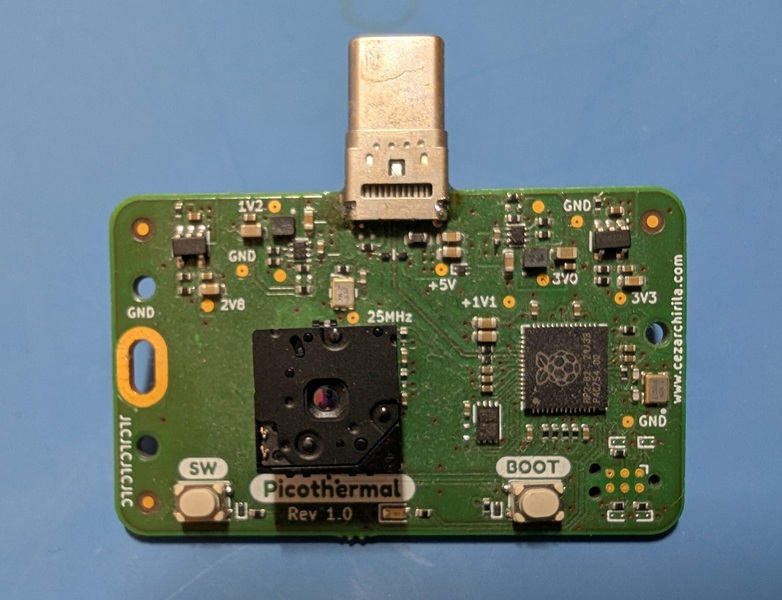
Top assembly
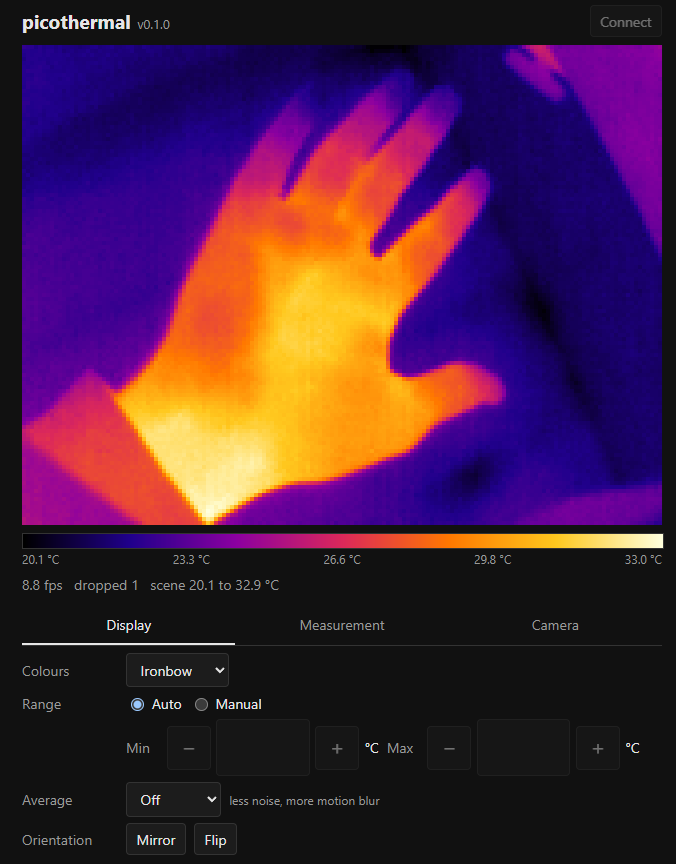
The hardware and software is open-source, see the picothermal-hardware folder for the Kicad project, manufacturing files and a PDF schematic.
There are also STLs available for an enclosure in enclosure. There are two variants for the bottom piece depending on the PCB thickness (0.8mm or 1.6mm).
For firmware, please see picothermal-fw.
Initially I wanted to write the software in C, using TinyUSB for the USB protocol. Unfortunately, due to lack of free time, I decided to rewrite this using agents in Rust, using embassy. The end result works quite good, although I expect the code to be pretty unmaintanable since it is mostly agent written.
MIT
| Qty | Value | Footprint | References |
|---|---|---|---|
| 21 | 0.1uF | miscellaneous:C_0402_1005Metric | C1, C2, C12, C13, C14, C18, C19, C20, C21, C22, C23, C24, C25, C30, C31, C32 +5 |
| 10 | 100K | miscellaneous:R_0402_1005Metric | R1, R11, R19, R20, R28, R29, R30, R31, R32, R33 |
| 8 | 27R | miscellaneous:R_0402_1005Metric | R6, R7, R16, R17, R24, R25, R26, R35 |
| 8 | 4.7uF | miscellaneous:C_0603_1608Metric | C7, C10, C11, C15, C16, C17, C34, C35 |
| 8 | ESD9C3.3ST5G | Diode_SMD:D_SOD-923 | D1, D2, D4, D5, D6, D7, D8, D9 |
| 5 | 0R | miscellaneous:R_0402_1005Metric | R2, R8, R9, R22, R23 |
| 4 | 1K | miscellaneous:R_0402_1005Metric | R3, R4, R5, R10 |
| 3 | , , | ||
| 3 | 2K4 | miscellaneous:R_0402_1005Metric | R13, R18, R21 |
| 3 | Fiducial | Fiducial:Fiducial_1mm_Mask2mm | FID1, FID2, FID3 |
| 3 | GND | miscellaneous:TestPoint_Pad_D1.0mm | TP9, TP10, TP12 |
| 2 | 10pF | miscellaneous:C_0402_1005Metric | C26, C27 |
| 2 | 18pF | miscellaneous:C_0402_1005Metric | C3, C4 |
| 2 | 1uF | miscellaneous:C_0402_1005Metric | C5, C6 |
| 2 | 1uH | Inductor_SMD:L_TDK_VLS201610CX-1 | L1, L2 |
| 2 | 22uF | miscellaneous:C_0603_1608Metric | C28, C29 |
| 2 | 5.1K | miscellaneous:R_0402_1005Metric | R34, R36 |
| 2 | 7K5 | miscellaneous:R_0402_1005Metric | R12, R14 |
| 2 | AP7330-W5-7 | Package_TO_SOT_SMD:SOT-25-5 | U2, U3 |
| 2 | SW_Push | Button_Switch_SMD:SW_SPST_PTS815 | SW1, SW2 |
| 2 | TLV62569A | Package_TO_SOT_SMD:SOT-563 | U5, U6 |
| 1 | +1V1 | miscellaneous:TestPoint_Pad_D1.0mm | TP1 |
| 1 | +5V | miscellaneous:TestPoint_Pad_D1.0mm | TP8 |
| 1 | 12MHz | Crystal:Crystal_SMD_2520-4Pin_2.5x2.0mm | Y2 |
| 1 | 1V2 | miscellaneous:TestPoint_Pad_D1.0mm | TP7 |
| 1 | 25MHz | miscellaneous:TestPoint_Pad_D1.0mm | TP13 |
| 1 | 2V8 | miscellaneous:TestPoint_Pad_D1.0mm | TP3 |
| 1 | 3K | miscellaneous:R_0402_1005Metric | R15 |
| 1 | 3V0 | miscellaneous:TestPoint_Pad_D1.0mm | TP6 |
| 1 | 3V3 | miscellaneous:TestPoint_Pad_D1.0mm | TP2 |
| 1 | 402k | miscellaneous:R_0402_1005Metric | R27 |
| 1 | DF2S6.2FS,L3M | Diode_SMD:D_SOD-923 | D10 |
| 1 | ECS-2520MV-250-CL | Oscillator:Oscillator_SMD_ECS_2520MV-xxx-xx-4Pin_2.5x2.0mm | Y1 |
| 1 | Flir LEPTON | Connector_Molex:MOLEX_105028-1001 | U7 |
| 1 | G*** | kibuzzard-63AA0EB3 | kibuzzard-63AA0EB3 |
| 1 | G*** | kibuzzard-63AA0F05 | kibuzzard-63AA0F05 |
| 1 | G*** | kibuzzard-63AA0E75 | kibuzzard-63AA0E75 |
| 1 | GND | TestPoint:TestPoint_Plated_Slot_5.0x2.5 | TP11 |
| 1 | LED | LED_SMD:LED_0603_1608Metric | D3 |
| 1 | MPZ1608S101ATAH0 | miscellaneous:L_0603_1608Metric | FB1 |
| 1 | PG_1V2 | miscellaneous:TestPoint_Pad_D1.0mm | TP5 |
| 1 | PG_3V0 | miscellaneous:TestPoint_Pad_D1.0mm | TP4 |
| 1 | RP2040 | Package_DFN_QFN:QFN-56-1EP_7x7mm_P0.4mm_EP3.2x3.2mm | U4 |
| 1 | TC2030-CTX | Connector:Tag-Connect_TC2030-IDC-NL_2x03_P1.27mm_Vertical | J1 |
| 1 | USB-C Plug | Connector_USB:USB_C_Plug_GCT_USB4155 | J2 |
| 1 | W25Q16JV | Package_SON:USON-8_2x3mm | U1 |
It measures 50 × 30 mm and has 4 copper layers, 0.8 mm thick.
121 parts, built around the RP2040, TLV62569ADRL, ESD9C3.3ST5G and DF2S6.2FS,L3M. The full list of its parts is on this page, with links to each part's symbol and footprint where PCBKit's library has them.
From the icamaster/picothermal repository on GitHub, at the commit this page was made from: the board is picothermal-hardware/picothermal-hardware.kicad_pcb and its schematic picothermal-hardware/picothermal-hardware.kicad_sch. PCBKit opens the board in the browser, with nothing to install.
Its repository publishes it under the MIT licence: you may reuse it on that licence's terms (keep the author's notice, and for a copyleft licence share your changes alike).


Balamanikandan-projects/ESP32-RFM95W-LoRa-Wireless-Telemetry-Node
A compact, high-performance, 4-layer custom PCB design integrating an ESP32-WROOM-32E microcontroller with an RFM95W sub-GHz LoRa radio module.

