2 layers28.3 × 39.8 mm
LevelShifter
gusmanb/logicanalyzer
24 channel, 100Msps logic analyzer hardware and software
21 parts5.1kGPL-3.0
 hsa-ees/asterics9
ASTERICS - An Open Toolbox for Sophisticated FPGA-Based Image Processing
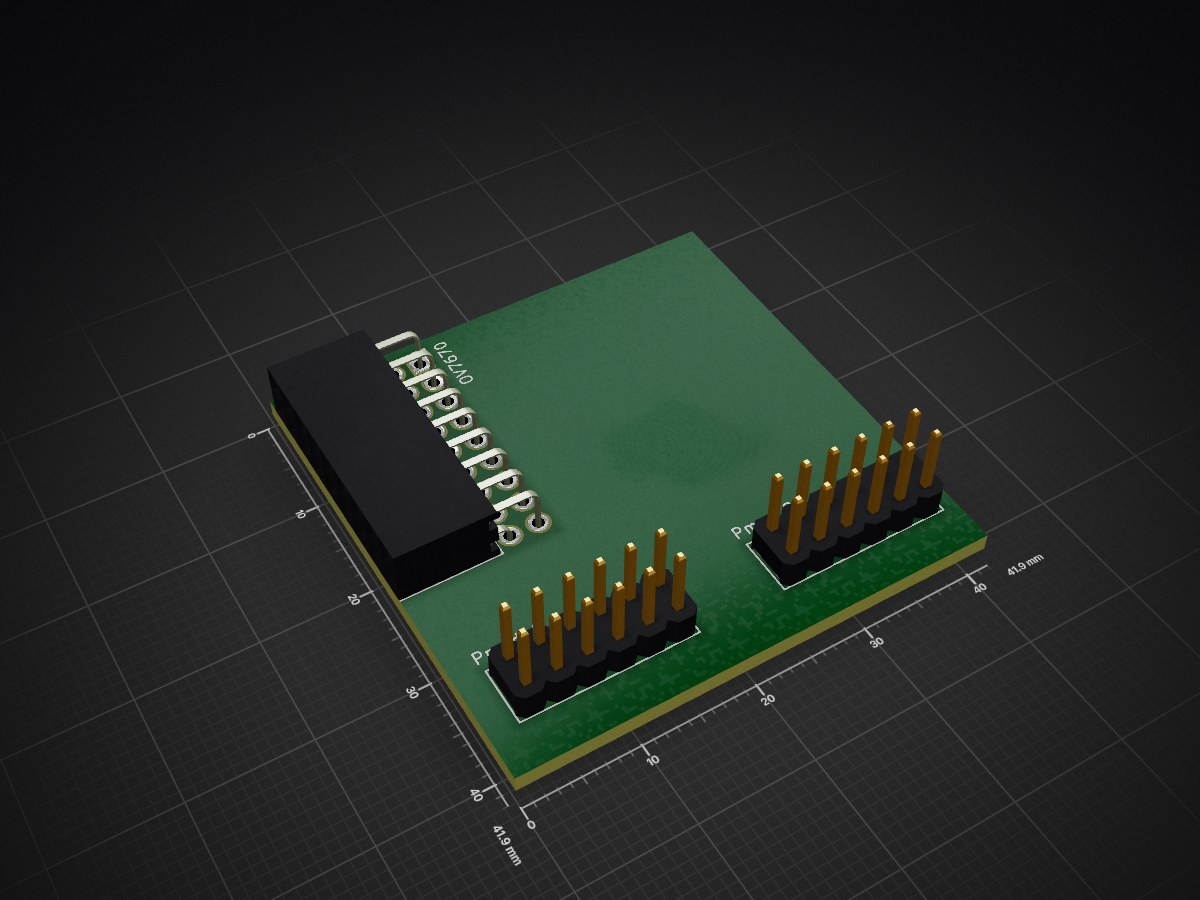
Ov7670 pmod is an open-source printed circuit board by hsa-ees, from the hsa-ees/asterics repository on GitHub. It is a 2-layer board of 41.9 × 41.9 mm with 21 parts on 34 nets, routed with 118 tracks and 0 vias.
It belongs with the fPGA and programmable logic boards of this library.
Image processing on embedded platforms is a challenging task, especially when implementing extensive computer vision applications. Field-programmable gate arrays (FPGAs) offer a suitable technology to accelerate image processing by customized hardware.
ASTERICS ("Augsburg Sophisticated Toolbox for Embedded Real-time Image Crunching Systems") is a modular framework to perform various real-time image processing tasks. It offers modules and interfaces to perform various image processing tasks including support for complex operations such as natural feature detection based on the SURF algorithm or variants of the Generalized Hough Transform. To simplify the process of developing and implementing image processing systems, ASTERICS includes the system generator /Automatics/. Automatics enables the generation of ASTERICS hardware descriptions including software drivers or entire IP-Cores from concise Python scripts.
This repository contains the core and free components of the ASTERICS framework. A list of publications and further information on the project can be found on the home page of the Efficient Embedded Systems group at the University of Applied Sciences Augsburg.
For a brief introduction on how to use the ASTERICS framework, we advise you to take a look at the ASTERICS manual.
Chapter 2 "Using ASTERICS" gives information on
Files distributed with the ASTERICS (GitHub) repository generally refer to the free and publicly available part of ASTERICS. This part is generally licensed under the LPGL (see LICENSE for details).
However, there are more ASTERICS modules available, which are presently not published under an open source license, but that can be made available individually on a per-project basis. These include modules for:
the Generalized Hough Transform and other variants of the Hough Transform [1, 2]
low latency lense distortion removal and stereo rectification (NITRA) [4, 5]
efficient, on-the-fly point feature extraction (SURF algorithm) [3]
Please contact the Efficient Embedded Systems (EES) group at the University of Applied Sciences Augsburg for further information on using these modules and collaborating with the EES group.
Parts of this work have been supported by the German Federal Ministry for Economic Affairs and Energy (BMWi), grant number ZF4102001KM5 (2015-2018).
Parts of this work have been supported by the German Federal Ministry of Education and Research (BMBF), grant number 17N3709 (2009-2013).
Julian Sarcher, Christian Scheglmann, Alexander Zoellner, Tim Dolereit, Michael Schaeferling, Matthias Vahl, Gundolf Kiefer: "A Configurable Framework for Hough-Transform-Based Embedded Object Recognition Systems", IEEE International Conference on Application-specific Systems, Architectures and Processors (ASAP) 2018, Mailand, 10. Juli 2018
Gundolf Kiefer, Matthias Vahl, Julian Sarcher, Michael Schäferling: "A Configurable Architecture for the Generalized Hough Transform Applied to the Analysis of Huge Aerial Images and to Traffic Sign Detection", IEEE International Conference on ReConFigurable Computing and FPGAs (ReConFig), 2016, DOI: 10.1109/ReConFig.2016.7857143.
Matthias Pohl, Michael Schäferling, Gundolf Kiefer: "An Efficient FPGA-based Hardware Framework for Natural Feature Extraction and Related Computer Vision Tasks", 24th International Conference on Field Programmable Logic and Applications (FPL), 2014, DOI: 10.1109/FPL.2014.6927463
Matthias Pohl, Michael Schäferling, Gundolf Kiefer, Plamen Petrow, Egmont Woitzel, Frank Papenfuß: "Leveraging polynomial approximation for non-linear image transformations in real time", Computers & Electrical Engineering, Available online 23 January 2014, ISSN 0045-7906, DOI: 10.1016/j.compeleceng.2013.12.011
Matthias Pohl, Michael Schäferling, Gundolf Kiefer, Plamen Petrow, Egmont Woitzel, Frank Papenfuß: "An Efficient and Scalable Architecture for Real-Time Distortion Removal and Rectification of Live Camera Images", IEEE International Conference on ReConFigurable Computing and FPGAs (ReConFig), 2012, DOI: 10.1109/ReConFig.2012.6416730.
| Qty | Value | Footprint | References |
|---|---|---|---|
| 16 | 100 | Resistors_SMD:R_0805_HandSoldering | R3, R4, R5, R6, R7, R8, R9, R10, R11, R12, R13, R14, R15, R16, R17, R18 |
| 2 | 1k5 | Resistors_SMD:R_0805_HandSoldering | R1, R2 |
| 2 | CONN_02X06 | Pin_Headers:Pin_Header_Straight_2x06 | Pmod_1, Pmod_2 |
| 1 | CONN_02X09 | Socket_Strips:Socket_Strip_Angled_2x09 | OV7670 |
It measures 41.9 × 41.9 mm and has 2 copper layers, 1.6 mm thick.
21 parts. The full list of its parts is on this page, with links to each part's symbol and footprint where PCBKit's library has them.
From the hsa-ees/asterics repository on GitHub, at the commit this page was made from: the board is systems/as_refdesign_zynq/doc/ov7670/pmod_adapter/kicad/ov7670_pmod.kicad_pcb. PCBKit opens the board in the browser, with nothing to install.
Its repository states no licence, so its author keeps all rights: ask hsa-ees before reusing the design.
gusmanb/logicanalyzer
24 channel, 100Msps logic analyzer hardware and software

mntmn/amiga2000-gfxcard
MNT VA2000, an Open Source Amiga 2/3/4000 Graphics Card (Zorro II/III), written in Verilog


hackclub/OnBoard
💡 Join 1,000 teenagers and make your first PCB with a $100 grant!

drandyhaas/KiCadRoutingTools
A set of Python/Rust tools to aid routing in KiCad

Arrow-air/project-quiver
Project Quiver documentation, designs, and project artifacts.

