


2 layers50.6 × 62.2 mm
Air ghost
HeyPCB/air-ghost
Air Ghost: A little ghost that blushes red when your room needs fresh air. KiCad 10, heypcb.ai merch.
19 partsCERN-OHL-S-2.0

 HeyPCB/phone-robot
Bolt, the phone stand robot: A little robot that holds your phone, charges it, and peeks over the top to tell you how it's eating. KiCad 10, heypcb.ai merch.
Phone robot is an open-source printed circuit board by HeyPCB, from the HeyPCB/phone-robot repository on GitHub, published under the CERN-OHL-S-2.0 licence. It is a 2-layer board of 80 × 125.3 mm with 35 parts on 37 nets, routed with 315 tracks and 35 vias.
It is built around the CH32V003F4P6, INA180A2IDBVR(LX) and CC0603KRX7R9BB104, with the CL21A106KAYNNNE, WS2812C-2020-V1 and 0603B103K500NT among its other parts. Its parts include 12 resistors, 7 capacitors, 2 ICs, 2 diodes and 2 transistors. It belongs with the robots and motor control boards and the RISC-V boards of this library.


A little robot that holds your phone, charges it, and peeks over the top to tell you how it's eating.
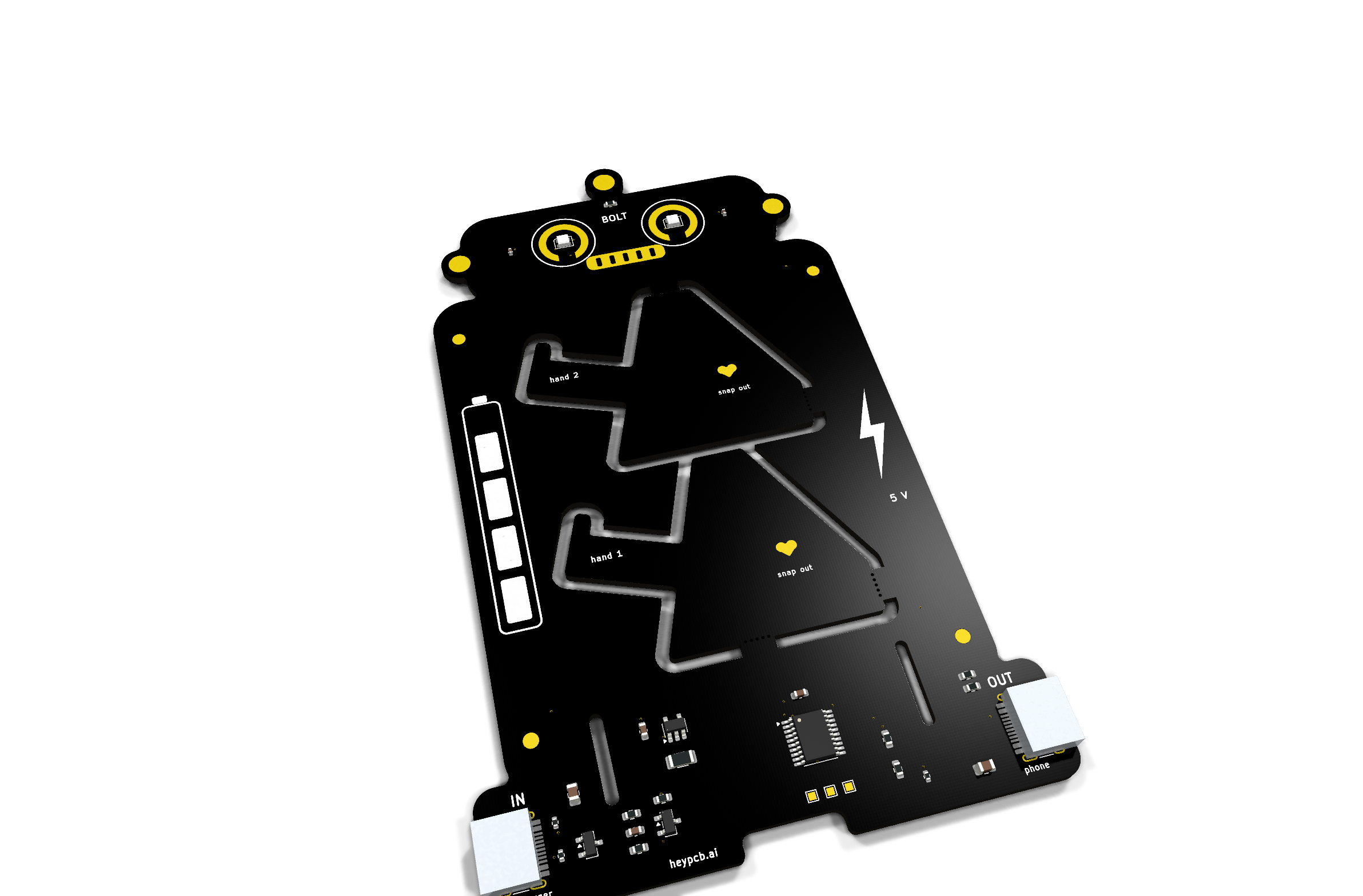
Bolt is a matte-black robot phone stand with gold eyes. Two kickstands snap out of its belly and slot through its hips; they become the hands your phone sits on, in landscape, leaning back at 70 degrees. Your charger plugs into its left foot and your phone's cable into its right: a 5 V USB-C pass-through that powers the phone port only when a phone is attached, offers the phone what the charger can give (up to 1.5 A), and measures the charge current. Its two RGB eyes peek over the phone and show it: orange and pulsing while the phone eats, green when it is full.
| Layers | Size | Parts | Nets | Connections routed | Vias | ERC errors | DRC errors / unconnected / parity | BOM @100 |
|---|---|---|---|---|---|---|---|---|
| 2 | 80.1 x 125.4 mm | 31 (+4 pads) | 21 | 76 -> 0 open | 35 | 0 | 0 / 0 / 0 | $1.33 |
Not fabricated, assembled or powered yet. Every number on this page is measured by KiCad 10.0.6 on
the files in this repository (report.json, measured.json) or read
from the live JLC/LCSC catalogue (bom_cost.json).
| Spec, power budget, BOM | SPEC.md |
| Store copy | STORE_COPY.md |
| KiCad 10 project | kicad/ |
| Gerbers, drill, BOM, CPL, STEP, schematic PDF | fab/ |
| Firmware | firmware/ |
| Renders | front, back, hero, Circuit World thumbnail |
| Brief and generator | design/ |
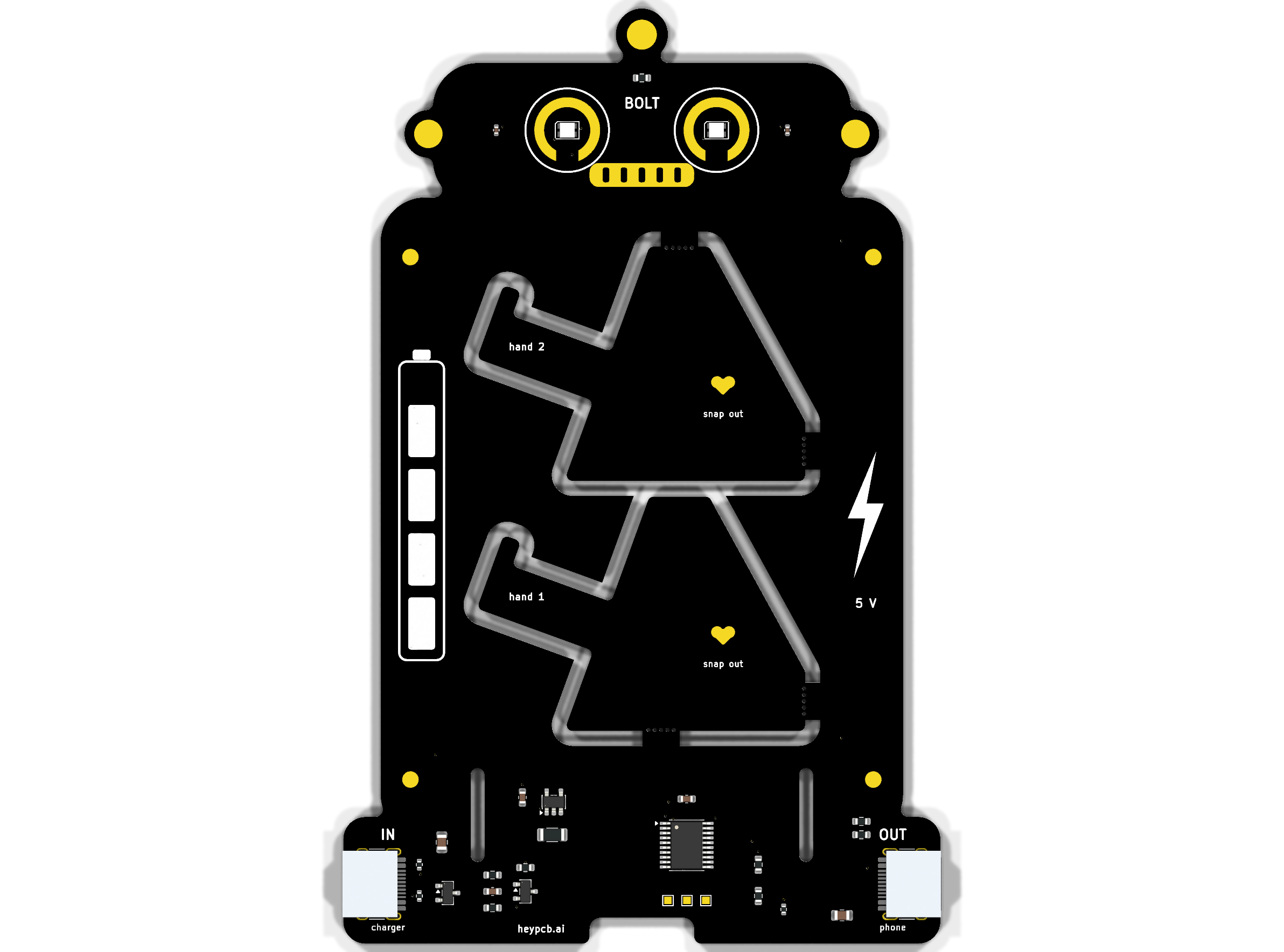
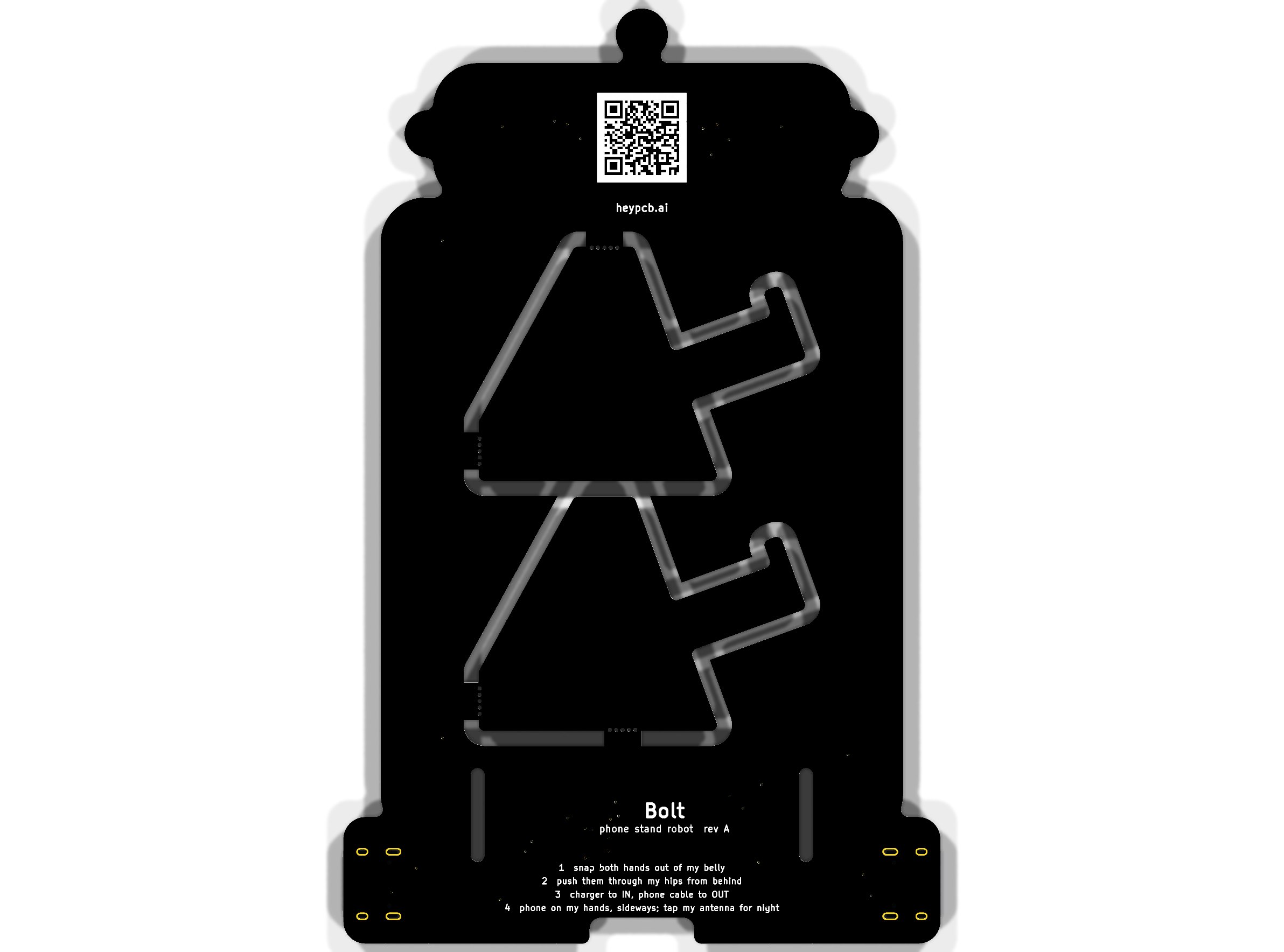
Matte Black solder mask, White silkscreen, ENIG copper finish, 1.6 mm FR4, top-side SMT assembly (J1, J2: an SMD part whose shell legs go through plated holes, soldered on the same SMT line). The gold art is bare copper under a mask opening (ENIG), drawn with its own keep-out so no track runs under it. The QR code on the back opens https://heypcb.ai/world/b/e8b0eb778647.
Designed with the HeyPCB method on KiCad 10.0.6, headless, by the heypcb-kicad pipeline: a written
brief composed from reusable circuit blocks, every pin from KiCad's own symbol library, every part bound
to an LCSC number from a dated catalogue read, then ERC, a netlist round trip, locked placement,
Freerouting 2.4.1, pours, silkscreen and board art, DRC with schematic parity, DFM and a fab gate,
each stage gated by a measurement. design/make_brief.py regenerates the brief (outline, part
locks and art) from code.
Part of the heypcb.ai merch collection.
Hardware: CERN-OHL-S v2. Firmware: MIT (see firmware/LICENSE). KiCad's symbol, footprint and 3D
libraries used in the design are CC-BY-SA 4.0 with the KiCad library exception.
| Qty | Value | Footprint | References |
|---|---|---|---|
| 4 | Breakaway | Panelization:BreakLine_5h_D0.5mm_P0.85mm | H1, H2, H3, H4 |
| 3 | 22k | Resistor_SMD:R_0603_1608Metric | R4, R7, R8 |
| 2 | 100k | Resistor_SMD:R_0603_1608Metric | R3, R5 |
| 2 | 100nF | Capacitor_SMD:C_0603_1608Metric | C3, C5 |
| 2 | 100nF | Capacitor_SMD:C_0402_1005Metric | C6, C7 |
| 2 | 10uF | Capacitor_SMD:C_0805_2012Metric | C1, C4 |
| 2 | 5.1k | Resistor_SMD:R_0402_1005Metric | R1, R2 |
| 2 | 56k | Resistor_SMD:R_0603_1608Metric | R9, R10 |
| 2 | WS2812C-2020-V1 | LED_SMD:LED_WS2812B-2020_PLCC4_2.0x2.0mm | D1, D2 |
| 1 | 10k | Resistor_SMD:R_0402_1005Metric | R11 |
| 1 | 10nF | Capacitor_SMD:C_0603_1608Metric | C2 |
| 1 | 1k | Resistor_SMD:R_0603_1608Metric | R12 |
| 1 | 20m | Resistor_SMD:R_1206_3216Metric | R6 |
| 1 | AO3400A | Package_TO_SOT_SMD:SOT-23 | Q2 |
| 1 | AO3401A | Package_TO_SOT_SMD:SOT-23 | Q1 |
| 1 | CH32V003F4P6 | Package_SO:TSSOP-20_4.4x6.5mm_P0.65mm | U2 |
| 1 | GND | TestPoint:TestPoint_Pad_1.0x1.0mm | TP3 |
| 1 | INA180A2 | Package_TO_SOT_SMD:SOT-23-5 | U1 |
| 1 | SWIO | TestPoint:TestPoint_Pad_1.0x1.0mm | TP2 |
| 1 | TOUCH | TestPoint:TestPoint_Pad_D4.0mm | TP4 |
| 1 | USB-C | Connector_USB:USB_C_Receptacle_HRO_TYPE-C-31-M-12 | J1 |
| 1 | USB-C out | Connector_USB:USB_C_Receptacle_HRO_TYPE-C-31-M-12 | J2 |
| 1 | VDD | TestPoint:TestPoint_Pad_1.0x1.0mm | TP1 |
It measures 80 × 125.3 mm and has 2 copper layers, 1.6 mm thick.
35 parts, built around the CH32V003F4P6, INA180A2IDBVR(LX), CC0603KRX7R9BB104 and CL21A106KAYNNNE. The full list of its parts is on this page, with links to each part's symbol and footprint where PCBKit's library has them.
From the HeyPCB/phone-robot repository on GitHub, at the commit this page was made from: the board is kicad/phone_robot.kicad_pcb and its schematic kicad/phone_robot.kicad_sch. PCBKit opens the board in the browser, with nothing to install.
Its repository publishes it under the CERN-OHL-S-2.0 licence: you may reuse it on that licence's terms (keep the author's notice, and for a copyleft licence share your changes alike).
HeyPCB/air-ghost
Air Ghost: A little ghost that blushes red when your room needs fresh air. KiCad 10, heypcb.ai merch.

FujiNetWIFI/fujinet-hardware
Schematics and design files for FujiNet hardware

HeyPCB/moon-light
Luna, the night-light moon: A sleepy moon that turns on at dusk and tucks itself in after you fall asleep. KiCad 10, heypcb.ai merch.

gallicchio/AMOD-and-RFMOD
The tutorial's 2x12 adapter (/mudd/133electronics/icepi-zero-dac-adc/adapterboard/) with a 2 x 6 right-angle Pmod socket on a 15 mm extension of its right-hand end, so an Icepi Zero can drive AMOD-A's and RF-MOD's Pmod…

CappyT/freedo
Local coordinator for tado V3+ heating devices, with a Home Assistant integration and add-on

bogdan-kovalchuk/esp32-lora-gps-tracker
Encrypted point-to-point GPS telemetry over 433 MHz LoRa between two ESP32 boards.

enkhbold470/iron-node
ESP32-S3 industrial gateway: W5500 Ethernet, isolated RS-485 (ADM2587E), CAN, 9-36 V input. 4-layer KiCad 10 board.

HeyPCB/esp32-sensors-2
ESP32-S3 boards, one sensor each: KiCad 10, JLCPCB-ready, CERN-OHL-S-2.0