2 layers49 × 35 mm
Boost sequencer
danupp/boost_sequencer
Universal sequencer for radio applications with 12 to 28V boost regulator for coaxial relays
56 parts1

 hb020/ersaswitch1
Make a Ersa i-con 1V soldering station work with 2 tools, without re-plugging
Ersaswitch is an open-source printed circuit board by hb020, from the hb020/ersaswitch repository on GitHub. It is a 2-layer board of 161.6 × 95.2 mm with 80 parts on 64 nets, routed with 324 tracks and 8 vias.
It is built around the ATTINY214-SSN, B1205LS-1WR2 and AMS1117-5.0, with the BC817 and IRFR5305 among its other parts. Its parts include 25 connectors, 17 resistors, 12 capacitors, 6 diodes and 4 ICs. It belongs with the AVR (ATmega, ATtiny) boards of this library.


This project is about an external switch to an Ersa i-CON controller. It allows switching between tools, without voiding Ersa warranty (at least, nothing from Ersa is opened and no wires are cut), and without occupying more desk space.
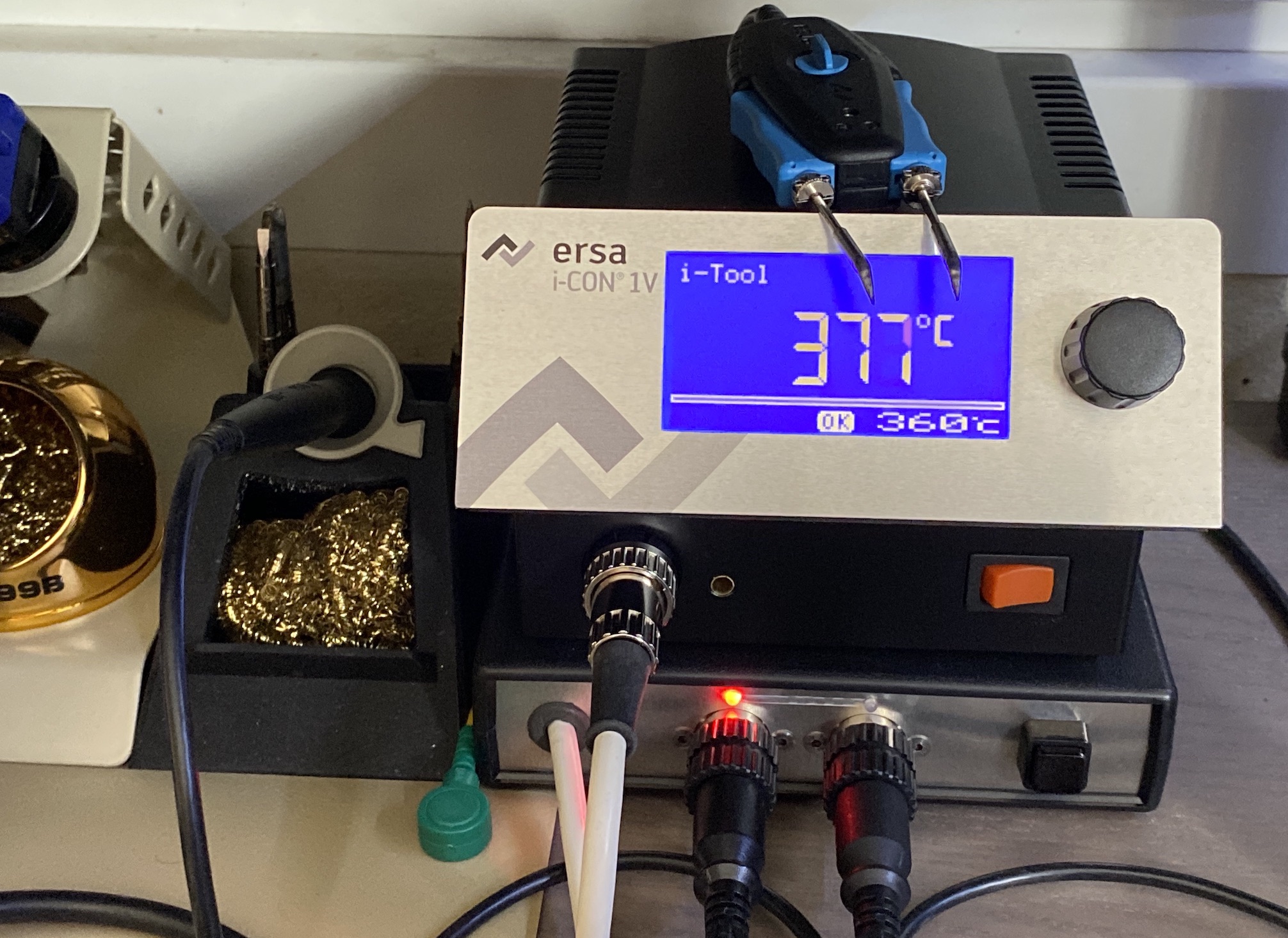
Inspired by https://www.eevblog.com/forum/reviews/ersa-i-con2v-(port-switch-hack)/
But I have an i-con 1V.
The switch has 3 states: left, right and a timed inbetween "no tool". The latter is mandatory between left/right tools for about 2 secs for the controller to not freak out. The switch is fully isolated, and via monitoring of the signals, switches itself on and off automatically in sync with the controller.
There is stuff inside this git repo about implementing communication with the tools to show "too hot to touch" temperatures of the disconnected tool, but that was put on hold, as I wanted to try out the Attiny 214. That guy would probably be too small for a full comms stack and it would require some more components and a lot more time.
Does the switch work well? Yes, and it is a joy too, since the heat up time of the tools is so short. Really easy to use. One big pushbutton. I designed it so that the relay click pattern gives audible hints too, so in short time you don't even have to look anymore as for what tool is active. You just grab it.
Is it economically viable? Probably not for a one-off, as the BOM gets close to 100 EUR if you have to buy it all (meaning: case and so) in small qty locally from Europe or the US. Just get the i-con 2V if you really use multiple tools regularly. But on the other hand you could use this to extend the port range of a 2V to 3 tools or more if you want (while keeping your warranty).
This should be easy to extend to 3 or more tools though. Just keep in mind that not all Ersa tools use only 5 wires. I have the i-tool and the Chip Tool Vario, and they only have 2 for power, 2 for logic, and 1 for earth. Some tools have more lines. If you have a tool with more lines, you'll have to change the relays.
| Qty | Value | Footprint | References |
|---|---|---|---|
| 8 | 100nF | Capacitor_SMD:C_1206_3216Metric_Pad1.42x1.75mm_HandSolder | C1, C2, C4, C7, C9, C10, C11, C12 |
| 8 | MountingHole | MountingHole:MountingHole_3mm | H1, H2, H3, H4, H5, H6, H7, H8 |
| 6 | Conn_01x01_Female | Connector_PinSocket_2.54mm:PinSocket_1x01_P2.54mm_Vertical | J2, J18, J19, J20, J22, J24 |
| 6 | Conn_01x01_Male | Connector_PinHeader_2.54mm:PinHeader_1x01_P2.54mm_Horizontal | J3, J16, J17, J21, J23, J25 |
| 4 | 0R | Resistor_SMD:R_2010_5025Metric_Pad1.52x2.65mm_HandSolder | R14, R15, R16, R17 |
| 4 | 4k7 | Resistor_SMD:R_1206_3216Metric_Pad1.42x1.75mm_HandSolder | R1, R2, R6, R9 |
| 2 | 100uF | Capacitor_THT:CP_Radial_D6.3mm_P2.50mm | C5, C6 |
| 2 | 10k | Resistor_SMD:R_1206_3216Metric_Pad1.42x1.75mm_HandSolder | R4, R8 |
| 2 | 1N4001 | Diode_SMD:D_SOD-123 | D1, D2 |
| 2 | 1N4148 | Diode_SMD:D_SOD-123 | D3, D4 |
| 2 | 470 | Resistor_SMD:R_1206_3216Metric_Pad1.42x1.75mm_HandSolder | R11, R13 |
| 2 | 680 | Resistor_SMD:R_1206_3216Metric_Pad1.42x1.75mm_HandSolder | R10, R12 |
| 2 | BC817 | Package_TO_SOT_SMD:SOT-23 | Q1, Q2 |
| 2 | Conn_01x02_Male | mylib:PinHeader_1x02_P2.54mm_Vertical_for_rivets | J4, J8 |
| 2 | Conn_01x03_Male | TerminalBlock_Phoenix:TerminalBlock_Phoenix_MKDS-1,5-3_1x03_P5.00mm_Horizontal | J14, J15 |
| 2 | Conn_01x03_Male | TerminalBlock_Phoenix:TerminalBlock_Phoenix_MKDS-1,5-3-5.08_1x03_P5.08mm_Horizontal | J1, J12 |
| 2 | Conn_01x06_Male | mylib:PinHeader_1x06_P2.54mm_Vertical_for_rivets | J5, J9 |
| 2 | FINDER-41.52 | Relay_THT:Relay_DPDT_Finder_40.52 | K1, K2 |
| 1 | 18uH | Inductor_SMD:L_Taiyo-Yuden_NR-50xx_HandSoldering | L1 |
| 1 | 1M | Resistor_SMD:R_1206_3216Metric_Pad1.42x1.75mm_HandSolder | R5 |
| 1 | 1k | Resistor_SMD:R_1206_3216Metric_Pad1.42x1.75mm_HandSolder | R7 |
| 1 | 1k? | Resistor_SMD:R_1206_3216Metric_Pad1.42x1.75mm_HandSolder | R3 |
| 1 | 470uF | Capacitor_THT:CP_Radial_D10.0mm_P5.00mm | C3 |
| 1 | 4u7F | Capacitor_THT:CP_Radial_D5.0mm_P2.00mm | C8 |
| 1 | 74VHC1G132 | Package_TO_SOT_SMD:SOT-23-5_HandSoldering | U3 |
| 1 | AMS1117-5.0 | Package_TO_SOT_SMD:SOT-223-3_TabPin2 | U2 |
| 1 | ATtiny214-SS | Package_SO:SOIC-14_3.9x8.7mm_P1.27mm | U1 |
| 1 | B1205LS-1WR2 | mylib:Converter_DCDC_BxxxxLS-1WR2 | PS1 |
| 1 | Barrel_Jack_Switch | Connector_BarrelJack:BarrelJack_CUI_PJ-102AH_Horizontal | J7 |
| 1 | Conn_01x03_Female | Connector_PinSocket_2.54mm:PinSocket_1x03_P2.54mm_Vertical | J11 |
| 1 | Conn_01x03_Male | mylib:PinHeader_1x03_P2.54mm_Vertical_biggerpads | J6 |
| 1 | Conn_01x03_Male | Connector_PinHeader_2.54mm:PinHeader_1x03_P2.54mm_Horizontal | J10 |
| 1 | Conn_01x04_Male | TerminalBlock_Phoenix:TerminalBlock_Phoenix_MKDS-1,5-4-5.08_1x04_P5.08mm_Horizontal | J13 |
| 1 | IRFR5305 | Package_TO_SOT_SMD:TO-252-2 | Q3 |
| 1 | LED1_Dual_CAC | LED_THT:LED_D3.0mm-3 | D6 |
| 1 | LED2_Dual_CAC | LED_THT:LED_D3.0mm-3 | D5 |
| 1 | PC817 | Package_DIP:DIP-4_W7.62mm_LongPads | U4 |
| 1 | SW_Push | mylib:PinHeader_1x02_P2.54mm_Vertical_for_rivets | SW1 |
It measures 161.6 × 95.2 mm and has 2 copper layers, 1.6 mm thick.
80 parts, built around the ATTINY214-SSN, B1205LS-1WR2, AMS1117-5.0 and BC817. The full list of its parts is on this page, with links to each part's symbol and footprint where PCBKit's library has them.
From the hb020/ersaswitch repository on GitHub, at the commit this page was made from: the board is Kicad/ersaswitch.kicad_pcb. PCBKit opens the board in the browser, with nothing to install.
Its repository states no licence, so its author keeps all rights: ask hb020 before reusing the design.
danupp/boost_sequencer
Universal sequencer for radio applications with 12 to 28V boost regulator for coaxial relays

sjgray/CBM-MX-Keyboards
Replacement and enhanced keyboards for Commodore machines


Meo98/picostack
Stackable, contract-driven module system for the Raspberry Pi Pico — open hardware, built by code

neilgibsonpinto-art/Brushed-esc
Powered by a 240 MHz dual-core ESP32, the STMESC features Tri-Mode Hybrid Control (Bluetooth LE, Wi-Fi, and standard hobby RC), onboard reverse polarity protection, real-time current sensing with stall detection, and an…

nunosousa/TelescopeMirrorTester
This is an application intended to provide useful tools to perform Foucault or Wire testing on reflective telescope mirrors

trublion/Boite_a_bourdon_control_board
HW control board for motorised hurgy-gurdy. Controls a DC motor with a half-H-bridge, reads an analog audio signal envelope, dual-PCB design.

bwack/C64-Saver-bwack
C64 Saver v1 and v2 - Overvoltage protection for the C64 and its power brick.