6 layers45 × 0 mm
Base board
GeniePod/genie-hardware
GeniePod Home V1 hardware: MVP testing build, wiring, BOM, and planned interface-board/enclosure docs.
222 parts2CERN-OHL-S-2.0

 GeniePod/genie-hardware2
GeniePod Home V1 hardware: MVP testing build, wiring, BOM, and planned interface-board/enclosure docs.
Led button is an open-source printed circuit board by GeniePod, from the GeniePod/genie-hardware repository on GitHub, published under the CERN-OHL-S-2.0 licence. It is a 2-layer board of 13.9 × 42.8 mm with 126 parts on 169 nets, routed with 1,158 tracks and 297 vias.
It is built around the ESP32-H2-MINI-1-N4, ES7210 and TPS62A01DRL, with the TXB0104RUTR, TXS0102DQER and 74LVC1G08Z among its other parts. Its parts include 50 capacitors, 26 resistors, 15 ICs, 13 diodes and 4 switches. It belongs with the ESP32 and RISC-V boards of this library.


Hardware documentation for GeniePod Home V1.
Current status: MVP testing. The working reference build uses off-the-shelf development boards, hand wiring, and the current GeniePod software stack. Custom PCB, enclosure, and product-design assets are planned, but they are not the source of truth yet.
GeniePod Home V1 is the first integrated home appliance target. The MVP in this repo validates the stack with dev boards first; the custom Home V1 hardware is expected to consolidate those functions into a purpose-built carrier, enclosure, and audio layout.
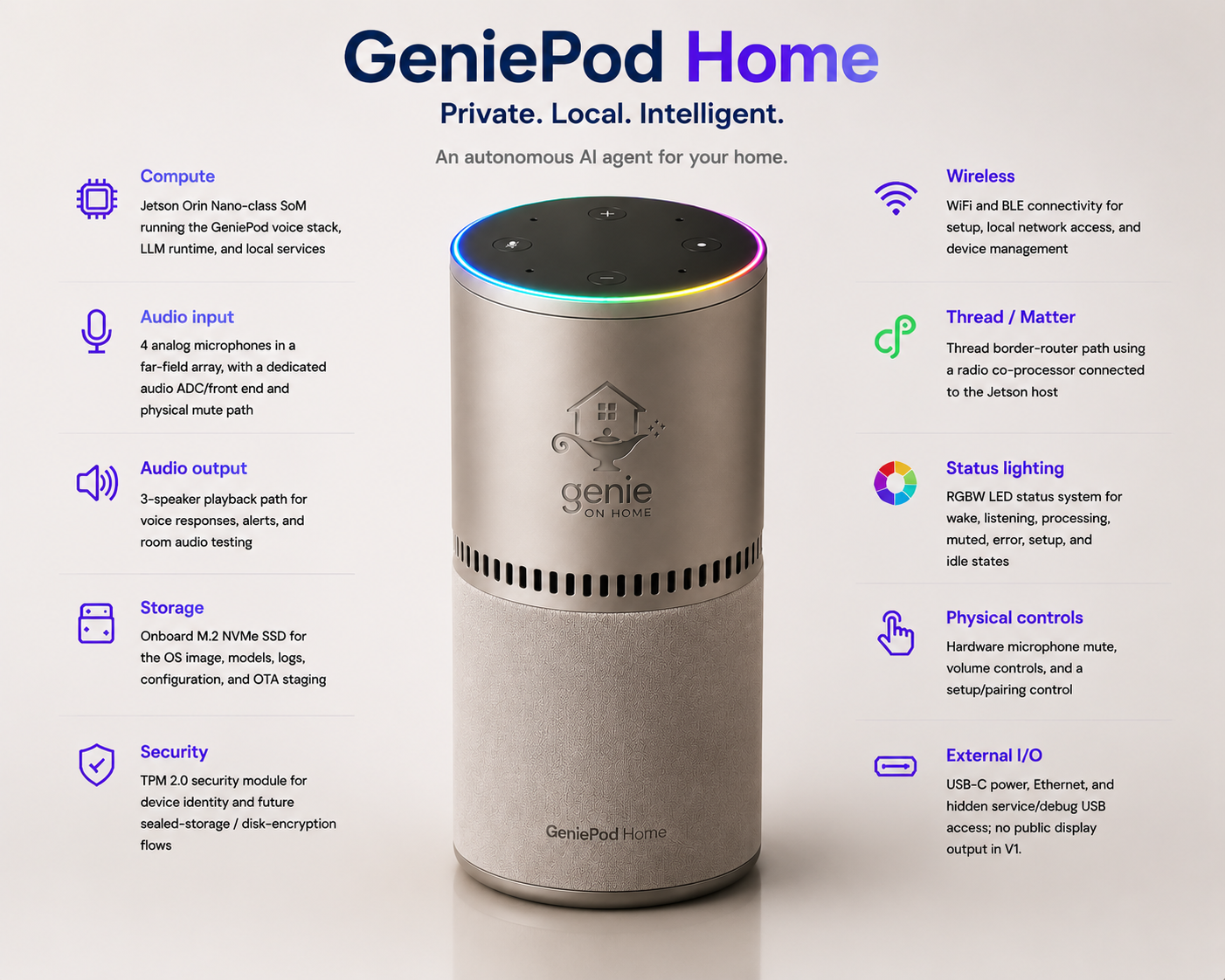
| Subsystem | Home V1 direction |
|---|---|
| Compute | Jetson Orin Nano-class SoM running the GeniePod voice stack, LLM runtime, and local services |
| Audio input | 4 analog microphones in a far-field array, with a dedicated audio ADC/front end and physical mute path |
| Audio output | 2-speaker playback path for voice responses, alerts, and room audio testing |
| Storage | Onboard M.2 NVMe SSD for the OS image, models, logs, configuration, and OTA staging |
| Security | TPM 2.0 security module for device identity and future sealed-storage / disk-encryption flows |
| Wireless | WiFi and BLE connectivity for setup, local network access, and device management |
| Thread / Matter | Thread border-router path using a radio co-processor connected to the Jetson host |
| Status lighting | RGBW LED status system for wake, listening, processing, muted, error, setup, and idle states |
| Physical controls | Hardware microphone mute, volume controls, and a setup/pairing control |
| External I/O | USB-C power, Ethernet, and hidden service/debug USB access; no public display output in V1 |
| Enclosure | Voice-first home form factor with top mic zone, separated speaker path, visible privacy/status cues, and rear/bottom I/O |
Verified MVP: Jetson Orin Nano Super + ESP32-LyraT V4.3, tested with
genie-clawalpha.7 on 2026-05-13.
This repo is only about GeniePod Home V1 hardware.
It currently documents:
It does not define other GeniePod products or future SKUs.
Everything here is licensed CERN-OHL-S v2.
flowchart LR
    subgraph HW["GeniePod Home V1 MVP hardware"]
        LyraT["ESP32-LyraT V4.3<br/>ES8388 + onboard mics<br/>I2S slave"]
        ORIN["Jetson Orin Nano Super<br/>8 GB, CUDA 12.6<br/>SM 8.7"]
        SPK["USB / 3.5 mm speaker"]
        C6["ESP32-C6 sidecar<br/>optional Thread / Matter test"]
    end

    subgraph SW["GeniePod software"]
        CLAW["genie-claw<br/>voice loop, memory, tools"]
        RUNTIME["genie-ai-runtime<br/>Orin LLM runtime"]
    end

    LyraT -- "I2S (24 kHz S16 stereo)" --> ORIN
    C6 -- "UART /dev/ttyTHS1" --> ORIN
    ORIN -- "ALSA output" --> SPK
    ORIN --- CLAW
    CLAW -- "HTTP :8080" --> RUNTIME

    classDef hw fill:#1f2937,stroke:#111827,color:#f9fafb;
    classDef sw fill:#fb923c,stroke:#7c2d12,color:#1c1917;
    classDef opt stroke-dasharray: 5 5;
    class LyraT,ORIN,SPK,C6 hw;
    class CLAW,RUNTIME sw;
class C6 opt;| Folder | Status | What it holds |
|---|---|---|
mvp/ | working MVP test build | BOM, wiring, and setup notes for the off-the-shelf reference build |
schematic/ | planned | KiCad schematics for the Home V1 interface board |
pcb/ | planned | PCB layouts, Gerbers, fab outputs, and renders |
enclosure/ | planned | CAD for the Home V1 MVP/developer enclosure |
product-design/ | planned | Home V1 industrial-design and packaging notes |
images/ | active | MVP photos and repo diagrams |
The current MVP test build:
| Component | Part | Approx USD |
|---|---|---|
| Compute | Jetson Orin Nano Super Devkit (8 GB) | $499 |
| Mic frontend | ESP32-LyraT V4.3 (ES8388 + 3 onboard mics) | $30-40 |
| Storage | microSD A2 U3 64 GB+ | $15 |
| Audio out | USB-A headphone or 3.5 mm speaker | $5-30 |
| Wiring | 40-pin GPIO ribbon + Dupont jumpers | $5 |
| Total core MVP | ~$550 |
Optional for testing: ESP32-C6 sidecar for Thread/Matter, upgraded speakers, and HDMI display for first boot.
Full BOM: mvp/bom.md
Wiring: mvp/wiring.md
flowchart TD
    A[Order MVP BOM] --> B[Install JetPack 6.2.1<br/>L4T R36.4.7, CUDA 12.6]
    B --> C[First boot and SSH access<br/>enable I2S2 with jetson-io.py]
    C --> D[Flash LyraT<br/>lyrat_jp4_passthrough firmware]
    D --> E[Wire LyraT JP4 to Jetson 40-pin<br/>I2S signals + GND]
    E --> F["Run GeniePod setup script<br/>install services, models, AHUB routes"]
    F --> G["Voice-loop smoke test<br/>push-to-talk response"]

    classDef start fill:#10b981,color:#022c22;
    classDef step fill:#f3f4f6,stroke:#9ca3af,color:#111827;
    classDef done fill:#fb923c,stroke:#7c2d12,color:#1c1917;
    class A start;
    class B,C,D,E,F step;
    class G done;
Full software setup lives in the genie-claw README, with the alpha.7 verification notes in the Alpha.7 Verified Voice Cycle section.
| Repo | What it is |
|---|---|
| GeniePod/genie-claw | Rust runtime: voice loop, memory, tools, Home Assistant integration. |
| GeniePod/genie-ai-runtime | Orin-tuned C++/CUDA LLM inference runtime. |
| GeniePod/genie-os | Jetson OS and image tooling for the target hardware. |
| GeniePod/genie-app | Companion client for setup and device management. |
| espressif/esp-adf | Upstream LyraT firmware framework. |
CERN Open Hardware Licence Version 2 — Strongly Reciprocal. See LICENSE.md.
| Qty | Value | Footprint | References |
|---|---|---|---|
| 24 | 100nF | Project Libraries:C_0402_1005Metric | C1, C2, C10, C11, C12, C13, C14, C15, C16, C17, C18, C19, C20, C21, C22, C23 +8 |
| 19 | 1uF | Project Libraries:C_0402_1005Metric | C25, C26, C27, C28, C29, C30, C31, C32, C33, C34, C35, C36, C37, C38, C39, C40 +3 |
| 12 | SKC6812RGBW-WS-B | Project Libraries:LED_SK6812_PLCC4_5.0x5.0mm_P3.2mm | LED1, LED2, LED3, LED4, LED5, LED6, LED7, LED8, LED9, LED10, LED11, LED12 |
| 11 | 0R | Project Libraries:R_0402_1005Metric | R1, R2, R3, R4, R5, R6, R7, R8, R9, R10, R11 |
| 8 | MountingHole | Project Libraries:MountingHole_2.2mm_M2 | H1, H2, H3, H4, H5, H6, H7, H8 |
| 7 | 100k | Project Libraries:R_0402_1005Metric | R16, R18, R20, R22, R23, R25, R26 |
| 6 | 10k | Project Libraries:R_0402_1005Metric | R12, R13, R15, R17, R21, R24 |
| 4 | 10uF | Project Libraries:C_0603_1608Metric | C47, C48, C49, C50 |
| 4 | IM73A135V01 | Project Libraries:Infineon_PG-LLGA-5-2 | MK1, MK2, MK3, MK4 |
| 3 | SW_Push | Project Libraries:SW_Push_1P1T_NO_Vertical_Wuerth_434133025816 | SW1, SW2, SW3 |
| 2 | 2N7002 | Project Libraries:SOT-23 | Q1, Q2 |
| 2 | Conn_02x03_Odd_Even | Project Libraries:PinHeader_2x03_P2.54mm_Vertical_SMD | J2, J3 |
| 2 | TXB0104RUT | Project Libraries:Texas_R-PUQFN-N12 | U13, U14 |
| 2 | TXS0102DQE | Project Libraries:X2SON-8_1.4x1mm_P0.35mm | U11, U15 |
| 1 | 1.0uH | Project Libraries:L_0603_1608Metric | L1 |
| 1 | 120pF | Project Libraries:C_0402_1005Metric | C44 |
| 1 | 22uF | Project Libraries:C_0603_1608Metric | C46 |
| 1 | 4.7uF | Project Libraries:C_0402_1005Metric | C45 |
| 1 | 453k | Project Libraries:R_0402_1005Metric | R19 |
| 1 | 470R | Project Libraries:R_0402_1005Metric | R14 |
| 1 | 5019514000 | Project Libraries:5019514000 | J8 |
| 1 | 74LVC1G08 | Project Libraries:Texas_R-PDSO-G5_DCK-5 | U5 |
| 1 | 74LVC3G14 | Project Libraries:VSSOP-8_2.3x2mm_P0.5mm | U2 |
| 1 | ES7210 | Project Libraries:VQFN-32-1EP_4x4mm_P0.4mm_EP2.8x2.8mm | U4 |
| 1 | ESP32-C5-MINI-1 | Project Libraries:ESP32-C5-MINI-1 | U12 |
| 1 | ESP32-H2-MINI-1-N4 | Project Libraries:ESP32-H2-MINI-1 | U9 |
| 1 | GT-TC018A-H0375-L1 | Project Libraries:GT-TC018A-H0375-L1 | SW4 |
| 1 | RED | Project Libraries:LED_0603_1608Metric | D1 |
| 1 | SN74LVC1G74DCUR | Project Libraries:VSSOP-8_2.3x2mm_P0.5mm | U3 |
| 1 | SN74LVC1T45DBV | Project Libraries:SOT-23-6 | U1 |
| 1 | TPS62A01DRL | Project Libraries:SOT-563 | U8 |
| 1 | TPS7A0518PDBV | Project Libraries:SOT-23-5 | U7 |
| 1 | TPS7A0525PDBV | Project Libraries:SOT-23-5 | U6 |
| 1 | TXB0102DCU | Project Libraries:VSSOP-8_2.3x2mm_P0.5mm | U10 |
GeniePod/genie-hardware
GeniePod Home V1 hardware: MVP testing build, wiring, BOM, and planned interface-board/enclosure docs.

michaudtime/lumary-zigbee
ESP32-H2 Zigbee firmware replacing Tuya WiFi in Lumary 6" RGBAI recessed lights — hub-independent control, 8 effects, OTA updates

super-cow-powers/better-lamp-controller
A custom lamp controller with audio, controlled with an RP2040


Open-Air-Foundation/pcb-go
AirGradient GO is a handheld air quality monitor. It measures particulate matter (Sensirion SPS30), CO₂ (Senseair S12), VOC/NOx (SGP41), temperature and humidity (SHT4x), and barometric pressure (DPS368), with an…

Bongorian/M5basspiezohat
M5StickS3 Hat2 five-channel bass piezo ADC board: KiCad design, TDM audio acquisition and JLCPCB fabrication data


It measures 13.9 × 42.8 mm and has 2 copper layers, 1.6 mm thick.
126 parts, built around the ESP32-H2-MINI-1-N4, ES7210, TPS62A01DRL and TXB0104RUTR. The full list of its parts is on this page, with links to each part's symbol and footprint where PCBKit's library has them.
From the GeniePod/genie-hardware repository on GitHub, at the commit this page was made from: the board is pcb/led_button/led_button.kicad_pcb and its schematic pcb/base_board/base_board.kicad_sch. PCBKit opens the board in the browser, with nothing to install.
Its repository publishes it under the CERN-OHL-S-2.0 licence: you may reuse it on that licence's terms (keep the author's notice, and for a copyleft licence share your changes alike).