2 layers104 × 66 mm
Vallox rs485-controller
Miroeilola/vallox-rs485-controller
Replacement control panel for legacy Vallox SE ventilation units. Vallox DIGIT RS-485 protocol, bus-powered, ESP32, Home Assistant.
65 parts

 generationmake/CyphalPicoBase-CAN5
Board for the Raspberry Pi Pico to connect via CAN using OpenCyphal and UCANPHY Micro
CyphalPicoBase CAN is an open-source printed circuit board by generationmake, from the generationmake/CyphalPicoBase-CAN repository on GitHub, published under the CERN-OHL-W-2.0 licence. It is a 2-layer board of 52 × 36 mm with 62 parts on 70 nets, routed with 592 tracks and 62 vias.
It is built around the SN65HVD230D, M24C64-RMN6TP and MCP2515T-I/SO-HX, with the SM04B-GHS-TB, SM04B-SRSS-TB and KT-0603R among its other parts. Its parts include 25 resistors, 11 capacitors, 8 connectors, 4 diodes and 4 inductors. It belongs with the RP2040 boards of this library.


 CyphalPicoBase/CAN
Board for the Raspberry Pi Pico to connect via CAN using OpenCyphal and UCANPHY Micro.
You can buy one here 💸.
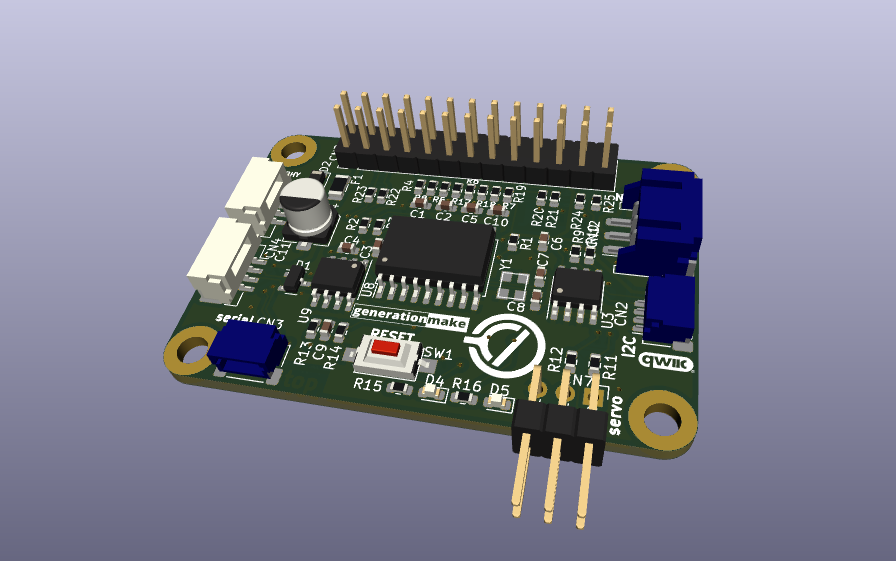
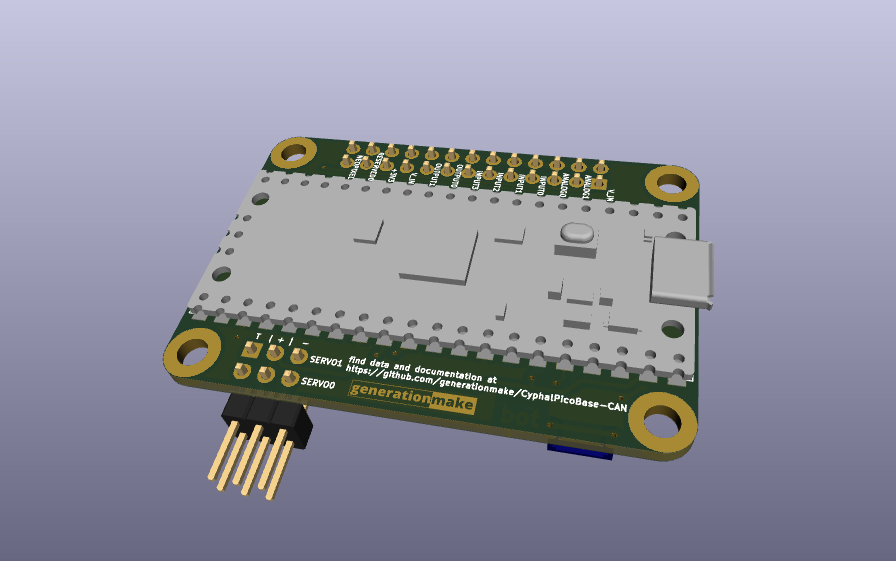
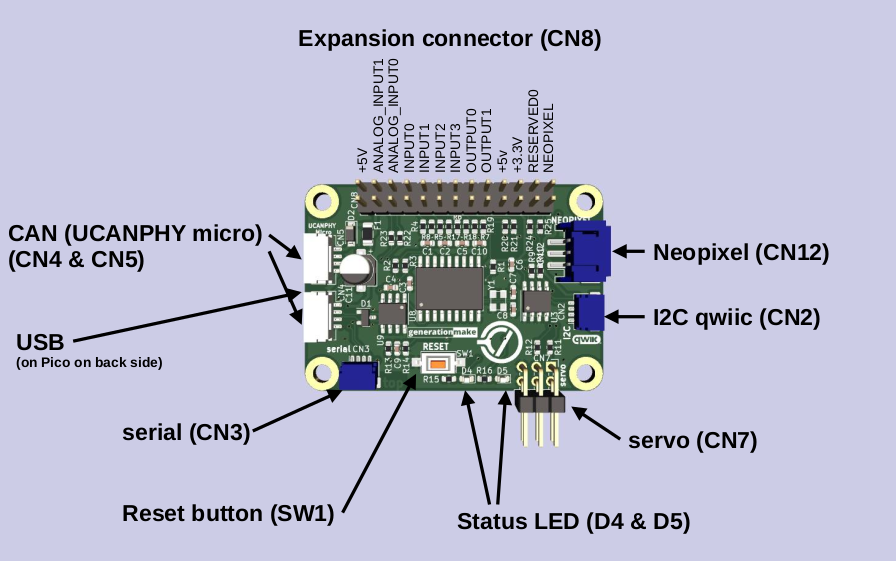
The CyphalPicoBase/CAN provides the following functions:
| Pin | Pin Name | Signal | Description |
|---|---|---|---|
| 1 | GP0 | UART0_TX | reserved for future use (GNSS) |
| 2 | GP1 | UART0_RX | reserved for future use (GNSS) |
| 3 | GND | GND | |
| 4 | GP2 | ||
| 5 | GP3 | ||
| 6 | GP4 | I2C0_SDA | for eeprom and qwiic connector |
| 7 | GP5 | I2C0_SCL | for eeprom and qwiic connector |
| 8 | GND | GND | |
| 9 | GP6 | GPI0 | input 0 |
| 10 | GP7 | GPI1 | input 1 |
| 11 | GP8 | GPI2 | input 2 |
| 12 | GP9 | GPI3 | input 3 |
| 13 | GND | GND | |
| 14 | GP10 | GPO0 | output 0 |
| 15 | GP11 | GPO1 | output 1 |
| 16 | GP12 | reserved | Neopixel |
| 17 | GP13 | reserved | radiation detector |
| 18 | GND | GND | |
| 19 | GP14 | SERVO0 | servo 0 |
| 20 | GP15 | SERVO1 | servo 1 |
| 21 | GP16 | SPI_MISO | SPI for MCP2515 |
| 22 | GP17 | MCP2515_CS | SPI for MCP2515 |
| 23 | GND | GND | |
| 24 | GP18 | SPI_CLK | SPI for MCP2515 |
| 25 | GP19 | SPI_MOSI | SPI for MCP2515 |
| 26 | GP20 | MCP2515_INT | interrupt for MCP2515 |
| 27 | GP21 | STATUS_LED2 | internal status LED 2 |
| 28 | GND | GND | |
| 29 | GP22 | STATUS_LED3 | internal status LED 3 |
| 30 | RUN | RESET | Reset for Board |
| 31 | GP26 | INPUT_VOLTAGE | measure input voltage |
| 32 | GP27 | ANALOG_INPUT0 | analog input |
| 33 | GND | GND | |
| 34 | GP28 | ANALOG_INPUT1 | analog input |
| 35 | ADC_VREF | ||
| 36 | 3V3 (OUT) | 3V3-rail | supply voltage for board |
| 37 | 3V3_EN | ||
| 38 | GND | GND | |
| 39 | VSYS | ||
| 40 | VBUS | 5V-rail | supply voltage for board |
compatible to the Sparkfun qwiic standard (https://www.sparkfun.com/qwiic). JST SH 1mm 4-pin.
| pin number | signal |
|---|---|
| 1 | GND |
| 2 | +3V3 |
| 3 | I2C_SDA |
| 4 | I2C_SCL |
JST SH 1mm 4-pin.
| pin number | signal |
|---|---|
| 1 | GND |
| 2 | +3V3 |
| 3 | SER_TX |
| 4 | SER_RX |
UCANPHY Micro connector, according to the UCANPHY_Specification (https://forum.opencyphal.org/t/cyphal-can-physical-layer-specification-v1-0/1471). JST GH 1.25mm 4-pin.
| pin number | signal |
|---|---|
| 1 | +5V |
| 2 | CANH |
| 3 | CANL |
| 4 | GND |
This is a regular 0.1-inch pin header.
Standard RC servos can be directly plugged into this connector
| pin number | signal |
|---|---|
| 1 | servo0 |
| 2 | servo1 |
| 3 | +5V |
| 4 | +5V |
| 5 | GND |
| 6 | GND |
This is a regular 0.1-inch pin header.
| pin number | signal |
|---|---|
| 1 | +5V |
| 2 | GND |
| 3 | ANALOG_INPUT1 |
| 4 | GND |
| 5 | ANALOG_INPUT0 |
| 6 | GND |
| 7 | INPUT0 |
| 8 | GND |
| 9 | INPUT1 |
| 10 | GND |
| 11 | INPUT2 |
| 12 | GND |
| 13 | INPUT3 |
| 14 | GND |
| 15 | OUTPUT0 |
| 16 | GND |
| 17 | OUTPUT1 |
| 18 | GND |
| 19 | +5V |
| 20 | GND |
| 21 | +3.3V |
| 22 | GND |
| 23 | RESERVED0 |
| 24 | GND |
| 25 | NEOPIXEL |
| 26 | GND |
+5V can be fed over this connector to the servo connector (CN7) and the neopixel connector (CN12) if power supply over the CAN connector is not sufficicant.
connector for Adafruit Neopixel RGB leds (https://learn.adafruit.com/adafruit-neopixel-uberguide/the-magic-of-neopixels). JST PH 2mm 3-pin.
| pin number | signal |
|---|---|
| 1 | neopixel |
| 2 | +5V |
| 3 | GND |
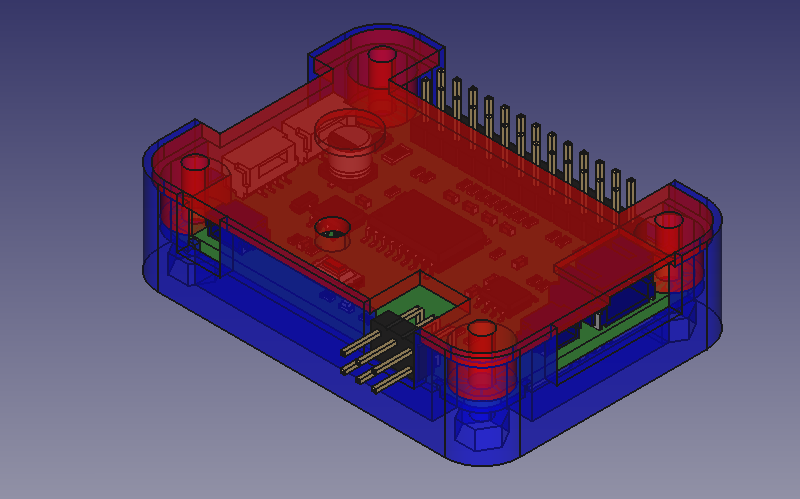
There exists a 3D printable enclosure to encapsulate the PCB.
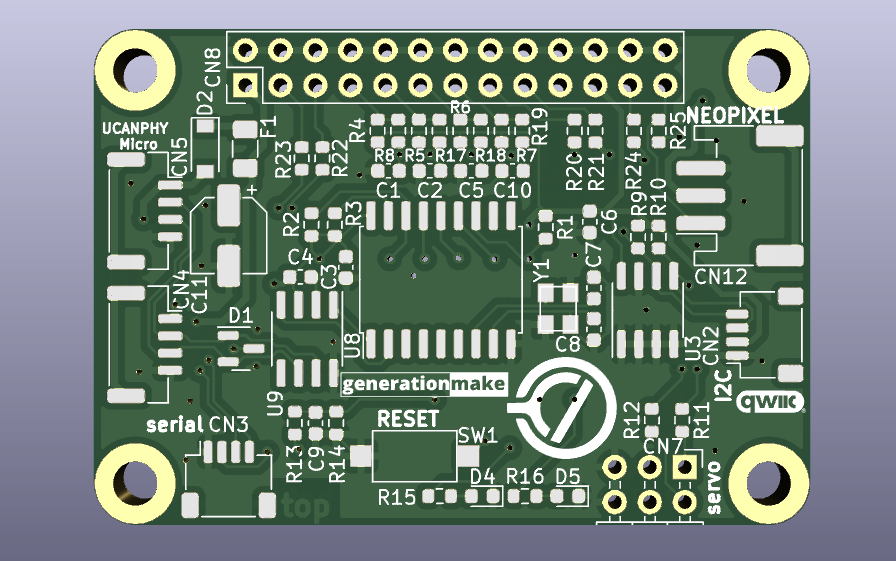
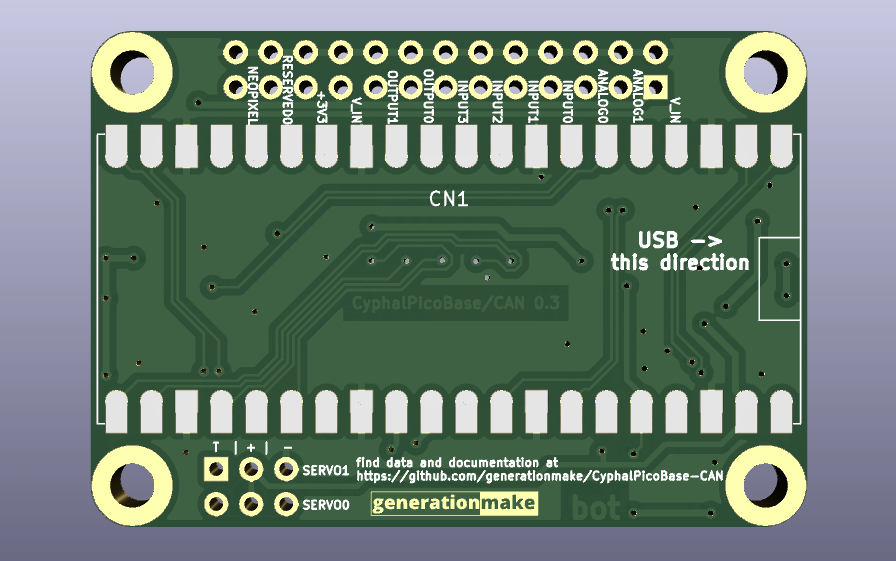
| Qty | Value | Footprint | References |
|---|---|---|---|
| 14 | 10k | Resistor_SMD:R_0603_1608Metric | R1, R2, R3, R4, R5, R6, R7, R8, R9, R10, R14, R17, R18, R19 |
| 8 | 100R | Resistor_SMD:R_0603_1608Metric | R11, R12, R20, R21, R22, R23, R24, R25 |
| 8 | 100nF | Capacitor_SMD:C_0603_1608Metric | C1, C2, C3, C4, C5, C6, C9, C10 |
| 4 | MHP_3.2_5.8 | MECH_mounting_holes:MHP_3.2_5.8 | MECH1, MECH2, MECH3, MECH4 |
| 2 | 10pF | Capacitor_SMD:C_0603_1608Metric | C7, C8 |
| 2 | 3k3 | Resistor_SMD:R_0603_1608Metric | R15, R16 |
| 2 | SM04B-GHS-TB | Connector_JST:JST_GH_SM04B-GHS-TB_1x04-1MP_P1.25mm_Horizontal | CN4, CN5 |
| 2 | SM04B-SRSS-TB | generationmake:JST_SH_SM04B-SRSS-TB_1x04-1MP_P1.00mm_Horizontal | CN2, CN3 |
| 1 | 100 uF / 6,3 V | Capacitor_SMD:CP_Elec_5x5.3 | C11 |
| 1 | 100k | Resistor_SMD:R_0603_1608Metric | R13 |
| 1 | DNI | Connector_PinHeader_2.54mm:PinHeader_2x13_P2.54mm_Vertical | CN8 |
| 1 | DNI | Package_TO_SOT_SMD:SOT-23 | D1 |
| 1 | DNI | Connector_PinHeader_2.54mm:PinHeader_2x03_P2.54mm_Horizontal | CN7 |
| 1 | KT-0603R | LED_SMD:LED_0603_1608Metric | D5 |
| 1 | Label | generationmake:qwiic_logo | L4 |
| 1 | Label | labels:generationmake_small_solder | L2 |
| 1 | Label | labels:opencyphal_small | L3 |
| 1 | Label | labels:generationmake_small_silk | L1 |
| 1 | M24C64-RMN6TP | Package_SO:SOIC-8_3.9x4.9mm_P1.27mm | U3 |
| 1 | MBR0530T | Diode_SMD:D_SOD-123 | D2 |
| 1 | MCP2515T-I/SO | Package_SO:SOIC-18W_7.5x11.6mm_P1.27mm | U8 |
| 1 | NCD0603Y1 | LED_SMD:LED_0603_1608Metric | D4 |
| 1 | PTS636 SM43 SMTR LFS | Button_Switch_SMD:SW_SPST_CK_RS282G05A3 | SW1 |
| 1 | RASPBERRYPI_PICO | generationmake:RASPI_PICO_SOLDER_Kopie | CN1 |
| 1 | S3B-PH-SM4-TB | generationmake:JST_PH_S3B-PH-SM4-TB_1x03-1MP_P2.00mm_Horizontal | CN12 |
| 1 | SN65HVD230 | Package_SO:SOIC-8_3.9x4.9mm_P1.27mm | U9 |
| 1 | X322516MLB4SI | crystals:Crystal_SMD_3.2x2.5mm_4Pad | Y1 |
| 1 | nSMD050-33V | Fuse:Fuse_1206_3216Metric | F1 |
It measures 52 × 36 mm and has 2 copper layers, 1.6 mm thick.
62 parts, built around the SN65HVD230D, M24C64-RMN6TP, MCP2515T-I/SO-HX and SM04B-GHS-TB. The full list of its parts is on this page, with links to each part's symbol and footprint where PCBKit's library has them.
From the generationmake/CyphalPicoBase-CAN repository on GitHub, at the commit this page was made from: the board is kicad_source/CyphalPicoBase-CAN.kicad_pcb and its schematic kicad_source/CyphalPicoBase-CAN.kicad_sch. PCBKit opens the board in the browser, with nothing to install.
Its repository publishes it under the CERN-OHL-W-2.0 licence: you may reuse it on that licence's terms (keep the author's notice, and for a copyleft licence share your changes alike).
Miroeilola/vallox-rs485-controller
Replacement control panel for legacy Vallox SE ventilation units. Vallox DIGIT RS-485 protocol, bus-powered, ESP32, Home Assistant.


DangerousPrototypes/BusPirate5-hardware
Bus Pirate Hardware and accessories for v5 and higher


