
2 layers96.6 × 82.8 mm
 evathenarobotics-stack/epot
This is a starbie project by hacklife. A starbie is meant to be similar to a tamogatchi. Using KiCad's Schematic editor, I created circuits on the XIAO ESP32C3 inwhich the starbie can move via buttons and detect the…
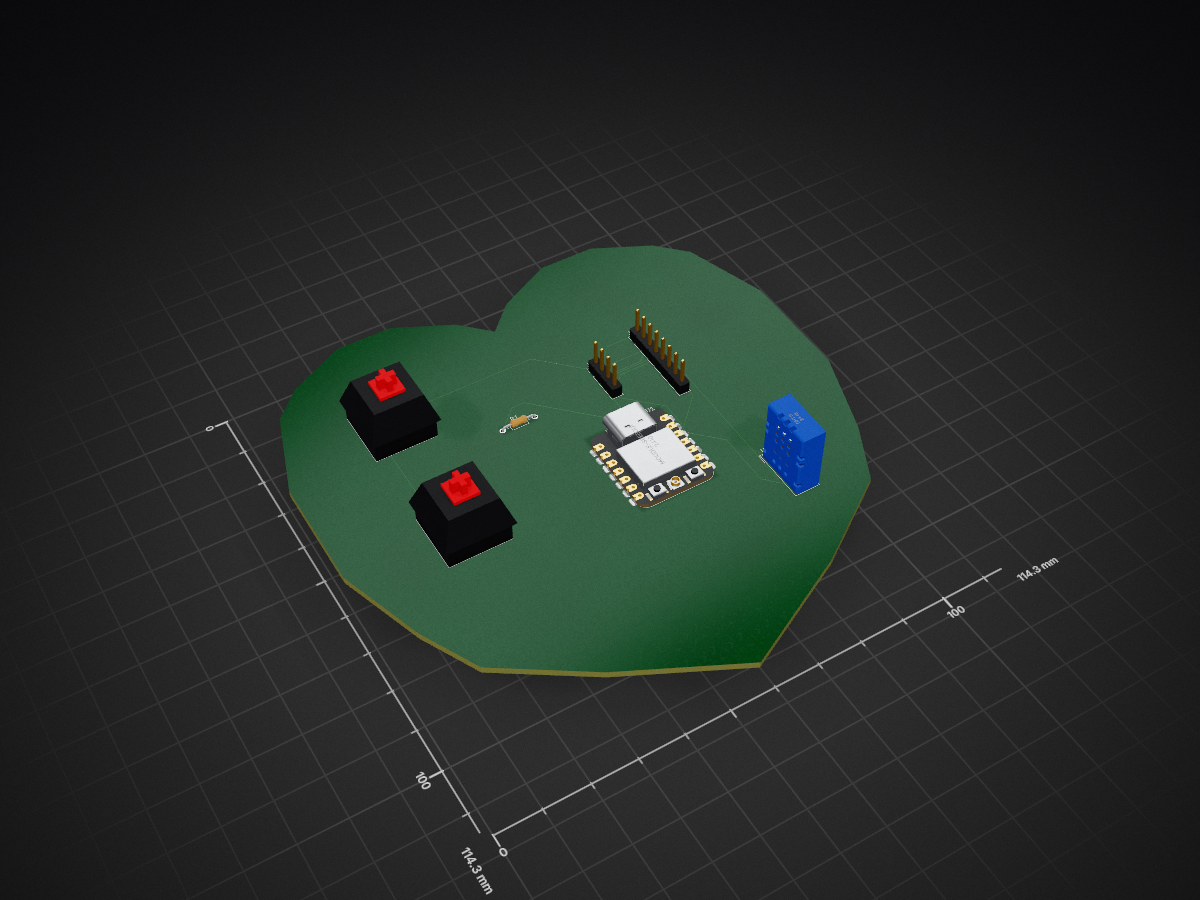
Hacklife1.0 is an open-source printed circuit board by evathenarobotics-stack, from the evathenarobotics-stack/epot repository on GitHub. It is a 2-layer board of 114.3 × 114.3 mm with 7 parts on 25 nets, routed with 50 tracks and 0 vias.
It is built around the DHT11. Its parts include 2 ICs, 2 connectors, 2 switches and 1 resistor. It belongs with the ESP32 and RISC-V boards of this library.
This is a starbie project by hacklife. A starbie is meant to be similar to a tamogatchi. Using KiCad's Schematic editor, I created circuits on the XIAO ESP32C3 inwhich the starbie can move via buttons and detect the enviornment with an enviornment sensor. This was then connected to the PCB and I chose a rounded heart shape as my base. In Arduino, I replicated the code given using my own wire managment and my starbie can draw hearts as well as little sparkles.
I turned it in late and lwk missed the dead line as a result of a mixture of errors and a busy schedule, however the errors I ran into were quite troublesome to manage. The code I replicated had errors running despite the lack of change at that point in the process.
But, I completed it and this is how the PCB board looks:
| Qty | Value | Footprint | References |
|---|---|---|---|
| 2 | SW_Push | Button_Switch_Keyboard:SW_Cherry_MX_1.00u_PCB | SW1, SW2 |
| 1 | 10k | Resistor_THT:R_Axial_DIN0204_L3.6mm_D1.6mm_P7.62mm_Horizontal | R1 |
| 1 | Conn_01x04_Pin | Connector_PinHeader_2.54mm:PinHeader_1x04_P2.54mm_Vertical | J1 |
| 1 | Conn_01x08_Pin | Connector_PinHeader_2.54mm:PinHeader_1x08_P2.54mm_Vertical | J2 |
| 1 | DHT11 | Sensor:Aosong_DHT11_5.5x12.0_P2.54mm | U2 |
| 1 | MOUDLE-SEEEDUINO-XIAO-ESP32C3 | RF_Module:MCU_Seeed_ESP32C3 | U1 |
It measures 114.3 × 114.3 mm and has 2 copper layers, 1.6 mm thick.
7 parts, built around the DHT11. The full list of its parts is on this page, with links to each part's symbol and footprint where PCBKit's library has them.
From the evathenarobotics-stack/epot repository on GitHub, at the commit this page was made from: the board is epot/hacklife1.0.kicad_pcb and its schematic epot/epot.kicad_sch. PCBKit opens the board in the browser, with nothing to install.
Its repository states no licence, so its author keeps all rights: ask evathenarobotics-stack before reusing the design.

lansidev/conveyor-belt
Miniature 3D printed conveyor belt for simulation and fun working with sensors, all controllable with Raspberry Pi


ebrithiljonas/OMG_PCB
All in One PCB for the OpenMQTTGateway Project

GeorgK/SniffingTrinket
A room climate monitor using the Adafruit Trinket Pro

bhaskar9980/Guardian
Guardian is an advanced, fully automated hydroponics system designed to optimize plant growth and maximize yield.

Twistx77/Firefly
Open WIFI-enabled RGB lamp with temperature, humidity, suspended air particles and eCO2 sensors.

unla-investigacion-desarrollo/ecosistema-iot
Antes de desarrollar el sistema final, realizamos una etapa de exploración donde investigamos y experimentamos con las siguientes tecnologías: