4 layers

 ephemeridis/GRBL_board2
This is a PCB designed to run GRBL, an open source CNC control software that is designed and optimised for Arduino.
GRBL board is an open-source printed circuit board by ephemeridis, from the ephemeridis/GRBL_board repository on GitHub, published under the GPL-3.0 licence. It is a 4-layer board of 138.4 × 138.3 mm with 287 parts on 310 nets, routed with 2,489 tracks and 175 vias.
It is built around the ATMEGA2560-16AU, ATMEGA328P-AU and TMC5160SILENTSTEPSTICK, with the LMV358, OPA2192ID and FT231XS-R among its other parts. Its parts include 89 resistors, 59 capacitors, 53 diodes, 32 ICs and 21 connectors. It belongs with the AVR (ATmega, ATtiny) boards of this library.


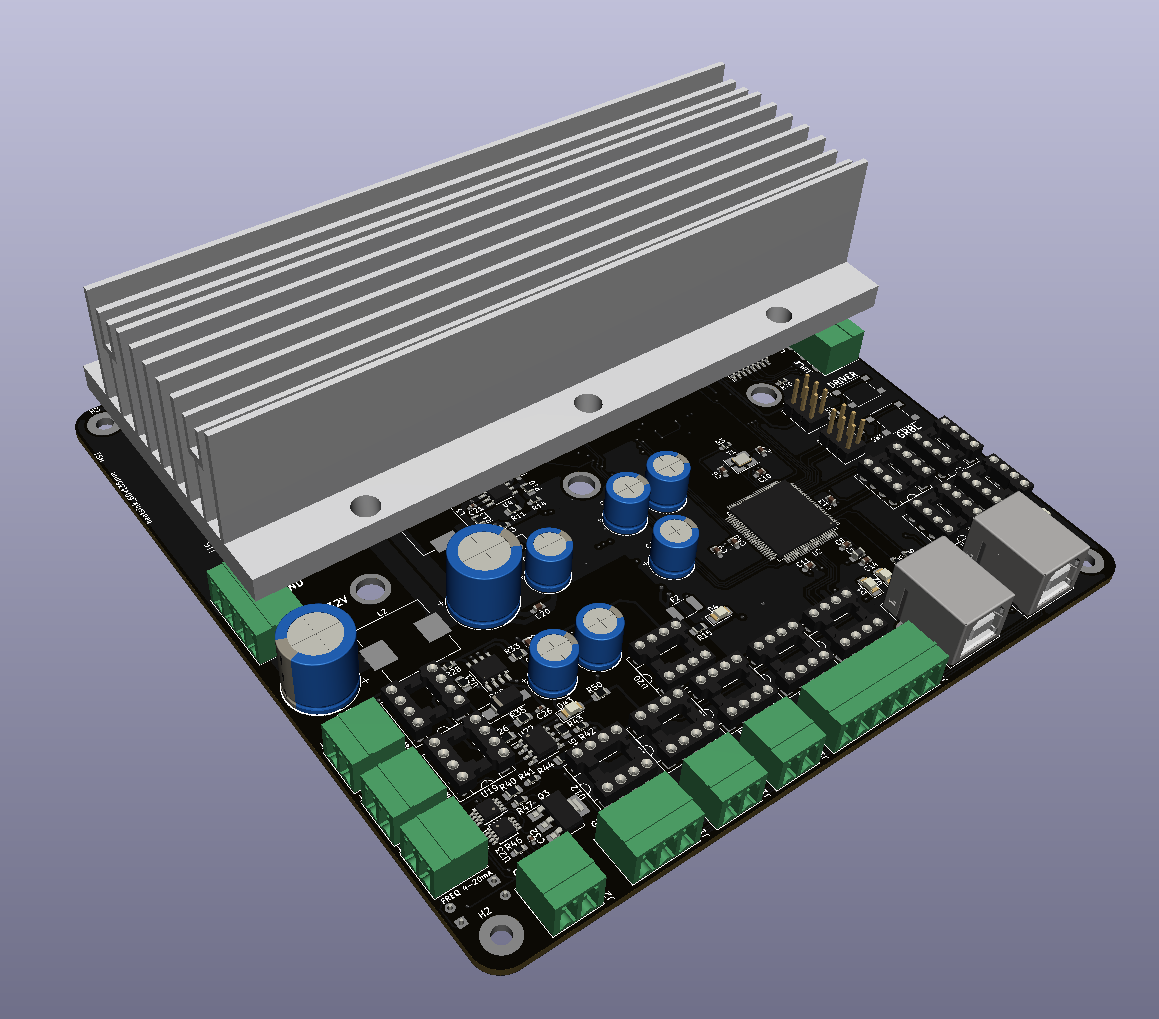
This is a PCB designed to run GRBL, an open source CNC control software that is designed and optimised for Arduino. This board uses GRBL-Mega, which is a version of GRBL that can run on the ATMEGA-2560, used in the Arduino Mega. This implementation allows GRBL to have a larger buffer size, since the ATMEGA-328P that GRBL was originally designed for has severe memory limitations.
This board design incorporates several additional features, such as:
The goal is to accomplish this with minimal editing of the GRBL code, thus to do so an additional ATMEGA-328P is added on the board to enable the additional features.
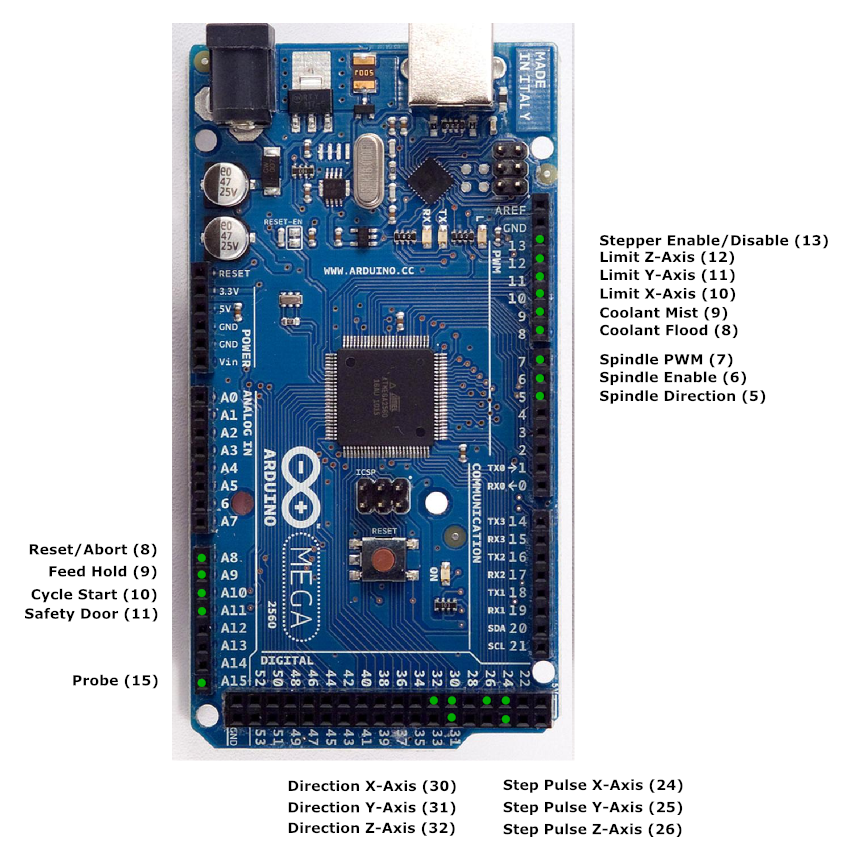
This board is designed with the aim of being as compatible as possible with the default GRBL, and as such, the pins are wired to follow the default GRBL-Mega pinout, as shown.
Trinamic stepper motor drivers are exceptional in terms of performance and efficiency, incorporating advanced features that enable steppers to run cooler and with near silent operation.
However, the tricky bit is that they are not a plug an play solution unlike other stepper drivers like the DRV8825 or the A4988 drivers. The drivers haveto be configured whenever they are powered up. To accomplish this, the separate ATMEGA-328P is used to communicate with the drivers via SPI in order to configure them.
Most CNC configurations include one axis which has dual stepper drive. GRBL has limited support for axis mirroring, and usually sacrifices some pins, such as spindle speed control. Thus, via the use of multiplexer ICs and the separate ATMEGA-328P, code can be uploaded to the ATMEGA-328P in order to specify which axis to mirror and whether to do gantry levelling for that axis.
To accomplish gantry levelling, the ATMEGA-328P will check the two limit switches on the mirrored axis, and if only one switch is triggered, the corresponding stepper's STEP pin will be held low, preventing it from moving until both switches are triggered. Once both limit switches are triggered, the limit switch signal will be sent to the GRBL controller running on the ATMEGA-2560.
Previously, I had an extremely bad experience with EMI on the limit switch lines when building a CNC, thus I decided to include an optocoupler on each input of the CNC controller. Although the switches are still normally open, the optocoupler requires current to drive the LED and thus it is nearly impossible for EMI to trigger the optocoupler. This should make the CNC much more robust against EMI, and it is possible to change the switches to normally closed by modifying GRBL.
| Qty | Value | Footprint | References |
|---|---|---|---|
| 33 | B360 | Diode_SMD:D_SMA_Handsoldering | D10, D11, D12, D13, D14, D15, D16, D17, D18, D19, D20, D21, D22, D23, D24, D25 +17 |
| 25 | 100n | Capacitor_SMD:C_0603_1608Metric_Pad1.05x0.95mm_HandSolder | C3, C10, C11, C12, C13, C14, C20, C21, C27, C38, C40, C41, C42, C46, C47, C48 +9 |
| 15 | 10k | Resistor_SMD:R_0805_2012Metric_Pad1.15x1.40mm_HandSolder | R11, R13, R15, R19, R21, R49, R56, R74, R81, R82, R85, R86, R87, R90, R91 |
| 15 | 1k | Resistor_SMD:R_0805_2012Metric_Pad1.15x1.40mm_HandSolder | R33, R34, R35, R36, R37, R42, R43, R44, R45, R51, R52, R53, R54, R57, R60 |
| 14 | 270 | Resistor_SMD:R_0805_2012Metric_Pad1.15x1.40mm_HandSolder | R4, R7, R8, R9, R10, R22, R24, R27, R46, R47, R48, R61, R75, R78 |
| 12 | 1k | Resistor_SMD:R_1206_3216Metric_Pad1.30x1.75mm_HandSolder | R28, R29, R30, R31, R32, R38, R39, R40, R41, R83, R84, R89 |
| 12 | 6N137 | Package_DIP:DIP-8_W7.62mm_Socket | U10, U11, U12, U13, U14, U15, U16, U17, U18, U19, U20, U21 |
| 9 | 100 | Resistor_SMD:R_0603_1608Metric_Pad0.98x0.95mm_HandSolder | R5, R6, R69, R70, R76, R77, R79, R80, R88 |
| 9 | LED | LED_SMD:LED_1206_3216Metric_Pad1.42x1.75mm_HandSolder | D1, D2, D3, D4, D5, D7, D46, D49, D50 |
| 6 | 4.7u | Capacitor_SMD:C_1206_3216Metric_Pad1.33x1.80mm_HandSolder | C1, C29, C30, C31, C32, C49 |
| 6 | BZX84C5V6 | Diode_SMD:D_SOT-23_ANK | D9, D43, D44, D51, D52, D53 |
| 5 | BSS127S | Package_TO_SOT_SMD:SOT-23 | Q1, Q2, Q5, Q6, Q7 |
| 4 | 100u | Capacitor_SMD:CP_Elec_8x10 | C33, C34, C35, C36 |
| 4 | 10u | Capacitor_THT:CP_Radial_D8.0mm_P3.50mm | C15, C18, C25, C37 |
| 4 | 20p | Capacitor_SMD:C_0603_1608Metric_Pad1.05x0.95mm_HandSolder | C6, C7, C50, C51 |
| 4 | 27 | Resistor_SMD:R_0603_1608Metric_Pad0.98x0.95mm_HandSolder | R1, R2, R72, R73 |
| 4 | 47p | Capacitor_SMD:C_0402_1005Metric_Pad0.74x0.62mm_HandSolder | C2, C4, C53, C55 |
| 4 | MountingHole | MountingHole:MountingHole_3.2mm_M3_Pad | H1, H2, H3, H4 |
| 4 | TMC5160_SILENTSTEPSTICK | grbl_board:TMC5160_SILENTSTEPSTICK | U6, U7, U8, U9 |
| 3 | 2.2k | Resistor_SMD:R_0603_1608Metric_Pad0.98x0.95mm_HandSolder | R16, R25, R58 |
| 3 | 33u | Inductor_SMD:L_Vishay_IHLP-4040 | L3, L4, L5 |
| 3 | 47k | Resistor_SMD:R_0805_2012Metric_Pad1.15x1.40mm_HandSolder | R14, R20, R55 |
| 3 | 6.8n | Capacitor_SMD:C_0402_1005Metric_Pad0.74x0.62mm_HandSolder | C19, C26, C39 |
| 3 | BD9G341EFJ | Package_SO:HTSOP-8-1EP_3.9x4.9mm_P1.27mm_EP2.4x3.2mm_ThermalVias | U3, U5, U22 |
| 3 | SS2150-LTP | Diode_SMD:D_SMA_Handsoldering | D6, D8, D45 |
| 2 | 100k | Resistor_SMD:R_0603_1608Metric_Pad0.98x0.95mm_HandSolder | R12, R18 |
| 2 | 100u | Capacitor_THT:CP_Radial_D8.0mm_P3.50mm | C23, C43 |
| 2 | 10u | Inductor_SMD:L_0805_2012Metric_Pad1.05x1.20mm_HandSolder | L1, L6 |
| 2 | 12k | Resistor_SMD:R_0805_2012Metric_Pad1.15x1.40mm_HandSolder | R23, R62 |
| 2 | 16M | Crystal:Crystal_SMD_SeikoEpson_TSX3225-4Pin_3.2x2.5mm_HandSoldering | Y1, Y2 |
| 2 | 1N4148 | Diode_THT:D_DO-35_SOD27_P7.62mm_Horizontal | D47, D48 |
| 2 | 1u | Capacitor_SMD:C_1206_3216Metric_Pad1.33x1.80mm_HandSolder | C22, C28 |
| 2 | 200 | Resistor_SMD:R_0603_1608Metric_Pad0.98x0.95mm_HandSolder | R17, R59 |
| 2 | 220p | Capacitor_SMD:C_0402_1005Metric_Pad0.74x0.62mm_HandSolder | C44, C45 |
| 2 | 24k | Resistor_SMD:R_0805_2012Metric_Pad1.15x1.40mm_HandSolder | R66, R67 |
| 2 | 2A | Fuse:Fuse_Bourns_MF-RHT200 | F1, F3 |
| 2 | 30k | Resistor_SMD:R_0603_1608Metric_Pad0.98x0.95mm_HandSolder | R64, R65 |
| 2 | 470u | Capacitor_THT:CP_Radial_D12.5mm_P5.00mm | C16, C17 |
| 2 | 74LS153 | Package_SO:SOIC-16_3.9x9.9mm_P1.27mm | U31, U32 |
| 2 | FT231XS | Package_SO:SSOP-20_3.9x8.7mm_P0.635mm | U1, U27 |
| 2 | Ferrite_Bead | Capacitor_SMD:C_0603_1608Metric_Pad1.05x0.95mm_HandSolder | FB1, FB2 |
| 2 | ICSP | Connector_PinHeader_2.54mm:PinHeader_2x03_P2.54mm_Vertical | J4, J21 |
| 2 | L7805 | Package_TO_SOT_SMD:TO-263-2 | U4, U26 |
| 2 | LMV358 | Package_SO:SOIC-8_3.9x4.9mm_P1.27mm | U23, U24 |
| 2 | SW_Push | Button_Switch_SMD:SW_Push_1P1T_NO_6x6mm_H9.5mm | SW1, SW2 |
| 2 | SolderJumper_3_Open | Jumper:SolderJumper-3_P1.3mm_Open_RoundedPad1.0x1.5mm | JP1, JP2 |
| 2 | USB_B | grbl_board:USB_B_OST_USB-B1HSxx_Horizontal | J3, J20 |
| 1 | 10n | Capacitor_SMD:C_0603_1608Metric_Pad1.08x0.95mm_HandSolder | C24 |
| 1 | 12VDC | Connector_Phoenix_MC:PhoenixContact_MC_1,5_2-G-3.81_1x02_P3.81mm_Horizontal | J2 |
| 1 | 13u | Inductor_SMD:L_Wuerth_HCI-1365 | L2 |
| 1 | 1M | Resistor_SMD:R_0603_1608Metric_Pad0.98x0.95mm_HandSolder | R3 |
| 1 | 22 | Resistor_SMD:R_0805_2012Metric_Pad1.15x1.40mm_HandSolder | R71 |
| 1 | 24VDC | Connector_Phoenix_MC:PhoenixContact_MC_1,5_2-G-3.81_1x02_P3.81mm_Horizontal | J22 |
| 1 | 24V_VFD | Connector_Phoenix_MC:PhoenixContact_MC_1,5_2-G-3.81_1x02_P3.81mm_Horizontal | J17 |
| 1 | 250 | Resistor_SMD:R_0603_1608Metric_Pad0.98x0.95mm_HandSolder | R68 |
| 1 | 300mA | Fuse:Fuse_1812_4532Metric_Castellated | F2 |
| 1 | 3k | Resistor_SMD:R_0603_1608Metric_Pad0.98x0.95mm_HandSolder | R63 |
| 1 | 40106 | Package_SO:TSSOP-14_4.4x5mm_P0.65mm | U28 |
| 1 | 74LS155 | Package_SO:SOIC-16_3.9x9.9mm_P1.27mm | U29 |
| 1 | ATmega2560-16AU | Package_QFP:TQFP-100_14x14mm_P0.5mm | U2 |
| 1 | ATmega328P-AU | Package_QFP:TQFP-32_7x7mm_P0.8mm | U30 |
| 1 | BRAKE | Connector_Phoenix_MC:PhoenixContact_MC_1,5_2-G-3.81_1x02_P3.81mm_Horizontal | J23 |
| 1 | COOL | Connector_Phoenix_MC:PhoenixContact_MC_1,5_3-G-3.81_1x03_P3.81mm_Horizontal | J1 |
| 1 | DOOR | Connector_Phoenix_MC:PhoenixContact_MC_1,5_2-G-3.81_1x02_P3.81mm_Horizontal | J10 |
| 1 | E_STEPPER | Connector_Phoenix_MC:PhoenixContact_MC_1,5_4-G-3.81_1x04_P3.81mm_Horizontal | J9 |
| 1 | INP | Connector_Phoenix_MC:PhoenixContact_MC_1,5_6-G-3.81_1x06_P3.81mm_Horizontal | J12 |
| 1 | IRF9Z24SPBF | Package_TO_SOT_SMD:TO-263-3_TabPin2 | Q4 |
| 1 | LIM_E | Connector_Phoenix_MC:PhoenixContact_MC_1,5_2-G-3.81_1x02_P3.81mm_Horizontal | J16 |
| 1 | LIM_X | Connector_Phoenix_MC:PhoenixContact_MC_1,5_2-G-3.81_1x02_P3.81mm_Horizontal | J13 |
| 1 | LIM_Y | Connector_Phoenix_MC:PhoenixContact_MC_1,5_2-G-3.81_1x02_P3.81mm_Horizontal | J14 |
| 1 | LIM_Z | Connector_Phoenix_MC:PhoenixContact_MC_1,5_2-G-3.81_1x02_P3.81mm_Horizontal | J15 |
| 1 | LT5400_10k | Package_SO:TSSOP-8_3x3mm_P0.65mm | RN1 |
| 1 | OPA2192 | Package_SO:TSSOP-8_3x3mm_P0.65mm | U25 |
| 1 | PROBE | Connector_Phoenix_MC:PhoenixContact_MC_1,5_2-G-3.81_1x02_P3.81mm_Horizontal | J11 |
| 1 | SSM3K361R,LF | Package_TO_SOT_SMD:SOT-23 | Q8 |
| 1 | Screw_Terminal_01x04 | Connector_Phoenix_MC:PhoenixContact_MC_1,5_4-G-3.81_1x04_P3.81mm_Horizontal | J5 |
| 1 | Spindle | Connector_Phoenix_MC:PhoenixContact_MC_1,5_2-G-3.81_1x02_P3.81mm_Horizontal | J18 |
| 1 | X_STEPPER | Connector_Phoenix_MC:PhoenixContact_MC_1,5_4-G-3.81_1x04_P3.81mm_Horizontal | J6 |
| 1 | Y_STEPPER | Connector_Phoenix_MC:PhoenixContact_MC_1,5_4-G-3.81_1x04_P3.81mm_Horizontal | J7 |
| 1 | ZVN4306GTA | Package_TO_SOT_SMD:SOT-223-3_TabPin2 | Q3 |
The 284 most common of 287 parts.


mauro-starspec/Elevation_Pivot_Daughter-Board
KiCad 9 daughter board for the Starspec elevation/pivot controller.

skunkforce/b115_4x_PoE_PSE_13W_TPS23861
to pull the submodules before opening the project with kicad.


RTES-Group/DigitSynth
A real-time audio effects processor built on Raspberry Pi — apply filters and effects to live audio using MIDI control messages.
It measures 138.4 × 138.3 mm and has 4 copper layers, 1.6 mm thick.
287 parts, built around the ATMEGA2560-16AU, ATMEGA328P-AU, TMC5160SILENTSTEPSTICK and LMV358. The full list of its parts is on this page, with links to each part's symbol and footprint where PCBKit's library has them.
From the ephemeridis/GRBL_board repository on GitHub, at the commit this page was made from: the board is grbl_board/grbl_board.kicad_pcb. PCBKit opens the board in the browser, with nothing to install.
Its repository publishes it under the GPL-3.0 licence: you may reuse it on that licence's terms (keep the author's notice, and for a copyleft licence share your changes alike).