2 layers114.3 × 98.8 mm
Mystic split40
Duckle29/MS40
The project uses Ai03s keyswitch library. Many thanks to Ai03 for releasing an awesome keyswitch library with an entirely open license.
160 parts1BSD-3-Clause

 Duckle29/ATMega32U4-backpack
This is a small PCB meant to sit behind an OLED LCD as a small backpack. Almost
ATM32U4 backpack is an open-source printed circuit board by Duckle29, from the Duckle29/ATMega32U4-backpack repository on GitHub, published under the MIT licence. It is a 2-layer board of 27 × 50.5 mm with 41 parts on 42 nets, routed with 467 tracks and 60 vias.
It is built around the ATMEGA32U4-AU, TXB0104PW and BAT54WS, with the WS2812 among its other parts. Its parts include 7 resistors, 7 connectors, 5 capacitors, 3 ICs and 1 diode. It belongs with the lEDs and displays boards and the AVR (ATmega, ATtiny) boards of this library.


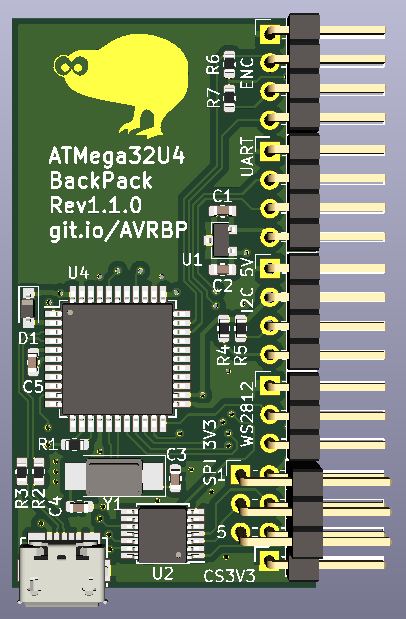
This is a small backpack PCB, meant to go with some 2.4" I2C OLED LCD. It exposes ALL pins on the ATMega32U4, so can be used for pretty much anything.
| Pin | Encoder | UART | I2C | WS2812 | SPI | CS3V3 |
|---|---|---|---|---|---|---|
| 1 | GND | GND | GND | GND | MISO | 3V3 shifted IO (B0) |
| 2 | B | TX-3V3 | 5V | Data | 3V3 | |
| 3 | A | RX | SCL-5V | 5V | SCK-3V3 | |
| 4 | SW | 5V in | SDA-5V | MOSI-3V3 | ||
| 5 | Reset | |||||
| 6 | GND |
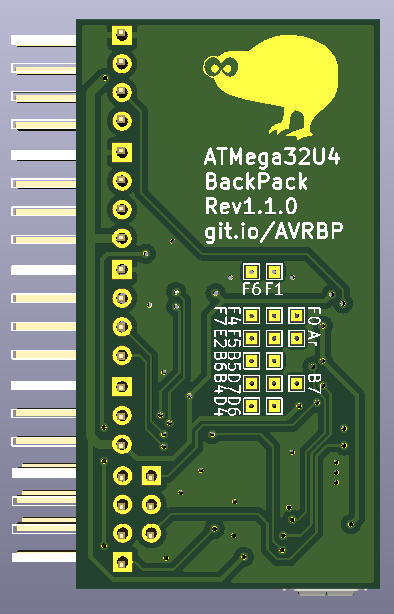
The remaining pins are broken out on the back, with their port and number listed.
On the bottom is a micro-B USB.
R4 and R5
Are I2C pullups. Attach these only if no other I2C device has pullups on them already.
R6 and R7
Are optional pull-ups for the encoder. These can help if you have a noisy signal due to the weak internal pullups of the IC.
Power
If the board is powered through the USB, the 5v power limit is 100mA, as it passes through D1. This is done to enable the chip to test if it's powered through USB or not.
bool has_usb(void) {
  /* return (UDADDR & _BV(ADDEN)); */
   USBCON |= (1 << OTGPADE); // enables VBUS pad
   _delay_us(5);
   return (USBSTA & (1<<VBUS));  // checks state of VBUS
}
| Qty | Value | Footprint | References |
|---|---|---|---|
| 3 | 1uF | Capacitor_SMD:C_0603_1608Metric | C1, C2, C5 |
| 3 | 4k7 | Resistor_SMD:R_0603_1608Metric | R1, R4, R5 |
| 2 | 18pF | Capacitor_SMD:C_0603_1608Metric | C3, C4 |
| 2 | 1k | Resistor_SMD:R_0603_1608Metric | R6, R7 |
| 2 | 22R | Resistor_SMD:R_0603_1608Metric | R2, R3 |
| 2 | LOGO | graphics:kiwi | G***, G*** |
| 1 | 16MHz | Crystal:Crystal_SMD_5032-2Pin_5.0x3.2mm_HandSoldering | Y1 |
| 1 | ATmega32U4-AU | Package_QFP:TQFP-44_10x10mm_P0.8mm | U4 |
| 1 | Ar | TestPoint:TestPoint_Pad_1.0x1.0mm | TP4 |
| 1 | B4 | TestPoint:TestPoint_Pad_1.0x1.0mm | TP2 |
| 1 | B5 | TestPoint:TestPoint_Pad_1.0x1.0mm | TP3 |
| 1 | B6 | TestPoint:TestPoint_Pad_1.0x1.0mm | TP5 |
| 1 | B7 | TestPoint:TestPoint_Pad_1.0x1.0mm | TP6 |
| 1 | BAT54WS | Diode_SMD:D_SOD-323_HandSoldering | D1 |
| 1 | CS3V3 | Connector_PinHeader_2.54mm:PinHeader_1x01_P2.54mm_Horizontal | J7 |
| 1 | D4 | TestPoint:TestPoint_Pad_1.0x1.0mm | TP9 |
| 1 | D6 | TestPoint:TestPoint_Pad_1.0x1.0mm | TP7 |
| 1 | D7 | TestPoint:TestPoint_Pad_1.0x1.0mm | TP8 |
| 1 | E2 | TestPoint:TestPoint_Pad_1.0x1.0mm | TP10 |
| 1 | ENC | Connector_PinHeader_2.54mm:PinHeader_1x04_P2.54mm_Horizontal | J6 |
| 1 | F0 | TestPoint:TestPoint_Pad_1.0x1.0mm | TP11 |
| 1 | F1 | TestPoint:TestPoint_Pad_1.0x1.0mm | TP12 |
| 1 | F4 | TestPoint:TestPoint_Pad_1.0x1.0mm | TP13 |
| 1 | F5 | TestPoint:TestPoint_Pad_1.0x1.0mm | TP14 |
| 1 | F6 | TestPoint:TestPoint_Pad_1.0x1.0mm | TP1 |
| 1 | F7 | TestPoint:TestPoint_Pad_1.0x1.0mm | TP16 |
| 1 | I2C 5V | Connector_PinHeader_2.54mm:PinHeader_1x04_P2.54mm_Horizontal | J5 |
| 1 | LM3480-3.3 | Package_TO_SOT_SMD:SOT-23 | U1 |
| 1 | SPI 3V3 | Connector_PinHeader_2.54mm:PinHeader_2x03_P2.54mm_Horizontal | J1 |
| 1 | TXB0104PW | Package_SO:TSSOP-14_4.4x5mm_P0.65mm | U2 |
| 1 | UART | Connector_PinHeader_2.54mm:PinHeader_1x04_P2.54mm_Horizontal | J3 |
| 1 | USB_B_Micro | Connector_USB:USB_Micro-B_Molex_47346-0001 | J4 |
| 1 | WS2812 | Connector_PinHeader_2.54mm:PinHeader_1x03_P2.54mm_Horizontal | J2 |
It measures 27 × 50.5 mm and has 2 copper layers, 1.6 mm thick.
41 parts, built around the ATMEGA32U4-AU, TXB0104PW, BAT54WS and WS2812. The full list of its parts is on this page, with links to each part's symbol and footprint where PCBKit's library has them.
From the Duckle29/ATMega32U4-backpack repository on GitHub, at the commit this page was made from: the board is ATM32U4_backpack.kicad_pcb. PCBKit opens the board in the browser, with nothing to install.
Its repository publishes it under the MIT licence: you may reuse it on that licence's terms (keep the author's notice, and for a copyleft licence share your changes alike).
Duckle29/MS40
The project uses Ai03s keyswitch library. Many thanks to Ai03 for releasing an awesome keyswitch library with an entirely open license.


thebiguno/microcontroller-projects
A home for a bunch of microcontroller projects which don't warrant their own repos.

oomlout/oomlout_oomp_project_bot_v_2

menloresearch/asimov-1
v1 of Asimov, an open-source humanoid robot

andykarpov/karabas-pro
FPGA based retrocomputer with FDD and HDD controllers
