

2 layers100 × 80 mm
Solid state relays 12v
dragon-mobile/solid_state_relays_12v
The Solid State Relays - 12Volts is an open hardware solid state relay PCB aimed at the tiny home, van life and maker communities.
98 parts3CC-BY-SA-4.0

 dragon-mobile/picow_ssr_control
Open Source hardware and software for a Raspberry Pi Pico W Solid State Relay Controller
Picow ssr control is an open-source printed circuit board by dragon-mobile, from the dragon-mobile/picow_ssr_control repository on GitHub, published under the CC-BY-SA-4.0 licence. It is a 2-layer board of 65 × 80 mm with 68 parts on 64 nets, routed with 176 tracks and 363 vias.
It is built around the 2N7002K, SHF-105-01-L-D-RA and 193-8MS, with the DMG2305UX-7, LTST-C190KGKT and SQ3419EV-T1_GE3 among its other parts. Its parts include 12 capacitors, 4 resistors, 2 ICs, 2 transistors and 1 switch. It belongs with the home automation and IoT boards and the RP2040 boards of this library.



The Raspberry Pi Pico W Solid State Relay Controller is primarily meant to be used with an open hardware solid state relay PCBs that is being co-developed alongside this project as part of my Dragon Mobile GitHub organization to make useful hardware with associated firmware and software for the tiny home, van life and maker communities.
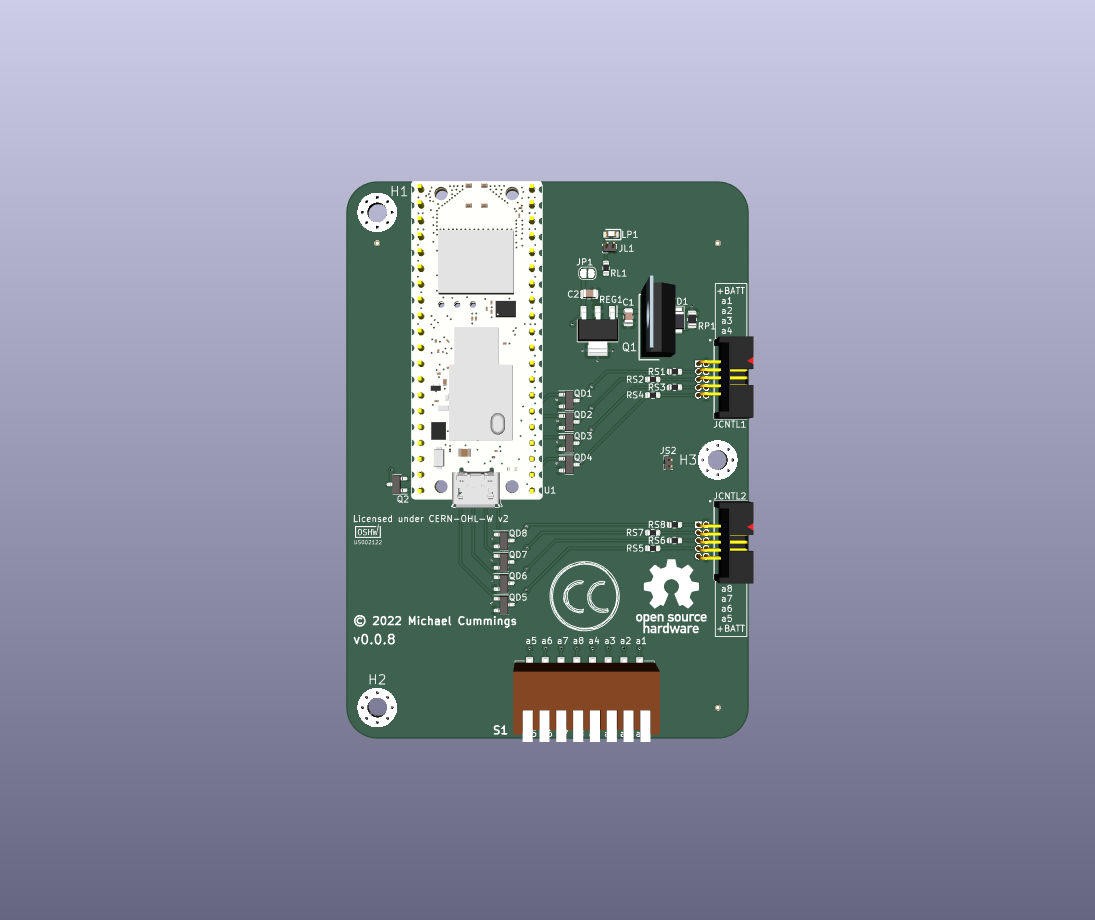
Top view
Bottom view
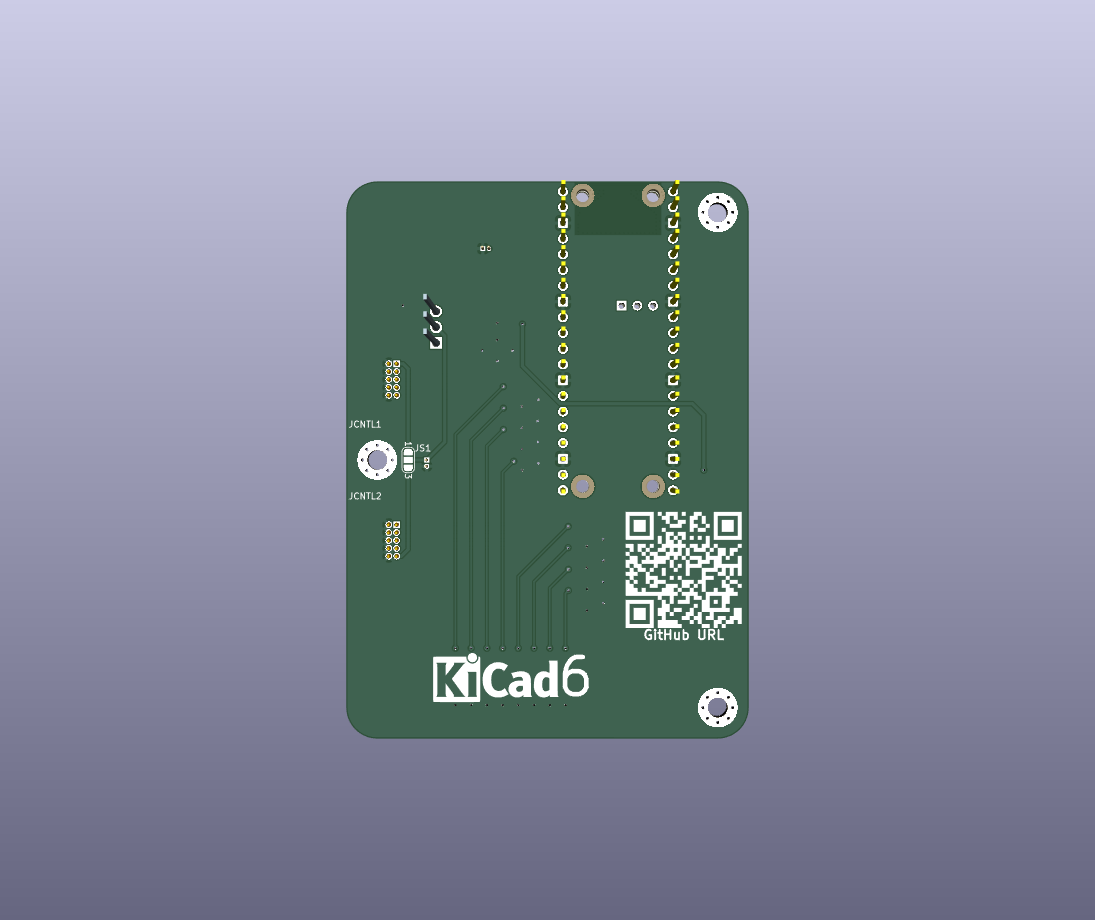
The board consist of four main electronic sections: Power In / Control Out, Power Management / Regulation, Manual Control, and the PicoW Control / Drivers. There is one mechanical section as well: Mounting Holes.
Contributors are welcome. Please note that this project has a Contributor Covenant Code of Conduct. By participating in this project you agree to abide by its terms.
All intentionally contributed hardware will be considered to be contributed under the CERN license without any additional terms or conditions.
All intentionally contributed code will be considered to be contributed under a MIT license without any additional terms or conditions. Please include your information in a comment on all code files for the copyright etc.
All intentionally contributed documentation, CAD files and libraries, footprints, artwork or non-code text like this README etc. will be considered to be contributed under the same CC-BY-SA license without any additional terms or conditions.
Pull requests are always welcome. For major changes, please open an issue first to discuss what you would like to change. Please make sure to update or add tests as appropriate for all software changes.
All hardware is licensed under the
You can find a copy of the CERN Open Hardware License - Weakly-reciprocal v2.0 in the LICENSE-CERN-OHL-W-2 file and the how-to guide in the CERN-HOWTO_GUIDE file.
All code is licensed under the
You can find a copy of the license in the LICENSE-MIT file.
All documentation like this README is licensed under the Creative Commons Attribution-ShareAlike 4.0 International License (CC-BY-SA).
All original CAD files and libraries, footprints, and artwork are also licensed under the Creative Commons Attribution-ShareAlike 4.0 International License (CC-BY-SA). You can find a copy of the CC-BY-SA license in the LICENSE-CC-BY-SA file.
If after reading the above license files, how-tos, and related FAQs on the linked license sites on how they apply to the project please either open an issue or contact me (Michael Cummings) via my Github email and I will try to guided you through my understanding of how it works.

| Qty | Value | Footprint | References |
|---|---|---|---|
| 9 | 270R | Resistor_SMD:R_0603_1608Metric | RL1, RS1, RS2, RS3, RS4, RS5, RS6, RS7, RS8 |
| 8 | 10k | Resistor_SMD:R_0603_1608Metric | RP1, RP2, RP3, RP4, RP5, RP6, RP7, RP8 |
| 8 | 2N7002K | dragon_mobile:2V7002KT1G | QD1, QD2, QD3, QD4, QD5, QD6, QD7, QD8 |
| 8 | 4u7 | Capacitor_SMD:C_0805_2012Metric | C1, C2, C3, C7, C8, C9, C10, C11 |
| 3 | 100k | Resistor_SMD:R_0603_1608Metric | R1, R2, R3 |
| 3 | Fiducial | Fiducial:Fiducial_0.5mm_Mask1mm | FID1, FID2, FID3 |
| 3 | MountingHole_Pad | MountingHole:MountingHole_3.2mm_M3_Pad_Via | H1, H2, H3 |
| 2 | 100n | Capacitor_SMD:C_0603_1608Metric | C6, C12 |
| 2 | Conn_01x02 | dragon_mobile:PinHeader_1x02_P1.00mm_Vertical | JL2, JP3 |
| 2 | SHF-105-01-L-D-RA | dragon_mobile:SAMTEC_SHF-105-01-L-D-RA | JCTL1, JCTL2 |
| 2 | SolderJumper_2_Bridged | Jumper:SolderJumper-2_P1.3mm_Bridged_RoundedPad1.0x1.5mm | JL1, JP1 |
| 1 | ${COMMENT5} | dragon_mobile:OSHW_Mono_0.1_Scale | OSHW_Mono_0.1_Scale |
| 1 | 10V | Diode_SMD:D_0805_2012Metric | ZD1 |
| 1 | 193-8MS | dragon_mobile:1938MS | S1 |
| 1 | 1u | Capacitor_SMD:C_0603_1608Metric | C5 |
| 1 | 220n | Capacitor_SMD:C_0603_1608Metric | C4 |
| 1 | 24k9 | Resistor_SMD:R_0603_1608Metric | R4 |
| 1 | 2u2 | Inductor_SMD:L_1008_2520Metric | L1 |
| 1 | DMG2305UX-7 | Package_TO_SOT_SMD:SOT-23 | Q2 |
| 1 | JCNTL1_Label | dragon_mobile:JCNTL1_Label | JCNTL1_Label |
| 1 | JCNTL2_Label | dragon_mobile:JCNTL2_Label | JCNTL2_Label |
| 1 | KiCad-Logo2_5mm_SilkScreen | Symbol:KiCad-Logo2_5mm_SilkScreen | REF_KiCAD |
| 1 | LMR33610BDDAR | Package_SO:Texas_HSOP-8-1EP_3.9x4.9mm_P1.27mm_ThermalVias | U2 |
| 1 | LTST-C190KGKT | dragon_mobile:LEDC1608X80N | LP1 |
| 1 | RaspberryPi-PicoW | dragon_mobile:Raspberry_Pi_Pico_THT | U1 |
| 1 | SQ3419EV-T1_GE3 | dragon_mobile:SOT95P284X110-6N | Q1 |
| 1 | SolderJumper_2_Open | Jumper:SolderJumper-2_P1.3mm_Open_RoundedPad1.0x1.5mm | JP2 |
The 66 most common of 68 parts.
dragon-mobile/solid_state_relays_12v
The Solid State Relays - 12Volts is an open hardware solid state relay PCB aimed at the tiny home, van life and maker communities.

AditeyaDC/BSPD
This is a repository containing files of a BSPD design used in FH+E 2026 and FB 2026.

absmach/synth
Open-source circuit compiler for engineers and AI agents

vikulin/OpenGammaKit
☢️ KiCad DIY Kit for gamma-ray spectrometer using a popular NaI(Tl) scintillator, SiPM and Raspberry Pi Pico 2.

mkmielke/LIV3F_mikroBUS
The KiCAD project files for a mikroBUS add-on board featuring the Teseo-LIV3F GNSS module.


r4hulrr/ausign
Real-time Auslan (Australian Sign Language) to English speech translation glove. Built with ESP32-S3, flex sensors, IMU on a custom PCB, and a Bluetooth-connected Python GUI.

It measures 65 × 80 mm and has 2 copper layers, 1.69 mm thick.
68 parts, built around the 2N7002K, SHF-105-01-L-D-RA, 193-8MS and DMG2305UX-7. The full list of its parts is on this page, with links to each part's symbol and footprint where PCBKit's library has them.
From the dragon-mobile/picow_ssr_control repository on GitHub, at the commit this page was made from: the board is hardware/picow_ssr_control/picow_ssr_control.kicad_pcb and its schematic hardware/picow_ssr_control/control_out.kicad_sch. PCBKit opens the board in the browser, with nothing to install.
Its repository publishes it under the CC-BY-SA-4.0 licence: you may reuse it on that licence's terms (keep the author's notice, and for a copyleft licence share your changes alike).