4 layers
 dkozel/noisesource-psu3
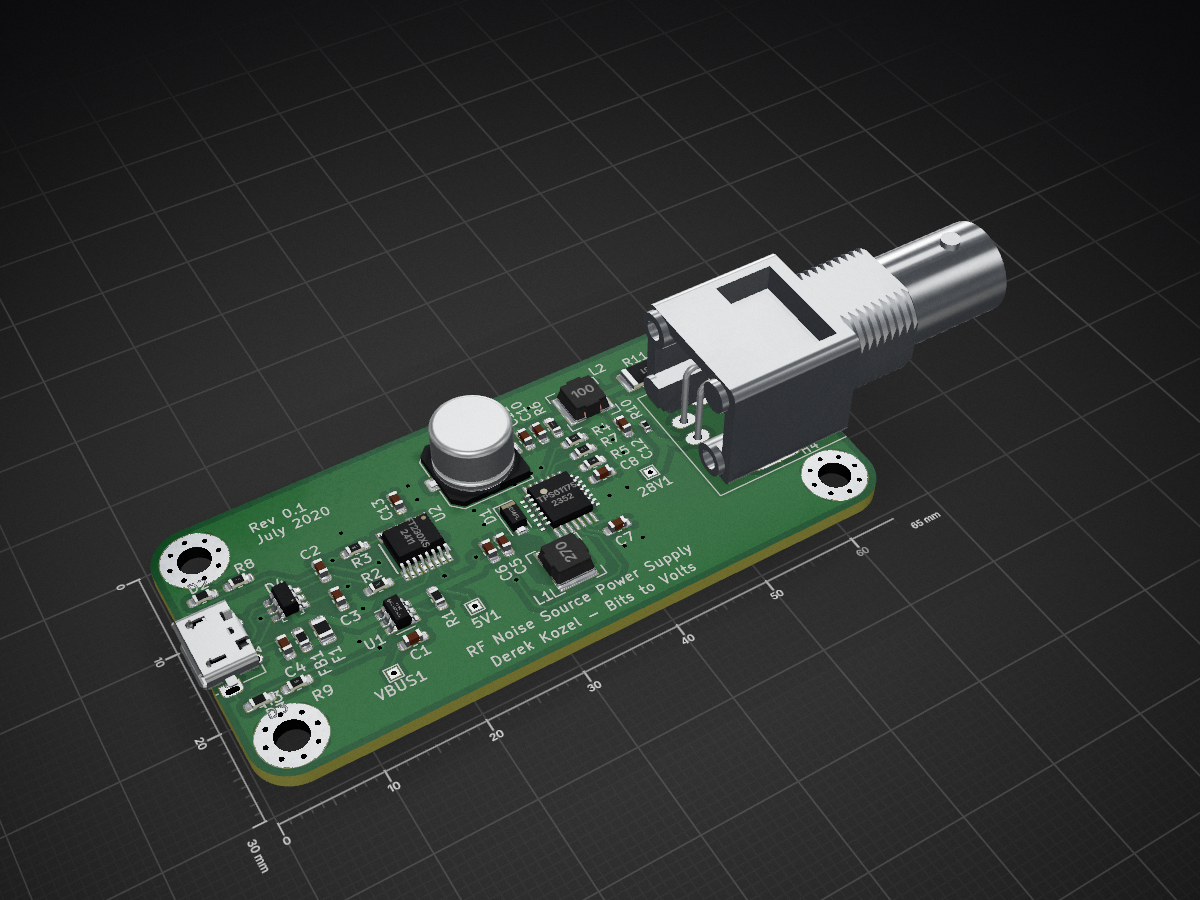
USB powered and controlled supply for RF Noise Sources
Noisesource psu is an open-source printed circuit board by dkozel, from the dkozel/noisesource-psu repository on GitHub. It is a 2-layer board of 65 × 30 mm with 45 parts on 35 nets, routed with 208 tracks and 41 vias.
It is built around the FT230XS-R, TPS61175PWP and TPS22917DBV, with the SS14FL and USBLC6-2SC6 among its other parts. Its parts include 13 capacitors, 11 resistors, 4 diodes, 3 ICs and 2 connectors. It belongs with the power and radio and wireless boards of this library.


This is a computer controlled, portable power supply for RF Noise Sources such as the Keysight or Noisecom 346 series devices. It is powered by USB 2.0 and controlled without installing drivers from Linux, Windows, and OSX.
Output:
Input:
Features:
The pyFTDI Python library allows the GPIO lines of an FT230X to be controlled from Linux, macOS, and Windows without the user installing any driver.
| Qty | Value | Footprint | References |
|---|---|---|---|
| 4 | 10uF | Capacitor_SMD:C_0603_1608Metric_Pad1.05x0.95mm_HandSolder | C5, C6, C11, C12 |
| 4 | MountingHole | MountingHole:MountingHole_3.2mm_M3_Pad_Via | H1, H2, H3, H4 |
| 3 | TestPoint | TestPoint:TestPoint_THTPad_1.0x1.0mm_Drill0.5mm | 5V1, 28V1, VBUS1 |
| 2 | 10nF | Capacitor_SMD:C_0603_1608Metric_Pad1.05x0.95mm_HandSolder | C4, C13 |
| 2 | 27 | Resistor_SMD:R_0603_1608Metric_Pad1.05x0.95mm_HandSolder | R2, R3 |
| 2 | 330 | Resistor_SMD:R_0603_1608Metric_Pad1.05x0.95mm_HandSolder | R8, R9 |
| 2 | 47pF | Capacitor_SMD:C_0603_1608Metric_Pad1.05x0.95mm_HandSolder | C2, C3 |
| 2 | LED | Resistor_SMD:R_0603_1608Metric_Pad1.05x0.95mm_HandSolder | D2, D3 |
| 1 | 10 | Resistor_SMD:R_0402_1005Metric | R10 |
| 1 | 100nF | Capacitor_SMD:C_0603_1608Metric_Pad1.05x0.95mm_HandSolder | C7 |
| 1 | 100pF | Capacitor_SMD:C_0603_1608Metric_Pad1.05x0.95mm_HandSolder | C1 |
| 1 | 10uH | l_bourns-SRN5040:L_Bourns-SRN5040 | L2 |
| 1 | 16.2k | Resistor_SMD:R_0603_1608Metric_Pad1.05x0.95mm_HandSolder | R7 |
| 1 | 1uF | Capacitor_SMD:C_0603_1608Metric_Pad1.05x0.95mm_HandSolder | C10 |
| 1 | 27uH | l_bourns-SRN5040:L_Bourns-SRN5040 | L1 |
| 1 | 28.7k | Resistor_SMD:R_0603_1608Metric_Pad1.05x0.95mm_HandSolder | R5 |
| 1 | 357k | Resistor_SMD:R_0603_1608Metric_Pad1.05x0.95mm_HandSolder | R6 |
| 1 | 460 | Resistor_SMD:R_2010_5025Metric_Pad1.52x2.65mm_HandSolder | R11 |
| 1 | 47uF | Capacitor_SMD:C_Elec_8x6.2 | C9 |
| 1 | 680pF | Capacitor_SMD:C_0603_1608Metric_Pad1.05x0.95mm_HandSolder | C8 |
| 1 | 86.6k | Resistor_SMD:R_0603_1608Metric_Pad1.05x0.95mm_HandSolder | R4 |
| 1 | Conn_Coaxial | Connector_Coaxial:BNC_Amphenol_B6252HB-NPP3G-50_Horizontal | J2 |
| 1 | DNP | Resistor_SMD:R_0603_1608Metric_Pad1.05x0.95mm_HandSolder | R1 |
| 1 | FT230XS | Package_SO:SSOP-16_3.9x4.9mm_P0.635mm | U2 |
| 1 | Ferrite_Bead | Resistor_SMD:R_0603_1608Metric_Pad1.05x0.95mm_HandSolder | FB1 |
| 1 | Polyfuse | Fuse:Fuse_0805_2012Metric_Pad1.15x1.40mm_HandSolder | F1 |
| 1 | SS14FL | Diode_SMD:D_SOD-123F | D1 |
| 1 | SolderJumper_3_Bridged12 | Jumper:SolderJumper-3_P1.3mm_Bridged12_RoundedPad1.0x1.5mm | JP1 |
| 1 | TPS22917DBV | Package_TO_SOT_SMD:SOT-23-6 | U1 |
| 1 | TPS61175 | tssop14:TSSOP14 | U3 |
| 1 | USBLC6-2SC6 | digikey-footprints:SOT23-6L | D4 |
| 1 | USB_B_Micro | Connector_USB:USB_Micro-AB_Molex_47590-0001 | J1 |
It measures 65 × 30 mm and has 2 copper layers, 1.6 mm thick.
45 parts, built around the FT230XS-R, TPS61175PWP, TPS22917DBV and SS14FL. The full list of its parts is on this page, with links to each part's symbol and footprint where PCBKit's library has them.
From the dkozel/noisesource-psu repository on GitHub, at the commit this page was made from: the board is pcb/noisesource-psu.kicad_pcb. PCBKit opens the board in the browser, with nothing to install.
Its repository states no licence, so its author keeps all rights: ask dkozel before reusing the design.

bluesatunsw/owr
This repo includes all software necessary to operate the Test Rover Platform that is being designed and developed in the 502 project.

Luos-io/luos_engine
Open-source and real-time orchestrator for cyber-physical-systems, to easily design, test and deploy embedded applications and digital twins.


VarunAPatil/MedSafe
The goal: a compact, wrist-worn device that simultaneously tracks heart rate & SpO₂, motion & orientation, altitude & atmospheric pressure, and GNSS location — all in one tightly integrated system.


TalismanDesign/PocketMage_PDA
An E-Ink PDA device using the ESP32 S3.