2 layers90 × 110 mm
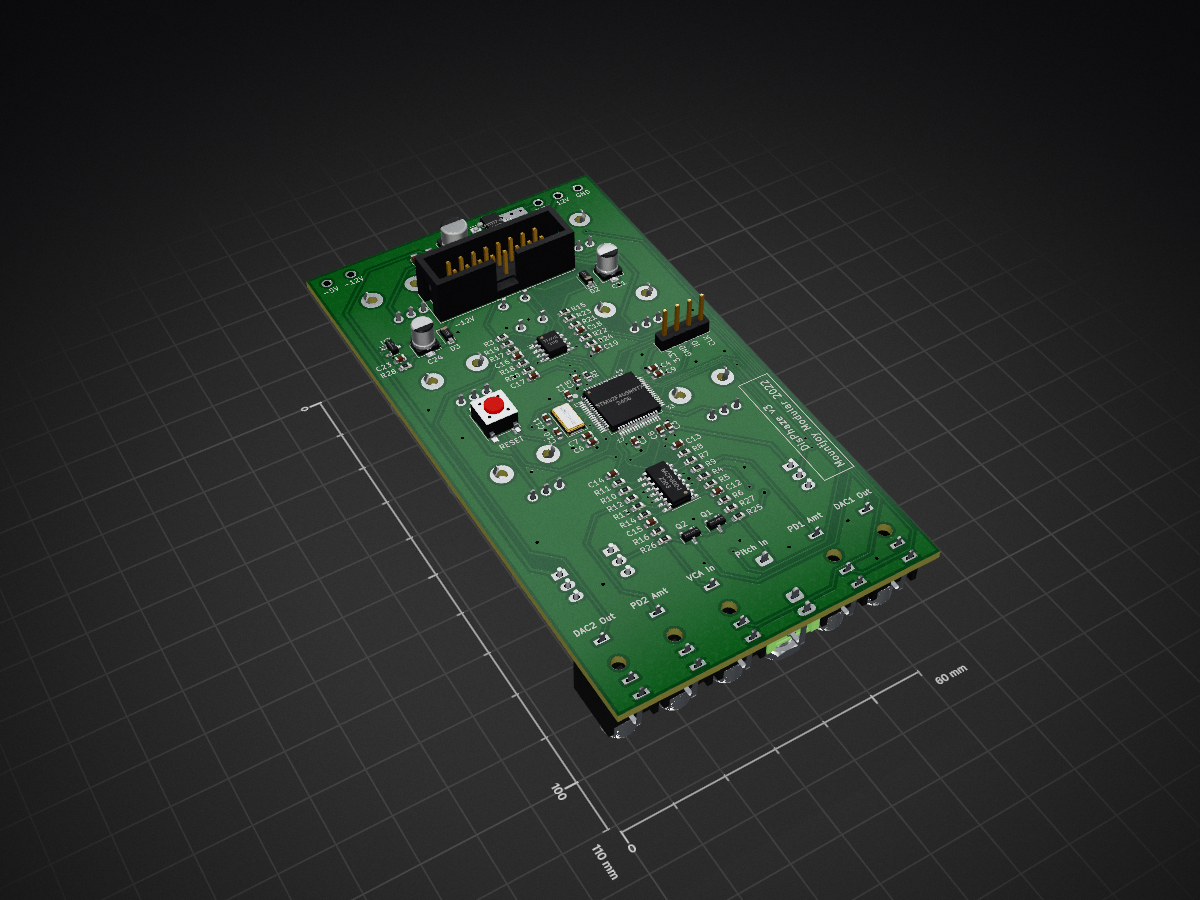
 dchwebb/DisPhaze21
Eurorack Phase Distortion Oscillator module
DisPhaze Components is an open-source printed circuit board by dchwebb, from the dchwebb/DisPhaze repository on GitHub, published under the Apache-2.0 licence. It is a 2-layer board of 60 × 110 mm with 89 parts on 94 nets, routed with 560 tracks and 93 vias.
It is built around the MCP6004-E/P, TL072 and LM1117-3.3, with the B10K and MMBT3904 among its other parts. Its parts include 28 resistors, 24 capacitors, 9 connectors, 5 ICs and 4 switches. It belongs with the audio and music boards and the STM32 boards of this library.


Eurorack module providing two Phase Distortion oscillators based on Casio's CZ synthesizors.
Phase distortion involves warping a sine wave using a second phase distortion signal. The phase distortion tables in this module were loosely based on waveforms sampled from a Casio CZ-1000. Both oscillators allow the sine wave to be warped by a greater amount than on the original and in the case of oscillator 1 the phase distortion tables can be continuously varied.
Disphaze is a two channel design where each channel controls 5 phase distortion waves. These are used to change the playback rate of the audio wave which is always a sine wave. All of the PD waves are based on the CZ but some are generated mathematically, some literally sampled and converted from an original CZ-1000.
The module is duophonic – channel one has a bit more range and so can go more extreme than the CZ. Channel one allows the PD waves morph from one to the next. The second channel does not morph and has a more limited range so it is a bit more 'authentic'. Channel two can also be offset by an octave from channel one which is particularly useful for ring modulation. The module works well in stereo with the two channels split left and right.
Channel one has a Ring Mod switch which digitally multiplies both channel ouputs. Channel two has a mix switch which adds both channel outputs.
The amount of phase distortion applied can be controlled with a knob and/or CV input. Pitch is applied with a 1V/Octave input which is also normalled to the Doepfer standard 16 pin Eurorack connector. The module is also supplied with a VCA input - this allows the use of an envelope generator (or other CV source) to control volume without the need for an external VCA.
The heart of the module is the STM32F405 microcontroller running at 168MHz. Timing is generated with an external 8MHz crystal oscillator. CV inputs are conditioned with an MCP6004 OpAmp. The outputs are derived from the Microcontroller's 12 bit DACs amplified via a TL072 OpAmp. The microcontroller is programmed from a 4 pin SWD header.
The module uses a two PCB sandwich construction with vertical potentiometers and jack sockets connecting the two PCBs and providing structural rigidity.

| Qty | Value | Footprint | References |
|---|---|---|---|
| 6 | 100nF | Capacitor_SMD:C_0603_1608Metric | C2, C3, C4, C5, C7, C23 |
| 6 | 47k | Resistor_SMD:R_0603_1608Metric | R8, R11, R14, R15, R20, R24 |
| 6 | B10k | Custom_Footprints:Alpha_9mm_Potentiometer_Aligned | CTune1, FTune1, PD1Amt1, PD1Type1, PD2Amt1, PD2Type1 |
| 5 | 100k | Resistor_SMD:R_0603_1608Metric | R1, R6, R9, R12, R16 |
| 5 | TestPoint | Custom_Footprints:1.3mm_Test_Point | TP1, TP2, TP3, TP4, TP5 |
| 4 | 1k | Resistor_SMD:R_0603_1608Metric | R2, R3, R19, R23 |
| 4 | 68k | Resistor_SMD:R_0603_1608Metric | R10, R13, R17, R21 |
| 3 | 4k7 | Resistor_SMD:R_0603_1608Metric | R25, R26, R27 |
| 2 | 1.5nF | Capacitor_SMD:C_0603_1608Metric | C13, C15 |
| 2 | 10uF | Capacitor_SMD:C_0603_1608Metric | C17, C19 |
| 2 | 1N5819 | Diode_SMD:D_SOD-123 | D2, D3 |
| 2 | 2.2nF | Capacitor_SMD:C_0603_1608Metric | C12, C14 |
| 2 | 2.2uF | Capacitor_SMD:C_0603_1608Metric | C8, C9 |
| 2 | 22pF | Capacitor_SMD:C_0603_1608Metric | C16, C18 |
| 2 | 22uF | Capacitor_SMD:CP_Elec_4x5.3 | C21, C24 |
| 2 | 30pF | Capacitor_SMD:C_0603_1608Metric | C10, C11 |
| 2 | 6.8k | Resistor_SMD:R_0603_1608Metric | R18, R22 |
| 2 | MMBT3904 | Package_TO_SOT_SMD:SOT-23 | Q1, Q2 |
| 1 | 10uF | Capacitor_SMD:C_0805_2012Metric | C20 |
| 1 | 12MHz_18pF | Crystal:Crystal_SMD_0603-2Pin_6.0x3.5mm | Y1 |
| 1 | 1uF | Capacitor_SMD:C_0603_1608Metric | C6 |
| 1 | 2.2k | Resistor_SMD:R_0603_1608Metric | R28 |
| 1 | 4.7uF | Capacitor_SMD:C_0603_1608Metric | C1 |
| 1 | 47uF | Capacitor_SMD:CP_Elec_5x5.4 | C22 |
| 1 | 56k | Resistor_SMD:R_0603_1608Metric | R5 |
| 1 | 82k | Resistor_SMD:R_0603_1608Metric | R7 |
| 1 | 91k | Resistor_SMD:R_0603_1608Metric | R4 |
| 1 | DAC1_Out | Custom_Footprints:THONKICONN_hole | J7 |
| 1 | DAC1_RingMod_Switch | Custom_Footprints:SPDTSubMiniature | SW2 |
| 1 | DAC2_Mix_Switch | Custom_Footprints:SPDTSubMiniature | SW3 |
| 1 | DAC2_Out | Custom_Footprints:THONKICONN_hole | J8 |
| 1 | Eurorack_16_pin_power | Custom_Footprints:Eurorack_16_pin_header | J9 |
| 1 | L | Inductor_SMD:L_0805_2012Metric | L1 |
| 1 | LED_Dual_AKA | LED_THT:LED_D3.0mm-3 | D1 |
| 1 | LM1117-3.3 | Package_TO_SOT_SMD:SOT-223-3_TabPin2 | U4 |
| 1 | LM4040DBZ-5 | Package_TO_SOT_SMD:SOT-23 | U7 |
| 1 | MCP6004 | Package_SO:SOIC-14_3.9x8.7mm_P1.27mm | U3 |
| 1 | Octave_Switch | Custom_Footprints:SPDTSubMiniature | SW1 |
| 1 | PD1_Amt_In | Custom_Footprints:THONKICONN_hole | J4 |
| 1 | PD2_Amt_In | Custom_Footprints:THONKICONN_hole | J5 |
| 1 | PItch_In | Custom_Footprints:Thonkiconn_Stereo-PJ366ST | J3 |
| 1 | STM32F405RGTx | Package_QFP:LQFP-64_10x10mm_P0.5mm | U1 |
| 1 | SWD_Header | Custom_Footprints:SWD_header | J1 |
| 1 | SW_Push | Custom_Footprints:SW_PUSH_6mm_aligned | SW4 |
| 1 | SW_Push | Custom_Footprints:SW_SPST_EVQQ2 | RESET1 |
| 1 | TL072 | Package_SO:SOIC-8_3.9x4.9mm_P1.27mm | U2 |
| 1 | USB_B_Micro | Custom_Footprints:USB_TE_1734517-1 | J2 |
| 1 | VCA_In | Custom_Footprints:THONKICONN_hole | J6 |
It measures 60 × 110 mm and has 2 copper layers, 1.6 mm thick.
89 parts, built around the MCP6004-E/P, TL072, LM1117-3.3 and B10K. The full list of its parts is on this page, with links to each part's symbol and footprint where PCBKit's library has them.
From the dchwebb/DisPhaze repository on GitHub, at the commit this page was made from: the board is Hardware_v3/DisPhaze_Components.kicad_pcb and its schematic Hardware/DisPhaze.kicad_sch. PCBKit opens the board in the browser, with nothing to install.
Its repository publishes it under the Apache-2.0 licence: you may reuse it on that licence's terms (keep the author's notice, and for a copyleft licence share your changes alike).


soggybag/Ugly-Face-3-SMD
A gated, envelope-controlled square-wave synth fuzz for guitar, in a Hammond 1590B. A TL072 preamp (gain 201) gates and bends a TLC555 oscillator, with a MIX control to blend the dry fuzz with the synth tone.

powsplatboom/Synth-DIY
Where I will be collecting documentation for all my synth parts