2 layers49.8 × 61.7 mm
 daredllama/CornerCursor
A trackball mouse with a scroll ring that allows the user to edit CAD while sitting on the corner of their laptop.
CornerCursor is an open-source printed circuit board by daredllama, from the daredllama/CornerCursor repository on GitHub. It is a 2-layer board of 102 × 42 mm with 41 parts on 56 nets, routed with 864 tracks and 69 vias.
It is built around the RP2040, PMW3360DM-T2QU and W25Q128JVSIQ, with the TLV73333PDBVR-HXY and ABM8-272-T3 among its other parts. Its parts include 20 capacitors, 7 resistors, 5 ICs, 4 switches and 2 connectors. It belongs with the keyboards and input and computers and single-board computers boards and the RP2040 boards of this library.


A trackball mouse with 2 configurable buttons and a scroll ring. Made to be positioned on the corner of a laptop so that CADding is easier in any location.
Hardware created through Onshape. PCB made through KiCad. Firmware developed through VSCode.
Currently unfinished. CAD, KiCAD, and Firmware are complete, but no actual model has been built. Debugging afterwards would also be expected.
This is the overall build for the CornerCursor, which includes the case and the trackball. Made using Onshape
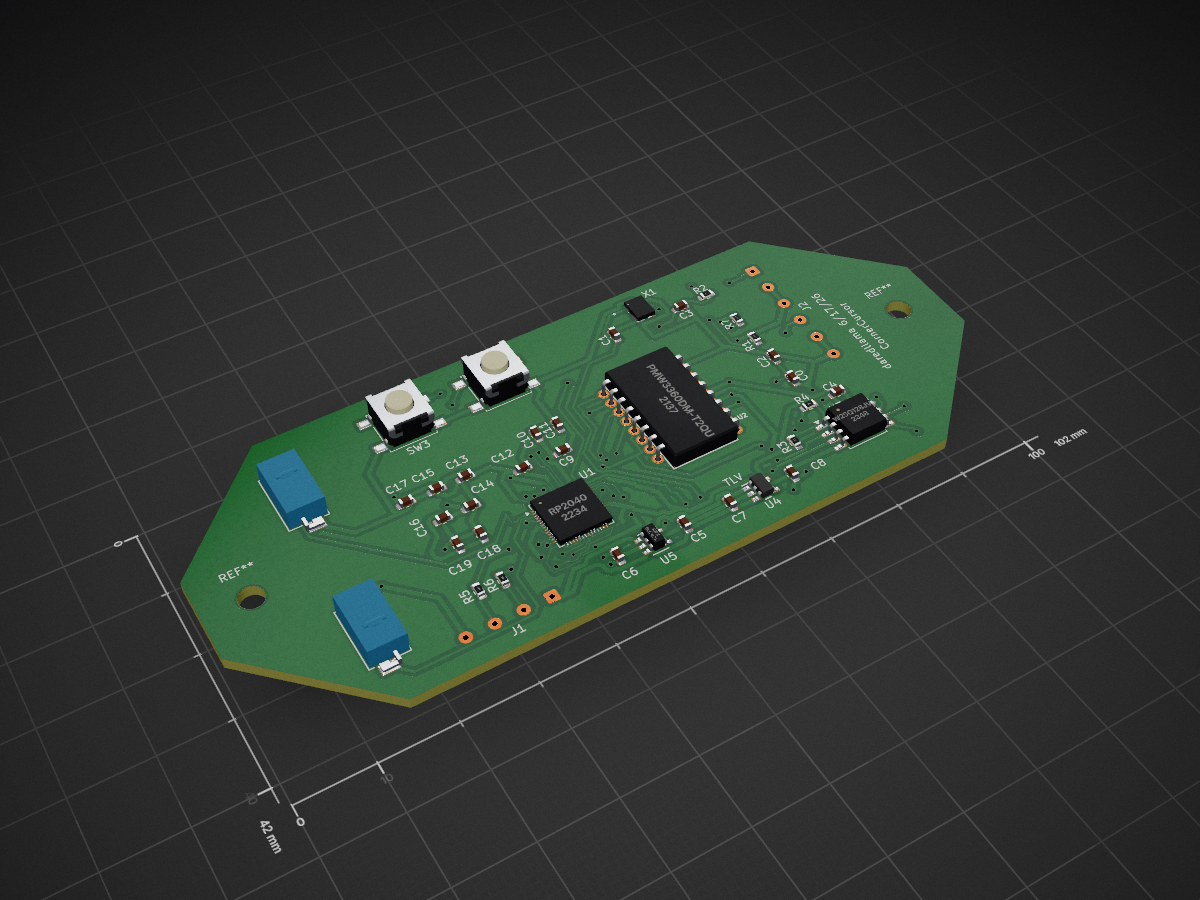
This is the schematic, PCB, and a render of the board. Note that the off-board component, such as the Hall effect sensor and USB-C connector, is not shown on the PCB>
Schematic
PCB
Render
Firmware sets up a 2-button trackball mouse that uses a PMW3360 sensor and a scroll ring.
To flash the software onto the board, connect your device to the mouse. A RPI-RP2 drive should show up, at which point you can drag the given UF2 file. To flash it again, hold the BOOT button and press the RESET button on the board.
Full Bill of Materials located in the BOM file.
AI Usage in this project was used for research, such as tutorials and datasheets; none of the code or CAD is AI-generated
| Qty | Value | Footprint | References |
|---|---|---|---|
| 10 | 100n | Capacitor_SMD:C_0603_1608Metric | C4, C10, C11, C13, C14, C15, C16, C17, C18, C19 |
| 5 | 1u | Capacitor_SMD:C_0603_1608Metric | C5, C6, C8, C9, C12 |
| 2 | 10k | Resistor_SMD:R_0603_1608Metric | R1, R3 |
| 2 | 15p | Capacitor_SMD:C_0603_1608Metric | C1, C3 |
| 2 | 1k | Resistor_SMD:R_0603_1608Metric | R2, R4 |
| 2 | 27.4 | Resistor_SMD:R_0603_1608Metric | R5, R6 |
| 2 | D2LS-2110M | D2LS-21:SW_D2LS-11_2_OMR | SW1, SW2 |
| 1 | 0.1u | Capacitor_SMD:C_0603_1608Metric | C7 |
| 1 | 100nF | Capacitor_SMD:C_0603_1608Metric | C2 |
| 1 | 39R | Resistor_SMD:R_0603_1608Metric | R7 |
| 1 | 4.7u | Capacitor_SMD:C_0603_1608Metric | C0 |
| 1 | ABM8-272-T3 | ABM8-272-T3:ABM8-272-T3_ABR | X1 |
| 1 | BOOT | Button_Switch_SMD:SW_SPST_B3S-1000 | SW3 |
| 1 | Header | Connector_Wire:SolderWire-0.1sqmm_1x06_P3.6mm_D0.4mm_OD1mm | J2 |
| 1 | PMW3360DM-T2QU | PMW3360DM-T2QU:PMW3360 | U2 |
| 1 | RP2040 | Package_DFN_QFN:QFN-56-1EP_7x7mm_P0.4mm_EP3.2x3.2mm | U1 |
| 1 | SW_Push | Button_Switch_SMD:SW_SPST_B3S-1000 | SW4 |
| 1 | TCR2F19 | TCR2EF19:SOT-25_SMV_TOS | U5 |
| 1 | TLV73333PDBVR | TLV73333:DBV0005A_N | U4 |
| 1 | USB | Connector_Wire:SolderWire-0.1sqmm_1x04_P3.6mm_D0.4mm_OD1mm | J1 |
| 1 | W25Q128JVS | Package_SO:SOIC-8_5.3x5.3mm_P1.27mm | U3 |
The 39 most common of 41 parts.
It measures 102 × 42 mm and has 2 copper layers, 1.6 mm thick.
41 parts, built around the RP2040, PMW3360DM-T2QU, W25Q128JVSIQ and TLV73333PDBVR-HXY. The full list of its parts is on this page, with links to each part's symbol and footprint where PCBKit's library has them.
From the daredllama/CornerCursor repository on GitHub, at the commit this page was made from: the board is PCB/CornerCursor.kicad_pcb and its schematic PCB/CornerCursor.kicad_sch. PCBKit opens the board in the browser, with nothing to install.
Its repository states no licence, so its author keeps all rights: ask daredllama before reusing the design.

ikajdan/katia
A split keyboard with 6 by 3 column staggered keys and 3 thumb keys, based on the Crkbrd design

alvarop/swd2usbc
Have you ever wanted to debug your device over USB-C? Sometimes there's not enough room for a JTAG/SWD connector, or even Tag-Connect pads!


pedalboard/pedalboard-hw
pedalboard audio midi processor open hardware

