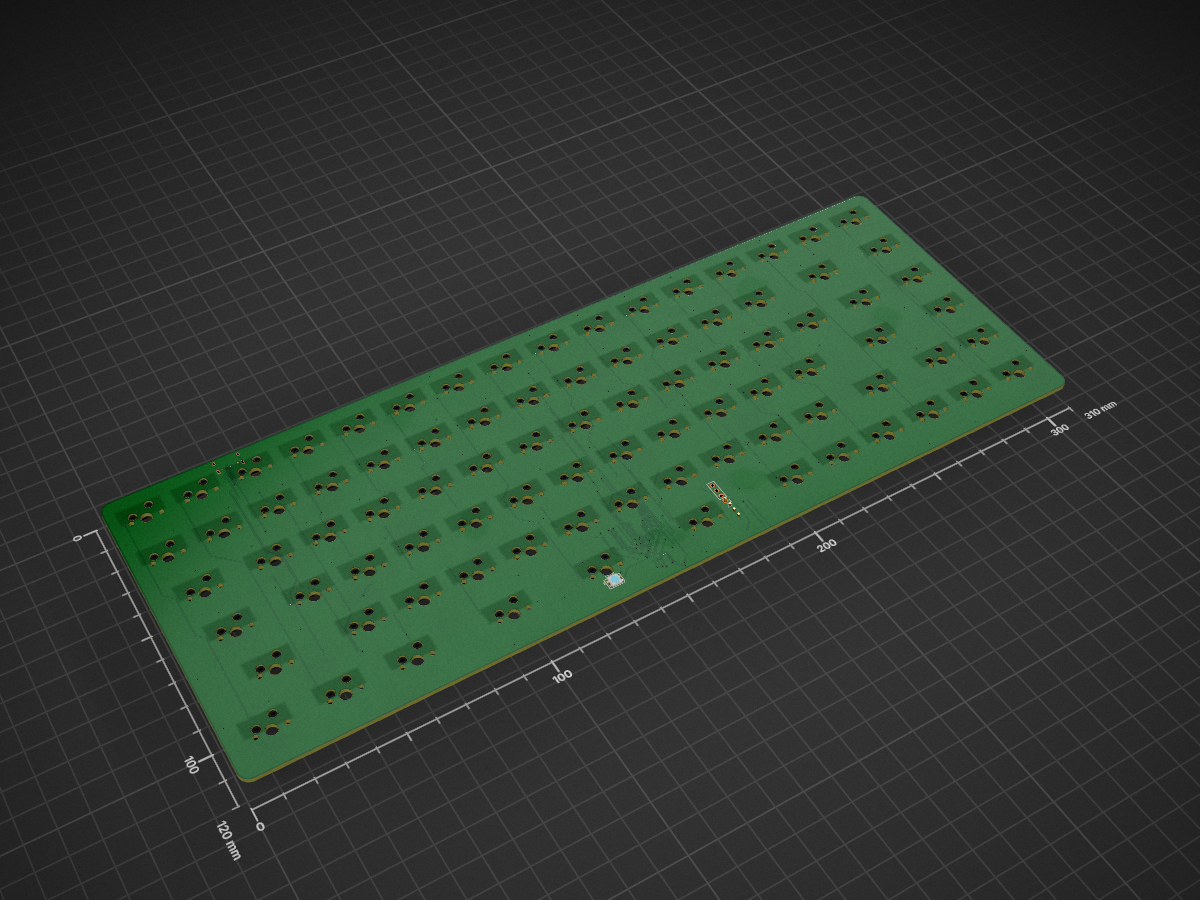
2 layers308.8 × 99.3 mm
 danigit/flow_751
A premium, programmer-focused 75% mechanical keyboard designed for maximum cognitive flow and zero hand displacement.
Flow 75 is an open-source printed circuit board by danigit, from the danigit/flow_75 repository on GitHub. It is a 2-layer board of 310 × 120 mm with 214 parts on 151 nets, routed with 1,587 tracks and 312 vias.
It is built around the RP2040, AP2112K-3.3 and 1N4148W, with the SK6812MINI-E among its other parts. Its parts include 87 diodes, 59 switches, 19 capacitors, 11 resistors and 2 ICs. It belongs with the keyboards and input boards and the RP2040 boards of this library.





A premium, programmer-focused 75% mechanical keyboard designed for maximum cognitive flow and zero hand displacement.
Traditional keyboards force software developers to constantly lift and stretch their hands to reach symbols, arrows, navigation keys, and mouse controls. Flow 75 brings full ergonomic layer power into a standard 75% unibody form factor using a 3-way split spacebar and an intuitive Left-Column Modifier Cascade.
graph TD
    %% Styling
    classDef spacebar fill:#2d3748,stroke:#4a5568,stroke-width:2px,color:#fff,font-weight:bold;
    classDef layer fill:#3182ce,stroke:#2b6cb0,stroke-width:2px,color:#fff;
    classDef standard fill:#4a5568,stroke:#2d3748,stroke-width:2px,color:#fff;

    subgraph The 3-Way Split Spacebar
        direction LR
        LS[Left Space<br>2.25u]:::spacebar
        C[Center Key<br>1.25u]:::spacebar
        RS[Right Space<br>2.75u]:::spacebar

        LS -->|Hold| IL((INPUT LAYER<br>Symbols & Operators)):::layer
        C -->|Tap| ENT((Fast ENTER)):::standard
        RS -->|Hold| AL((ACTION LAYER<br>Vim, Mods, Nav)):::layer
    end

    subgraph Left-Column Modifier Cascade
        direction LR
        P1[Physical Caps Lock]:::standard -->|Maps to| M1(SHIFT<br>Zero-stretch):::layer
        P2[Physical L-Shift]:::standard -->|Maps to| M2(CTRL<br>Comfort reach):::layer
        P3[Physical L-Ctrl]:::standard -->|Maps to| M3(CAPS LOCK<br>Cornered):::layer
endINPUT): Tap for space, hold for programming symbols ({, }, [, ], (, ), =, etc.) mapped directly on the home row.ACTION): Tap for space, hold for VIM navigation (I/J/K/L), word jumps, text edits (delete word, copy/paste, undo), and mouse emulation.ENTER): Fast thumb Enter without moving the right pinky off the home row.Shift, Left Shift becomes Control, Left Ctrl becomes Caps Lock.flow_75/
├── .gemini/ # Workspace rules, guidelines, and context
├── docs/ # Architectural guides, firmware instructions, and history
│ ├── 01_system_architecture.md # Concept, hardware specs, and layers mental model
│ ├── 02_keymap_and_layers.md # Exact keymap matrix, Input & Action logic
│ ├── 03_firmware_and_compilation.md # QMK environment setup and flashing instructions
│ └── CHANGELOG.md # Iteration history and bug fixes
├── firmware/
│ └── qmk/ # QMK firmware source, rules, config, and keymaps
├── hardware/ # Hardware design assets (KiCad schematics, CAD case models)
│ ├── pcb/
│ ├── cad/
│ └── keycaps/
├── tools/
│ └── simulator/ # Reserved for future browser keymap simulator
├── brainstorming/ # Initial ideation records and Six Hats debates
│ ├── ideation_memory_input.md
│ ├── ideation_memory_action.md
│ ├── six_hats_debate_input.md
│ ├── six_hats_debate_action.md
│ └── roadmap.md
└── README.mdINPUT Layer Definition (Symbols & Operators mapping)ACTION Layer Definition (Vim nav, text mutations, mouse emulation)flow_75 projectINPUT & ACTION Layers logicTAPPING_TERM, PERMISSIVE_HOLD)Flow 75 is an open-source project and we welcome contributions from the community! Whether you want to optimize the QMK firmware, tweak the layer maps, or contribute to the PCB design, please check out our Contributing Guidelines first.
Please note that this project is released with a Code of Conduct. By participating in this project you agree to abide by its terms.
Flow 75 uses a dual-licensing model:
See the LICENSE file for full details.
| Qty | Value | Footprint | References |
|---|---|---|---|
| 86 | 1N4148W | Diode_SMD:D_SOD-123 | D1, D2, D10, D11, D12, D13, D14, D15, D16, D17, D18, D19, D20, D21, D22, D23 +70 |
| 12 | 100nF | Capacitor_SMD:C_0805_2012Metric | C2, C3, C4, C5, C6, C7, C8, C9, C11, C13, C14, C16 |
| 3 | 1uF | Capacitor_SMD:C_0805_2012Metric | C1, C10, C12 |
| 2 | 10k | Resistor_SMD:R_0805_2012Metric | R5, R8 |
| 2 | 15pF | Capacitor_SMD:C_0805_2012Metric | C17, C18 |
| 2 | 27 | Resistor_SMD:R_0805_2012Metric | R3, R4 |
| 2 | 27R | Resistor_SMD:R_0805_2012Metric | R6, R7 |
| 2 | 5.1k | Resistor_SMD:R_0805_2012Metric | R1, R2 |
| 2 | SW_Push | SW_SPST_B3U-1000P | SW_BOOT, SW_RESET |
| 1 | 100MHz | Resistor_SMD:R_0805_2012Metric | FB1 |
| 1 | 100nF | C_0805_2012Metric | C19 |
| 1 | 10uF | Capacitor_SMD:C_0805_2012Metric | C15 |
| 1 | 12MHz | Crystal:Crystal_SMD_3225-4Pin_3.2x2.5mm | Y1 |
| 1 | 1M | Resistor_SMD:R_0805_2012Metric | R9 |
| 1 | 1k | R_0805_2012Metric | R11 |
| 1 | 1k | Resistor_SMD:R_0805_2012Metric | R10 |
| 1 | 500mA | Fuse:Fuse_1206_3216Metric | F1 |
| 1 | AP2112K-3.3 | Package_TO_SOT_SMD:SOT-23-5 | U1 |
| 1 | Conn_01x04 | Connector_PinHeader_2.54mm:PinHeader_1x04_P2.54mm_Vertical | J2 |
| 1 | RP2040 | Package_DFN_QFN:QFN-56-1EP_7x7mm_P0.4mm_EP3.2x3.2mm | U3 |
| 1 | SK6812MINI | LED_SMD:LED_SK6812MINI_PLCC4_3.5x3.5mm_P1.75mm | LED1 |
| 1 | SW_R0C0 | MX_Alps_Hybrid:MXOnly-1U-Hotswap | SW1 |
| 1 | SW_R0C1 | MX_Alps_Hybrid:MXOnly-1U-Hotswap | SW2 |
| 1 | SW_R0C10 | MX_Alps_Hybrid:MXOnly-1U-Hotswap | SW11 |
| 1 | SW_R0C11 | MX_Alps_Hybrid:MXOnly-1U-Hotswap | SW12 |
| 1 | SW_R0C12 | MX_Alps_Hybrid:MXOnly-1U-Hotswap | SW13 |
| 1 | SW_R0C13 | MX_Alps_Hybrid:MXOnly-1U-Hotswap | SW14 |
| 1 | SW_R0C14 | MX_Alps_Hybrid:MXOnly-1U-Hotswap | SW15 |
| 1 | SW_R0C15 | MX_Alps_Hybrid:MXOnly-1U-Hotswap | SW16 |
| 1 | SW_R0C2 | MX_Alps_Hybrid:MXOnly-1U-Hotswap | SW3 |
| 1 | SW_R0C3 | MX_Alps_Hybrid:MXOnly-1U-Hotswap | SW4 |
| 1 | SW_R0C4 | MX_Alps_Hybrid:MXOnly-1U-Hotswap | SW5 |
| 1 | SW_R0C5 | MX_Alps_Hybrid:MXOnly-1U-Hotswap | SW6 |
| 1 | SW_R0C6 | MX_Alps_Hybrid:MXOnly-1U-Hotswap | SW7 |
| 1 | SW_R0C7 | MX_Alps_Hybrid:MXOnly-1U-Hotswap | SW8 |
| 1 | SW_R0C8 | MX_Alps_Hybrid:MXOnly-1U-Hotswap | SW9 |
| 1 | SW_R0C9 | MX_Alps_Hybrid:MXOnly-1U-Hotswap | SW10 |
| 1 | SW_R1C0 | MX_Alps_Hybrid:MXOnly-1U-Hotswap | SW17 |
| 1 | SW_R1C1 | MX_Alps_Hybrid:MXOnly-1U-Hotswap | SW18 |
| 1 | SW_R1C10 | MX_Alps_Hybrid:MXOnly-1U-Hotswap | SW27 |
| 1 | SW_R1C11 | MX_Alps_Hybrid:MXOnly-1U-Hotswap | SW28 |
| 1 | SW_R1C12 | MX_Alps_Hybrid:MXOnly-1U-Hotswap | SW29 |
| 1 | SW_R1C13 | MX_Alps_Hybrid:MXOnly-1U-Hotswap | SW30 |
| 1 | SW_R1C14 | MX_Alps_Hybrid:MXOnly-1U-Hotswap | SW31 |
| 1 | SW_R1C15 | MX_Alps_Hybrid:MXOnly-1U-Hotswap | SW32 |
| 1 | SW_R1C2 | MX_Alps_Hybrid:MXOnly-1U-Hotswap | SW19 |
| 1 | SW_R1C3 | MX_Alps_Hybrid:MXOnly-1U-Hotswap | SW20 |
| 1 | SW_R1C4 | MX_Alps_Hybrid:MXOnly-1U-Hotswap | SW21 |
| 1 | SW_R1C5 | MX_Alps_Hybrid:MXOnly-1U-Hotswap | SW22 |
| 1 | SW_R1C6 | MX_Alps_Hybrid:MXOnly-1U-Hotswap | SW23 |
| 1 | SW_R1C7 | MX_Alps_Hybrid:MXOnly-1U-Hotswap | SW24 |
| 1 | SW_R1C8 | MX_Alps_Hybrid:MXOnly-1U-Hotswap | SW25 |
| 1 | SW_R1C9 | MX_Alps_Hybrid:MXOnly-1U-Hotswap | SW26 |
| 1 | SW_R2C0 | MX_Alps_Hybrid:MXOnly-1U-Hotswap | SW33 |
| 1 | SW_R2C1 | MX_Alps_Hybrid:MXOnly-1U-Hotswap | SW34 |
| 1 | SW_R2C10 | MX_Alps_Hybrid:MXOnly-1U-Hotswap | SW43 |
| 1 | SW_R2C11 | MX_Alps_Hybrid:MXOnly-1U-Hotswap | SW44 |
| 1 | SW_R2C12 | MX_Alps_Hybrid:MXOnly-1U-Hotswap | SW45 |
| 1 | SW_R2C14 | MX_Alps_Hybrid:MXOnly-1U-Hotswap | SW46 |
| 1 | SW_R2C15 | MX_Alps_Hybrid:MXOnly-1U-Hotswap | SW47 |
| 1 | SW_R2C2 | MX_Alps_Hybrid:MXOnly-1U-Hotswap | SW35 |
| 1 | SW_R2C3 | MX_Alps_Hybrid:MXOnly-1U-Hotswap | SW36 |
| 1 | SW_R2C4 | MX_Alps_Hybrid:MXOnly-1U-Hotswap | SW37 |
| 1 | SW_R2C5 | MX_Alps_Hybrid:MXOnly-1U-Hotswap | SW38 |
| 1 | SW_R2C6 | MX_Alps_Hybrid:MXOnly-1U-Hotswap | SW39 |
| 1 | SW_R2C7 | MX_Alps_Hybrid:MXOnly-1U-Hotswap | SW40 |
| 1 | SW_R2C8 | MX_Alps_Hybrid:MXOnly-1U-Hotswap | SW41 |
| 1 | SW_R2C9 | MX_Alps_Hybrid:MXOnly-1U-Hotswap | SW42 |
| 1 | SW_R3C0 | MX_Alps_Hybrid:MXOnly-1U-Hotswap | SW48 |
| 1 | SW_R3C10 | MX_Alps_Hybrid:MXOnly-1U-Hotswap | SW57 |
| 1 | SW_R3C11 | MX_Alps_Hybrid:MXOnly-1U-Hotswap | SW58 |
| 1 | SW_R3C12 | MX_Alps_Hybrid:MXOnly-1U-Hotswap | SW59 |
| 1 | SW_R3C13 | MX_Alps_Hybrid:MXOnly-1U-Hotswap | SW60 |
| 1 | SW_R3C14 | MX_Alps_Hybrid:MXOnly-1U-Hotswap | SW61 |
| 1 | SW_R3C15 | MX_Alps_Hybrid:MXOnly-1U-Hotswap | SW62 |
| 1 | SW_R3C2 | MX_Alps_Hybrid:MXOnly-1U-Hotswap | SW49 |
| 1 | SW_R3C3 | MX_Alps_Hybrid:MXOnly-1U-Hotswap | SW50 |
| 1 | SW_R3C4 | MX_Alps_Hybrid:MXOnly-1U-Hotswap | SW51 |
| 1 | SW_R3C5 | MX_Alps_Hybrid:MXOnly-1U-Hotswap | SW52 |
| 1 | SW_R3C6 | MX_Alps_Hybrid:MXOnly-1U-Hotswap | SW53 |
The 184 most common of 214 parts.
It measures 310 × 120 mm and has 2 copper layers, 1.6 mm thick.
214 parts, built around the RP2040, AP2112K-3.3, 1N4148W and SK6812MINI-E. The full list of its parts is on this page, with links to each part's symbol and footprint where PCBKit's library has them.
From the danigit/flow_75 repository on GitHub, at the commit this page was made from: the board is hardware/pcb/flow_75.kicad_pcb and its schematic hardware/pcb/flow_75.kicad_sch. PCBKit opens the board in the browser, with nothing to install.
Its repository states no licence, so its author keeps all rights: ask danigit before reusing the design.

techy-robot/JoyKey
A small macropad that simultaneously acts as game controller and an entertainment device.

seancaulfield/ISOish87
h87 compatible keyboard PCB for my own preferred layout

seancaulfield/ISOish88e
Evo80 compatible keyboard PCB for my own preferred layout

TheRealBluesun/keeb4x4
4x4 macropad: STM32G431, per-key RGB, ScreenKey display keycaps, encoder. KiCad + Rust/Embassy firmware, USB bootloader, host CLI, printable base.


TweetyDaBird/Fat-Chameleon
A Grid Ortho keyboard for BM40, JJ40/JJ50 cases inspired by Planck and Preonic

slopus/codex-keybored
A 100% vibe-coded hardware build: Fusion 360, six-layer KiCad PCB, STM32 firmware, and live JLC factory handoff.