2 layers308.8 × 99.3 mm

 TheRealBluesun/keeb4x4
4x4 macropad: STM32G431, per-key RGB, ScreenKey display keycaps, encoder. KiCad + Rust/Embassy firmware, USB bootloader, host CLI, printable base.
Keeb4x4 is an open-source printed circuit board by TheRealBluesun, from the TheRealBluesun/keeb4x4 repository on GitHub, published under the CERN-OHL-P-2.0 licence. It is a 4-layer board of 100 × 142.5 mm with 127 parts on 98 nets, routed with 1,797 tracks and 302 vias.
It is built around the STM32G431CBT6, 74AHCT1G125SE and W25Q128JVSIQ, with the 74HC154D, AP2112K-3.3 and USBLC6-2SC6 among its other parts. Its parts include 32 diodes, 29 capacitors, 19 switches, 17 resistors and 15 connectors. It belongs with the keyboards and input and lEDs and displays boards and the STM32 boards of this library.


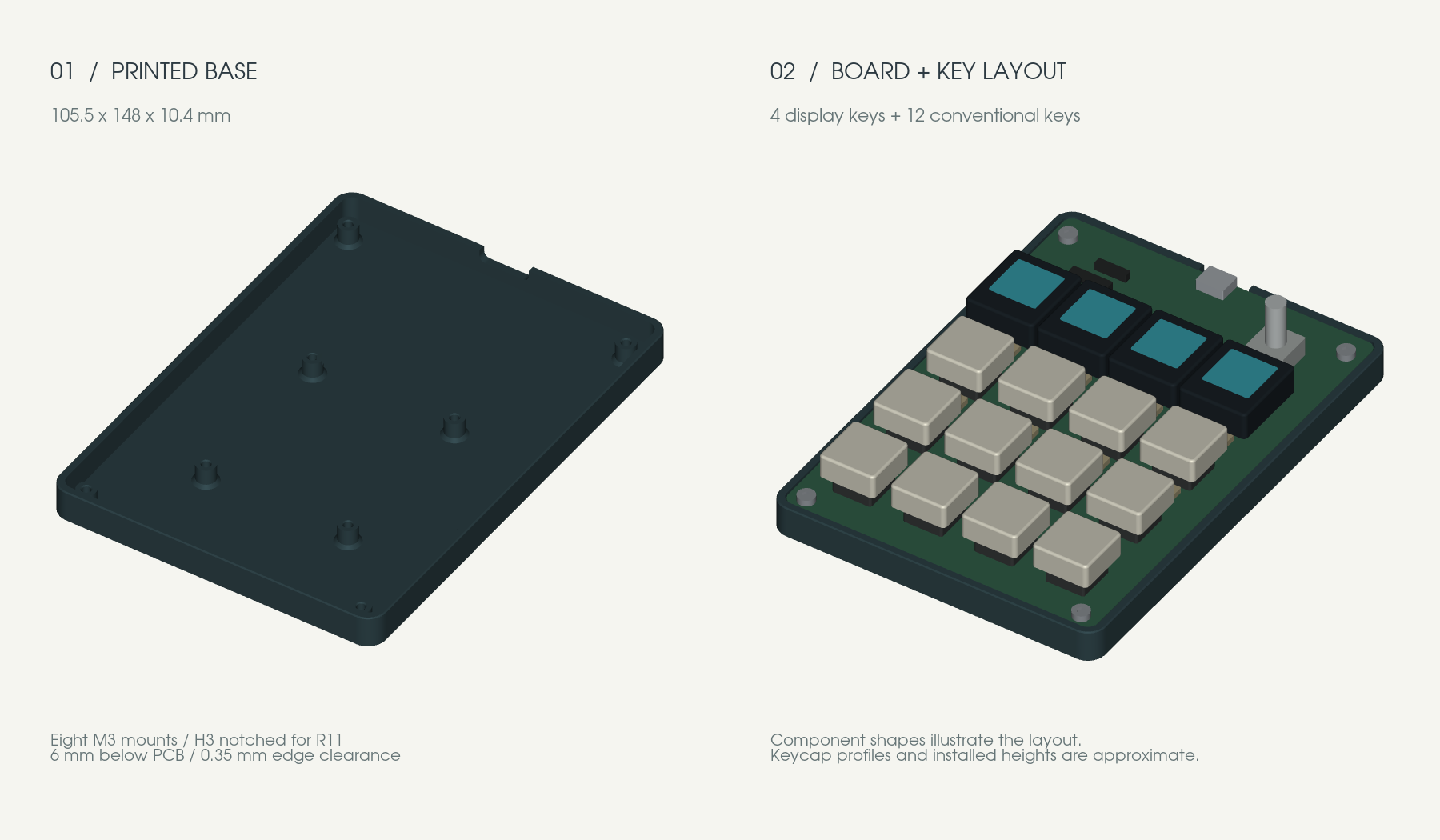
A 4×4 macropad: STM32G431, 16 MX-style keys with per-key SK6812 RGB, up to 12 Waveshare 0.85" ScreenKey display keycaps, an EC11 rotary encoder, and a USB-C connection that streams key/encoder events to the host as JSON. Firmware is Rust/Embassy, with a resident USB bootloader so you never need a debug probe after the first flash.
| Path | Contents |
|---|---|
keeb4x4.kicad_{pro,sch,pcb} | KiCad project: schematic and 4-layer PCB (100 × 142.5 mm) |
fab/ | Gerbers, BOM and CPL for JLCPCB, plus order settings and hand-solder list |
FIRMWARE_NOTES.md | Pin map, matrix polarity, encoder, LED chain — the hardware facts firmware relies on |
firmware/ | Rust/Embassy application firmware |
bootloader/ | USB DFU bootloader, recovery, memory layout |
host/ | keeb CLI: list devices, listen to events, build and flash firmware |
enclosure/ | 3D-printable base (STL/STEP) and its parametric source |
docs/PARTS.md | What to buy beyond the assembled board: ScreenKeys, switches, encoder |
docs/PROGRAMMER.md | One-time bootloader flashing with an ST-Link clone |
tools/pcb/ | KiCad Python scripts used while routing the LED chain and GND stitching |
New board?
- Buy the parts that aren't on the assembled board: docs/PARTS.md (ScreenKeys, switches, encoder, ST-Link…)
- Flash the pre-built firmware once with an ST-Link: docs/PROGRAMMER.md. Image on the releases page.
Requires rustup. Toolchains and targets are pinned per project and install automatically.
cargo build --manifest-path host/Cargo.toml --release --locked
host/target/release/keeb list      # should show the board
host/target/release/keeb listen    # watch key / encoder events
To rebuild and flash firmware over USB:
host/target/release/keeb build
host/target/release/keeb update firmware/artifacts/update/keeb-v2.kbf
On Linux, install the udev rules first (see
bootloader/README.md). If the application
ever stops responding, hold the encoder button while plugging in USB to enter
recovery, then run keeb update --recovery ....
A newly assembled board is blank. It needs a one-time bootloader install
over the SWD header (J3) with a cheap ST-Link V2 clone and probe-rs. Start
with docs/PROGRAMMER.md, which covers what to buy,
wiring and troubleshooting.
JLC assembles the SMT parts on both sides. You hand-solder the 16 switches, the EC11 encoder, and the SWD/OLED headers. Check the part rotations in JLC's preview before you order. See fab/README.md.
The USB VID/PID (c0de:cafe, plus STM32 DFU 0483:df11 in recovery) are
prototype identities, not allocated ones.
fab/, enclosure/): CERN-OHL-P-2.0firmware/, bootloader/, host/, tools/): MITScreenKey init values are adapted from Waveshare's MIT-licensed example; see firmware/THIRD_PARTY.md.
| Qty | Value | Footprint | References |
|---|---|---|---|
| 24 | 100nF | Capacitor_SMD:C_0603_1608Metric | C1, C2, C10, C11, C12, C13, C14, C15, C16, C17, C18, C19, C20, C21, C22, C23 +8 |
| 16 | 1N4148W | Diode_SMD:D_SOD-123 | D1, D2, D3, D4, D5, D6, D7, D8, D9, D10, D11, D12, D13, D14, D15, D16 |
| 16 | SK6812MINI-E | LED_SMD:LED_SK6812MINI-E_3.2x2.8mm_P1.5mm_ReverseMount | LED1, LED2, LED3, LED4, LED5, LED6, LED7, LED8, LED9, LED10, LED11, LED12, LED13, LED14, LED15, LED16 |
| 16 | SW_Push | Button_Switch_Keyboard:SW_Cherry_MX_1.00u_PCB | SW1, SW2, SW3, SW4, SW5, SW6, SW7, SW8, SW9, SW10, SW11, SW12, SW13, SW14, SW15, SW16 |
| 12 | 100 | Resistor_SMD:R_0603_1608Metric | R6, R7, R8, R9, R10, R11, R12, R13, R14, R15, R16, R17 |
| 8 | MountingHole:MountingHole_3.2mm_M3 | H1, H2, H3, H4, H5, H6, H7, H8 | |
| 3 | 1uF | Capacitor_SMD:C_0603_1608Metric | C5, C25, C26 |
| 2 | 4.7k | Resistor_SMD:R_0603_1608Metric | R4, R5 |
| 2 | 5.1k | Resistor_SMD:R_0603_1608Metric | R1, R2 |
| 1 | 10k | Resistor_SMD:R_0603_1608Metric | R3 |
| 1 | 10uF | Capacitor_SMD:C_0805_2012Metric | C27 |
| 1 | 4.7uF | Capacitor_SMD:C_0603_1608Metric | C4 |
| 1 | 74AHCT1G125 | Package_TO_SOT_SMD:SOT-23-5 | U4 |
| 1 | 74HC154 | Package_SO:SOIC-24W_7.5x15.4mm_P1.27mm | U5 |
| 1 | AO3400A | Package_TO_SOT_SMD:SOT-23 | Q1 |
| 1 | AP2112K-3.3 | Package_TO_SOT_SMD:SOT-23-5 | U3 |
| 1 | BOOT | Button_Switch_SMD:SW_SPST_B3U-1000P | SW18 |
| 1 | EC11 | Rotary_Encoder:RotaryEncoder_Alps_EC11E-Switch_Vertical_H20mm | SW17 |
| 1 | OLED_SSD1306 | Connector_PinHeader_2.54mm:PinHeader_1x04_P2.54mm_Vertical | J2 |
| 1 | RESET | Button_Switch_SMD:SW_SPST_B3U-1000P | SW19 |
| 1 | STM32G431CBT6 | Package_QFP:LQFP-48_7x7mm_P0.5mm | U1 |
| 1 | SWD | Connector_PinHeader_2.54mm:PinHeader_1x05_P2.54mm_Vertical | J3 |
| 1 | ScreenKey1 | Connector_FFC-FPC:Hirose_FH12-12S-0.5SH_1x12-1MP_P0.50mm_Horizontal | J4 |
| 1 | ScreenKey10 | Connector_FFC-FPC:Hirose_FH12-12S-0.5SH_1x12-1MP_P0.50mm_Horizontal | J13 |
| 1 | ScreenKey11 | Connector_FFC-FPC:Hirose_FH12-12S-0.5SH_1x12-1MP_P0.50mm_Horizontal | J14 |
| 1 | ScreenKey12 | Connector_FFC-FPC:Hirose_FH12-12S-0.5SH_1x12-1MP_P0.50mm_Horizontal | J15 |
| 1 | ScreenKey2 | Connector_FFC-FPC:Hirose_FH12-12S-0.5SH_1x12-1MP_P0.50mm_Horizontal | J5 |
| 1 | ScreenKey3 | Connector_FFC-FPC:Hirose_FH12-12S-0.5SH_1x12-1MP_P0.50mm_Horizontal | J6 |
| 1 | ScreenKey4 | Connector_FFC-FPC:Hirose_FH12-12S-0.5SH_1x12-1MP_P0.50mm_Horizontal | J7 |
| 1 | ScreenKey5 | Connector_FFC-FPC:Hirose_FH12-12S-0.5SH_1x12-1MP_P0.50mm_Horizontal | J8 |
| 1 | ScreenKey6 | Connector_FFC-FPC:Hirose_FH12-12S-0.5SH_1x12-1MP_P0.50mm_Horizontal | J9 |
| 1 | ScreenKey7 | Connector_FFC-FPC:Hirose_FH12-12S-0.5SH_1x12-1MP_P0.50mm_Horizontal | J10 |
| 1 | ScreenKey8 | Connector_FFC-FPC:Hirose_FH12-12S-0.5SH_1x12-1MP_P0.50mm_Horizontal | J11 |
| 1 | ScreenKey9 | Connector_FFC-FPC:Hirose_FH12-12S-0.5SH_1x12-1MP_P0.50mm_Horizontal | J12 |
| 1 | USBLC6-2SC6 | Package_TO_SOT_SMD:SOT-23-6 | U2 |
| 1 | USB_C_16P | Connector_USB:USB_C_Receptacle_HRO_TYPE-C-31-M-12 | J1 |
| 1 | W25Q128JVSIQ | SOIC-8_5.3x5.3mm_P1.27mm | U6 |


Ethansuttor/drone_PCB
An 80×80 mm STM32F405 flight controller for a 4S freestyle quad, running Betaflight off a custom target I wrote.

jadenrhee/wigglecam-controller
RP2040 co-processor board for a 4-lens wigglegram camera: constant-current flash, controls, battery telemetry, Pi 5 I2C interface. 4-layer, DRC-clean, fab-ready.

h3ll5ur7er/TokenBoard
You wouldn't vibe code a keyboard.. or would you? uses konnect to interact with KiCad and CADence to model the case


Brillar0101/agentdeck
RP2040 macropad for supervising AI coding agents: 13 hot-swap keys with per-key RGB status, encoder, joystick, 4-layer PCB, CircuitPython firmware, printable enclosure

blafr103/pico-numpad
Hand-wired 17-key USB numpad on Pi Pico W. CircuitPython, diode matrix, event-driven scanning.
It measures 100 × 142.5 mm and has 4 copper layers, 1.6 mm thick.
127 parts, built around the STM32G431CBT6, 74AHCT1G125SE, W25Q128JVSIQ and 74HC154D. The full list of its parts is on this page, with links to each part's symbol and footprint where PCBKit's library has them.
From the TheRealBluesun/keeb4x4 repository on GitHub, at the commit this page was made from: the board is keeb4x4.kicad_pcb and its schematic keeb4x4.kicad_sch. PCBKit opens the board in the browser, with nothing to install.
Its repository publishes it under the CERN-OHL-P-2.0 licence: you may reuse it on that licence's terms (keep the author's notice, and for a copyleft licence share your changes alike).