
4 layers100 × 142.5 mm
Keeb4x4
TheRealBluesun/keeb4x4
4x4 macropad: STM32G431, per-key RGB, ScreenKey display keycaps, encoder. KiCad + Rust/Embassy firmware, USB bootloader, host CLI, printable base.
127 partsCERN-OHL-P-2.0

A 65% ANSI keyboard PCB with an RP2040 on the board
Hem is an open-source printed circuit board by marcocampione, from the marcocampione/Hem-keyboard repository on GitHub, published under the MIT licence. It is a 2-layer board of 308.8 × 99.3 mm with 302 parts on 177 nets, routed with 3,410 tracks and 258 vias.
It is built around the RP2040, 74AHCT1G125SE and W25Q128JVSIQ, with the AP2112K-3.3, 1N4148W and SK6812MINI-E among its other parts. Its parts include 86 capacitors, 67 diodes, 62 switches, 6 resistors and 4 ICs. It belongs with the keyboards and input boards and the RP2040 boards of this library.


A 65% ANSI keyboard PCB with an RP2040 on the board, per-key RGB and a small OLED. The back of the PCB is a street map of central Stockholm, with a pin at home ("hem" in Swedish), 59°20'34"N 18°02'58"E. It is meant to be seen through a clear acrylic bottom. The case files will follow.
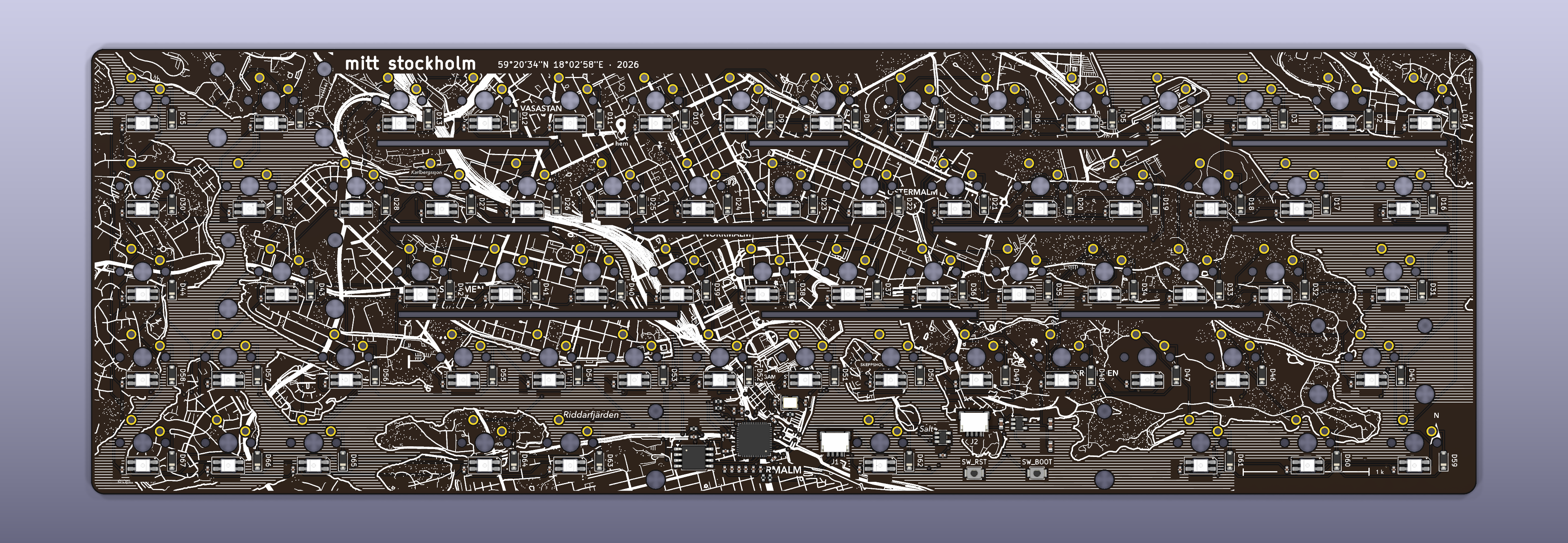
| Folder | Contents |
|---|---|
pcb/ | hem_gerbers.zip (Gerbers + drills), hem_bom.csv and hem_cpl.csv (assembly), hem_layers.pdf (every layer at 1:1, for checking) |
pcb/kicad/ | The KiCad 10 board (hem.kicad_pcb), with its project and design rules |
firmware/hem/ | QMK keyboard definition and default keymap |
images/ | Renders |
Upload pcb/hem_gerbers.zip to PCBWay or JLCPCB:
2 layers, FR-4 1.6 mm, black solder mask, white silkscreen, ENIG, 1 oz copper,
min track/space 0.15 mm (6 mil), min hole 0.3 mm, internal cut-outs (LED holes and slots).
For assembly, add hem_bom.csv and hem_cpl.csv.
There are 235 SMD parts on both sides: 18 on the top and 217 on the bottom.
Mark the SK6812MINI-E as reverse-mount.
You solder the switches yourself.
cp -r firmware/hem <qmk_firmware>/keyboards/hem
qmk compile -kb hem -km default
To flash: hold BOOT, plug in USB (or press RESET while holding BOOT), and copy the .uf2 file to the RPI-RP2 drive.
Measure 5 V, 3.3 V and GND for shorts with a multimeter.
MIT, see LICENSE.
The map on the back of the PCB is made from OpenStreetMap data: © OpenStreetMap contributors, available under the
Open Database License (ODbL), https://www.openstreetmap.org/copyright
| Qty | Value | Footprint | References |
|---|---|---|---|
| 79 | 100nF | C_0402_1005Metric | C1, C2, C3, C4, C5, C6, C7, C8, C9, C10, C15, C30, CL1, CL10, CL11, CL12 +63 |
| 67 | 1N4148W | D_SOD-123 | D1, D2, D10, D11, D12, D13, D14, D15, D16, D17, D18, D19, D20, D21, D22, D23 +51 |
| 67 | SK6812MINI-E | LED_SK6812MINI-E_3.2x2.8mm_P1.5mm_ReverseMount | RGB1, RGB2, RGB10, RGB11, RGB12, RGB13, RGB14, RGB15, RGB16, RGB17, RGB18, RGB19, RGB20, RGB21, RGB22, RGB23 +51 |
| 2 | 10uF | C_0603_1608Metric | C20, C21 |
| 2 | 15pF | C_0402_1005Metric | C13, C14 |
| 2 | 1k | R_0402_1005Metric | R3, R4 |
| 2 | 1uF | C_0402_1005Metric | C11, C12 |
| 2 | 27 | R_0402_1005Metric | R5, R6 |
| 2 | 4.7k | R_0402_1005Metric | R9, R10 |
| 1 | ' | SW_Cherry_MX_1.00u_PCB | SW42 |
| 1 | , | SW_Cherry_MX_1.00u_PCB | SW53 |
| 1 | - | SW_Cherry_MX_1.00u_PCB | SW12 |
| 1 | . | SW_Cherry_MX_1.00u_PCB | SW54 |
| 1 | / | SW_Cherry_MX_1.00u_PCB | SW55 |
| 1 | 0 | SW_Cherry_MX_1.00u_PCB | SW11 |
| 1 | 1 | SW_Cherry_MX_1.00u_PCB | SW2 |
| 1 | 12MHz | Crystal_SMD_3225-4Pin_3.2x2.5mm | Y1 |
| 1 | 2 | SW_Cherry_MX_1.00u_PCB | SW3 |
| 1 | 22uF | C_0603_1608Metric | C31 |
| 1 | 3 | SW_Cherry_MX_1.00u_PCB | SW4 |
| 1 | 4 | SW_Cherry_MX_1.00u_PCB | SW5 |
| 1 | 5 | SW_Cherry_MX_1.00u_PCB | SW6 |
| 1 | 6 | SW_Cherry_MX_1.00u_PCB | SW7 |
| 1 | 7 | SW_Cherry_MX_1.00u_PCB | SW8 |
| 1 | 74AHCT1G125 | SOT-23-5 | U4 |
| 1 | 8 | SW_Cherry_MX_1.00u_PCB | SW9 |
| 1 | 9 | SW_Cherry_MX_1.00u_PCB | SW10 |
| 1 | ; | SW_Cherry_MX_1.00u_PCB | SW41 |
| 1 | = | SW_Cherry_MX_1.00u_PCB | SW13 |
| 1 | A | SW_Cherry_MX_1.00u_PCB | SW32 |
| 1 | AP2112K-3.3 | SOT-23-5 | U2 |
| 1 | B | SW_Cherry_MX_1.00u_PCB | SW50 |
| 1 | BOOTSEL | SW_SPST_B3U-1000P | SW_BOOT |
| 1 | BSPC | SW_Cherry_MX_2.00u_PCB | SW14 |
| 1 | C | SW_Cherry_MX_1.00u_PCB | SW48 |
| 1 | CAPS | SW_Cherry_MX_1.75u_PCB | SW31 |
| 1 | D | SW_Cherry_MX_1.00u_PCB | SW34 |
| 1 | DEL | SW_Cherry_MX_1.00u_PCB | SW15 |
| 1 | DOWN | SW_Cherry_MX_1.00u_PCB | SW66 |
| 1 | E | SW_Cherry_MX_1.00u_PCB | SW19 |
| 1 | END | SW_Cherry_MX_1.00u_PCB | SW58 |
| 1 | ENT | SW_Cherry_MX_2.25u_PCB | SW43 |
| 1 | F | SW_Cherry_MX_1.00u_PCB | SW35 |
| 1 | FN | SW_Cherry_MX_1.00u_PCB | SW64 |
| 1 | G | SW_Cherry_MX_1.00u_PCB | SW36 |
| 1 | H | SW_Cherry_MX_1.00u_PCB | SW37 |
| 1 | I | SW_Cherry_MX_1.00u_PCB | SW24 |
| 1 | J | SW_Cherry_MX_1.00u_PCB | SW38 |
| 1 | K | SW_Cherry_MX_1.00u_PCB | SW39 |
| 1 | L | SW_Cherry_MX_1.00u_PCB | SW40 |
| 1 | LALT | SW_Cherry_MX_1.25u_PCB | SW61 |
| 1 | LCTL | SW_Cherry_MX_1.25u_PCB | SW59 |
| 1 | LEFT | SW_Cherry_MX_1.00u_PCB | SW65 |
| 1 | LGUI | SW_Cherry_MX_1.25u_PCB | SW60 |
| 1 | LSFT | SW_Cherry_MX_2.25u_PCB | SW45 |
| 1 | M | SW_Cherry_MX_1.00u_PCB | SW52 |
| 1 | N | SW_Cherry_MX_1.00u_PCB | SW51 |
| 1 | O | SW_Cherry_MX_1.00u_PCB | SW25 |
| 1 | OLED I2C | JST_SH_SM04B-SRSS-TB_1x04-1MP_P1.00mm_Horizontal | J2 |
| 1 | P | SW_Cherry_MX_1.00u_PCB | SW26 |
| 1 | PGDN | SW_Cherry_MX_1.00u_PCB | SW44 |
| 1 | PGUP | SW_Cherry_MX_1.00u_PCB | SW30 |
| 1 | Q | SW_Cherry_MX_1.00u_PCB | SW17 |
| 1 | R | SW_Cherry_MX_1.00u_PCB | SW20 |
| 1 | RALT | SW_Cherry_MX_1.00u_PCB | SW63 |
| 1 | RESET | SW_SPST_B3U-1000P | SW_RST |
| 1 | RGHT | SW_Cherry_MX_1.00u_PCB | SW67 |
| 1 | RP2040 | QFN-56-1EP_7x7mm_P0.4mm_EP3.2x3.2mm | U1 |
| 1 | RSFT | SW_Cherry_MX_1.75u_PCB | SW56 |
| 1 | S | SW_Cherry_MX_1.00u_PCB | SW33 |
| 1 | SPC | SW_Cherry_MX_6.25u_PCB | SW62 |
| 1 | T | SW_Cherry_MX_1.00u_PCB | SW21 |
| 1 | TAB | SW_Cherry_MX_1.50u_PCB | SW16 |
| 1 | U | SW_Cherry_MX_1.00u_PCB | SW23 |
| 1 | UP | SW_Cherry_MX_1.00u_PCB | SW57 |
| 1 | V | SW_Cherry_MX_1.00u_PCB | SW49 |
| 1 | W | SW_Cherry_MX_1.00u_PCB | SW18 |
| 1 | W25Q128JVS | SOIC-8_5.3x5.3mm_P1.27mm | U3 |
| 1 | X | SW_Cherry_MX_1.00u_PCB | SW47 |
| 1 | Y | SW_Cherry_MX_1.00u_PCB | SW22 |
The 296 most common of 302 parts.
TheRealBluesun/keeb4x4
4x4 macropad: STM32G431, per-key RGB, ScreenKey display keycaps, encoder. KiCad + Rust/Embassy firmware, USB bootloader, host CLI, printable base.


LucasLHenry/spelltwister
This is the third version of the code for the Spelltwister module with CCTV. This version uses the Arduino platform and the RP2040, a chip developed by Raspberry Pi for their RPi Pico board.

wwintjong/macropad
My take on a macropad that I think will suit me. The layout is a 5x4 keys with hot-swappable switch and LED. Current iteration has no knobs or display implemented, but that is an idea for future versions.

It measures 308.8 × 99.3 mm and has 2 copper layers, 1.6 mm thick.
302 parts, built around the RP2040, 74AHCT1G125SE, W25Q128JVSIQ and AP2112K-3.3. The full list of its parts is on this page, with links to each part's symbol and footprint where PCBKit's library has them.
From the marcocampione/Hem-keyboard repository on GitHub, at the commit this page was made from: the board is pcb/kicad/hem.kicad_pcb. PCBKit opens the board in the browser, with nothing to install.
Its repository publishes it under the MIT licence: you may reuse it on that licence's terms (keep the author's notice, and for a copyleft licence share your changes alike).