2 layers112 × 104 mm

 crides/fusion84
A folded minimally spaced choc mini (PG1232) keyboard for traveling
Fusion is an open-source printed circuit board by crides, from the crides/fusion repository on GitHub. It is a 2-layer board of 271.5 × 91.8 mm with 126 parts on 113 nets, routed with 941 tracks and 92 vias.
It is built around the MS88SF3-NRF52840, LN4913NR-G and MCP23S08-E/P, with the SRV05-4, XC6220B331MR and AO3400A among its other parts. Its parts include 39 switches, 23 resistors, 8 capacitors, 8 ICs and 6 connectors. It belongs with the keyboards and input boards and the nRF52 and nRF5x boards of this library.


My travel board. Uses minimum spacing with choc mini (PG1232) and Cirque touchpad. It's meant to be folded for easy packing for traveling/going to classes. It's called fusion because the halves are now "fused" together (all my previous boards have been split).
The following picture shows how it's originally assembled:
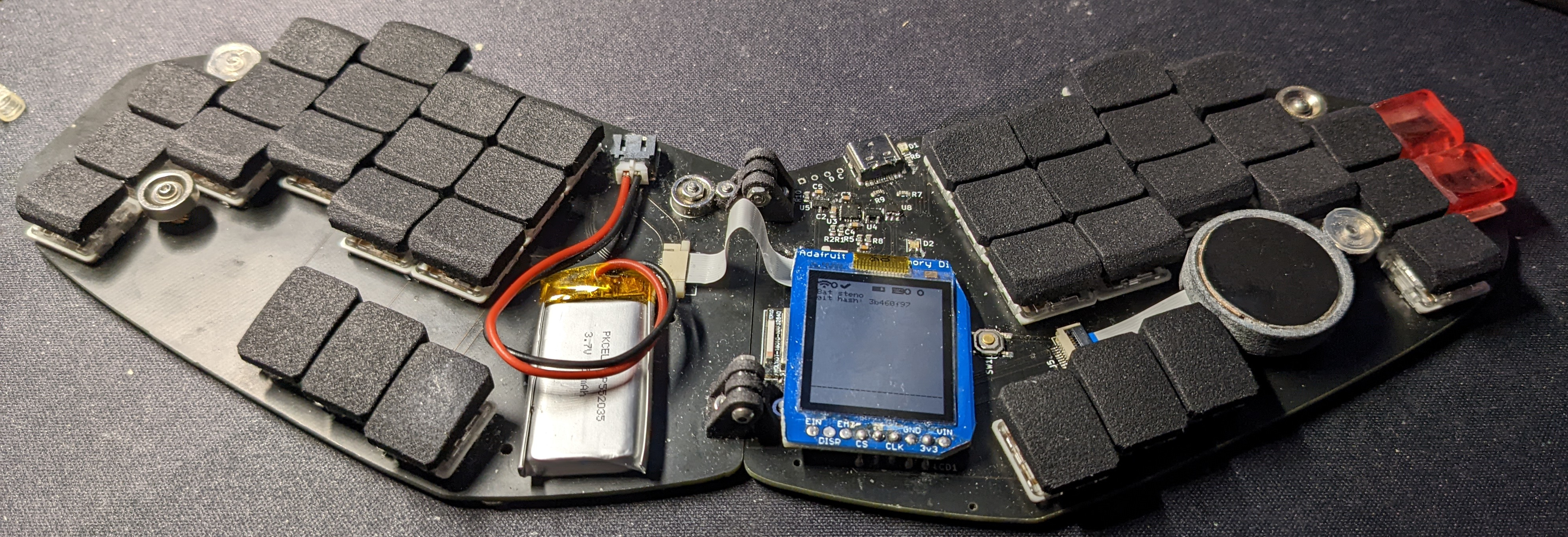
You can find the caps here. They are printed with the MJF Nylon process at JLCPCB.
The 2 extra pinky keys on the right side are different because I forgot about them when designing and printing the keycaps. Those keys are for steno, and like the fissure this includes embedded stenograpy.
The keymap is basically the same as on the fissure with a little difference in how the gaming and alternative layout layers are toggled.
One extra small feature it has is a PWM controlled RGB LED, which I use to display LED widgets on.
You can find a recent-ish configuration for this board here.
With the 350mAh battery on the board, this lasted me ~5 months of usage (it could've been even longer, the battery started out not on full charge (~3.8V)).
The board measures 148 x 79.5 x 21mm when it's folded (23mm thick if you include the bumpons, and 133mm long if the last 2 keys are cut off, like in the current state (see the bottom of this page)), which fits into a small bag. I carry this with my Pixel 5a in my big sweatpants pocket for quite a while. I would just go to places, take out the keeb and my phone, unfold it and work with Termux.
All parts are generated from Python, some using solidff, some using CadQuery, depending on when the part was designed. The only parts actually used are hinge1, hinge2 and touchpad-holder.
Includes JLCPCB BOM (bom.csv) and POS (pos.csv) files for PCBA.
Here's the board after almost 11 months of usage (right before 2023):
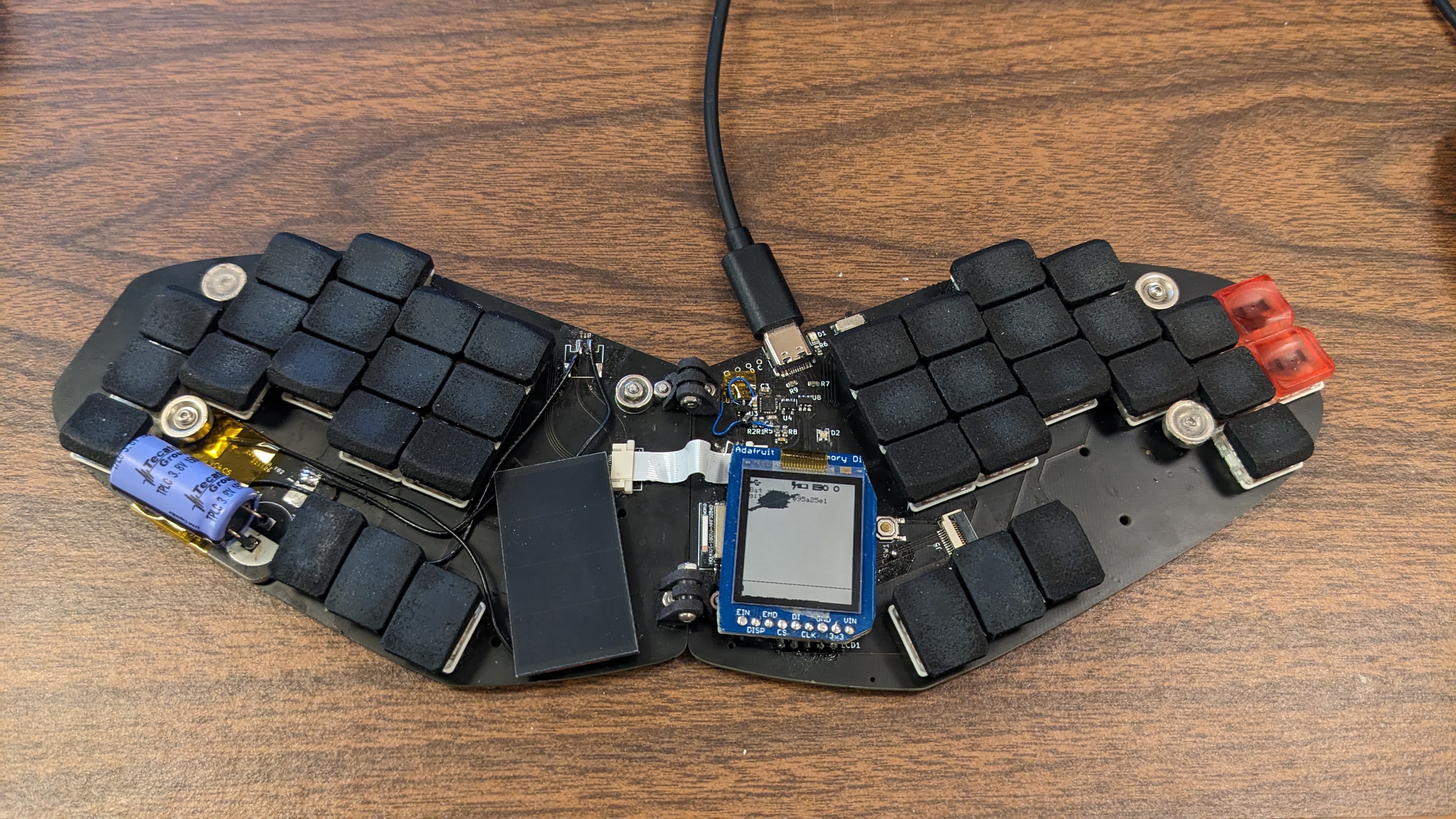
Main differences:
Here it is after 1 year:
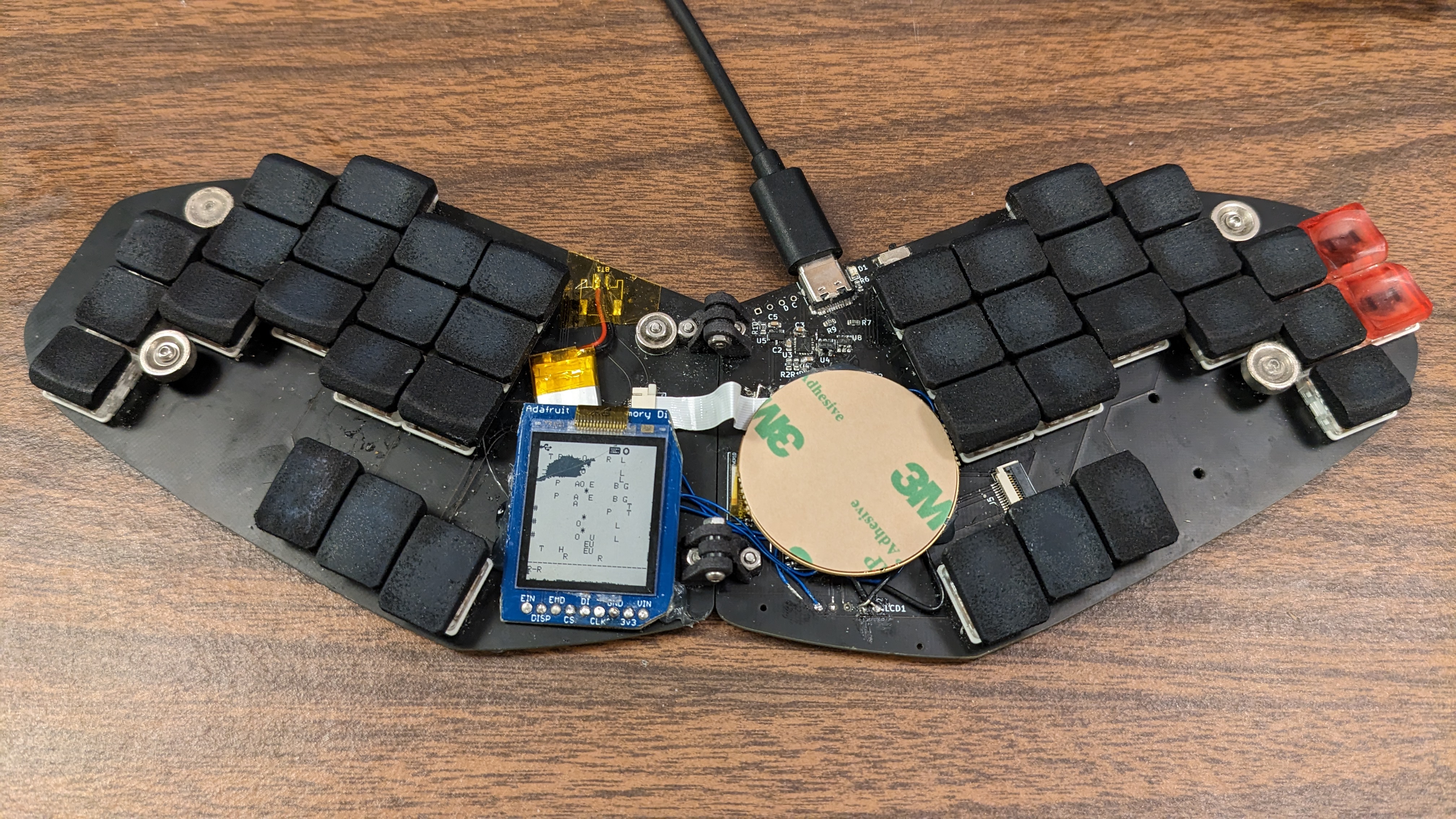
Somehow the supercap doesn't seem to do well with the cold, so I swapped to the old small battery. Tried out a larger Cirque touchpad, by basically shifting the screen to the left side though a bunch of wires.
Here's what it looks like after 16 months:
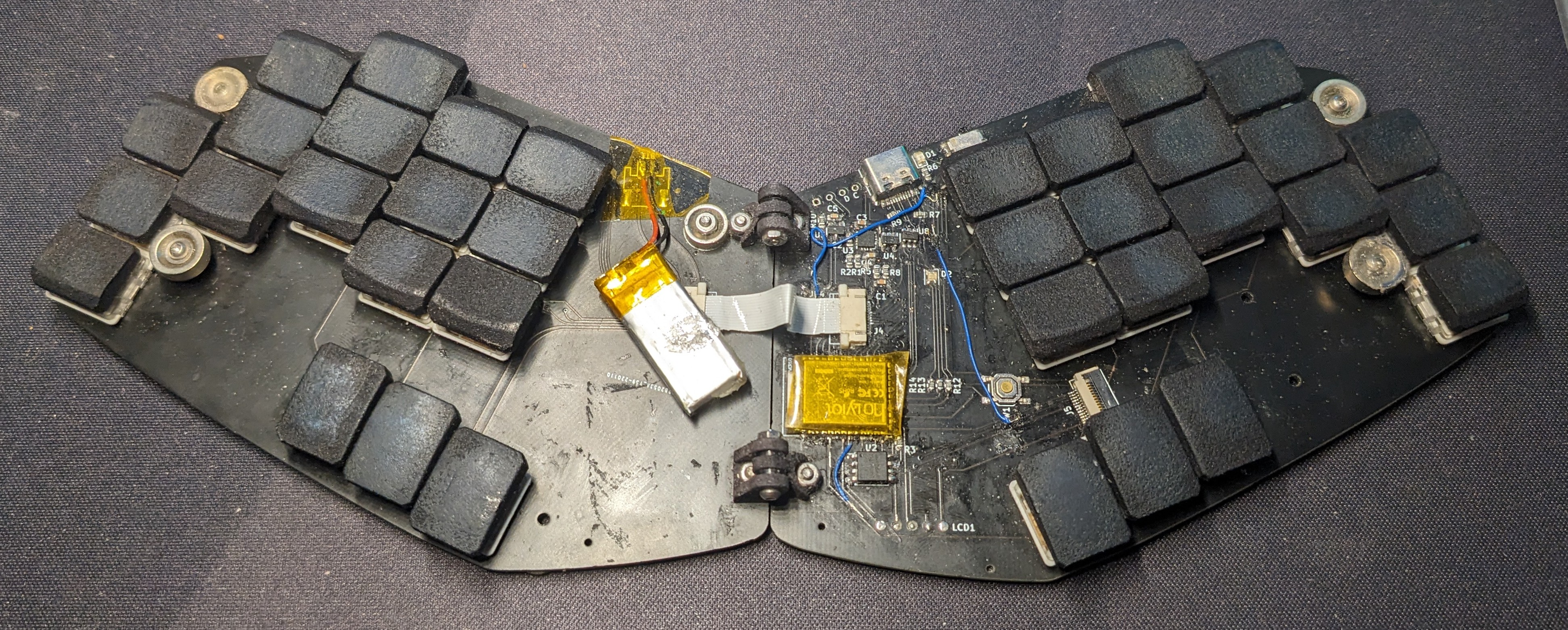
The screen's completely broken, with the ribbon cable half "cut" (no idea how that happened). The trackpad location is better, but still pretty useless for my use cases (I use it 95% on top of my laptop keyboard most of the time, and the touchpad is right there, with more ready-to-be-used gestures. So touchpads and solar panels are gone. Nothing interesting to see here...
| Qty | Value | Footprint | References |
|---|---|---|---|
| 12 | diode-choc | pg1232:pg1232-DC | K3, K8, K13, K16, K17, K18, K21, K26, K31, K36, K37, K38 |
| 12 | diode-choc | pg1232:pg1232-DCN | K1, K5, K6, K10, K11, K15, K19, K23, K24, K28, K29, K33 |
| 6 | 5.1M | Resistor_SMD:R_0603_1608Metric | R6, R11, R12, R13, R15, R16 |
| 6 | diode-choc | pg1232:pg1232-DCR | K2, K7, K12, K22, K27, K32 |
| 6 | diode-choc | pg1232:pg1232-DCL | K4, K9, K14, K20, K25, K30 |
| 4 | mount-magnet | misc:m2-heat-insert-pad | H3, H4, H7, H8 |
| 4 | mouse-bite | Keebio-Parts:breakaway-mousebites | H9, H10, H11, H12 |
| 2 | 0.1uF | Capacitor_SMD:C_0603_1608Metric | C1, C6 |
| 2 | 10M | Resistor_SMD:R_0603_1608Metric | R2, R23 |
| 2 | 10nF | Capacitor_SMD:C_0603_1608Metric | C4, C5 |
| 2 | 1M | Resistor_SMD:R_0603_1608Metric | R9, R17 |
| 2 | 1k | Resistor_SMD:R_0603_1608Metric | R14, R22 |
| 2 | 22 | Resistor_SMD:R_0603_1608Metric | R3, R5 |
| 2 | 4.12M | Resistor_SMD:R_0603_1608Metric | R1, R18 |
| 2 | 4.7uF | Capacitor_SMD:C_0603_1608Metric | C3, C8 |
| 2 | 5.1k | Resistor_SMD:R_0603_1608Metric | R7, R8 |
| 2 | Conn_01x12_MountingPin | Connector_FFC-FPC:Hirose_FH12-12S-0.5SH_1x12-1MP_P0.50mm_Horizontal | J3, J4 |
| 2 | hinge-big | fusion:hinge2 | H2, H5 |
| 2 | hinge-small | fusion:hinge1 | H1, H6 |
| 1 | 1.2k | Resistor_SMD:R_0603_1608Metric | R20 |
| 1 | 1.5k | Resistor_SMD:R_0603_1608Metric | R21 |
| 1 | 100k | Resistor_SMD:R_0603_1608Metric | R10 |
| 1 | 10uH | Inductor_SMD:L_0603_1608Metric | L2 |
| 1 | 22uH | Inductor_SMD:L_Wuerth_WE-TPC-3816 | L1 |
| 1 | 3V3 | TestPoint:TestPoint_THTPad_D1.0mm_Drill0.5mm | TP1 |
| 1 | 4.87M | Resistor_SMD:R_0603_1608Metric | R19 |
| 1 | 47uF | Capacitor_SMD:C_0805_2012Metric | C7 |
| 1 | 5.9M | Resistor_SMD:R_0603_1608Metric | R4 |
| 1 | AO3400A | Package_TO_SOT_SMD:SOT-23 | Q2 |
| 1 | AO3401A | Package_TO_SOT_SMD:SOT-23 | Q1 |
| 1 | All or none | Jumper:SolderJumper-3_P1.3mm_Open_RoundedPad1.0x1.5mm | JP5 |
| 1 | CS | TestPoint:TestPoint_THTPad_D1.0mm_Drill0.5mm | TP5 |
| 1 | Conn_01x03_Female | Connector_PinSocket_2.54mm:PinSocket_1x03_P2.54mm_Vertical | J5 |
| 1 | D | Diode_SMD:D_SOD-123 | D1 |
| 1 | DR | TestPoint:TestPoint_THTPad_D1.0mm_Drill0.5mm | TP4 |
| 1 | D_Small | Diode_SMD:D_SOD-123 | D2 |
| 1 | GND | TestPoint:TestPoint_THTPad_D1.0mm_Drill0.5mm | TP2 |
| 1 | LED | Connector_PinSocket_2.54mm:PinSocket_1x02_P2.54mm_Vertical | D4 |
| 1 | LED_RABG | LED_SMD:LED_ASMB-KTF0-0A306 | D3 |
| 1 | LN4913 | Package_TO_SOT_SMD:SOT-23 | U4 |
| 1 | Li Cap | Capacitor_THT:CP_Radial_D13.0mm_P5.00mm | C2 |
| 1 | MCP23S08 | Package_SO:SOIC-18W_7.5x11.6mm_P1.27mm | U7 |
| 1 | MISO | TestPoint:TestPoint_THTPad_D1.0mm_Drill0.5mm | TP6 |
| 1 | MOSI | TestPoint:TestPoint_THTPad_D1.0mm_Drill0.5mm | TP3 |
| 1 | MT25QL128ABA1ESE | Package_SO:SOIC-8_5.23x5.23mm_P1.27mm | U8 |
| 1 | SCLK | TestPoint:TestPoint_THTPad_D1.0mm_Drill0.5mm | TP7 |
| 1 | SRV05-4 | Package_TO_SOT_SMD:SOT-23-6 | U5 |
| 1 | SW_Push | Button_Switch_SMD:SW_SPST_TL3342 | SW2 |
| 1 | SW_Push | Button_Switch_SMD:SW_SPST_B3U-1000P | SW3 |
| 1 | SW_SPDT | Button_Switch_SMD:SW_SPDT_PCM12 | SW1 |
| 1 | Solar_Cell | misc:KXOB25-05X3F | SC1 |
| 1 | SolderJumper_2_Open | Jumper:SolderJumper-2_P1.3mm_Open_RoundedPad1.0x1.5mm | JP2 |
| 1 | SolderJumper_3_Open | Jumper:SolderJumper-3_P1.3mm_Open_RoundedPad1.0x1.5mm | JP3 |
| 1 | TLV70237_SOT23-5 | Package_TO_SOT_SMD:SOT-23-5 | U3 |
| 1 | USB_C_Receptacle_USB2.0 | Connector_USB:USB_C_Receptacle_HRO_TYPE-C-31-M-12 | J2 |
| 1 | XC6220B331MR | Package_TO_SOT_SMD:SOT-23-5 | U2 |
| 1 | adafruit-sharp-memory-display-no-useless | display:adafruit-sharp-memory-display-1.3in-no-mounting-no-useless | LCD1 |
| 1 | debug-port | misc:debug-port-single-side | J1 |
| 1 | ms88sf3-nrf52840 | mcu:ms88sf3 | U1 |
| 1 | touchpad-holder | fusion:touchpad-holder | P1 |
| 1 | ~ | Jumper:SolderJumper-2_P1.3mm_Open_RoundedPad1.0x1.5mm | JP1 |
| 1 | ~ | Package_DFN_QFN:QFN-16-1EP_3x3mm_P0.5mm_EP1.7x1.7mm | U6 |
The 117 most common of 126 parts.
It measures 271.5 × 91.8 mm and has 2 copper layers, 1.6 mm thick.
126 parts, built around the MS88SF3-NRF52840, LN4913NR-G, MCP23S08-E/P and SRV05-4. The full list of its parts is on this page, with links to each part's symbol and footprint where PCBKit's library has them.
From the crides/fusion repository on GitHub, at the commit this page was made from: the board is fusion.kicad_pcb and its schematic fusion.kicad_sch. PCBKit opens the board in the browser, with nothing to install.
Its repository states no licence, so its author keeps all rights: ask crides before reusing the design.


arcticlula/Netscore
Device that keeps track of a volleyball's game score (points and sets). Ideally it should be mounted on the net, since it has a display on the front and back and buttons on the sides.

KVR-CIBER/luchtmeter-s3
ESP32-S3 luchtmeter: 4.3in touch, SCD41/SHT45/LTR-303, NFC, LiPo, ESPHome + behuizing


DouniaBoudefla/piadcio
PIADC-IO is a versatile and I/O expansion project designed to enhance the GPIO capabilities of the Raspberry Pi.