2 layers58 × 65 mm
 cpldcpu/TouchSynth
Analog Monophonic Synthesizer with a touch keyboard. Controller by CH32V00x
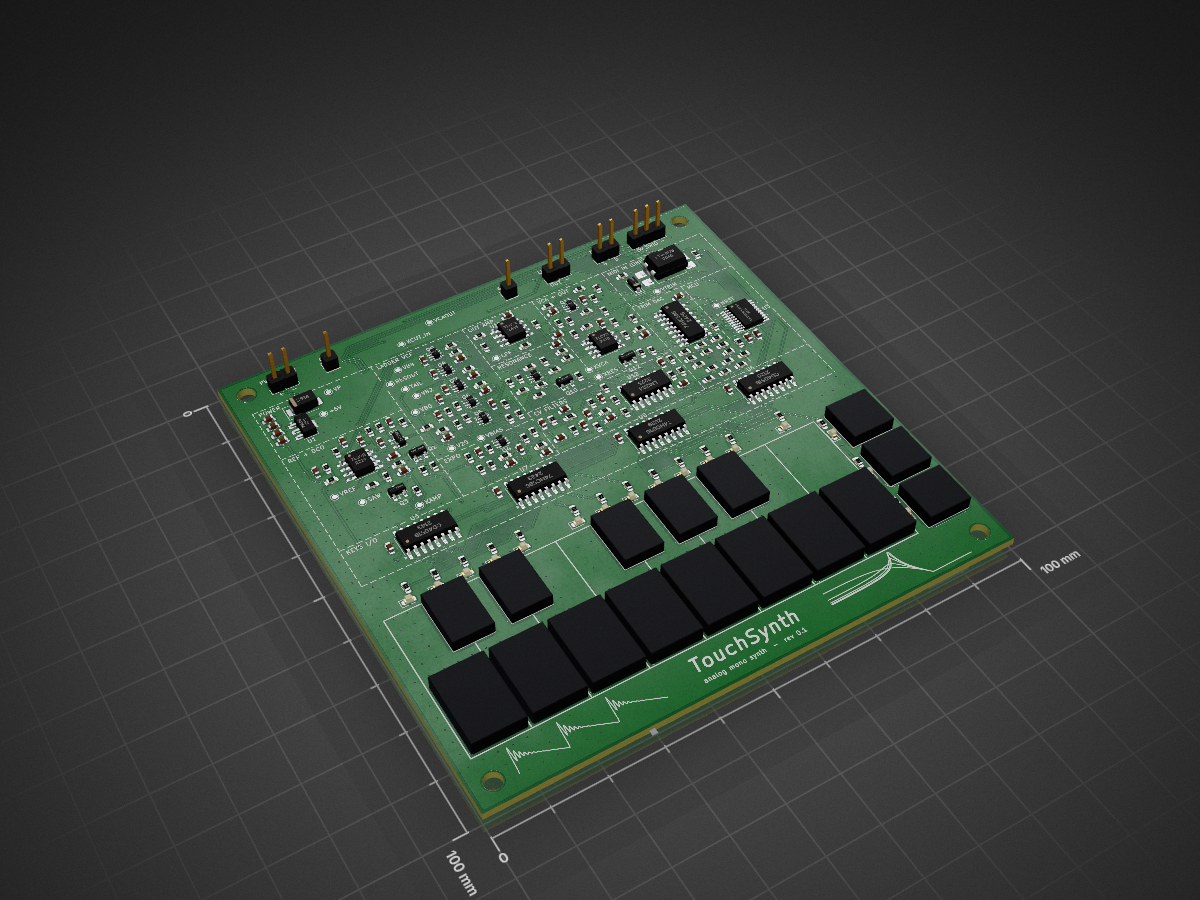
TouchSynth is an open-source printed circuit board by cpldcpu, from the cpldcpu/TouchSynth repository on GitHub, published under the MIT licence. It is a 4-layer board of 100 × 100 mm with 246 parts on 167 nets, routed with 1,773 tracks and 626 vias.
It is built around the TL072, LM324 and 74HC595, with the CD4051BE, 78L05 and LTV-817S among its other parts. Its parts include 110 resistors, 48 capacitors, 18 diodes, 13 transistors and 12 ICs. It belongs with the audio and music boards and the RISC-V boards of this library.


A small MCU-controlled analog monophonic synthesizer on a 100 × 100 mm, 4-layer PCB. It has no potentiometers and no mechanical switches: 13 capacitive touch keys plus SHIFT / − / + play and edit it, and 16 LEDs show the settings. A CH32V003 (or CH32V002 / V006) generates the oscillator timing and four PWM control voltages for a discrete analog voice:
All assembled parts are JLCPCB Basic or Promotional Extended parts: 40 BOM lines, 196 placements, about USD 3.65 of parts per board at list price. The MCU, headers and MIDI parts are hand-soldered.
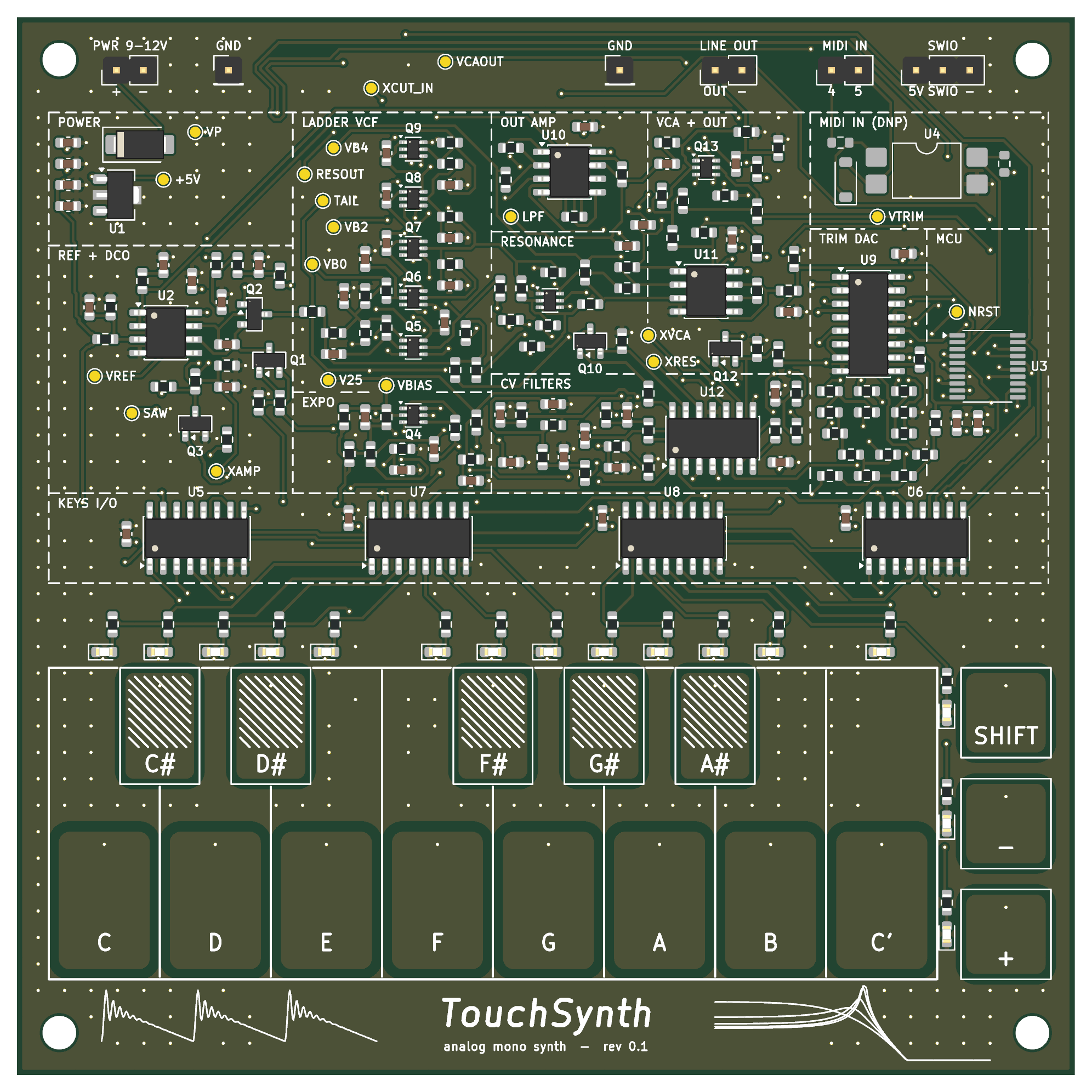
Status (2026-10-18): board 1 (rev 0.1, CH32V006) is built and brought up. It passes the bring-up steps and functional tests T1, T2 and T4–T12 (noise marginal at about −55 dB); T3 (touch scan rate) and T14 (MIDI) have not been measured. The results are in the design report, section 10. Firmware 0.1 runs on the board, including multitrack demo pieces and percussion presets. Calibration storage in flash is still open.
The polyphonic_exp branch experiments with extensions. So far it turns the pulse output into a PWM DAC
(CH32V006) for digital voices through the analog filter and VCA, starting with a modal timpani, the kettle
(kettle_model.mp3; report, section 10.5).
Design: cpldcpu & Claude Opus 5.5.
Recorded from board 1's line out. The synth is monophonic, so the multitrack pieces were played one part at a time and mixed:
| Piece | Board 1 | Model |
|---|---|---|
| TouchSynth Demo, original, 7 parts (drums, acid bass, arp, lead, pad) | demo_hw | demo_model |
| Purcell, Queen Mary's March: 4 trumpets, bass, timpani (modal synthesis on the PWM DAC) | march_hw | march_model |
| Bach, Toccata BWV 565, mm. 1–30: 9 organ voices | toccata_hw | toccata_model |
| Aerosphere, original space-synth piece, 8 parts | aero_hw | aero_model |
| Suite: Aerosphere intro into the Toccata | suite_hw | suite_model |
The three built-in demo tunes (SHIFT + C' on the board), recorded from board 1: acid, prelude (Bach BWV 846) and ode (Beethoven). Also from the board: a waveform tour and a scale on the self-oscillating filter. The behavioural model renders every single feature (waveforms, filter, envelopes, glide, …) in docs/audio/features/. docs/README.md lists all audio files.
| Document | Content |
|---|---|
| docs/report/touchsynth_report.pdf | design report: requirements, architecture, circuits, simulations, PCB, BOM, firmware, demo tunes and instruments, V&V with the board 1 results |
| docs/README.md | index of everything in docs/: documents, figures, result data, audio |
| docs/spec.md | specification and design decisions (some pre-layout details are outdated; the report is current) |
| docs/sim_report.md | simulation report S1–S7 and the behavioural model |
| docs/verification_plan.md | bring-up, functional tests, calibration and validation, board 1 results |
| docs/touchsynth_schematic.pdf | schematic (7 sheets) |
| firmware/touchsynth/README.md | firmware build, playing instructions and test console |
| hw/README.md | schematic generator scripts |
docs/        report (LaTeX), spec, simulation report, V&V plan, figures, audio examples, result CSVs
sim/         ngspice simulations S1–S7 (one folder per block), shared netlists and models, behavioural model
hw/          design.py (single source of truth) -> KiCad schematic, PCB, routing and fab outputs
  touchsynth/  KiCad 10 project (generated; edit the Python sources, not the KiCad files)
firmware/    touchsynth/ firmware 0.1, ch32fun (git submodule)
parts/       JLCPCB Basic / Promotional Extended part lists
tools/ bench tools: hardware tests, scope recording, multitrack mixing, figures; Freerouting jar (not in git)Every stage is generated by scripts from hw/design.py, which holds the parts, values, LCSC numbers and nets.
simulate      sim/s*/s*.py                 ngspice-42 in WSL -> docs/results/*.csv, docs/figures/*.png
model         sim/behav/validate.py        behavioural model vs. ngspice
              sim/behav/examples.py        audio examples + spectrograms
schematic     hw/gen_sch2.py               -> hw/touchsynth/*.kicad_sch
              hw/check_netlist.py          KiCad netlist == design.py
              hw/check_sim.py              design.py == simulation netlists
PCB           hw/gen_pcb.py [--route]      placement, silkscreen art, planes, Freerouting + GND stitching
              hw/gen_pcb.py --finish       post-route clean-up (islands, leftovers via the A* router)
fab           hw/fab.py                    gerbers, drill, BOM and CPL -> hw/touchsynth/production/
report        docs/report/gen_tables.py    then: latexmk -pdf touchsynth_report.tex (WSL)
firmware      firmware/touchsynth/gen_tables.py, check_pins.py, make
tunes         sim/behav/tunes.py, pieces.py    demo tunes, multitrack pieces and presets (-> firmware tables)
bench         tools/hwtest.py              functional tests over the SWIO console -> docs/results/hw_board1*
              tools/hw_figures.py          board 1 figures for the report
              tools/record_parts.sh        record one multitrack part per take with the scope (on the lab PC)
              tools/mix_parts.py, suite.py align, clock-correct and mix the takes -> docs/audio/
The bench tools need the lab setup (the PC with the programmer, the scope address) in tools/lab.conf: copy
tools/lab.conf.example and edit it; lab.conf is not in git.
gen_pcb.py needs KiCad's bundled Python (pcbnew) and Java 17 for Freerouting 1.9.0. The hw scripts find KiCad 10
in its standard install folder, or in KICAD_DIR if set. The other Python
scripts use a normal Python 3 with numpy and matplotlib. ngspice, LaTeX and the RISC-V toolchain run in WSL.
| Supply | 9–12 V DC, about 31 mA (simulated); board 1: 25 mA, MCU running, LEDs off |
| Pitch range | C1 … C8, saw amplitude flat within ±2.2 % |
| Filter | 20 Hz … 20 kHz cutoff, −23 dB/oct, self-oscillation |
| VCA | 121 dB off-attenuation, thump < 0.6 mV after trim |
| Output | about 1.2 Vpp line level, AC-coupled |
| Control | 4 × 12-bit CV (10-bit PWM at 46.9 kHz + 2-bit dither), 1 kHz envelope / LFO rate |
| Touch | 16 pads via 2 × CD4051, 1.4 kHz scan |
| PCB | 100 × 100 mm, 4 layers (signal / GND / split power / signal), 242 parts, 166 nets |
| Qty | Value | Footprint | References |
|---|---|---|---|
| 29 | 4.7k | Resistor_SMD:R_0603_1608Metric | R16, R17, R18, R19, R20, R21, R22, R23, R24, R25, R26, R27, R28, R29, R102, R103 +13 |
| 17 | 100n | Capacitor_SMD:C_0603_1608Metric | C2, C4, C15, C17, C18, C19, C20, C21, C22, C26, C28, C34, C36, C41, C45, C48 +1 |
| 17 | 10k | Resistor_SMD:R_0603_1608Metric | R6, R7, R55, R63, R64, R66, R67, R73, R81, R82, R85, R86, R87, R104, R106, R109 +1 |
| 16 | red | LED_SMD:LED_0603_1608Metric | D3, D4, D5, D6, D7, D8, D9, D10, D11, D12, D13, D14, D15, D16, D17, D18 |
| 15 | 1k | Resistor_SMD:R_0603_1608Metric | R1, R9, R10, R11, R12, R48, R52, R57, R62, R74, R78, R90, R94, R98, R99 |
| 10 | 100k | Resistor_SMD:R_0603_1608Metric | R34, R36, R38, R40, R42, R44, R46, R65, R68, R108 |
| 9 | 200k | Resistor_SMD:R_0603_1608Metric | R32, R33, R35, R37, R39, R41, R43, R45, R47 |
| 8 | 10µ | Capacitor_SMD:C_0603_1608Metric | C1, C5, C10, C11, C12, C13, C14, C46 |
| 8 | 1µ | Capacitor_SMD:C_0603_1608Metric | C3, C7, C8, C9, C16, C35, C39, C44 |
| 8 | 33n | Capacitor_SMD:C_0603_1608Metric | C23, C27, C30, C31, C32, C33, C37, C42 |
| 8 | BC847BS | Package_TO_SOT_SMD:SOT-363_SC-70-6 | Q4, Q5, Q6, Q7, Q8, Q9, Q11, Q13 |
| 4 | 15k | Resistor_SMD:R_0603_1608Metric | R51, R77, R93, R110 |
| 4 | 470k | Resistor_SMD:R_0603_1608Metric | R70, R71, R72, R96 |
| 4 | M3 | MountingHole_3.2mm_M3 | H1, H2, H3, H4 |
| 4 | MMBT3904 | Package_TO_SOT_SMD:SOT-23 | Q1, Q3, Q10, Q12 |
| 3 | 22k | Resistor_SMD:R_0603_1608Metric | R89, R105, R107 |
| 3 | 22n | Capacitor_SMD:C_0603_1608Metric | C24, C38, C43 |
| 3 | 33k | Resistor_SMD:R_0603_1608Metric | R53, R59, R97 |
| 3 | 74HC595 | Package_SO:SOIC-16_3.9x9.9mm_P1.27mm | U7, U8, U9 |
| 3 | TL072 | Package_SO:SOIC-8_3.9x4.9mm_P1.27mm | U2, U10, U11 |
| 2 | 1.5k | Resistor_SMD:R_0603_1608Metric | R5, R60 |
| 2 | 1n | Capacitor_SMD:C_0603_1608Metric | C29, C47 |
| 2 | 2.2k | Resistor_SMD:R_0603_1608Metric | R8, R54 |
| 2 | CD4051B | Package_SO:SOIC-16_3.9x9.9mm_P1.27mm | U5, U6 |
| 2 | GND | Connector_PinHeader_2.54mm:PinHeader_1x01_P2.54mm_Vertical | TP1, TP2 |
| 1 | +5V | TestPoint:TestPoint_Pad_D1.0mm | TP4 |
| 1 | 10 | Resistor_SMD:R_0603_1608Metric | R3 |
| 1 | 10n | Capacitor_SMD:C_0603_1608Metric | C25 |
| 1 | 120k | Resistor_SMD:R_0603_1608Metric | R80 |
| 1 | 150k | Resistor_SMD:R_0603_1608Metric | R69 |
| 1 | 1M | Resistor_SMD:R_0603_1608Metric | R100 |
| 1 | 1N4148W | Diode_SMD:D_SOD-123 | D2 |
| 1 | 2.4k | Resistor_SMD:R_0603_1608Metric | R13 |
| 1 | 220 | Resistor_SMD:R_0603_1608Metric | R14 |
| 1 | 2M | Resistor_SMD:R_0603_1608Metric | R101 |
| 1 | 2N7002 | Package_TO_SOT_SMD:SOT-23 | Q2 |
| 1 | 3.3k | Resistor_SMD:R_0603_1608Metric | R4 |
| 1 | 300k | Resistor_SMD:R_0603_1608Metric | R61 |
| 1 | 4.7µ | Capacitor_SMD:C_0603_1608Metric | C40 |
| 1 | 470 | Resistor_SMD:R_0603_1608Metric | R15 |
| 1 | 6.2k | Resistor_SMD:R_0603_1608Metric | R79 |
| 1 | 78L05 | Package_TO_SOT_SMD:SOT-89-3 | U1 |
| 1 | 9.1k | Resistor_SMD:R_0603_1608Metric | R2 |
| 1 | CH32V003F4P6 / CH32V002F4P6 | Package_SO:TSSOP-20_4.4x6.5mm_P0.65mm | U3 |
| 1 | LINE OUT | Connector_PinHeader_2.54mm:PinHeader_1x02_P2.54mm_Vertical | J4 |
| 1 | LM324 | Package_SO:SOIC-14_3.9x8.7mm_P1.27mm | U12 |
| 1 | LPF | TestPoint:TestPoint_Pad_D1.0mm | TP15 |
| 1 | LTV-817S | Package_DIP:SMDIP-4_W9.53mm | U4 |
| 1 | MIDI IN | Connector_PinHeader_2.54mm:PinHeader_1x02_P2.54mm_Vertical | J3 |
| 1 | NRST | TestPoint:TestPoint_Pad_D1.0mm | TP11 |
| 1 | PWR 9-12V | Connector_PinHeader_2.54mm:PinHeader_1x02_P2.54mm_Vertical | J1 |
| 1 | RESOUT | TestPoint:TestPoint_Pad_D1.0mm | TP18 |
| 1 | SAW | TestPoint:TestPoint_Pad_D1.0mm | TP12 |
| 1 | SS14 | Diode_SMD:D_SMA | D1 |
| 1 | SWIO | Connector_PinHeader_2.54mm:PinHeader_1x03_P2.54mm_Vertical | J2 |
| 1 | TAIL | TestPoint:TestPoint_Pad_D1.0mm | TP14 |
| 1 | Touch + | TouchSynth:TouchPad_Func | KEY16 |
| 1 | Touch - | TouchSynth:TouchPad_Func | KEY15 |
| 1 | Touch A | TouchSynth:TouchPad_White | KEY10 |
| 1 | Touch A# | TouchSynth:TouchPad_Black | KEY11 |
| 1 | Touch B | TouchSynth:TouchPad_White | KEY12 |
| 1 | Touch C | TouchSynth:TouchPad_White | KEY1 |
| 1 | Touch C# | TouchSynth:TouchPad_Black | KEY2 |
| 1 | Touch C' | TouchSynth:TouchPad_White | KEY13 |
| 1 | Touch D | TouchSynth:TouchPad_White | KEY3 |
| 1 | Touch D# | TouchSynth:TouchPad_Black | KEY4 |
| 1 | Touch E | TouchSynth:TouchPad_White | KEY5 |
| 1 | Touch F | TouchSynth:TouchPad_White | KEY6 |
| 1 | Touch F# | TouchSynth:TouchPad_Black | KEY7 |
| 1 | Touch G | TouchSynth:TouchPad_White | KEY8 |
| 1 | Touch G# | TouchSynth:TouchPad_Black | KEY9 |
| 1 | Touch SHIFT | TouchSynth:TouchPad_Func | KEY14 |
| 1 | V25 | TestPoint:TestPoint_Pad_D1.0mm | TP7 |
| 1 | VB0 | TestPoint:TestPoint_Pad_D1.0mm | TP8 |
| 1 | VB2 | TestPoint:TestPoint_Pad_D1.0mm | TP9 |
| 1 | VB4 | TestPoint:TestPoint_Pad_D1.0mm | TP10 |
| 1 | VBIAS | TestPoint:TestPoint_Pad_D1.0mm | TP6 |
| 1 | VCAOUT | TestPoint:TestPoint_Pad_D1.0mm | TP19 |
| 1 | VP | TestPoint:TestPoint_Pad_D1.0mm | TP3 |
| 1 | VREF | TestPoint:TestPoint_Pad_D1.0mm | TP5 |
The 241 most common of 246 parts.
It measures 100 × 100 mm and has 4 copper layers, 1.6 mm thick.
246 parts, built around the TL072, LM324, 74HC595 and CD4051BE. The full list of its parts is on this page, with links to each part's symbol and footprint where PCBKit's library has them.
From the cpldcpu/TouchSynth repository on GitHub, at the commit this page was made from: the board is hw/touchsynth/touchsynth.kicad_pcb and its schematic hw/touchsynth/dco.kicad_sch. PCBKit opens the board in the browser, with nothing to install.
Its repository publishes it under the MIT licence: you may reuse it on that licence's terms (keep the author's notice, and for a copyleft licence share your changes alike).


JordanAceto/micro_ox
Monosynth with analog signal path and digital controls. SSI2130 VCOs and SSI2140 VCF.

gabrielfbdiniz/PFC-Boost-STM32
Conversor estático de potência CA/CC com Correção Ativa do Fator de Potência (Active PFC) na topologia Boost, projetado para elevar a tensão da rede elétrica retificada (127V / 220V AC) para um barramento CC…


Cherry-Blossom-Development/GreywireStudio
GreywireStudio - a combined software/hardware product

soggybag/FU-3
An octave / "tripler" distortion with a big two-knob tone stage: the Distort-o-matic XI (Stompboxology Vol. 13 No.

soggybag/Ugly-Face-3-SMD
A gated, envelope-controlled square-wave synth fuzz for guitar, in a Hammond 1590B. A TL072 preamp (gain 201) gates and bends a TLC555 oscillator, with a MIX control to blend the dry fuzz with the synth tone.