4 layers148 × 78 mm
Hub
Bruhdows/klink
Klink is a magnetic tile system for building programmable machines. First up: a marble run with sensors, buttons, lights, gates, splitters and an elevator.
85 parts
 clankagent/usb-replug
USB 2.0 timed disconnect adapter with CMOS 555; revision B unbuilt prototype for design review
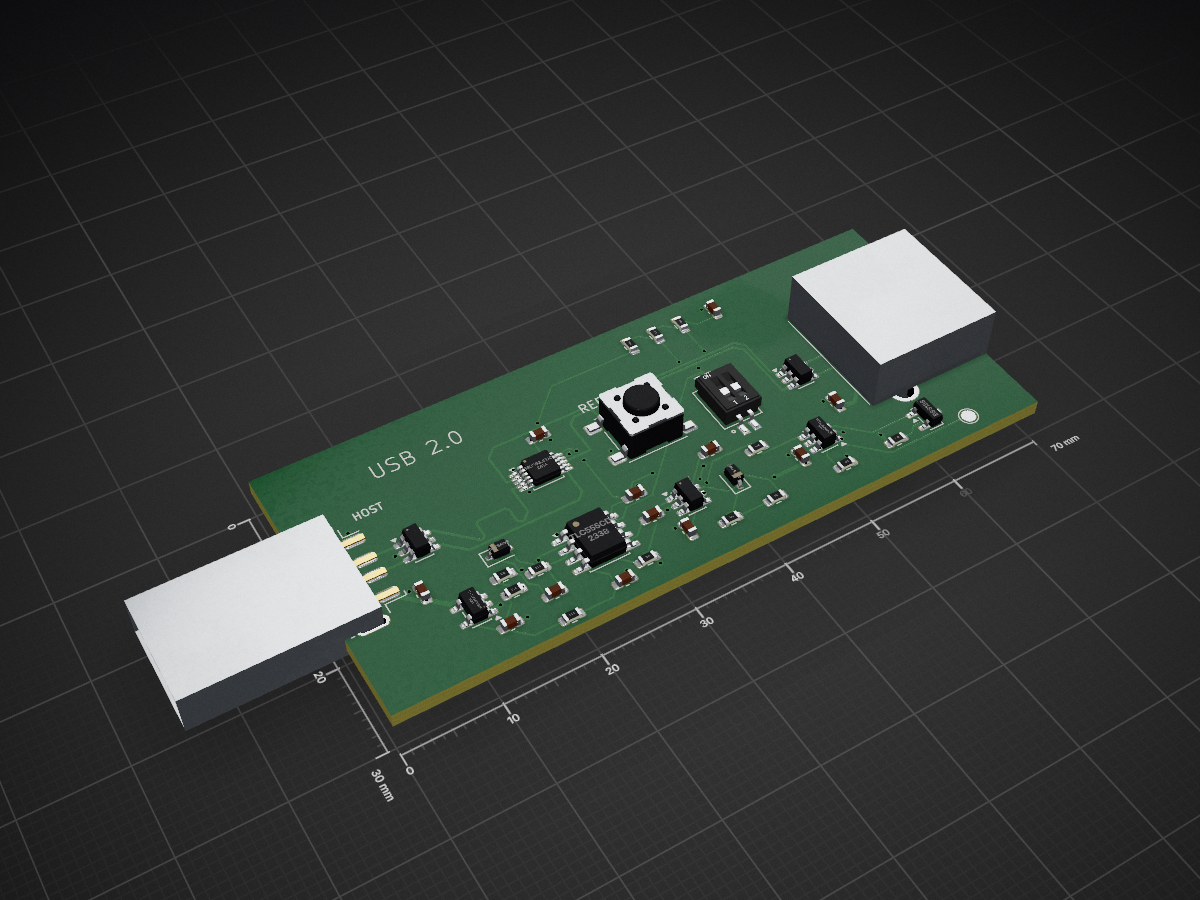
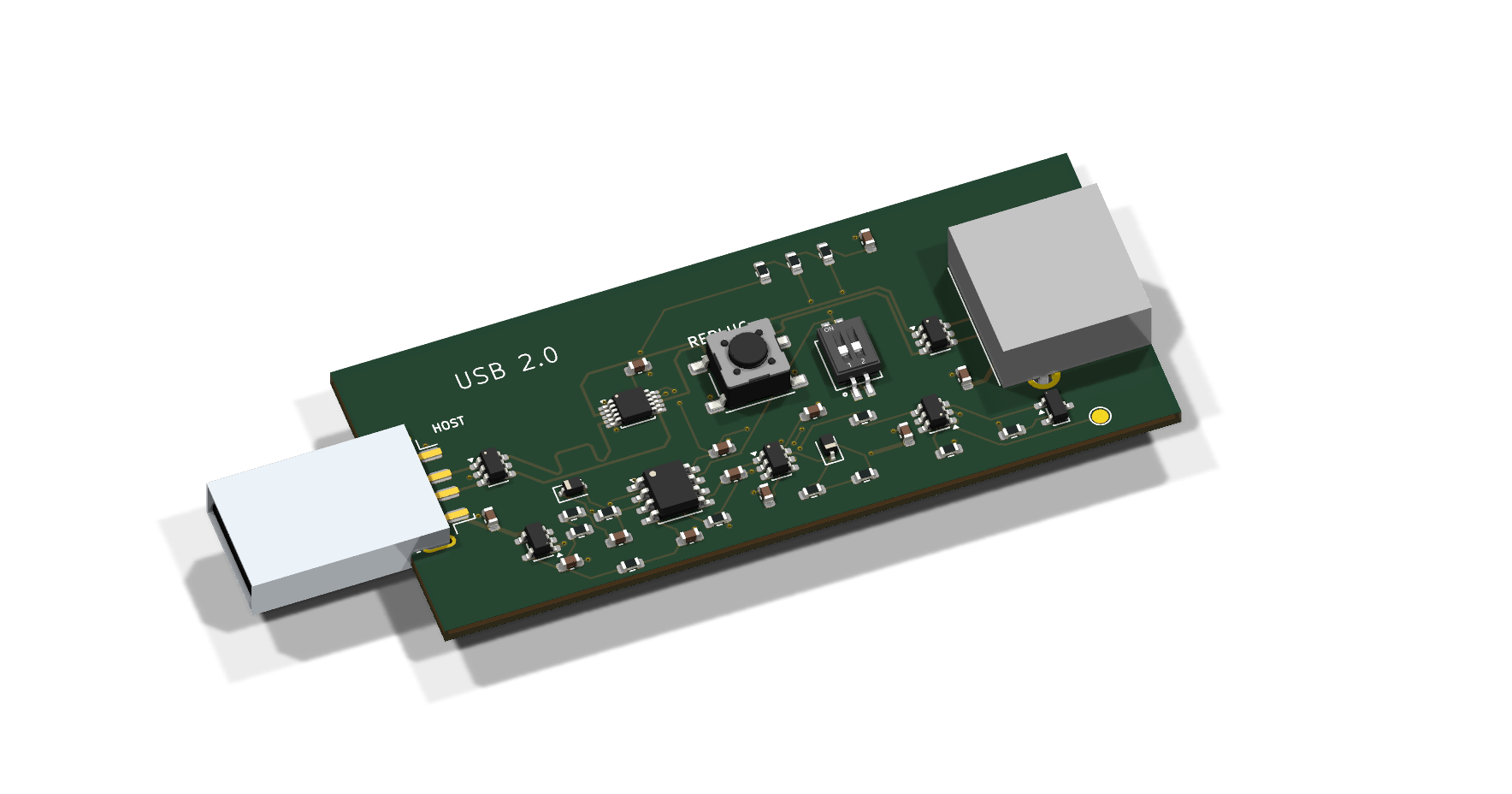
Usb replug is an open-source printed circuit board by clankagent, from the clankagent/usb-replug repository on GitHub. It is a 4-layer board of 70 × 30 mm with 40 parts on 27 nets, routed with 436 tracks and 63 vias.
It is built around the SN74LVC2G14DBVR, TLV75533PDBVR-MS and TPS2552DBVR-1, with the TS3USB30EDGSR-TP, CC0603KRX7R9BB104 and BAT54WS-7-F-CN among its other parts. Its parts include 13 resistors, 12 capacitors, 5 ICs, 4 diodes and 2 connectors. It belongs with the interfaces and adapters boards of this library.


A USB-A male-to-female adapter intended to simulate unplugging and reconnecting a USB 2.0 peripheral with one button press. A CMOS 555 provides the delay; there is no microcontroller or firmware.
Public design review. Unbuilt prototype; not ready to order. Assembly placement mappings remain unresolved and hardware performance has not been tested. This repository contains only the current revision B source and review material, not previous design iterations or fabrication releases.
Schematic PDF · 3D STEP model · BOM · Remaining work
Press the central button to disconnect device VBUS and both data lines, then reconnect automatically. Ground and shields stay connected. The trigger circuit is intended to let the timer expire even when the button remains held down.
| Two-position DIP switch | Approximate off time |
|---|---|
| Both OFF | 3 seconds |
| Either ON | 2 seconds |
| Both ON | 1 second |
Change the DIP settings while idle. RC tolerance, leakage and capacitor bias affect timing; these are nominal settings, not calibrated delays.
Open usb-replug.kicad_pro in KiCad 10. The root schematic links three functional sheets. The PCB, footprints and referenced STEP models are included with project-relative paths. Official symbols are embedded in the schematics; the custom symbol library is under libraries/.
The board is 70 × 30 mm with four copper layers and nominal 1.6 mm thickness. Its fabrication target is JLC04161H-7628, outer 1 oz / inner 0.5 oz copper, green mask, white silkscreen and lead-free HASL. The male connector overhangs the PCB edge. A different manufacturer needs a stackup and assembly review.
The packaged source was checked with KiCad 10.0.6: no reported ERC, PCB DRC, unconnected-item or schematic-parity findings. Reports and their configured ignored-check lists are included in docs/checks/. This is not a claim that every possible rule is enabled or that hardware works.
The intended USB data rate is up to 480 Mbps. Signal integrity, impedance, interoperability, ESD behavior, loaded voltage drop and timing still require review and physical testing. Length matching alone does not validate the USB routing; the layout includes uncoupled breakout sections. A self-powered peripheral may disconnect logically without actually power-cycling. Host power budget includes the adapter's own consumption.
All small components are intended for factory assembly. JLCPCB's quoted Economic option excluded J1, the male connector; it has accessible surface-mount signal joints plus shell mounting joints. J2 is through-hole. The quoted Standard option included both connectors. Historical September 2026 batch estimates were $71.08 and $106.07 respectively for five PCBs with two populated, excluding shipping and tax. These are not current offers or endorsements.
Gerbers and pick-and-place files are deliberately absent: the previous assembler preview exposed rotation and connector-origin mismatches. No order-ready release has been published and no board has been ordered.
See THIRD_PARTY.md. Public visibility does not grant an open-source license for the original project; no project license has been selected. Existing third-party licenses remain in effect. Provenance and redistribution permissions for the imported footprints and DIP-switch model remain unresolved; see the linked notes.
Prepared with AI-assisted design and review; the KiCad files, not an image, are the design source of truth.
| Qty | Value | Footprint | References |
|---|---|---|---|
| 6 | 100nF | Capacitor_SMD:C_0603_1608Metric | C4, C5, C6, C7, C8, C9 |
| 6 | 1uF | Capacitor_SMD:C_0603_1608Metric | C1, C2, C3, C10, C11, C12 |
| 5 | 100k | Resistor_SMD:R_0603_1608Metric | R2, R3, R8, R9, R18 |
| 3 | 1M | Resistor_SMD:R_0603_1608Metric | R5, R6, R7 |
| 3 | 1k | Resistor_SMD:R_0603_1608Metric | R4, R16, R17 |
| 2 | BAT54WS | Diode_SMD:D_SOD-323 | D3, D4 |
| 2 | USBLC6-2SC6 | Package_TO_SOT_SMD:SOT-23-6 | D1, D2 |
| 1 | 45.3k | Resistor_SMD:R_0603_1608Metric | R1 |
| 1 | 47k | Resistor_SMD:R_0603_1608Metric | R15 |
| 1 | BSS138 | Package_TO_SOT_SMD:SOT-23 | Q1 |
| 1 | DELAY SELECT | ReplugB:SHOUHAN_1.27-2P_TPPT | SW2 |
| 1 | FAULT_N | TestPoint:TestPoint_Pad_D1.5mm | TP1 |
| 1 | REPLUG | Button_Switch_SMD:SW_SPST_PTS645Sx43SMTR92 | SW1 |
| 1 | SN74LVC2G14DBVR | Package_TO_SOT_SMD:SOT-23-6 | U6 |
| 1 | TLC555CDR | Package_SO:SOIC-8_3.9x4.9mm_P1.27mm | U4 |
| 1 | TLV75533PDBVR | Package_TO_SOT_SMD:SOT-23-5 | U2 |
| 1 | TPS2552DBVR | Package_TO_SOT_SMD:SOT-23-6 | U1 |
| 1 | TS3USB30EDGSR | Package_SO:MSOP-10_3x3mm_P0.5mm | U3 |
| 1 | USB-A PLUG | Connector_USB:USB_A_Molex_48037-2200_Horizontal | J1 |
| 1 | USB-A SOCKET | ReplugB:Jingtuo_902-131A1011D10100 | J2 |
It measures 70 × 30 mm and has 4 copper layers, 1.6 mm thick.
40 parts, built around the SN74LVC2G14DBVR, TLV75533PDBVR-MS, TPS2552DBVR-1 and TS3USB30EDGSR-TP. The full list of its parts is on this page, with links to each part's symbol and footprint where PCBKit's library has them.
From the clankagent/usb-replug repository on GitHub, at the commit this page was made from: the board is usb-replug.kicad_pcb and its schematic sheet1.kicad_sch. PCBKit opens the board in the browser, with nothing to install.
Its repository states no licence, so its author keeps all rights: ask clankagent before reusing the design.
Bruhdows/klink
Klink is a magnetic tile system for building programmable machines. First up: a marble run with sensors, buttons, lights, gates, splitters and an elevator.

iandchasse/silkscreen-pcb
Silkscreen: open-hardware ESP32-S3 e-paper reader mainboard (KiCad 9). Formerly the de-link hub.

dennowiggle/Retro-PETER
3.3V Retro computer project => FPGA + RCBUS + CPU boards making a custom system.

SophBG/pi-tin-mod
Personal build of jackw01's Pi Tin (3D-printed clamshell version, KiCad 10). It adds 10 RGB LEDs under the buttons, a centred speaker, a USB-drive mode for the ROMs, and ESD protection on USB, and runs on an Orange Pi…


gslee-dev/portpulse
USB replug test dongle with KiCad hardware, CH552 firmware, and native C host

benvonhandorf/kicad-library
Schematic symbols and footprints for kicad, useful across more than one project
