Skip to the content
PCBKitNew board
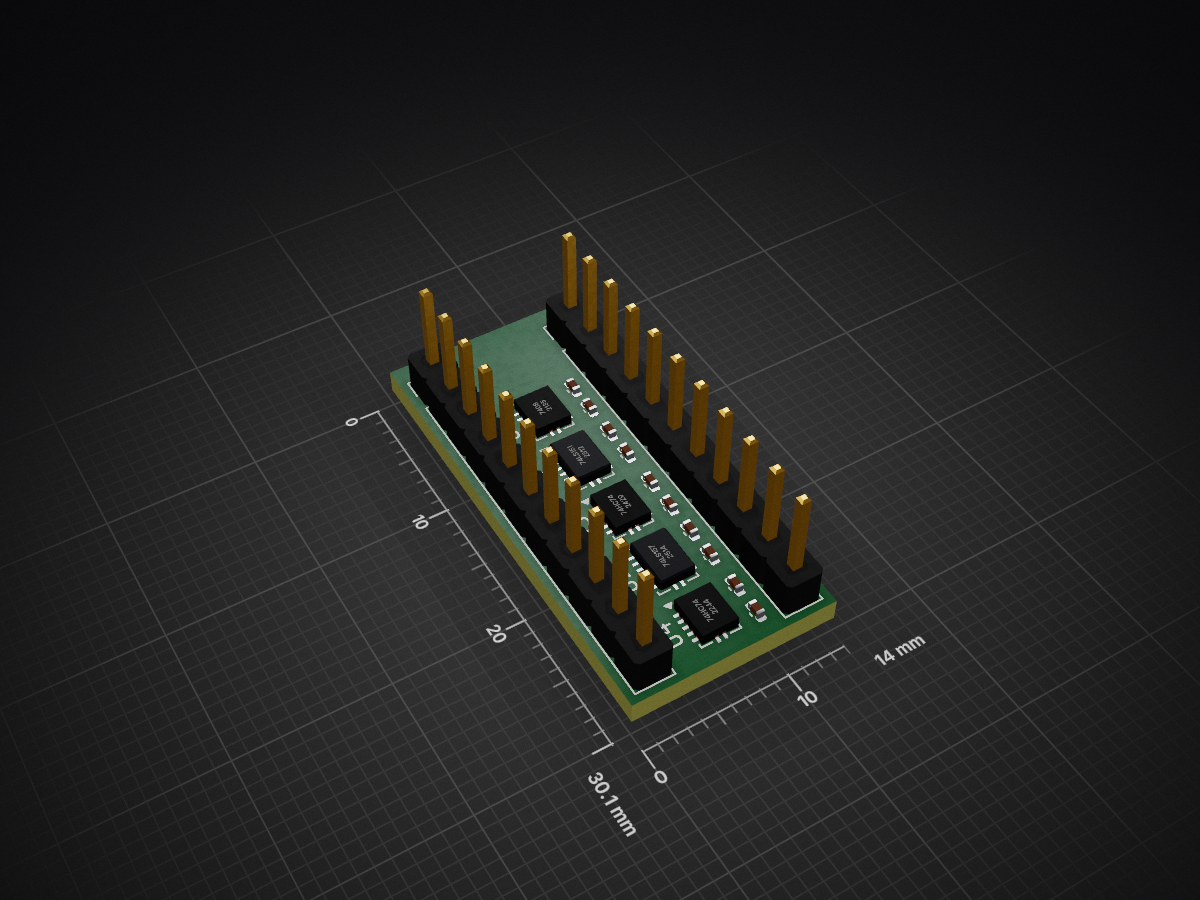
2 layers14 × 30.1 mmStack DIP, the printed circuit board in 3D

A project to create a microprocessor optimized for human visual verification

Size
14 × 30.1 mm
Copper layers
2
Thickness
1.6 mm
Parts
17
Nets
116
Pads
128
Tracks, vias
0, 0
Routed
Not yet
KiCad
KiCad 8.0 (file 20240108)
Created
20 Dec 2022
Updated
1 Dec 2025

Overview

Stack DIP is an open-source printed circuit board by charlespax, from the charlespax/macroprocessor repository on GitHub, published under the MIT licence. It is a 2-layer board of 14 × 30.1 mm with 17 parts on 116 nets.

It is built around the 74HC74D, 74LS151PC and 74LS157PC. Its parts include 10 capacitors, 5 ICs and 2 connectors.

Main components

3

README

README.md

macroprocessor

A project to create a microprocessor optimized for human visual verification

Introduction

A user should be able to trust the output of a computational device without having to trust the computatoinal device itself.

Application

Cryptographic security

Bitcoin

Design

The design is not optimized for price, area, power, efficiency, yield, or other traditional parameter. The design is optimized for human readability and understanding.

Requirements

  • MUST be visible to a human with minimal optical magnification
  • An integrated circuit design layout SHOULD aid understanding
  • IC layout SHOULD correspond to the layout as seen in a digitial simulation
  • Microprocessor design architecture SHOULD be optimized for understanding
  • The registers or other circuitry MAY emit light
  • MAY have features to aid cryptography
  • MAY have serial output for debugging or other purposes

Design notes

The overall chip layout and data flow SHOULD run from left to right.

Logical elements SHOULD have inputs on the left and outputs on the right

The metal layer or other features MUST NOT obscure any features such that the circuit can not be verified visually.

Chip packaging MUST NOT obscure the electrical path from the IC to the package pins.

The design MAY use multiple IC components if each component meets the requirements of this document.

The design MAY include wire-bonded components

Notes

  • RISC-V RV32I or RV32E are candidates
  • Research making a Forth-native processor
  • Can the macroprocessor be made using the same process as LEDs?
  • Can a wafer be put through a secondary LED process to create registers that emit light?
  • What is the current state of light-emitting transistors (LETs)?
  • Can I use diode logic and use LEDs?
  • I believe the normal silicon process cannot be used to create features that emit light because the band gap of silicon is too greaet. True?
  • RISC-V would be a great choice if it can be visually verified. This has the advantage that many more eyes would be on the chip. However, I think it is more important to make choices that result in more users in verifying their own devices.
  • Check out https://zeroToASICCourse.com - this is a course for designing and ordering your own chip designs.
  • Check out https://developers.google.com/silicon - Google's wafer batching program for open source designs. Cool, but I am happy to pay if reasonable.
  • MAY take an external diode-based ROM
  • Is there anything about this processor that would make it bad at cryptographic functions? Minimal circuitry could be included to address issues.
  • Can x-ray crystalography be used to verify the surface of an IC?
  • https://www.skywatertechnology.com is a US-based silicon fab.
  • What happens to the equipment from old semiconductor fabrication technologies?
  • Fab technologies: https://en.wikipedia.org/wiki/Semiconductor\_device\_fabrication
  • Are there fabs that use old technologies for new chips?
  • Wire bonding can be used in places where the metal layer would obscure layers below
  • wire bonding can be used as jumpers that can be cut to permanently disable a ffeature
  • Rather than wire bonding, the connections can be routed to the outside of the package, so they can be explicetly enabled
  • Maybe multi gate transistors can be used on such large features if one large gate is not appropriate
  • Make the binary instruction decoding physicallyl easy to see on the die. Put them in the same order you would find them in a specification table
  • Is silicon transparent to any frequency of light? If so, maybe this can be used for verification and would be a design consideration.

Conventions

The keywords below are to be interpreted as described in BCP14 [RFC2119] [RFC8174].

  • MUST
  • MUST NOT
  • REQUIRED
  • SHOULD
  • SHOULD NOT
  • RECOMMENDED
  • NOT RECOMMENDED
  • MAY
  • OPTIONAL

Parts

17
QtyValueFootprintReferences
10C_SmallCapacitor_SMD:C_0402_1005MetricC1, C2, C3, C4, C5, C6, C7, C8, C9, C10
274HC74Package_DFN_QFN:DHVQFN-14-1EP_2.5x3mm_P0.5mm_EP1x1.5mmU3, U4
2Conn_01x11_PinConnector_PinHeader_2.54mm:PinHeader_1x11_P2.54mm_VerticalJ1, J2
17408Package_DFN_QFN:DHVQFN-14-1EP_2.5x3mm_P0.5mm_EP1x1.5mmU6
174LS151Package_DFN_QFN:DHVQFN-16-1EP_2.5x3.5mm_P0.5mm_EP1x2mmU2
174LS157Package_DFN_QFN:DHVQFN-16-1EP_2.5x3.5mm_P0.5mm_EP1x2mmU1

Questions

How big is the Stack DIP PCB?

It measures 14 × 30.1 mm and has 2 copper layers, 1.6 mm thick.

What parts does the Stack DIP use?

17 parts, built around the 74HC74D, 74LS151PC and 74LS157PC. The full list of its parts is on this page, with links to each part's symbol and footprint where PCBKit's library has them.

Where can I download the Stack DIP KiCad files?

From the charlespax/macroprocessor repository on GitHub, at the commit this page was made from: the board is vm-digital/stack DIP/stack DIP.kicad_pcb and its schematic vm-digital/diode-matrix-rom-dip/diode-matrix-rom-dip.kicad_sch. PCBKit opens the board in the browser, with nothing to install.

Can I use the Stack DIP design in my own project?

Its repository publishes it under the MIT licence: you may reuse it on that licence's terms (keep the author's notice, and for a copyleft licence share your changes alike).

More from charlespax/macroprocessor

4
  • 2 layersDiode matrix rom, the printed circuit board in 3D

    Diode matrix rom

    charlespax/macroprocessor

    A project to create a microprocessor optimized for human visual verification

    31 partsMIT
  • 4 layers27.9 × 58.4 mmDiode matrix rom dip, the printed circuit board in 3D

    Diode matrix rom dip

    charlespax/macroprocessor

    A project to create a microprocessor optimized for human visual verification

    29 partsMIT
  • 2 layers89.2 × 62.9 mmStack module, the printed circuit board in 3D

    Stack module

    charlespax/macroprocessor

    A project to create a microprocessor optimized for human visual verification

    16 partsMIT
  • 4 layers27.9 × 45.7 mmTemp kicad, the printed circuit board in 3D

    Temp kicad

    charlespax/macroprocessor

    A project to create a microprocessor optimized for human visual verification

    15 partsMIT

Similar boards

  • 2 layers137.2 × 88.8 mmGPU SCH, the printed circuit board in 3D

    GPU SCH

    snippyrow/-816-board

    A retro computer motherboard for the W65C816S CPU. Dual-core expandable, 16mb extended memory, four expansion ports.

    67 partsMIT
  • 2 layers364 × 203 mmCPU6S, the printed circuit board in 3D

    CPU6S

    Meisaka/CenMiniCom

    Centurion Minicomputer Schematics

    240 parts8
  • 2 layers156 × 100.1 mmVIO MPF v2.0, the printed circuit board in 3D

    VIO MPF v2.0

    electrickery/VIO_MPF_I

    Extended firmware for the 6845 based video card for the Microprofessor MPF-I(b)

    64 parts4
  • 2 layers100 × 51.6 mmCGPalReader24, the printed circuit board in 3D

    CGPalReader24

    RichCini/PALReader

    Bit-banged PAL reader based on the work by Chuck Guzis and adds by Daver2

    27 parts1
  • 2 layers486 × 306.3 mmMonacoGP, the printed circuit board in 3D

    MonacoGP

    stonedDiscord/MonacoGP

    Sega MonacoGP TTL Boards

    257 parts1
  • 2 layers630 × 300 mmSecretBase, the printed circuit board in 3D

    SecretBase

    stonedDiscord/SecretBase

    SEGA Secret Base Arcade Game

    441 parts
  • 2 layers37.5 × 16 mmSk-1-octave, the printed circuit board in 3D

    Sk-1-octave

    jonaspaulkarlsson/sk-1-octave

    Octave switch for the Casio SK-1 keyboard

    20 parts8CC0-1.0
  • 2 layers150 × 150 mm8bit computer, the printed circuit board in 3D

    8bit computer

    halfburnttoast/TCPU8-Alpha

    Discontinued computer I made in 2020

    138 parts4GPL-2.0