2 layers114.3 × 86.4 mm

 cerebrinolab/EEG
Eletroencefalograma
OpenEEG is an open-source printed circuit board by cerebrinolab, from the cerebrinolab/EEG repository on GitHub, published under the GPL-3.0 licence. It is a 2-layer board of 89.5 × 54.1 mm with 53 parts on 31 nets, routed with 154 tracks and 18 vias.
It is built around the TLC277ID, BC547 and BC557. Its parts include 20 capacitors, 19 resistors, 5 connectors, 4 ICs and 4 transistors.


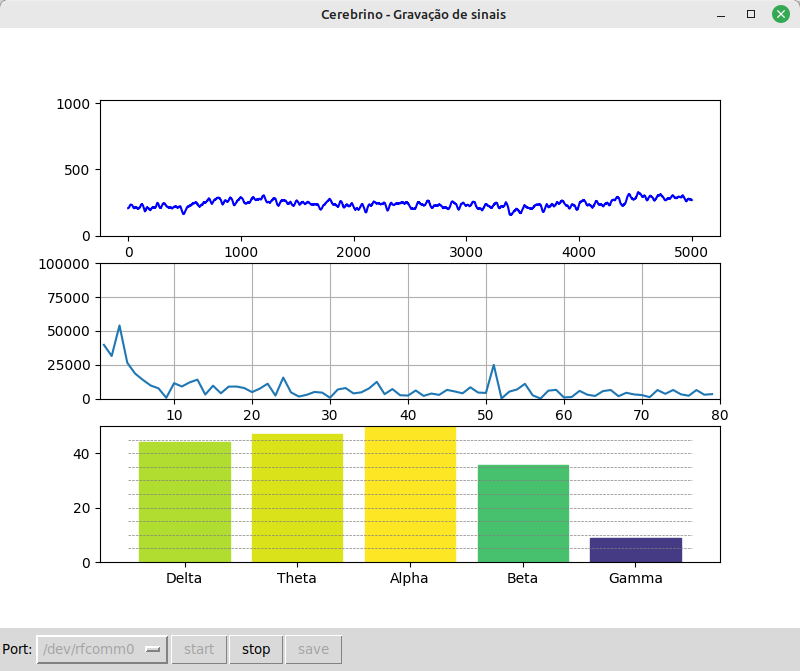
Essa é a tela de captura, inicialmente com uma interface minimalista, com diferentes gráficos combinados para facilitar a leitura.
Primeiro gráfico - sinal x tempo: Aqui é possível acompanhar o sinal capturado, o eixo horizontal esta graduado em mili segundos.
Segundo grafico - espectrograma: Plota o espectro de frequancia, num intervado de 0 á 80Hz
Terceiro grafico - Grafico de barras Semelhante ao grafico de espectro, permite visualisar de forma simples e direta, as faixas de ondas: Delta (0 a 4 Hz) Theta (4 a 8 Hz) Alpha (8 a 13 Hz) Beta (13 a 30 Hz) Gama (30 a 80 Hz)
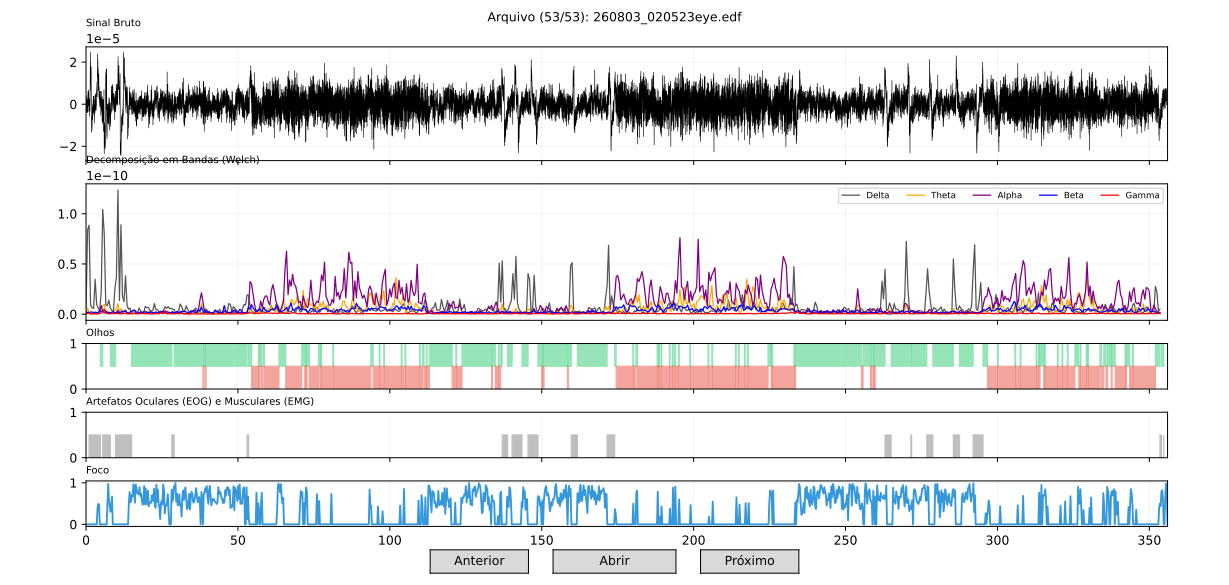
O sinal do gráfico abaixo foi processado por I.A., treinada com datasets etiquetados para olhos abertos, fechados, piscadas e movimentos musculares. Esse sinal com duração de 6 minutos, alternando minuto a minuto entre olhos abertos e olhos fechados, iniciando com os olhos abertos. Atualmente a análise é feita offline, mas o objetivo é que a I.A. efetue a análise em tempo real e que a interface traduza o resultado em estímulos sonoros e visuais, possibilitando que o usuário possa aprender a controlar seus estados mentais.
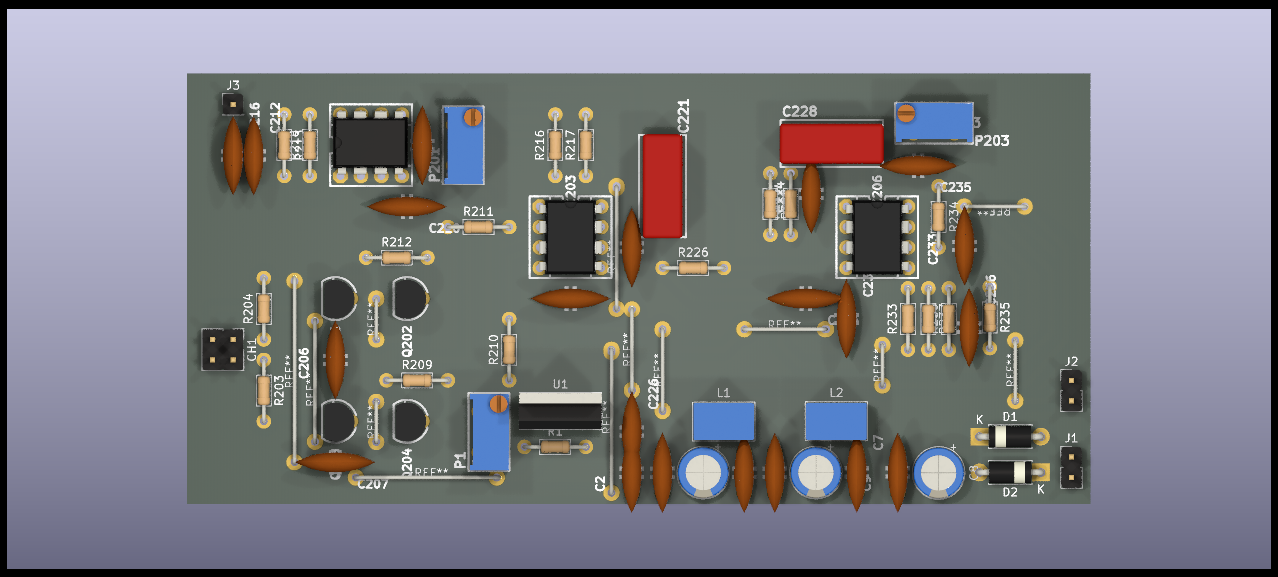
Circuito de aquisição de sinais
| Qty | Value | Footprint | References |
|---|---|---|---|
| 7 | 100nF | openEEG:R_Axial_DIN0204_L3.6mm_D1.6mm_P2.54mm_Vertical | C104, C105, C207, C208, C303, C304, C402 |
| 6 | 2k2 | openEEG:R_Axial_DIN0204_L3.6mm_D1.6mm_P2.54mm_Vertical | R101, R102, R103, R104, R107, R108 |
| 4 | 1nF | openEEG:R_Axial_DIN0204_L3.6mm_D1.6mm_P2.54mm_Vertical | C202, C206, C301, C302 |
| 3 | 20k | openEEG:Potentiometer_Bourns_3386P_Vertical | P201, P301, P401 |
| 2 | 100k | openEEG:R_Axial_DIN0204_L3.6mm_D1.6mm_P2.54mm_Vertical | R203, R208 |
| 2 | 100pF | openEEG:R_Axial_DIN0204_L3.6mm_D1.6mm_P2.54mm_Vertical | C102, C103 |
| 2 | 1M | openEEG:R_Axial_DIN0204_L3.6mm_D1.6mm_P2.54mm_Vertical | R201, R204 |
| 2 | 1µF | openEEG:CP_Radial_Tantal_D4.5mm_P2.50mm | C201, C203 |
| 2 | 2k2 | openEEG:R_Axial_DIN0204_L3.6mm_D1.6mm_P5.08mm_Vertical | R105, R106 |
| 2 | BC547 | openEEG:TO92alinhado | Q101, Q102 |
| 2 | BC557 | openEEG:TO92alinhado | Q103, Q104 |
| 1 | 100 | openEEG:R_Axial_DIN0204_L3.6mm_D1.6mm_P2.54mm_Vertical | R401 |
| 1 | 10k | openEEG:R_Axial_DIN0204_L3.6mm_D1.6mm_P7.62mm_Horizontal | R302 |
| 1 | 10k | openEEG:R_Axial_DIN0204_L3.6mm_D1.6mm_P2.54mm_Vertical | R205 |
| 1 | 10nF | openEEG:R_Axial_DIN0204_L3.6mm_D1.6mm_P2.54mm_Vertical | C403 |
| 1 | 10pF | openEEG:R_Axial_DIN0204_L3.6mm_D1.6mm_P2.54mm_Vertical | C101 |
| 1 | 15k | openEEG:R_Axial_DIN0204_L3.6mm_D1.6mm_P2.54mm_Vertical | R207 |
| 1 | 1k | openEEG:R_Axial_DIN0204_L3.6mm_D1.6mm_P2.54mm_Vertical | R202 |
| 1 | 200k | openEEG:R_Axial_DIN0204_L3.6mm_D1.6mm_P2.54mm_Vertical | R301 |
| 1 | 220nF 5% | openEEG:R_Axial_DIN0204_L3.6mm_D1.6mm_P2.54mm_Vertical | C204 |
| 1 | 22µH | openEEG:L_Radial_L7.5mm_W4.6mm_P5.00mm_Neosid_SD75 | L401 |
| 1 | 33nF 5% | openEEG:R_Axial_DIN0204_L3.6mm_D1.6mm_P2.54mm_Vertical | C205 |
| 1 | 47µF | openEEG:CP_Radial_D5.0mm_P2.50mm | C401 |
| 1 | 8.2k | openEEG:R_Axial_DIN0204_L3.6mm_D1.6mm_P2.54mm_Vertical | R206 |
| 1 | Arduino | openEEG:PinHeader_1x04_P2.54mm_Vertical | J2 |
| 1 | Eletrodos | openEEG:PinHeader_2x04_P2.54mm_Vertical | J1 |
| 1 | INA114P | openEEG:DIL-08 | IC1 |
| 1 | LM317_TO-220 | openEEG:TO-220-3_Vertical | U401 |
| 1 | TLC277 | openEEG:DIL-08 | IC3 |
| 1 | TLC277P | openEEG:DIL-08 | IC2 |


dotnet/iot
This repo includes .NET Core implementations for various IoT boards, chips, displays and PCBs.

robsonsmartins/usbflashprog
A memory device programmer (Flash/EPROM/E2PROM) board and software, connected to PC by USB port.


telec16/modular-synth
Little side project, don't expect much updates.

nodep/NovaBox
Circuit and PCB design of simple Bluetooth stereo receiver and amplifier
It measures 89.5 × 54.1 mm and has 2 copper layers, 1.6 mm thick.
53 parts, built around the TLC277ID, BC547 and BC557. The full list of its parts is on this page, with links to each part's symbol and footprint where PCBKit's library has them.
From the cerebrinolab/EEG repository on GitHub, at the commit this page was made from: the board is kicad/openEEG.kicad_pcb and its schematic kicad/openEEG.kicad_sch. PCBKit opens the board in the browser, with nothing to install.
Its repository publishes it under the GPL-3.0 licence: you may reuse it on that licence's terms (keep the author's notice, and for a copyleft licence share your changes alike).