
2 layers114.3 × 86.4 mm
 cel8473/CMPE480-Spring-2021
Interface & Digital Electronics
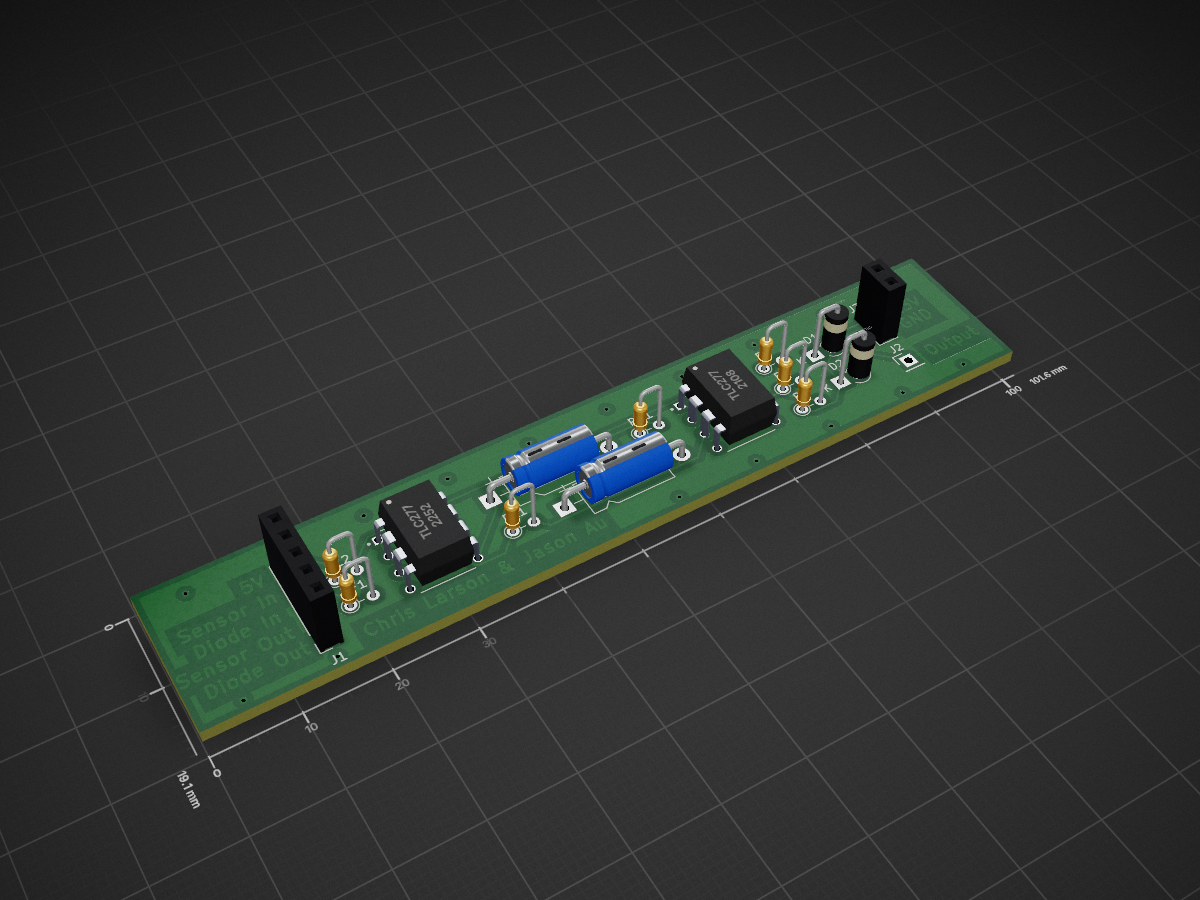
HeartRateMonitor is an open-source printed circuit board by cel8473, from the cel8473/CMPE480-Spring-2021 repository on GitHub. It is a 2-layer board of 101.6 × 19.1 mm with 16 parts on 12 nets, routed with 78 tracks and 17 vias.
It is built around the TLC277ID. Its parts include 3 resistors, 3 connectors, 2 ICs and 2 diodes.
Interface & Digital Electronics at RIT during Spring 2021
Lab 1: Intro to K64F GPIO and Keil MicroVision
Lab 2: UART Driver
Lab 3: Characterization of OPB745
Lab 4: UART Over Bluetooth
Lab 5: K64 Timers, Interrupts, and Analog-To-Digital Converter
Lab 6: Motor Control
Lab 7: Filter Design and Simulation
Lab 8: Heartrate Monitor
| Qty | Value | Footprint | References |
|---|---|---|---|
| 2 | D_Schottky | Diode_THT:D_A-405_P2.54mm_Vertical_KathodeUp | D1, D2 |
| 2 | TLC277 | TLC277CP:DIP794W45P254L959H508Q8 | U1, U2 |
| 1 | 100 | Resistor_THT:R_Axial_DIN0204_L3.6mm_D1.6mm_P2.54mm_Vertical | R4 |
| 1 | 10k | Resistor_THT:R_Axial_DIN0204_L3.6mm_D1.6mm_P2.54mm_Vertical | RL2 |
| 1 | 10u | Capacitor_THT:CP_Axial_L10.0mm_D4.5mm_P15.00mm_Horizontal | CH1 |
| 1 | 12k | Resistor_THT:R_Axial_DIN0204_L3.6mm_D1.6mm_P2.54mm_Vertical | RL1 |
| 1 | 33k | Resistor_THT:R_Axial_DIN0204_L3.6mm_D1.6mm_P2.54mm_Vertical | RH1 |
| 1 | 4.7u | Capacitor_THT:CP_Axial_L10.0mm_D4.5mm_P15.00mm_Horizontal | CL1 |
| 1 | 72k | Resistor_THT:R_Axial_DIN0204_L3.6mm_D1.6mm_P2.54mm_Vertical | R2 |
| 1 | 82.5 | Resistor_THT:R_Axial_DIN0204_L3.6mm_D1.6mm_P2.54mm_Vertical | RF1 |
| 1 | 820 | Resistor_THT:R_Axial_DIN0204_L3.6mm_D1.6mm_P2.54mm_Vertical | R1 |
| 1 | Conn_01x01_Male | Connector_PinHeader_2.54mm:PinHeader_1x01_P2.54mm_Vertical | J2 |
| 1 | Conn_01x02_Female | Connector_PinSocket_2.54mm:PinSocket_1x02_P2.54mm_Vertical | J3 |
| 1 | Conn_01x05_Female | Connector_PinSocket_2.54mm:PinSocket_1x05_P2.54mm_Vertical | J1 |


google/mozc-devices
Circuit diagrams and firmware source code for Gboard DIY keyboards

conorpp/u2f-zero
U2F USB token optimized for physical security, affordability, and style

rusefi/rusefi
rusefi - GPL internal combustion engine control unit

VoronDesign/Voron-Hardware
Cool Hardware designed by the Voron Design group

hoglet67/RGBtoHDMI
Bare-metal Raspberry Pi project that provides pixel-perfect sampling of Retro Computer RGB/YUV video and conversion to HDMI

hackclub/OnBoard
💡 Join 1,000 teenagers and make your first PCB with a $100 grant!
It measures 101.6 × 19.1 mm and has 2 copper layers, 1.6 mm thick.
16 parts, built around the TLC277ID. The full list of its parts is on this page, with links to each part's symbol and footprint where PCBKit's library has them.
From the cel8473/CMPE480-Spring-2021 repository on GitHub, at the commit this page was made from: the board is Lab8/HeartRateMonitor/HeartRateMonitor.kicad_pcb. PCBKit opens the board in the browser, with nothing to install.
Its repository states no licence, so its author keeps all rights: ask cel8473 before reusing the design.