
2 layers45.7 × 31.8 mm
LEDx16 board
tardate/LittleArduinoProjects
a collection of "Little Electronic & Arduino Projects", most involving electronics or an Arduino in one way or another!
36 parts803MIT

 Cambalab/arduinoponia2
Memeplanta is an open-source printed circuit board by Cambalab, from the Cambalab/arduinoponia repository on GitHub, published under the GPL-3.0 licence. It is a 2-layer board of 27.9 × 62.2 mm with 11 parts on 21 nets, routed with 38 tracks and 0 vias.
It is built around the 74HC595. Its parts include 5 resistors, 5 diodes and 1 IC.
El objetivo del taller es utilizar un Arduino UNO para medir la luz ambiente y la humedad en el sustrato de una planta, mostrar la información mediante una interfaz de usuario y automatizar un sistema de riego por goteo si la humedad cae por debajo de un umbral.
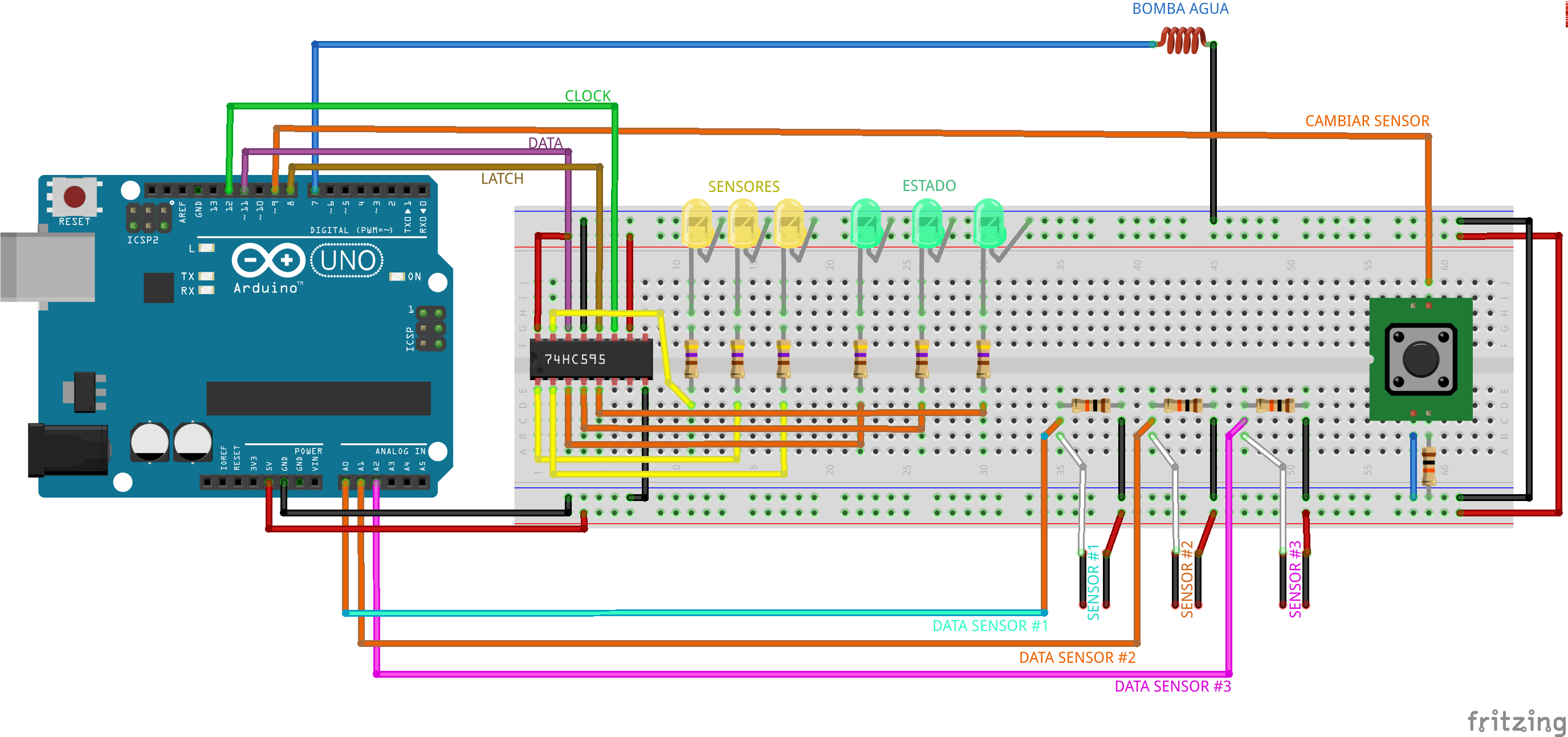
Se tratara de utilizar elementos reciclados siempre que sea posible y se tratara de abaratar costos y enfocarse no en la exactitud del dispositivo, sino mas bien el uso de herramientas comunes que nos permitan conocer mas sobre los componentes y su funcionamiento. Como por ejemplo, al utilizar los clavos para medir la humedad de la tierra, estamos creando una resistencia variable, basada en la conductividad de la tierra, la cual es mayor cuando esta humeda, y menor cuando esta seca.
**Medidor de Humedad del sustrato: **
Sistema de riego por goteo:
Interfaz de usuario:
https://www.arduino.cc/en/Tutorial/ShiftIn https://www.arduino.cc/en/Tutorial/ShiftOut https://www.arduino.cc/reference/en/language/functions/math/constrain/ https://www.arduino.cc/reference/en/language/functions/math/map/ https://www.arduino.cc/reference/en/language/functions/analog-io/analogread/
| Qty | Value | Footprint | References |
|---|---|---|---|
| 5 | LED | LEDs:LED-5MM | D1, D2, D3, D4, D5 |
| 4 | R_Small | Resistors_SMD:R_0805_HandSoldering | R1, R3, R4, R5 |
| 1 | 220ohm | Resistors_SMD:R_0805_HandSoldering | R2 |
| 1 | 74HC595 | SMD_Packages:SO-16-N | U1 |
It measures 27.9 × 62.2 mm and has 2 copper layers, 1.6 mm thick.
11 parts, built around the 74HC595. The full list of its parts is on this page, with links to each part's symbol and footprint where PCBKit's library has them.
From the Cambalab/arduinoponia repository on GitHub, at the commit this page was made from: the board is kicads/memeplanta/memeplanta.kicad_pcb. PCBKit opens the board in the browser, with nothing to install.
Its repository publishes it under the GPL-3.0 licence: you may reuse it on that licence's terms (keep the author's notice, and for a copyleft licence share your changes alike).
tardate/LittleArduinoProjects
a collection of "Little Electronic & Arduino Projects", most involving electronics or an Arduino in one way or another!

ChrisChrisLoLo/beyblock20
The magnetic, modular, 20-key macropad that can join together to form an ortholinear board

slu4coder/Minimal-64x4-Home-Computer
My DIY TTL home computer with VGA and PS/2 and 4x the processing power of a Commodore C64 or Apple II.

electroniceel/protoboard
Advanced protoboard layout with 1.27mm pitch for smd parts

TobleMiner/DC-UPS
A small DC UPS, designed to keep small appliances like consumer network equipment running during power outages


