4 layers100 × 132.5 mm
IcE1usb panel
osmocom/osmo-e1-hardware
Osmocom open source E1 (TDM) hardware; mirror of https://gitea.osmocom.org/retronetworking/osmo-e1-hardware
240 parts9
 electroniceel/protoboard311
Advanced protoboard layout with 1.27mm pitch for smd parts
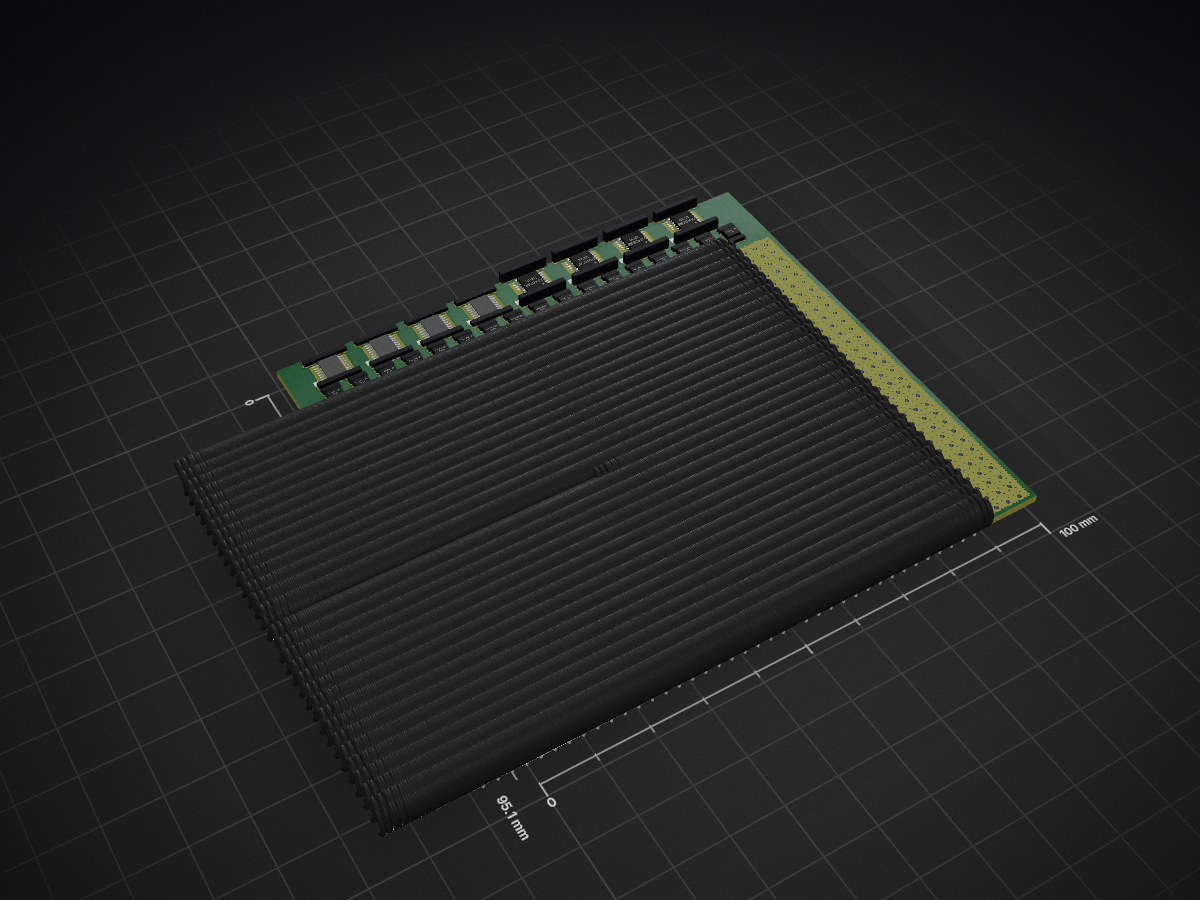
Protoboard-6x4-breakout is an open-source printed circuit board by electroniceel, from the electroniceel/protoboard repository on GitHub, published under the CC-BY-4.0 licence. It is a 2-layer board of 100 × 95.1 mm with 4,745 parts on 31 nets, routed with 1,404 tracks and 98 vias.
It is built around the IP4220CZ6 and 74HC595. Its parts include 21 ICs and 16 connectors. It belongs with the interfaces and adapters boards of this library.


|  |
 |

These packages can be directly used without adapter:
Adapters to 1.27mm pitch smd are provided for these packages:
My original design uses the 1.27mm pattern on both sides. For some analog and RF circuits I wanted a better GND plane. So I made a variant with a near-solid GND plane on the bottom side.
|  |
 |
Chinese pcb manufacturing services became so cheap even for small quantities that it's easiest for you to order the protoboards there for yourself.
When I began designing these boards, I ordered samples from Elecrow and JLCPCB and both came out fine. But when ordering some new boards, JLCPCB now declined to manufacture them with (cheap) HASL surface finish and only wanted to manufacture them if I switched to (more expensive) ENIG. They explained that the HASL process might leave small solder blobs on the surface creating shorts. Elecrow continued to manufacture them without any issues.
So I recommend to order the boards from Elecrow.
Finished gerber zips ready for ordering can be found in the "gerber" directory.
If you prefer another layout, see below.
For the variant with GND plane on the bottom:
Populating this protoboard needs obviously a bit more care than regular protoboard. Here are some tips to get you started.
Use a smaller soldering tip than usual, I prefer a 1.2mm chisel type (JBC C245-906).
Reduce the soldering temperature to drag traces. I prefer 295°C for Sn60Pb40 solder with my JBC station, other stations may need it slightly hotter.
The lower temperature makes the solder flow less liquid and so it is a bit easier to control where it should flow and where not. So you can drag the solder blobs around a bit. If the solder doesn't want to make the connection you need, take the tip away and let the spot cool for about 5 seconds. Then try again.
This needs a bit of getting used to as it is completely different than populating boards with pads etched to match the circuit where you usually want heat transfer as fast and even as possible.
This layout might not fit everyones needs. Here are some other protoboard designs with a grid of 1.27mm or lower:

This work is licensed under a Creative Commons Attribution 4.0 International License.
Please link to http://git.io/vNUDX for attribution.
| Qty | Value | Footprint | References |
|---|---|---|---|
| 68 | SIL-3-1mm | , , , , , , , , , , , , , , , +52 | |
| 17 | IP4220CZ6 | SOT-363 | U10, U10, U10, U10, U10, U10, U10, U10, U10, U10, U10, U10, U10, U10, U10, U10 +1 |
| 16 | CONN_01X08 | modules:8pin-1.27-pitch | J1, J1, J1, J1, J1, J1, J1, J1, J2, J2, J2, J2, J2, J2, J2, J2 |
| 8 | SIL-7-1mm | , , , , , , , | |
| 8 | modules:7pin-1.27-pitch | , , , , , , , | |
| 4 | SSOP14 | , , , | |
| 4 | 74HC595 | Housings_SSOP:TSSOP-16_4.4x5mm_Pitch0.65mm | U11, U11, U11, U11 |
The 125 most common of 4,745 parts.
It measures 100 × 95.1 mm and has 2 copper layers, 1.6 mm thick.
4,745 parts, built around the IP4220CZ6 and 74HC595. The full list of its parts is on this page, with links to each part's symbol and footprint where PCBKit's library has them.
From the electroniceel/protoboard repository on GitHub, at the commit this page was made from: the board is kicad/protoboard-6x4-breakout.kicad_pcb. PCBKit opens the board in the browser, with nothing to install.
Its repository publishes it under the CC-BY-4.0 licence: you may reuse it on that licence's terms (keep the author's notice, and for a copyleft licence share your changes alike).
osmocom/osmo-e1-hardware
Osmocom open source E1 (TDM) hardware; mirror of https://gitea.osmocom.org/retronetworking/osmo-e1-hardware


electroniceel/stm32....c-breakout
A breakout module for STM32 microcontrollers in LQFP48 and UFQFPN48 footprint.


NTNU-TDT4295/BRICOLEUR
This is the collision detection group's final submission for the course TDT4295 Computer Design Project 2018. This course aims to give students an introduction to the process of designing physical computer solutions…