4 layers140.5 × 58.6 mm

 butzist/phoniesp3211
A kid-friendly jukebox powered by the ESP32
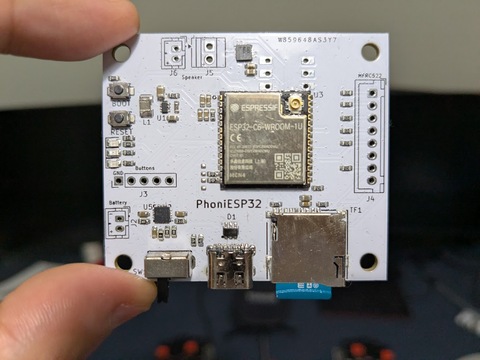
Phoniesp32 is an open-source printed circuit board by butzist, from the butzist/phoniesp32 repository on GitHub, published under the MIT licence. It is a 4-layer board of 57.4 × 49.9 mm with 82 parts on 65 nets, routed with 519 tracks and 368 vias.
It is built around the MAX98357AETE+T, BQ24073RGTR and ESP32-C6-WROOM-1U-N4, with the TS-1088-AR02016, B2B-PH-K-S(LF)(SN) and B8B-XH-A(LF)(SN) among its other parts. Its parts include 29 resistors, 15 capacitors, 6 connectors, 5 ICs and 4 diodes. It belongs with the ESP32 and RISC-V boards of this library.


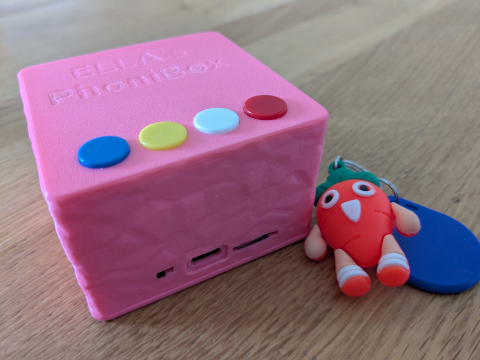
A kid-friendly jukebox powered by the ESP32, inspired by Phoniebox. Unlike the original Raspberry Pi–based version, phoniesp32 is designed to be battery-operated, low-power, and ultra-portable.
⚠️ Work in Progress — Contributions, ideas, and wiring tips are very welcome!
Download Firmware (download the
firmware artifact from the latest run on main)
embassy
async embedded framework.I'm grateful to PCBWay for sponsoring this project!
The PCB and assembly quality was excellent, and their BOM review caught a few mistakes I made in component selection — super helpful. I used the sponsorship to fix minor bugs from v1 (charging indicator) and produce a version that can be hand soldered. I opted for partial assembly (resistors, capacitors, LEDs) and am practicing soldering connectors and ICs myself. Update and tutorial TBD — while waiting, check out my project on PCBWay's shared project platform.

dioxus: Support sass:color.channel()mfrc522: async / IRQ support implemented in
mfrc522-asyncWant to help build the cheapest, most fun, and hackable jukebox for kids?
PRs, issues, and ideas are always welcome!
MIT License — free to use, hack, and share.
| Qty | Value | Footprint | References |
|---|---|---|---|
| 14 | TestPoint | TestPoint:TestPoint_Pad_D1.0mm | TP1, TP2, TP3, TP4, TP5, TP6, TP7, TP8, TP9, TP10, TP11, TP12, TP13, TP14 |
| 8 | 47kΩ | JLCPCB:R_0603_Label | R19, R23, R24, R25, R26, R27, R28, R29 |
| 5 | 10kΩ | JLCPCB:R_0603_Label | R3, R14, R15, R17, R18 |
| 4 | 100nF | JLCPCB:C_0603_Label | C7, C9, C10, C13 |
| 4 | 1uF | JLCPCB:C_0603_Label | C1, C11, C16, C17 |
| 3 | 0Ω | JLCPCB:R_0603_Label | R20, R21, R22 |
| 3 | 22uF | JLCPCB:C_0603_Label | C4, C6, C8 |
| 2 | 1.5kΩ | JLCPCB:R_0603_Label | R5, R12 |
| 2 | 22Ω | JLCPCB:R_0603_Label | R10, R11 |
| 2 | 4.7uF | JLCPCB:C_0603_Label | C2, C3 |
| 2 | 470Ω | JLCPCB:R_0603_Label | R6, R7 |
| 2 | Tactile Button, 160gf | PCM_JLCPCB:SW_TS-1088-AR02016 | S1, S2 |
| 1 | 10uF | JLCPCB:C_0603_Label | C12 |
| 1 | 150Ω | JLCPCB:R_0603_Label | R16 |
| 1 | 200Ω | JLCPCB:R_0603_Label | R13 |
| 1 | 2x1.5kΩ | JLCPCB:R_0603_Label | R4 |
| 1 | 2x5.1kΩ | JLCPCB:R_0603_Label | R1 |
| 1 | 47uF | PCM_JLCPCB:C_0805 | C5 |
| 1 | 5.1kΩ | JLCPCB:R_0603_Label | R2 |
| 1 | 510kΩ | JLCPCB:R_0603_Label | R8 |
| 1 | 91kΩ | JLCPCB:R_0603_Label | R9 |
| 1 | BQ24073RGTR | JLCPCB:QFN-16_L3.0-W3.0-P0.50-TL-EP1.7 | U5 |
| 1 | Conn_01x02_Pin | Connector_JST:JST_PH_B2B-PH-K_1x02_P2.00mm_Vertical | J6 |
| 1 | Conn_01x08_Pin | Connector_JST:JST_XH_B8B-XH-A_1x08_P2.50mm_Vertical | J4 |
| 1 | Conn_Battery | Connector_JST:JST_PH_B2B-PH-K_1x02_P2.00mm_Vertical | J2 |
| 1 | Conn_Buttons | Connector_PinHeader_2.54mm:PinHeader_1x05_P2.54mm_Vertical | J3 |
| 1 | Connector, USB-TYPE-C-16P | PCM_JLCPCB:TYPE-C-SMD_HX-TYPE-C-16PIN | J1 |
| 1 | DFE252012P-1R0M=P2 | JLCPCB:L1008 | L1 |
| 1 | ESP32-C6-WROOM-1U-N4 | JLCPCB:WIFIM-SMD_28P-L19.2-W18.0-P1.27-TL | U3 |
| 1 | Green | PCM_JLCPCB:D_0805 | D4 |
| 1 | INMP411_MODULE | JLCPCB:INMP411_MODULE | U4 |
| 1 | MAX98357AETE+T | JLCPCB:TQFN-16_L3.0-W3.0-P0.50-BL-EP1.5 | U2 |
| 1 | Red | PCM_JLCPCB:D_0805 | D2 |
| 1 | SK12D07VG5 | JLCPCB:SW-TH_SK12D07VG5-1 | SW1 |
| 1 | Screw_Terminal_01x02 | TerminalBlock:TerminalBlock_Xinya_XY308-2.54-2P_1x02_P2.54mm_Horizontal | J5 |
| 1 | TF-CARD H1.8 | JLCPCB:TF-SMD_TF-CARD-H1.8 | TF1 |
| 1 | TPS631000DRLR | JLCPCB:SOT-583-8_L2.1-W1.2-P0.50-LS1.6-BL | U1 |
| 1 | USBLC6-2SC6 | JLCPCB:SOT-23-6_L2.9-W1.6-P0.95-LS2.8-BL | D1 |
| 1 | Yellow | PCM_JLCPCB:D_0805 | D3 |
The 78 most common of 82 parts.

Soulboy420/BP_flappyBird
Eigenständiger KiCad-10-Entwurf für das HAW-Bachelorprojekt. Der ursprüngliche Entwurf unter hardware/ und absichtliche Benutzerlöschungen wurden nicht überschrieben. Es wurde nichts bestellt, committed oder gepusht.


daedalus-ind/icarus-hardware
Hardware of the onboard flight computer for the Icarus rocket.

demik/quack
Bluetooth and ADB Mouse Converter for Macintosh 128/512/Plus, Apple Lisa and Apple IIc


NCSU-High-Powered-Rocketry-Club/FIRM-KiCad
Full and open hardware design for FIRM
It measures 57.4 × 49.9 mm and has 4 copper layers, 1.6 mm thick.
82 parts, built around the MAX98357AETE+T, BQ24073RGTR, ESP32-C6-WROOM-1U-N4 and TS-1088-AR02016. The full list of its parts is on this page, with links to each part's symbol and footprint where PCBKit's library has them.
From the butzist/phoniesp32 repository on GitHub, at the commit this page was made from: the board is pcb/PhoniESP32/PhoniESP32.kicad_pcb and its schematic pcb/PhoniESP32/I2S.kicad_sch. PCBKit opens the board in the browser, with nothing to install.
Its repository publishes it under the MIT licence: you may reuse it on that licence's terms (keep the author's notice, and for a copyleft licence share your changes alike).