Skip to the content
PCBKitNew board
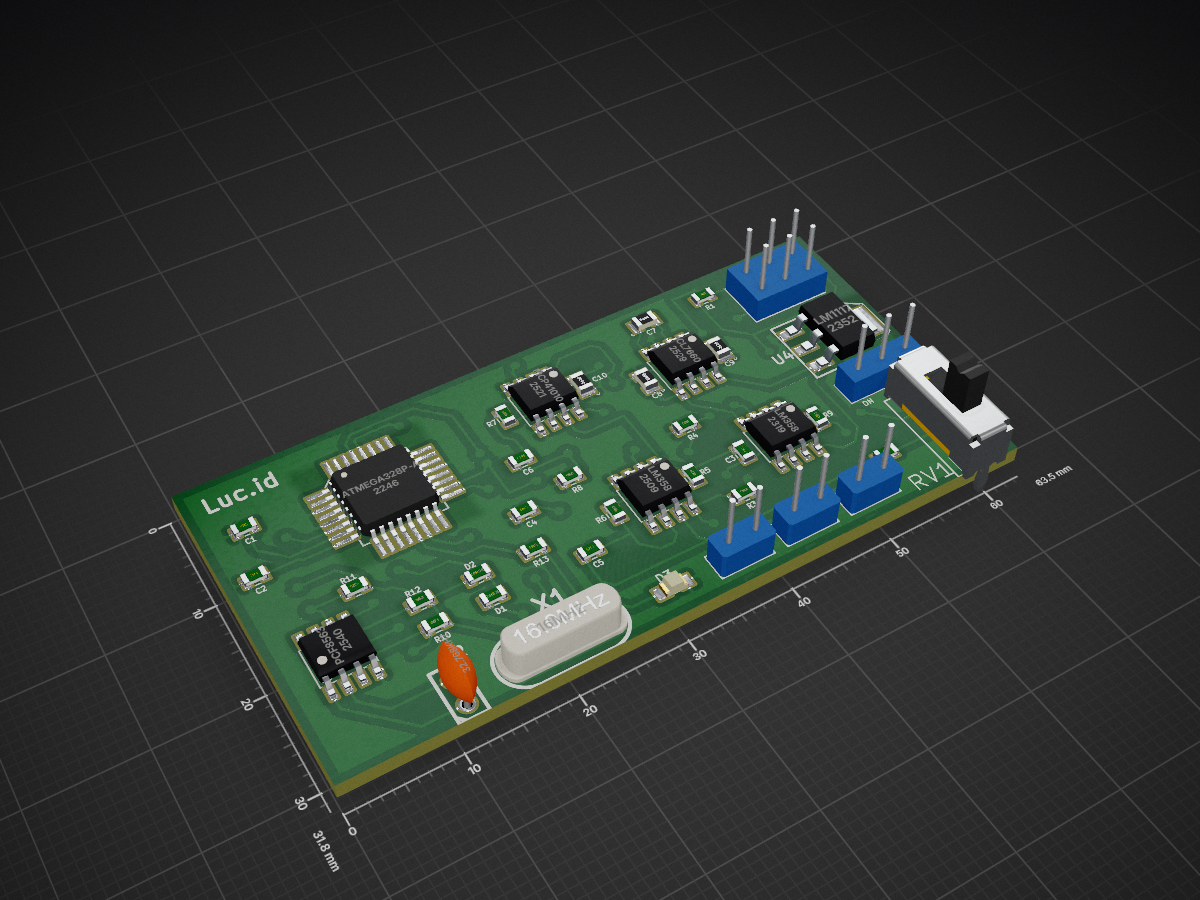
2 layers63.5 × 31.8 mmLucid, the printed circuit board in 3D

Everything that deals with my Lucid Dreaming project

Size
63.5 × 31.8 mm
Copper layers
2
Thickness
1.6 mm
Parts
41
Nets
36
Pads
150
Tracks, vias
401, 55
Pours
2
Routed
Yes
KiCad
KiCad 3
Created
30 Dec 2014
Updated
26 Apr 2015

Overview

Lucid is an open-source printed circuit board by breadboardbasics, from the breadboardbasics/Lucid repository on GitHub, published under the MIT licence. It is a 2-layer board of 63.5 × 31.8 mm with 41 parts on 36 nets, routed with 401 tracks and 55 vias.

It is built around the ATMEGA328P-AU, LM358 and ICL7660N, with the LM1117-3.3, MCP41010-E/P and PCF8563 among its other parts. Its parts include 13 resistors, 10 capacitors, 7 ICs, 3 diodes and 2 connectors. It belongs with the AVR (ATmega, ATtiny) boards of this library.

Main components

6

README

README.md

This is a repository for my Hackaday project here: http://hackaday.io/project/3715-tacs-lucid-dreaming-device

Thanks for checking out my project! To make everything easier just click the download zip button on the right side of the main page of this repository. Then extract everthing to a folder. Next you should be able to view the board and schematic files with KiCad or you can just view the schematic with the pdf that I included.

All code that is used in this project will also be posted in this repository and will be updated as I progress through the project.

Also for those wondering RevA (Revision A) is what I am calling the first version of the hardware. It is still a work in progress but is almost complete and ready for testing.

Disclaimer - I am not responsible for any damages or injury related to this project The project is very safe. It is battery powered and has a maximum of about 18v present on the board. Do not attempt to use the headset when it is connected to mains (the wall) in any way ex. you are powereing it with the programmer which is connected a desktop computer ect.
Parts

41
QtyValueFootprintReferences
610kSM0603R1, R2, R7, R10, R11, R12
4.22uFSM0603C3, C4, C5, C6
410uFSM0805C7, C8, C9, C10
213kSM0603R5, R6
22.2kSM0603R3, R4
222pFSM0603C1, C2
2BATTERYPIN_ARRAY_2X1BT1, BT2
2DIODESM0603D1, D2
2LM358so-8U1, U2
110MSM0603R8
116MHzHC-49VX1
12.5kSM0603R9
120kTRIMPOT_VRV1
13.3kSM0603R13
132.768kHzC1X2
1ATMEGA328P-ATQFP32IC1
1ELECTODESPIN_ARRAY_2X1P2
1ICL7660so-8U5
1ICSPpin_array_3x2P1
1LEDLED-0805D3
1LM1117SOT223U4
1MCP41010so-8U3
1PCF8563so-8U6
1Power SwitchPIN_ARRAY_3X1SW1

Questions

How big is the Lucid PCB?

It measures 63.5 × 31.8 mm and has 2 copper layers, 1.6 mm thick.

What parts does the Lucid use?

41 parts, built around the ATMEGA328P-AU, LM358, ICL7660N and LM1117-3.3. The full list of its parts is on this page, with links to each part's symbol and footprint where PCBKit's library has them.

Where can I download the Lucid KiCad files?

From the breadboardbasics/Lucid repository on GitHub, at the commit this page was made from: the board is RevA.kicad_pcb. PCBKit opens the board in the browser, with nothing to install.

Can I use the Lucid design in my own project?

Its repository publishes it under the MIT licence: you may reuse it on that licence's terms (keep the author's notice, and for a copyleft licence share your changes alike).

Similar boards

  • 2 layers56.8 × 68.6 mmEmg, the printed circuit board in 3D

    Emg

    leikoilja/muscle-imbalance-detection

    A device to assist patients with the rehabilitation of the knee joint after a knee surgery using EMG biofeedback. The device can reliably detect muscle activity and display it in an easy-to-use mobile application.

    84 parts6MIT
  • 4 layers73 × 32 mmIm converter, the printed circuit board in 3D

    Im converter

    Kononenko-K/Image-To-Scope-Converter

    Raster oscilloscope images generator from an arbitrary bitmap file.

    56 parts2
  • 2 layers81.3 × 101.6 mmApplied electronics multimeter, the printed circuit board in 3D

    Applied electronics multimeter

    Harpur01/applied-electronics-multimeter-pcb

    Portfolio project: custom Applied Electronics PCB multimeter using KiCad, ATmega328P, LCD display, Arduino code, and hardware test evidence.

    63 parts
  • 2 layers99.5 × 99.5 mmCarico elettronico, the printed circuit board in 3D

    Carico elettronico

    dario0603/electronic_load

    Un progetto open-source per la progettazione e simulazione di un Carico Elettronico Bipolare (Electronic Load), ideato per il test e la caratterizzazione di alimentatori, batterie e circuiti di potenza.

    92 parts
  • 2 layersVhf uhf IQ Modulator, the printed circuit board in 3D

    Vhf uhf IQ Modulator

    antonjan/IQ_Modulator

    IQ Modulator for 2M and 70cm from I2C and ALSA PCM Audio on Orange PI Zero (Estimated TX Power 500mW)

    88 parts7GPL-3.0
  • 2 layers65.5 × 57.2 mmEspclock3, the printed circuit board in 3D

    Espclock3

    victor-chew/espclock3

    Internet-enabled Analog Clock using ESP8266 and ATtiny85

    26 parts3Apache-2.0
  • 2 layers45.8 × 37.2 mmPCF8563 RTC, the printed circuit board in 3D

    PCF8563 RTC

    RedonTahiri/PCF8563_module

    A PCB module with the PCF8563 RTC.

    28 parts
  • 2 layers25.5 × 27.9 mmMicroduino RTC DE, the printed circuit board in 3D

    Microduino RTC DE

    r-map/rmap

    rete monitoraggio ambientale partecipativo documentation at https://doc.rmap.cc

    16 parts55