2 layers126.3 × 71.1 mm
 bornhack/badge202012
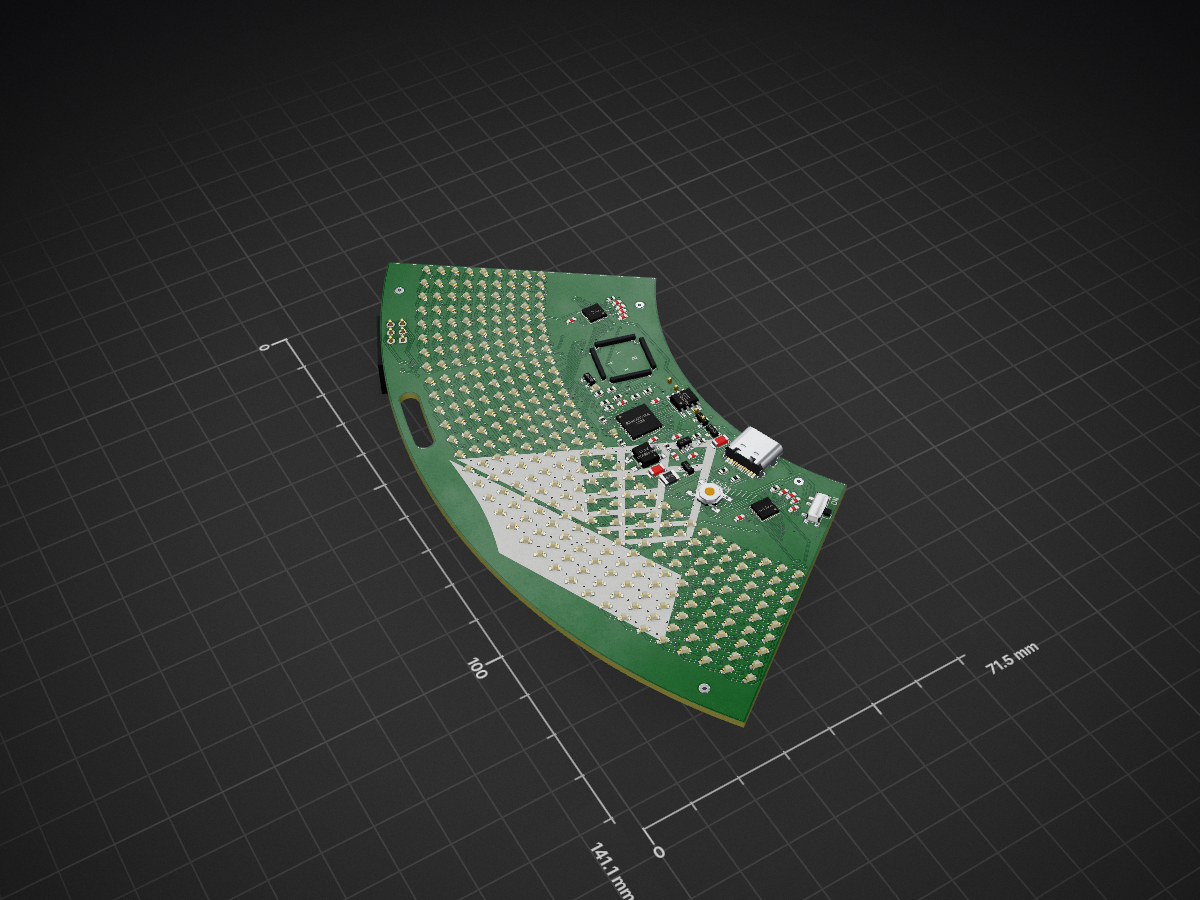
BornHack Badge 2020
Charliedistance is an open-source printed circuit board by bornhack, from the bornhack/badge2020 repository on GitHub, published under the CC-BY-SA-4.0 licence. It is a 2-layer board of 120 × 141.1 mm with 362 parts on 101 nets, routed with 2,990 tracks and 459 vias.
It is built around the PA16, GD25Q32C and HX9193-33GB, with the BC817, CJ2302 and CJ2305 among its other parts. Its parts include 290 diodes, 18 capacitors, 16 resistors, 7 ICs and 6 switches. It belongs with the lEDs and displays boards and the SAM D and SAM boards of this library.


Similar to the last couple of years, this badge has an ARM cortex M0+ as the main controller, but on this badge it's the SAMD21 from Microchip, with 4 times as much flash and RAM compared to the chips from the previous badges.
This makes it possible to run Adafruit CircuitPython on this badge, which lowers the
bar for how easy it is to get started hacking on the badge, since all you need is a
USB cable to connect it to your computer and an editor (vi, nano, VSCode, notepad,
you name it) to change the code.py file on the badge. No need to have a tool chain
installed on your computer, it's all happening on the badge when you save the file.
To start making your badge your own, you can connect it via USB and a mass storage
device should show up with a code.py file in the root directory.
If you open that file in your favorite text editor you will find a few lines first that loads some libraries, then some initialisation of the LED drivers and on line 20 you will find an assignment of a string variable with the scrolling text shown on the LED matrix. To put eg. your name on the badge, you can change this text and save the file, and after a few seconds, the badge will restart the code and your text should be slowly scrolling across the "screen".
If you have gotten this far you are up and running with your first "hack" of the 2020 BornHack badge and you can continue with more elaborate hacking.
| Qty | Value | Footprint | References |
|---|---|---|---|
| 288 | LED_Small_ALT | Opto:LED_0603_Clean | D1, D10, D11, D100, D101, D102, D103, D104, D105, D106, D107, D108, D109, D110, D111, D112 +272 |
| 5 | 100nF | Capacitors_SMD:C_0603 | C2, C3, C5, C6, C9 |
| 5 | 10uF | Capacitors_SMD:C_0603 | C10, C12, C13, C14, C15 |
| 5 | 1uF | Capacitors_SMD:C_0603 | C1, C4, C7, C8, C11 |
| 5 | 4.7k | Resistors_SMD:R_0603 | R3, R9, R11, R12, R13 |
| 2 | 100 | Resistors_SMD:R_0603 | R8, R16 |
| 2 | 100uF | Capacitors_SMD:C_1206 | C16, C17 |
| 2 | 1k | Resistors_SMD:R_0603 | R7, R15 |
| 2 | 20k | Resistors_SMD:R_0603 | R1, R2 |
| 2 | 5.1k | Resistors_SMD:R_0603 | R5, R6 |
| 2 | AA | Power:Single_AA | BT1, BT2 |
| 2 | IS31FL3731-QF | Housings_DFN_QFN:QFN-28-1EP_4x4mm_Pitch0.4mm | U1, U2 |
| 1 | 100k | Resistors_SMD:R_0603 | R14 |
| 1 | 10k | Resistors_SMD:R_0603 | R10 |
| 1 | 2.2uF | Capacitors_SMD:C_0603 | C18 |
| 1 | 47uH | Inductors_SMD:L_1210 | L1 |
| 1 | 6.8k | Resistors_SMD:R_0603 | R4 |
| 1 | A | Buttons:SW_SPST_TS3625A-HT | SW2 |
| 1 | B | Buttons:SW_SPST_TS3625A-HT | SW3 |
| 1 | BC817 | TO_SOT_Packages_SMD:SOT-23 | Q3 |
| 1 | Badgelife_sao_connector_v169bis | badgelife_sao_v169bis:Badgelife-SAOv169-BADGE-2x3 | X1 |
| 1 | CJ2302 | TO_SOT_Packages_SMD:SOT-23 | Q1 |
| 1 | CJ2305 | TO_SOT_Packages_SMD:SOT-23 | Q2 |
| 1 | DEBUG | Pin_Headers:Pin_Header_Straight_1x06_Pitch2.54mm | J2 |
| 1 | GD25Q32C | Housings_SOIC:SOIC-8-1EP_3.9x4.9mm_Pitch1.27mm | U4 |
| 1 | HX9193-33GB | TO_SOT_Packages_SMD:SOT-23-5 | U3 |
| 1 | IR19-21C/TR8(AQL) | Opto:LED_0603_Clean | D290 |
| 1 | IRM-H6xxT | Opto:IRM-H6xxT | U6 |
| 1 | LED | Opto:LED_0603_Clean | D289 |
| 1 | LOGO | Aesthetics:bh2020_make_clean_silk | G*** |
| 1 | LOGO | Aesthetics:bh2020_logo_2_silk | G*** |
| 1 | PA0 | Connectors:TestPoint_Large | TP1 |
| 1 | PA1 | Connectors:TestPoint_Large | TP2 |
| 1 | PA16 | Connectors:TestPoint_Large | TP14 |
| 1 | PA17 | Connectors:TestPoint_Large | TP13 |
| 1 | PA18 | Connectors:TestPoint_Large | TP12 |
| 1 | PA19 | Connectors:TestPoint_Large | TP11 |
| 1 | PA2 | Connectors:TestPoint_Large | TP3 |
| 1 | PA28 | Connectors:TestPoint_Large | TP10 |
| 1 | PA3 | Connectors:TestPoint_Large | TP4 |
| 1 | PA6 | Connectors:TestPoint_Large | TP6 |
| 1 | PA7 | Connectors:TestPoint_Large | TP7 |
| 1 | PB2 | Connectors:TestPoint_Large | TP9 |
| 1 | PB3 | Connectors:TestPoint_Large | TP8 |
| 1 | PB9 | Connectors:TestPoint_Large | TP5 |
| 1 | POWER | Buttons_Switches_SMD:SW_SPDT_PCM12 | SW6 |
| 1 | QX2304 | TO_SOT_Packages_SMD:SOT-23 | U5 |
| 1 | RESET | Buttons_Switches_SMD:SW_SPST_TL3342 | SW1 |
| 1 | SAMD21G18A | Housings_DFN_QFN:QFN-48-1EP_7x7mm_Pitch0.5mm | IC1 |
| 1 | USB_C | Connectors:USB_C_Receptacle_U262-161N-4BVC11 | J1 |
| 1 | X | Buttons:SW_SPST_TS3625A-HT | SW4 |
| 1 | Y | Buttons:SW_SPST_TS3625A-HT | SW5 |
It measures 120 × 141.1 mm and has 2 copper layers, 1.6 mm thick.
362 parts, built around the PA16, GD25Q32C, HX9193-33GB and BC817. The full list of its parts is on this page, with links to each part's symbol and footprint where PCBKit's library has them.
From the bornhack/badge2020 repository on GitHub, at the commit this page was made from: the board is charliedistance.kicad_pcb. PCBKit opens the board in the browser, with nothing to install.
Its repository publishes it under the CC-BY-SA-4.0 licence: you may reuse it on that licence's terms (keep the author's notice, and for a copyleft licence share your changes alike).

flummer/dmm-sao
A small digital multimeter specifically for measuring SAO related stuff

bornhack/badge2025
This badge focuses on LoRa and wireless communication in general, as there are also WiFi and Bluetooth Low Energy included in the ESP32-C3 module.


BHDynamics/dynossat-edu-obc
DynOSSAT-EDU, educational PocketQube satellite On-Board Computer files


