6 layers90.1 × 135 mm
 blaizard/bzd14
Fullstack, lightweight and flexible framework for IoT applications
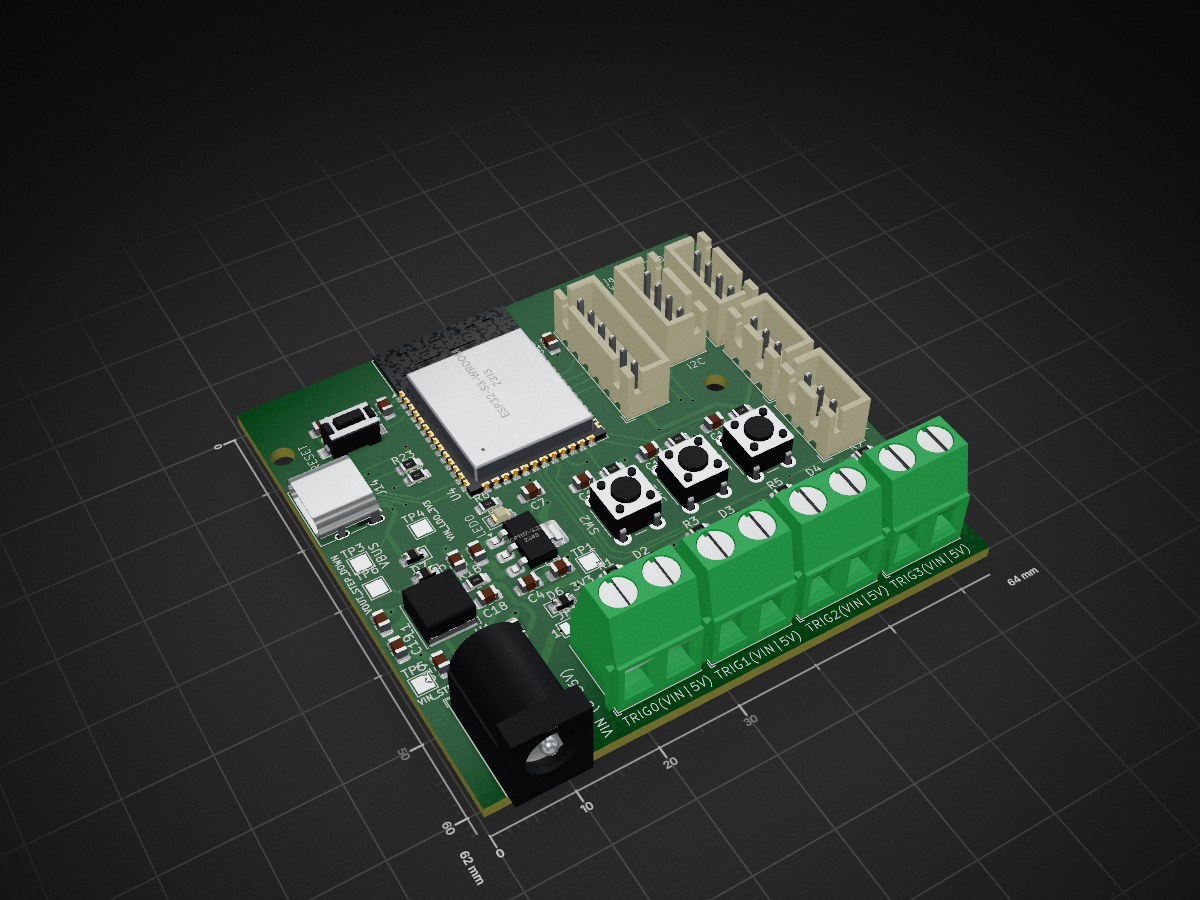
Jardinier2000 is an open-source printed circuit board by blaizard, from the blaizard/bzd repository on GitHub. It is a 2-layer board of 64 × 62 mm with 72 parts on 64 nets, routed with 528 tracks and 38 vias.
It is built around the ESP32-S3-WROOM-1-N8 and AO3400A. Its parts include 17 resistors, 15 capacitors, 11 connectors, 7 diodes and 4 transistors. It belongs with the home automation and IoT boards and the ESP32 boards of this library.


Access the rendered version of this documentation.
Fullstack, lightweight and flexible framework for IoT applications. This mono-repository enables the following technologies:
| C++20 | Rust (2024) | Python 3.13 | Node (v23) | Vue | Bazel | KiCad |
|---|---|---|---|---|---|---|
 |  |  |  |  |  |  |
This framework is built to run on all sorts of embedded platforms, from bare-metal 8-bit microcontrollers to high-performance compute units. It is made to remove any dependency on the STL, but to provide a similar set of components and utilities to develop applications in an efficient and safe manner.
It features the following:
The following target platforms are currently supported:
| Name | Compiler | Version | Executors | Debug |
|---|---|---|---|---|
| linux_x86_64_clang* | clang | 19.1.7 | host* | |
| linux_x86_64_gcc | gcc | 14.2.0 | host* | |
| esp32_xtensa_lx6_gcc | gcc | 14.2.0 | sim*, uart | x |
| esp32s3_xtensa_lx7_gcc | gcc | 14.2.0 | sim*, uart | x |
* Default.
When debug is supported by the platform, one can run a target with the --config=debug option and a debug environment will
be made available.
To build everything, just run:
./tools/bazel test //...This will build locally; it will fetch all tools needed to build on your machine.
To build Bazel targets, simply run ./tools/bazel with --config=remote appended.
For debugging purposes, toolchains can be run locally in a docker sandbox which is very similar to what runs on remote execution.
To enable this configuration, run ./tools/bazel with --config=docker.
To build the full project documentation, run:
./tools/bazel run //docsAll supported languages come with their own set of code quality related tools. To run all static sanity checks, code formatters and documentation generators at once, run the following command:
./tools/bazel run //:sanitizerTo run all tests, run the following command:
./quality_gateThis is a non-exhaustive list of languages and their supported tools. In addition to that, formatters and linters for YAML, JSON and Markdown are also available.
| Language | Formatters | Code Analyzers | Code Coverage | Test Framework | Documentation |
|---|---|---|---|---|---|
| C++ | clang-format | clang-tidy, asan, lsan, tsan, ubsan | Yes | Yes | doxygen-based |
| Python | ruff | ruff, mypy | Yes | Yes | |
| Node | prettier | eslint | Yes | Yes | |
| Skylark | buildifier | buildifier | stardoc |
Update compile_commands.json
./tools/bazel run @bzd_sanitizer//aspects/compile_commands:buildUpdate rust-project.json
./tools/bazel run @rules_rust//tools/rust_analyzer:gen_rust_project -- //rust/...The code in this repository follows several principles regarding naming conventions. The following rules are applied across languages.
snake_case using only the characters matching the regex: [a-z0-9_/.]. This is enforced by tools/bazel_build/modules/bzd_sanitizer/actions/structure.camelCase.PascalCase._ character.All classes offered by this library share the same objective: a fixed memory size. Their footprint or maximum size is determined at compile time, ensuring no memory allocation at runtime, making this library ideal for any safety-critical application.
| Qty | Value | Footprint | References |
|---|---|---|---|
| 10 | 0.1u | Capacitor_SMD:C_0805_2012Metric_Pad1.18x1.45mm_HandSolder | C1, C2, C5, C6, C7, C13, C14, C15, C16, C18 |
| 8 | 10K | Resistor_SMD:R_0805_2012Metric_Pad1.20x1.40mm_HandSolder | R1, R3, R5, R7, R16, R17, R20, R21 |
| 6 | D_Schottky | Diode_SMD:D_0805_2012Metric_Pad1.15x1.40mm_HandSolder | D1, D2, D3, D4, D6, D7 |
| 4 | 100 | Resistor_SMD:R_0805_2012Metric_Pad1.20x1.40mm_HandSolder | R2, R4, R8, R9 |
| 4 | 10u | Capacitor_SMD:C_0805_2012Metric_Pad1.18x1.45mm_HandSolder | C3, C4, C19, C20 |
| 4 | AO3400A | Package_TO_SOT_SMD:SOT-23 | Q1, Q2, Q3, Q4 |
| 4 | SolderJumper_3_Open | Jumper:SolderJumper-3_P1.3mm_Open_Pad1.0x1.5mm_NumberLabels | JP1, JP2, JP3, JP4 |
| 4 | ~ | TerminalBlock_Phoenix:TerminalBlock_Phoenix_MKDS-1,5-2-5.08_1x02_P5.08mm_Horizontal | J1, J2, J3, J4 |
| 3 | SW_Push | Button_Switch_THT:SW_PUSH_6mm | SW4, SW5, SW6 |
| 2 | 5.1K | Resistor_SMD:R_0805_2012Metric_Pad1.20x1.40mm_HandSolder | R22, R23 |
| 2 | I2C | Connector_JST:JST_XH_B4B-XH-AM_1x04_P2.50mm_Vertical | J7, J11 |
| 1 | 100k | Resistor_SMD:R_0805_2012Metric_Pad1.20x1.40mm_HandSolder | R18 |
| 1 | 13.7k | Resistor_SMD:R_0805_2012Metric_Pad1.20x1.40mm_HandSolder | R19 |
| 1 | 1k | Resistor_SMD:R_0805_2012Metric_Pad1.20x1.40mm_HandSolder | R6 |
| 1 | 2.2u | Capacitor_SMD:C_0805_2012Metric_Pad1.18x1.45mm_HandSolder | C17 |
| 1 | 3.3uH & 3A | Inductor_SMD:L_Cenker_CKCS6028 | L1 |
| 1 | 3V3 | TestPoint:TestPoint_Pad_2.0x2.0mm | TP1 |
| 1 | ADC1_CH0 | Connector_JST:JST_XH_B3B-XH-AM_1x03_P2.50mm_Vertical | J5 |
| 1 | ADC2_CH0 | Connector_JST:JST_XH_B3B-XH-AM_1x03_P2.50mm_Vertical | J6 |
| 1 | Barrel_Jack_Switch | Connector_BarrelJack:BarrelJack_Horizontal | J12 |
| 1 | ESP32-S3-WROOM-1 | RF_Module:ESP32-S3-WROOM-1 | U4 |
| 1 | JTAG | Connector_JST:JST_XH_B6B-XH-AM_1x06_P2.50mm_Vertical | J9 |
| 1 | LED | LED_SMD:LED_0805_2012Metric_Pad1.15x1.40mm_HandSolder | D8 |
| 1 | LMR51430YDDCR | Package_TO_SOT_SMD:SOT-23-6 | U1 |
| 1 | LOGO | LOGO | G*** |
| 1 | NCP1117-3.3_SOT223 | Package_TO_SOT_SMD:SOT-223-3_TabPin2 | U2 |
| 1 | RESET | bzd:push_button_6x3 | SW3 |
| 1 | USB_C_Receptacle_USB2.0_16P | Connector_USB:USB_C_Receptacle_G-Switch_GT-USB-7010ASV | J14 |
| 1 | VBUS | TestPoint:TestPoint_Pad_2.0x2.0mm | TP3 |
| 1 | VIN_LDO_3V3 | TestPoint:TestPoint_Pad_2.0x2.0mm | TP4 |
| 1 | VIN_STEP_DOWN | TestPoint:TestPoint_Pad_2.0x2.0mm | TP5 |
| 1 | VOUT_STEP_DOWN | TestPoint:TestPoint_Pad_2.0x2.0mm | TP6 |
It measures 64 × 62 mm and has 2 copper layers, 1.6 mm thick.
72 parts, built around the ESP32-S3-WROOM-1-N8 and AO3400A. The full list of its parts is on this page, with links to each part's symbol and footprint where PCBKit's library has them.
From the blaizard/bzd repository on GitHub, at the commit this page was made from: the board is apps/jardinier2000/hardware/jardinier2000.kicad_pcb and its schematic apps/jardinier2000/hardware/jardinier2000.kicad_sch. PCBKit opens the board in the browser, with nothing to install.
Its repository states no licence, so its author keeps all rights: ask blaizard before reusing the design.

Circuit-Digest/Wireless-Stepper-Motor-Controller
The Wireless Stepper Driver is a compact and efficient motion control system designed to control stepper motors over Wi-Fi.

chl33/Plant133
Firmware, circuit design, and 3D-printable components for an automated plant-watering system.

maximus64/opendiag-hardware
OpenDIAG - Open Source OBD2 Interface (Hardware)

Pegoku/Monopoly-Electronic-V2
Gameplay focuses on NFC interaction instead of menus.

Visaging/ESP32-Gimbal
A high-performance, open-source 3-axis smartphone gimbal built from scratch using a custom PCB and the SimpleFOC library. It features real-time stabilization, native USB-C programming, and custom motion modes.

thePunderWoman/SnipsControllers
The controllers built to work with Amidala

Jankyneering/Waffle_hw
Hardware designs for Waffle, a compact Pager and general RF multitool.