2 layers28.3 × 39.8 mm
LevelShifter
gusmanb/logicanalyzer
24 channel, 100Msps logic analyzer hardware and software
21 parts5.1kGPL-3.0

 bl-instr/leak-cube
The Leak Cube is a compact, wireless instrumentation module in the Blinky-Lite Instrumentation Platform. It is designed to detect water leaks using long, low-cost resistive wire detectors, then communicate leak states…
Blinky cube is an open-source printed circuit board by bl-instr, from the bl-instr/leak-cube repository on GitHub, published under the MIT licence. It is a 2-layer board of 86.4 × 48.3 mm with 21 parts on 38 nets, routed with 78 tracks and 2 vias.
Its parts include 11 resistors, 4 capacitors, 3 connectors, 1 IC and 1 diode. It belongs with the RP2040 boards of this library.
Two-channel, wireless water-leak detection for wide-area coverage in remote equipment spaces, tunnels, basements, and other hard-to-reach locations.
| Enclosure | PCB | Installation |
|---|---|---|
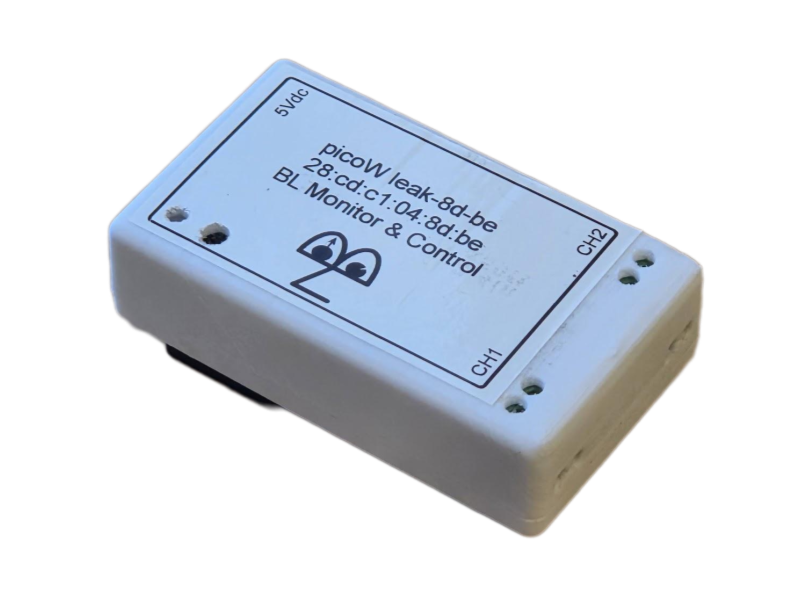 | 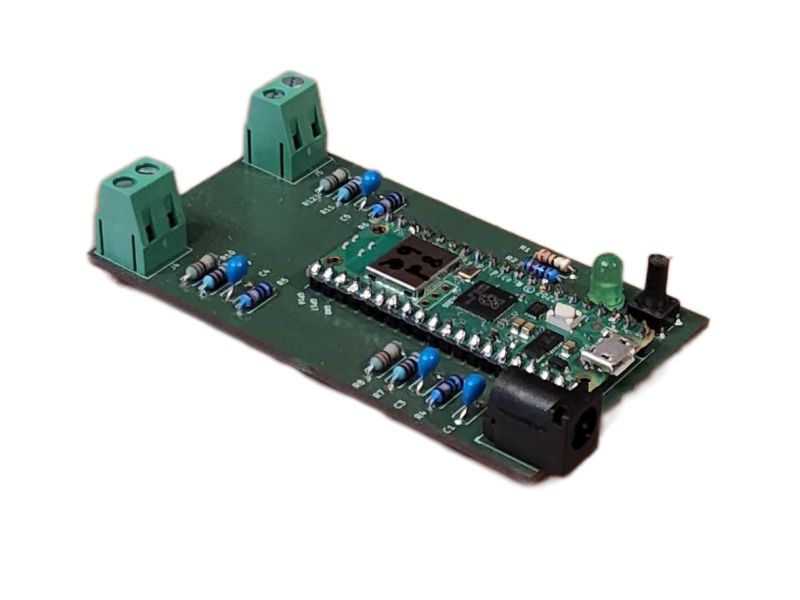 |  |
The Leak Cube is a compact, wireless instrumentation module in the Blinky-Lite Instrumentation Platform. It is designed to detect water leaks using long, low-cost resistive wire detectors, then communicate leak states and alarms to a central Blinky-Lite control system.
Each detector strip consists of two parallel thin stainless-steel wires embedded in a plastic mesh. When water bridges the wires, the resistance between them drops and the Leak Cube detects a leak. The strips can be many metres long, providing broad coverage along floors, cable routes, tunnels, basements, and other remote locations.
The high-impedance measurement network is sensitive to impedances on the order of 10 MΩ. This enables detection of small conductivity changes while also helping identify an open circuit caused by a damaged or cut detector strip.
Built around the Raspberry Pi Pico W / RP2040, the module uses 2.4 GHz Wi-Fi and MQTT publish/subscribe communication. This event-driven approach supports distributed deployments without wired data connections and enables Blinky-Lite to use device information for recording, notifications, visualisation, and machine-protection workflows.
| Specification | Details |
|---|---|
| Primary function | Resistive water-leak detection and detector-integrity monitoring |
| Sensor / interface | Parallel thin stainless-steel wire detector strips embedded in plastic mesh |
| Channels | Two independent leak-detection channels |
| Detection principle | Water bridging parallel detector wires lowers the measured resistance |
| Measurement sensitivity | Impedances on the order of 10 MΩ |
| Detector coverage | Detector strips can be many metres long |
| Detector integrity | Open-circuit detection can indicate a damaged or cut wire detector |
| Inputs / outputs | 5 mm screw terminals for two-wire detector-strip connections |
| Power input | 5 V DC via 2.1 mm barrel connector |
| Wireless | 2.4 GHz Wi-Fi |
| Communication | MQTT publish/subscribe protocol |
| Controller | Raspberry Pi Pico W / RP2040 |
| PCB dimensions | 48 mm × 86 mm |
| Enclosure and mounting | 53 mm × 93 mm × 25 mm; DIN Mod3-compatible enclosure with removable DIN-rail mount |
| Platform | Blinky-Lite Instrumentation Platform |
The firmware targets the Raspberry Pi Pico W / RP2040 using the Arduino-Pico board support.
The firmware is released under the MIT License, giving users broad permission to study, modify, and adapt the code for their own applications. The open hardware design can likewise be customised to suit site-specific requirements. The firmware uses the open-source Arduino-BlinkyPicoW library, which is also available under the MIT License.
The Leak Cube uses MQTT to publish detector states, leak events, and detector-fault events. This event-driven model avoids conventional polling and enables prompt control-system responses to changing conditions.
In a typical deployment, the device connects by Wi-Fi to the network and communicates through an MQTT broker. Blinky-Lite represents it as an integrated instrumentation node and can use its information for recording, display, notification, alarms, and machine-protection logic.
| Qty | Value | Footprint | References |
|---|---|---|---|
| 4 | 1uF | Capacitor_THT:C_Disc_D4.7mm_W2.5mm_P5.00mm | C1, C3, C4, C5 |
| 3 | 100k | Resistor_THT:R_Axial_DIN0207_L6.3mm_D2.5mm_P7.62mm_Horizontal | R4, R5, R6 |
| 3 | 120k | Resistor_THT:R_Axial_DIN0207_L6.3mm_D2.5mm_P7.62mm_Horizontal | R8, R10, R12 |
| 3 | 82k | Resistor_THT:R_Axial_DIN0207_L6.3mm_D2.5mm_P7.62mm_Horizontal | R7, R9, R11 |
| 2 | Screw_Terminal_01x02 | TerminalBlock_Phoenix:TerminalBlock_Phoenix_MKDS-3-2-5.08_1x02_P5.08mm_Horizontal | J4, J5 |
| 1 | 10k | Resistor_THT:R_Axial_DIN0207_L6.3mm_D2.5mm_P7.62mm_Horizontal | R2 |
| 1 | 220 | Resistor_THT:R_Axial_DIN0207_L6.3mm_D2.5mm_P7.62mm_Horizontal | R1 |
| 1 | Barrel_Jack_Switch | Connector_BarrelJack:BarrelJack_Horizontal | J2 |
| 1 | LED | LED_THT:LED_D5.0mm | D1 |
| 1 | Pico | MCU_RaspberryPi_and_Boards:RPi_Pico_SMD_TH | U1 |
| 1 | SW_Push | Button_Switch_THT:SW_PUSH_6mm | SW1 |
It measures 86.4 × 48.3 mm and has 2 copper layers, 1.6 mm thick.
21 parts. The full list of its parts is on this page, with links to each part's symbol and footprint where PCBKit's library has them.
From the bl-instr/leak-cube repository on GitHub, at the commit this page was made from: the board is schematics/kiCad/blinky-cube.kicad_pcb and its schematic schematics/kiCad/blinky-cube.kicad_sch. PCBKit opens the board in the browser, with nothing to install.
Its repository publishes it under the MIT licence: you may reuse it on that licence's terms (keep the author's notice, and for a copyleft licence share your changes alike).
gusmanb/logicanalyzer
24 channel, 100Msps logic analyzer hardware and software

mntmn/amiga2000-gfxcard
MNT VA2000, an Open Source Amiga 2/3/4000 Graphics Card (Zorro II/III), written in Verilog


hackclub/OnBoard
💡 Join 1,000 teenagers and make your first PCB with a $100 grant!

drandyhaas/KiCadRoutingTools
A set of Python/Rust tools to aid routing in KiCad

Arrow-air/project-quiver
Project Quiver documentation, designs, and project artifacts.

