
2 layers68.8 × 53.6 mm
Relatively Universal ROM Programmer
AndersBNielsen/Relatively-Universal-ROM-Programmer
Hardware to program W27C512 EEPROM or any 24/28/32 pin ROM requiring from 5V to 27V programming voltage.
149 parts257GPL-3.0

 bitbank2/RPI_UNO_Shield2
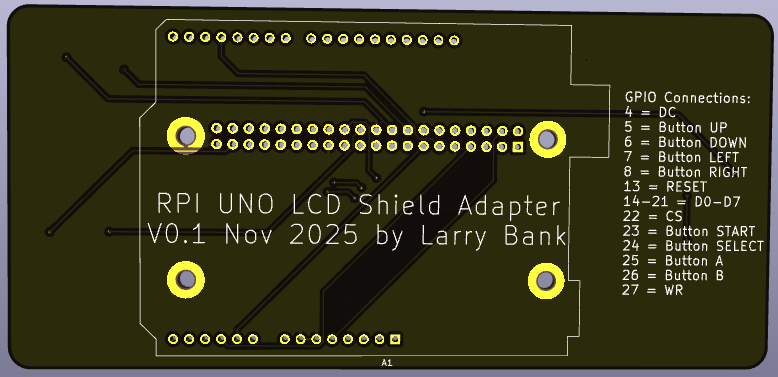
A KiCad project for a RPI HAT to use old 8-bit parallel Arduino UNO LCD shields
RPI UNO Shield is an open-source printed circuit board by bitbank2, from the bitbank2/RPI_UNO_Shield repository on GitHub, published under the Apache-2.0 licence. It is a 2-layer board of 122.9 × 58.2 mm with 13 parts on 53 nets, routed with 193 tracks and 14 vias.
It is built around the ARDUINO UNO R3. It belongs with the AVR (ATmega, ATtiny) boards of this library.
A PCB to use old Arduino LCD Shields with Raspberry Pi SBCs
This project is possible because of the fast, parallel GPIO capability of RPIs (except the RPI5). It allows inexpensive LCD displays to run at higher speeds than are possible with the SPI interface.
| Qty | Value | Footprint | References |
|---|---|---|---|
| 8 | SW_Push | Button_Switch_SMD:SW_Push_1P1T_NO_Vertical_Wuerth_434133025816 | BUTTON_A1, BUTTON_B1, DOWN1, LEFT1, RIGHT1, SELECT1, START1, UP1 |
| 2 | R_Pack04_SIP | Resistor_SMD:R_Array_Convex_4x0603 | RN1, RN2 |
| 1 | Arduino_UNO_R3 | Module:Arduino_UNO_R3 | A1 |
| 1 | QWIIC | Connector_JST:JST_SH_SM04B-SRSS-TB_1x04-1MP_P1.00mm_Horizontal | J2 |
| 1 | Raspberry_Pi_2_3 | Module:Raspberry_Pi_Zero_Socketed_THT_FaceDown_MountingHoles | J1 |
AndersBNielsen/Relatively-Universal-ROM-Programmer
Hardware to program W27C512 EEPROM or any 24/28/32 pin ROM requiring from 5V to 27V programming voltage.

AlanFord/self-balancing-stick
Dual Axis Reaction Wheel Inverted Pendulum

Edging-Machines/Edging-Machines
This repository is intended to contain as much information as possible about building, designing, prototyping, and using automated edging machines.

PedroCNeves/AC_ChargingStation
A learning project to create an EV AC Charging station based on an Arduino Uno

jonsag/arduTester
An arduino component tester based on https://create.arduino.cc/projecthub/plouc68000/ardutester-v1-13-the-arduino-uno-transistor-tester-dbafb4


ICRS/101
The all-new open source Robotics 101 course from ICRS. It's specifically designed to be run in hackspaces, after school clubs and university societies.

It measures 122.9 × 58.2 mm and has 2 copper layers, 1.6 mm thick.
13 parts, built around the ARDUINO UNO R3. The full list of its parts is on this page, with links to each part's symbol and footprint where PCBKit's library has them.
From the bitbank2/RPI_UNO_Shield repository on GitHub, at the commit this page was made from: the board is RPI_UNO_Shield.kicad_pcb and its schematic RPI_UNO_Shield.kicad_sch. PCBKit opens the board in the browser, with nothing to install.
Its repository publishes it under the Apache-2.0 licence: you may reuse it on that licence's terms (keep the author's notice, and for a copyleft licence share your changes alike).