2 layers101.6 × 53.3 mm

 bhatasaka/LUFA_AVRISP-MKII1
This repo contains the PCB and firmware configuration files for a compact USB-C programming board designed for LUFA's AVRISP-MKII firmware based on an ATMega16u2.
AVR ISPMKII is an open-source printed circuit board by bhatasaka, from the bhatasaka/LUFA_AVRISP-MKII repository on GitHub. It is a 2-layer board of 30 × 17.8 mm with 32 parts on 44 nets, routed with 314 tracks and 49 vias.
It is built around the ATMEGA16U2-MU and CPDER5V0U. Its parts include 10 capacitors, 9 resistors, 4 diodes, 3 ICs and 3 connectors. It belongs with the AVR (ATmega, ATtiny) boards of this library.

Custom PCB designed for the LUFA AVRISP-MKII Project https://github.com/abcminiuser/lufa
This repo contains the PCB and firmware configuration files for a compact USB-C programming board designed for LUFA's AVRISP-MKII firmware based on an ATMega16u2. Major thanks to the LUFA project for making this possible!
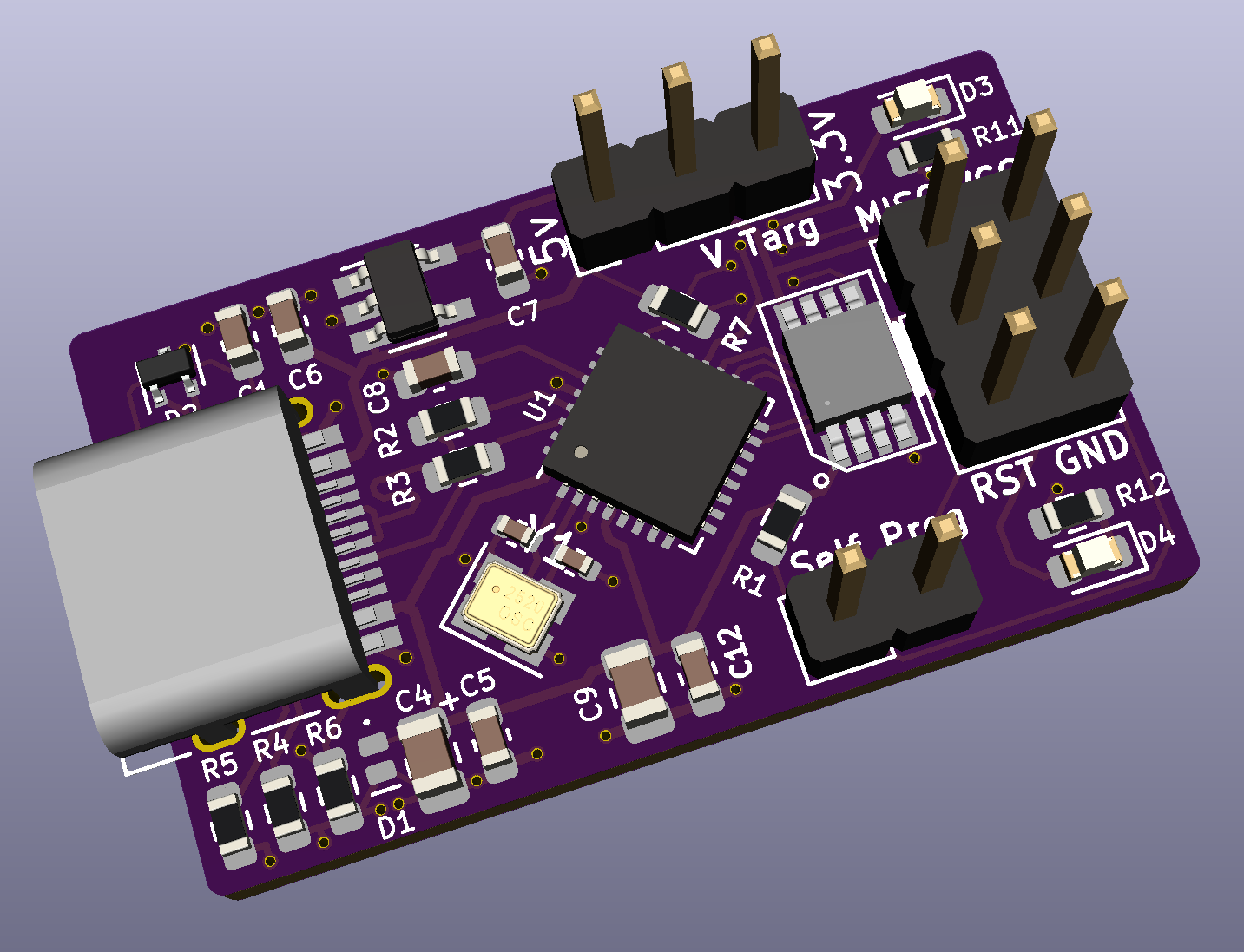
This PCB is designed only for ISP. However, the PCB could be expanded to break out the PDI and TPI pins as well! It has a level shifter that allows programming of targets other than 5V. Adding a 2-pin jumper to V Targ allows the target device to be powered from this board as well. 2 voltages are available - 5v and 3.3v. If you wish to program the 16u2 from the ISP header, the RST pin must be shorted to the 16u2's RST pin, this can be done with a jumper on the Self Prog pin header.
Firmware
KiCad
images
Firmware folder, copy and replace the Config folder and makefile into Projects/AVRISP-MKII/ in the LUFA repo.Firmware folder, copy BHATASAKA folder intoLUFA/Divers/Board/AVR8 in the LUFA repo.LUFA/Drivers/Board/Board.h and copy the last #elif, then modify it to use BHATASAKA as the board name.LUFA/Drivers/Board/LEDs.h and copy the last #elif, then modify it to use BHATASAKA as the board name.Go to Projects/AVRISP-MKII/ and type make. Make sure Make and avr-gcc are installed and in your path.
Projects/AVRISP-MKII/ folder can be flashed through DFU. Plug the board into your computer. If it is blank it will show up as ATMega 16u2. If it doesn't, reset the chip after it's plugged in.libusb-win32 driver for the chip.Install AVRISP-MKII drivers with Zadig (https://zadig.akeo.ie/). Choose libusb-win32.
To use with Arduino, select the AVRISP mkii programmer. To use with AVRDude, use -c avrispmkII.
Major thanks to LUFA, KiCad, and Zadig!
| Qty | Value | Footprint | References |
|---|---|---|---|
| 3 | 1uF | Capacitor_SMD:C_0603_1608Metric | C6, C7, C8 |
| 2 | 10k | Resistor_SMD:R_0603_1608Metric | R1, R7 |
| 2 | 18pF | Capacitor_SMD:C_0402_1005Metric | C2, C3 |
| 2 | 22 | Resistor_SMD:R_0603_1608Metric | R2, R3 |
| 2 | 5.1k | Resistor_SMD:R_0603_1608Metric | R4, R5 |
| 1 | 100nF | Capacitor_SMD:C_0603_1608Metric | C5 |
| 1 | 10nF | Capacitor_SMD:C_0603_1608Metric | C12 |
| 1 | 10uF | Capacitor_SMD:C_0805_2012Metric | C9 |
| 1 | 16MHz | AVR-ISPMKII:Crystal_SMD_2520-4Pin_2.5x2.0mm | Y1 |
| 1 | 1M | Resistor_SMD:R_0603_1608Metric | R6 |
| 1 | 2.2k | Resistor_SMD:R_0603_1608Metric | R12 |
| 1 | 22k | Resistor_SMD:R_0603_1608Metric | R11 |
| 1 | 4.7nF | Capacitor_SMD:C_0603_1608Metric | C1 |
| 1 | 4.7uF | Capacitor_SMD:C_0805_2012Metric | C4 |
| 1 | AP7365-33WG-7 | Package_TO_SOT_SMD:TSOT-23-5 | U2 |
| 1 | ATmega16U2-MU | Package_DFN_QFN:QFN-32-1EP_5x5mm_P0.5mm_EP3.1x3.1mm | U1 |
| 1 | CPDER5V0U | AVR-ISPMKII:D_0402_1005Metric | D1 |
| 1 | EGUARD0502BTR | Package_TO_SOT_SMD:SOT-523 | D2 |
| 1 | G_LED | LED_SMD:LED_0603_1608Metric | D3 |
| 1 | ISP_Header | Connector_PinHeader_2.54mm:PinHeader_2x03_P2.54mm_Vertical | J4 |
| 1 | NLSX4373DMR2G | AVR-ISPMKII:TSSOP8 | U3 |
| 1 | R_LED | LED_SMD:LED_0603_1608Metric | D4 |
| 1 | SolderJumper_2_Open | Jumper:SolderJumper-2_P1.3mm_Open_TrianglePad1.0x1.5mm | JP1 |
| 1 | TestPoint | TestPoint:TestPoint_Pad_D2.0mm | TP1 |
| 1 | USB_C_Receptacle_USB2.0 | Connector_USB:USB_C_Receptacle_HRO_TYPE-C-31-M-12 | J1 |
| 1 | V_Target | Connector_PinHeader_2.54mm:PinHeader_1x03_P2.54mm_Vertical | J3 |

GaudiLabs/OpenThereminV4_EurorackBreakout
Break-Out-Modules for the OpenTheremin V45


Tempmonitor/Tempmonitor
Hardware and software for Temp monitor - An open source external system monitor.


ded811/Mega-Uno-2560
An Arduino-compatible ATmega2560 development board in the Arduino Uno form factor

EbenezerBoadiBoateng/Arduino-Mega-260-R3-Ebenezer-Boadi-01230884b-
Recreating an Arduino mega on a kicad
It measures 30 × 17.8 mm and has 2 copper layers, 1.6 mm thick.
32 parts, built around the ATMEGA16U2-MU and CPDER5V0U. The full list of its parts is on this page, with links to each part's symbol and footprint where PCBKit's library has them.
From the bhatasaka/LUFA_AVRISP-MKII repository on GitHub, at the commit this page was made from: the board is KiCad/AVR-ISPMKII.kicad_pcb. PCBKit opens the board in the browser, with nothing to install.
Its repository states no licence, so its author keeps all rights: ask bhatasaka before reusing the design.