6 layers50 × 75 mm
Ecp5u85-bse usb
open-ephys/ECP5U85-BSE-USB
USB development board featuring USB3.0, Lattice ECP5U85 FPGA, and Samtec BSE GPIO Headers
223 parts10

 bence98/qcp2232
USB-to-Quad UART with Dual RS-232, Single 5V TTL, Flow Control and 16 GPIOs
CR serial is an open-source printed circuit board by bence98, from the bence98/qcp2232 repository on GitHub. It is a 4-layer board of 81.5 × 67.8 mm with 99 parts on 124 nets, routed with 705 tracks and 425 vias.
It is built around the MAX232N, TVS4201MR6 and ECMF02-4CMX8, with the M2.5 among its other parts. Its parts include 52 resistors, 15 ICs, 11 capacitors and 8 connectors. It belongs with the interfaces and adapters boards of this library.


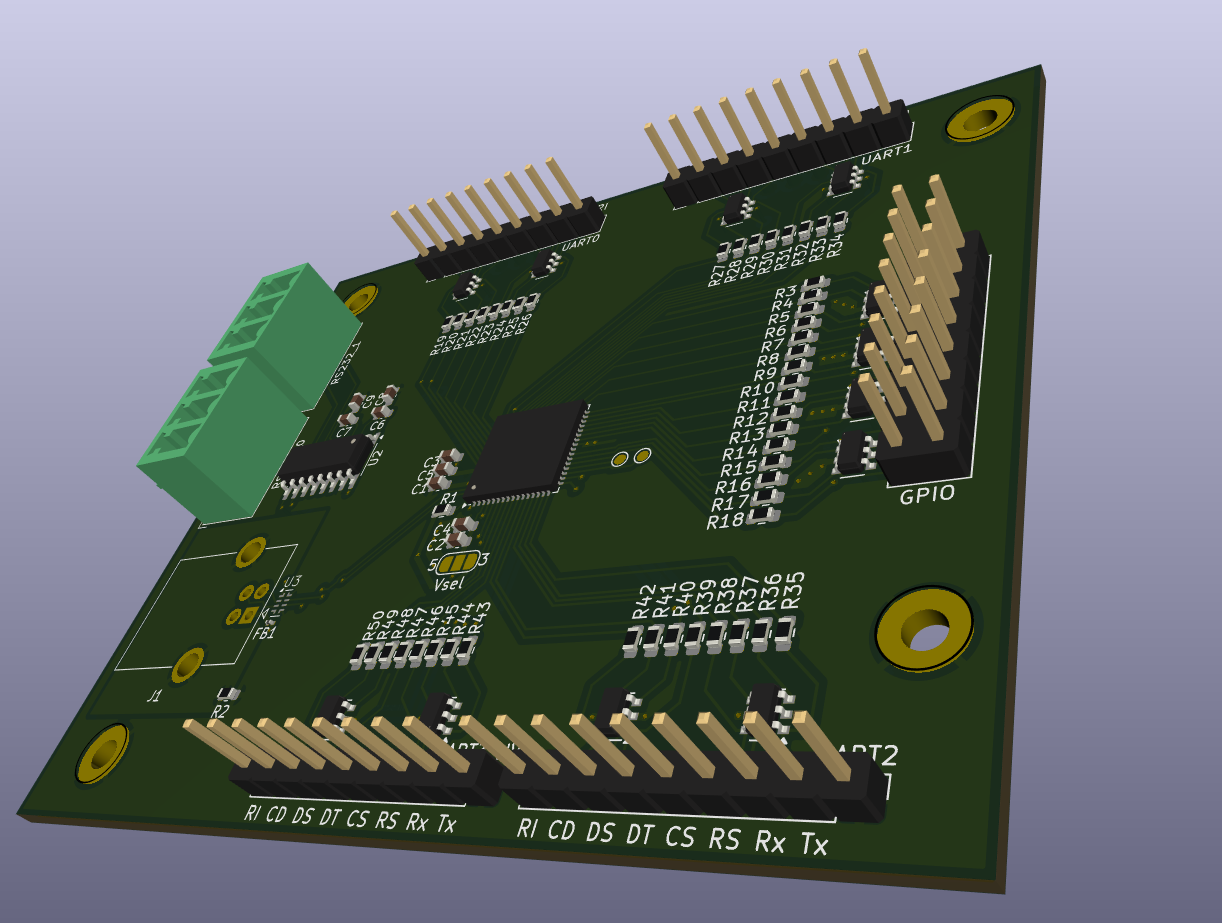
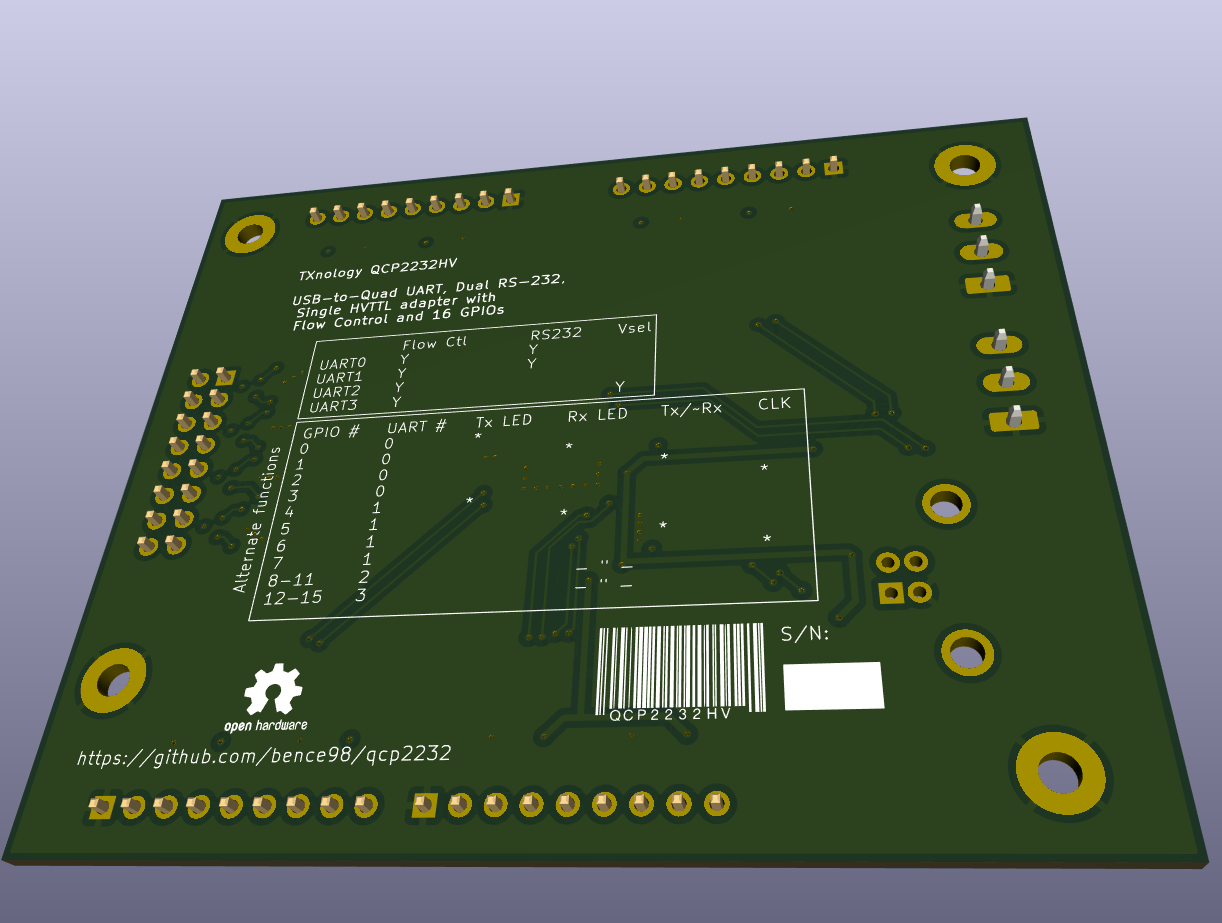
4 TTL UARTs with full Flow Control
UART0 and UART1 have RS-232 option
UART3 has selectable TTL voltage (Vsel)
USB Type-B connector
16 GPIOs
| GPIO # | UART # | function |
|---|---|---|
| 0 | 0 | Tx LED |
| 1 | 0 | Rx LED |
| 2 | 0 | Tx mode |
| 3 | 0 | clock |
| 4 | 1 | Tx LED |
| 5 | 1 | Rx LED |
| 6 | 1 | Tx mode |
| 7 | 1 | clock |
| 8 | 2 | Tx LED |
| 9 | 2 | Rx LED |
| 10 | 2 | Tx mode |
| 11 | 2 | clock |
| 12 | 3 | Tx LED |
| 13 | 3 | Rx LED |
| 14 | 3 | Tx mode |
| 15 | 3 | clock |
Pinout (UARTs):
| GND | TX | RX | RTS | CTS | DTR | DSR | DCD | RI | |
|---|---|---|---|---|---|---|---|---|---|
| Label on board | Tx | Rx | RS | CS | DT | DS | CD | RI | |
| Direction | N/A | Out | In | Out | In | Out | In | In | In |
| Qty | Value | Footprint | References |
|---|---|---|---|
| 48 | 100R | Resistor_SMD:R_0603_1608Metric | R10, R11, R12, R13, R14, R15, R16, R17, R18, R19, R20, R21, R22, R23, R24, R25 +32 |
| 12 | TVS4201MR6 | Package_SO:TSOP-6_1.65x3.05mm_P0.95mm | U4, U5, U6, U7, U8, U9, U10, U11, U12, U13, U14, U15 |
| 6 | 1u | Capacitor_SMD:C_0603_1608Metric | C6, C7, C8, C9, C10, C11 |
| 4 | M2.5 | MountingHole:MountingHole_2.7mm_M2.5_Pad | H1, H2, H3, H4 |
| 3 | 0R | Resistor_SMD:R_0603_1608Metric | R2, R51, R52 |
| 3 | 10u | Capacitor_SMD:C_0603_1608Metric | C1, C2, C3 |
| 3 | Fiducial | QCP_parts:Fiducial_Cross_0.5mm_Mask2mm | FID1, FID2, FID3 |
| 2 | 100n | Capacitor_SMD:C_0603_1608Metric | C4, C5 |
| 1 | #SUSPEND | TestPoint:TestPoint_Pad_D1.0mm | TP2 |
| 1 | 4k7 | Resistor_SMD:R_0603_1608Metric | R1 |
| 1 | BLM18PG181SN1D | Inductor_SMD:L_0603_1608Metric | FB1 |
| 1 | CP2108-xxx-xM | Package_DFN_QFN:QFN-64-1EP_9x9mm_P0.5mm_EP4.1x4.1mm | U1 |
| 1 | ECMF02-4CMX8 | QCP_parts:ST_UQFN-8L_1.15x2.45mm_P0.5mm | U3 |
| 1 | GPIO | Connector_PinHeader_2.54mm:PinHeader_2x08_P2.54mm_Vertical | J2 |
| 1 | Logo_Open_Hardware_Small | Symbol:OSHW-Logo2_7.3x6mm_SilkScreen | SYM1 |
| 1 | MAX232 | Package_SO:SOIC-16_3.9x9.9mm_P1.27mm | U2 |
| 1 | QCP2232HV | LOGO | G*** |
| 1 | RS232_0 | Connector_Phoenix_MC:PhoenixContact_MCV_1,5_3-G-3.81_1x03_P3.81mm_Vertical | J7 |
| 1 | RS232_1 | Connector_Phoenix_MC:PhoenixContact_MCV_1,5_3-G-3.81_1x03_P3.81mm_Vertical | J8 |
| 1 | SUSPEND | TestPoint:TestPoint_Pad_D1.0mm | TP1 |
| 1 | UART0 | Connector_PinHeader_2.54mm:PinHeader_1x09_P2.54mm_Vertical | J3 |
| 1 | UART1 | Connector_PinHeader_2.54mm:PinHeader_1x09_P2.54mm_Vertical | J4 |
| 1 | UART2 | Connector_PinHeader_2.54mm:PinHeader_1x09_P2.54mm_Vertical | J5 |
| 1 | UART3_HV | Connector_PinHeader_2.54mm:PinHeader_1x09_P2.54mm_Vertical | J6 |
| 1 | USB_B | Connector_USB:USB_B_OST_USB-B1HSxx_Horizontal | J1 |
| 1 | Vsel | Jumper:SolderJumper-3_P1.3mm_Bridged12_RoundedPad1.0x1.5mm_NumberLabels | JP1 |
open-ephys/ECP5U85-BSE-USB
USB development board featuring USB3.0, Lattice ECP5U85 FPGA, and Samtec BSE GPIO Headers

1upkeyboards/PCBs
Repository containing production files and schematics for 1upkeyboards pcbs


ChakraRokaya/AARCTRONICS
AARCTRONICS- All kinds of the schematic design and PCB design, hardware implementation and functional testing.


leenknegt-eu/choccy47
47 key planck-style layout layer switching mechanical keyboard for use with Gateron KS-33 low profile switches

It measures 81.5 × 67.8 mm and has 4 copper layers, 1.6 mm thick.
99 parts, built around the MAX232N, TVS4201MR6, ECMF02-4CMX8 and M2.5. The full list of its parts is on this page, with links to each part's symbol and footprint where PCBKit's library has them.
From the bence98/qcp2232 repository on GitHub, at the commit this page was made from: the board is CR-serial.kicad_pcb and its schematic CR-serial.kicad_sch. PCBKit opens the board in the browser, with nothing to install.
Its repository states no licence, so its author keeps all rights: ask bence98 before reusing the design.