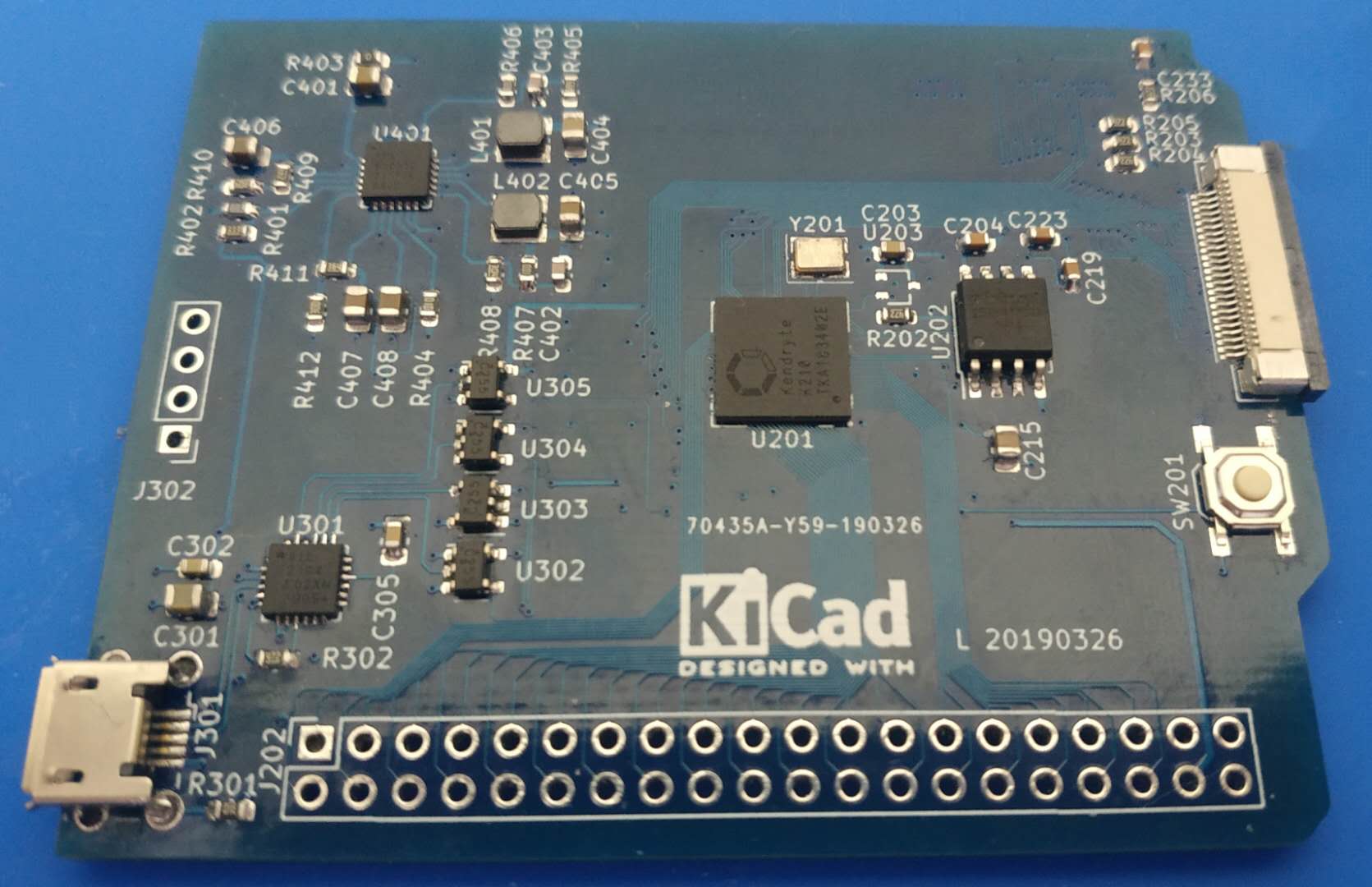
4 layers68.8 × 53.6 mm
ESP32 K210
ATmega8/kiterf
Release KiteRF is a SDR system with K210 & FPGA & ESP32 as its core controller, which make SDR more intelligent, portable and cheap.
91 parts25MIT

 ATmega8/kiterf25
Release KiteRF is a SDR system with K210 & FPGA & ESP32 as its core controller, which make SDR more intelligent, portable and cheap.
MSI001 is an open-source printed circuit board by ATmega8, from the ATmega8/kiterf repository on GitHub, published under the MIT licence. It is a 2-layer board of 99 × 69 mm with 170 parts on 130 nets, routed with 1,488 tracks and 249 vias.
It is built around the 74LVC1G125, MSI001 and LP5907MFX-3.3, with the 74LVC1G08Z, LP5907MFX-2.8 and SI5351A-B-GT among its other parts. Its parts include 97 capacitors, 25 resistors, 23 inductors, 13 ICs and 4 connectors. It belongs with the radio and wireless and fPGA and programmable logic boards of this library.


KiteRF is a SDR system with K210 & FPGA & ESP32 as its core controller, which make SDR more intelligent, portable and cheap.
KiteRF Structure

DS (Digital Signal) unit
FPGA (Field-Programmable Gate Array)
Radio Frequency Data Processing
DS Control
Communication with PC
K210 (Kendryte K210)
LCD control
Camera control
Audio
FFT
ESP32 (Espressif ESP32)
Wi-Fi Data Transmission
SDCARD control
Touch Button
RGB LED Control
RF (Radio Frequency) unit
ADC (Analog-to-Digital Converter)
DAC (Digital-to-Analog Converter)
RF Transceiver
VCO (Voltage-Controlled Oscillator)
Mixer (Frequency mixer)
LNA (Low-Noise Amplifier)
RF Switch
KiteRF core-board v1.0.0

Directory tree
├── add_path.sh
├── data
│   ├── kendryte_datasheet.pdf
│   ├── kendryte_freertos_programming_guide.pdf
│   ├── kiterf_1.0.0.jpg
│   ├── kiterf_structure.pos
│   └── kiterf_structure.svg
├── docs
│   └── Doxyfile
├── LICENSE
├── project
│   ├── code
│   │   ├── ESP32
│   │   ├── ESP8266
│   │   └── K210
│   └── pcb
│       ├── K210
│       └── RF
├── README.md
└── tools
    ├── cmake-3.14.2
    ├── ESP32
    │   └── esp-idf
├── ESP8266project
PCB project (KiCAD)
FPGA project (ISE)
ESP32 project (esp-idf)
K210 project (Kendryte FreeRTOS)
release
PCB Gerber
FPGA bin
ESP32 bin
K210 bin
tools
script
SDK
toolchain
You can follow the steps below to set up the development environment, or directly download the release version of the full environment.
clone
git clone --recursive https://github.com/ATmega8/kiterf
cd kiterf
note
Don't omit --recursive, because we use submodule.
update
git pull
git submodule update --init --recursive
Add environment variables
. add_path.shnote
Don't forget "."
Install toolchain
K210
Ubuntu/Debian/Kali
wget https://www.kiterf.xyz/download/kendryte-toolchain-ubuntu-amd64-8.2.0-20190213.tar.gz
tar zxvf kendryte-toolchain-ubuntu-amd64-8.2.0-20190213.tar.gz -C tools/K210/
rm kendryte-toolchain-ubuntu-amd64-8.2.0-20190213.tar.gz
Arch
wget https://www.kiterf.xyz/download/kendryte-toolchain-arch-amd64-8.2.0-20190415.tar.gz
tar zxvf kendryte-toolchain-arch-amd64-8.2.0-20190415.tar.gz -C tools/K210/
rm kendryte-toolchain-arch-amd64-8.2.0-20190415.tar.gz
ESP32
Ubuntu/Debian/Kali/Arch
cd tools/ESP32/esp-idf
./install.sh
cd $KITERF_PATH
ESP8266
KiteRF also integrates the ESP8266 development environment, which is not necessary, and you can choose to ignore it.
Ubuntu/Debian/Kali/Arch
wget https://www.kiterf.xyz/download/xtensa-lx106-elf-linux64-1.22.0-92-g8facf4c-5.2.0.tar.gz
tar zxvf xtensa-lx106-elf-linux64-1.22.0-92-g8facf4c-5.2.0.tar.gz -C tools/ESP8266/
rm xtensa-lx106-elf-linux64-1.22.0-92-g8facf4c-5.2.0.tar.gz
CMake
Ubuntu/Debian/Kali/Arch
wget https://www.kiterf.xyz/download/cmake-3.14.2.tar.gz
tar xf cmake-3.14.2.tar.gz -C tools/
cd tools/cmake-3.14.2
./configure
# Please do not use all CPU cores to compile, otherwise your computer may crash.
make -j2
cd $KITERF_PATH
rm cmake-3.14.2.tar.gzdownload
wget https://www.kiterf.xyz/download/kiterf-debain-amd64-1.2.0-20190517.tar.gz
tar zxvf kiterf-debain-amd64-1.2.0-20190517.tar.gz
rm kiterf-debain-amd64-1.2.0-20190517.tar.gz
cd kiterf
Add environment variables
. add_path.shnote
Don't forget "."

MIT License
A short and simple permissive license with conditions only requiring preservation of copyright and license notices. Licensed works, modifications, and larger works may be distributed under different terms and without source code.

If you want to support this project, we hope you can contribute your code or circuit.
| Qty | Value | Footprint | References |
|---|---|---|---|
| 26 | 10nF | Capacitor_SMD:C_0603_1608Metric | C305, C307, C308, C309, C317, C318, C319, C330, C331, C332, C415, C419, C421, C422, C423, C424 +10 |
| 16 | 0.1uF | Capacitor_SMD:C_0603_1608Metric | C202, C204, C205, C206, C207, C208, C209, C210, C211, C212, C213, C214, C215, C217, C303, C313 |
| 10 | 0R | Resistor_SMD:R_0603_1608Metric | R205, R206, R207, R208, R209, R210, R503, R504, R505, R506 |
| 8 | 10uF | Capacitor_SMD:C_0805_2012Metric | C201, C203, C216, C503, C505, C507, C508, C509 |
| 4 | 1000pF | Capacitor_SMD:C_0603_1608Metric | C312, C322, C323, C324 |
| 4 | 33R | Resistor_SMD:R_0603_1608Metric | R401, R402, R405, R406 |
| 4 | 36R | Resistor_SMD:R_0603_1608Metric | R201, R202, R203, R204 |
| 4 | 39pF | Capacitor_SMD:C_0603_1608Metric | C301, C316, C325, C414 |
| 4 | 5.6pF | Capacitor_SMD:C_0603_1608Metric | C401, C402, C403, C404 |
| 3 | 1.8pF | Capacitor_SMD:C_0603_1608Metric | C407, C412, C416 |
| 3 | 1uF | Capacitor_SMD:C_0805_2012Metric | C510, C511, C512 |
| 3 | 22pF | Capacitor_SMD:C_0603_1608Metric | C410, C501, C502 |
| 3 | Ferrite_Bead | Inductor_SMD:L_0805_2012Metric | FB501, FB502, FB503 |
| 2 | 1.5pF | Capacitor_SMD:C_0603_1608Metric | C413, C418 |
| 2 | 100nF | Capacitor_SMD:C_0603_1608Metric | C426, C427 |
| 2 | 100nH | Inductor_SMD:L_0603_1608Metric | L406, L411 |
| 2 | 100pF | Capacitor_SMD:C_0603_1608Metric | C304, C306 |
| 2 | 10K | Resistor_SMD:R_0603_1608Metric | R501, R502 |
| 2 | 10pF | Capacitor_SMD:C_0603_1608Metric | C409, C420 |
| 2 | 120pF | Capacitor_SMD:C_0603_1608Metric | C302, C311 |
| 2 | 18R | Resistor_SMD:R_0603_1608Metric | R403, R404 |
| 2 | 2.7pF | Capacitor_SMD:C_0603_1608Metric | C315, C328 |
| 2 | 27pF | Capacitor_SMD:C_0603_1608Metric | C406, C408 |
| 2 | 3.3pF | Capacitor_SMD:C_0603_1608Metric | C310, C326 |
| 2 | 330nH | Inductor_SMD:L_0603_1608Metric | L304, L307 |
| 2 | 4.7pF | Capacitor_SMD:C_0603_1608Metric | C329, C405 |
| 2 | 47nH | Inductor_SMD:L_0603_1608Metric | L308, L410 |
| 2 | 74LVC1G125 | Package_TO_SOT_SMD:SOT-23-5 | U201, U202 |
| 2 | 82nH | Inductor_SMD:L_0603_1608Metric | L310, L401 |
| 2 | DMG1016 | Package_TO_SOT_SMD:SOT-23 | Q301, Q302 |
| 2 | LP5907MFX-3.3 | Package_TO_SOT_SMD:SOT-23-5 | U502, U503 |
| 2 | PE42641 | Package_DFN_QFN:QFN-16-1EP_3x3mm_P0.5mm_EP1.7x1.7mm | U301, U305 |
| 1 | +5V | Connector_PinSocket_2.54mm:PinSocket_1x02_P2.54mm_Vertical | J501 |
| 1 | 100K | Resistor_SMD:R_0603_1608Metric | R302 |
| 1 | 120nH | Inductor_SMD:L_0603_1608Metric | L309 |
| 1 | 12pF | Capacitor_SMD:C_0603_1608Metric | C327 |
| 1 | 150nH | Inductor_SMD:L_0603_1608Metric | L301 |
| 1 | 15nH | Inductor_SMD:L_0603_1608Metric | L402 |
| 1 | 180pF | Capacitor_SMD:C_0603_1608Metric | C320 |
| 1 | 1nF | Capacitor_SMD:C_0603_1608Metric | C411 |
| 1 | 1uH | Inductor_SMD:L_0603_1608Metric | L303 |
| 1 | 2.2pF | Capacitor_SMD:C_0603_1608Metric | C417 |
| 1 | 220nH | Inductor_SMD:L_0603_1608Metric | L306 |
| 1 | 22nH | Inductor_SMD:L_0603_1608Metric | L404 |
| 1 | 25MHz 10ppm | Crystal:Crystal_SMD_3225-4Pin_3.2x2.5mm | Y501 |
| 1 | 270R | Resistor_SMD:R_0603_1608Metric | R301 |
| 1 | 270nH | Inductor_SMD:L_0603_1608Metric | L412 |
| 1 | 3.9pF | Capacitor_SMD:C_0603_1608Metric | C321 |
| 1 | 33nF | Capacitor_SMD:C_0603_1608Metric | C435 |
| 1 | 33nH | Inductor_SMD:L_0603_1608Metric | L405 |
| 1 | 390 | Resistor_SMD:R_0603_1608Metric | R407 |
| 1 | 390nH | Inductor_SMD:L_0603_1608Metric | L302 |
| 1 | 39nH | Inductor_SMD:L_0603_1608Metric | L407 |
| 1 | 470nH | Inductor_SMD:L_0603_1608Metric | L305 |
| 1 | 6.8nH | Inductor_SMD:L_0603_1608Metric | L409 |
| 1 | 6.8pF | Inductor_SMD:L_0603_1608Metric | L408 |
| 1 | 6800pF | Capacitor_SMD:C_0603_1608Metric | C434 |
| 1 | 68nH | Inductor_SMD:L_0603_1608Metric | L403 |
| 1 | 74LVC1G08 | Package_TO_SOT_SMD:SOT-23-5 | U303 |
| 1 | 8.2nH | Inductor_SMD:L_0603_1608Metric | L413 |
| 1 | 82pF | Capacitor_SMD:C_0603_1608Metric | C314 |
| 1 | AD9288 | Package_QFP:LQFP-48_7x7mm_P0.5mm | U203 |
| 1 | ANT | Connector_Coaxial:SMA_Amphenol_132289_EdgeMount | J301 |
| 1 | CONTROL | Connector_PinSocket_2.54mm:PinSocket_2x08_P2.54mm_Vertical | J101 |
| 1 | Conn_02x12_Odd_Even | Connector_PinSocket_2.54mm:PinSocket_2x12_P2.54mm_Vertical | J201 |
| 1 | Jumper_NC_Dual | Jumper:SolderJumper-3_P1.3mm_Open_Pad1.0x1.5mm | JP201 |
| 1 | LP5907MFX-2.8 | Package_TO_SOT_SMD:SOT-23-5 | U504 |
| 1 | MGA68563 | Package_TO_SOT_SMD:SOT-363_SC-70-6 | U302 |
| 1 | MSI001 | Package_DFN_QFN:QFN-40-1EP_6x6mm_P0.5mm_EP4.6x4.6mm_ThermalVias | U401 |
| 1 | SI5351A | Package_SO:MSOP-10_3x3mm_P0.5mm | U501 |
| 1 | SKY13251 | Package_DFN_QFN:DFN-8-1EP_2x2mm_P0.5mm_EP0.9x1.3mm | U304 |
| 1 | SolderJumper_3_Open | Jumper:SolderJumper-3_P1.3mm_Open_RoundedPad1.0x1.5mm | JP202 |
It measures 99 × 69 mm and has 2 copper layers, 1.6 mm thick.
170 parts, built around the 74LVC1G125, MSI001, LP5907MFX-3.3 and 74LVC1G08Z. The full list of its parts is on this page, with links to each part's symbol and footprint where PCBKit's library has them.
From the ATmega8/kiterf repository on GitHub, at the commit this page was made from: the board is project/pcb/RF/MSI001.kicad_pcb. PCBKit opens the board in the browser, with nothing to install.
Its repository publishes it under the MIT licence: you may reuse it on that licence's terms (keep the author's notice, and for a copyleft licence share your changes alike).
ATmega8/kiterf
Release KiteRF is a SDR system with K210 & FPGA & ESP32 as its core controller, which make SDR more intelligent, portable and cheap.


Oleg-mk/MOST25-to-AUDIO
Passive MOST25 listener: Tang Nano 20K FPGA, ESP32 host, stereo I2S out with the head unit's volume, balance and tone
