2 layers
 architolk/architolk.github.io
Github docs from architolk
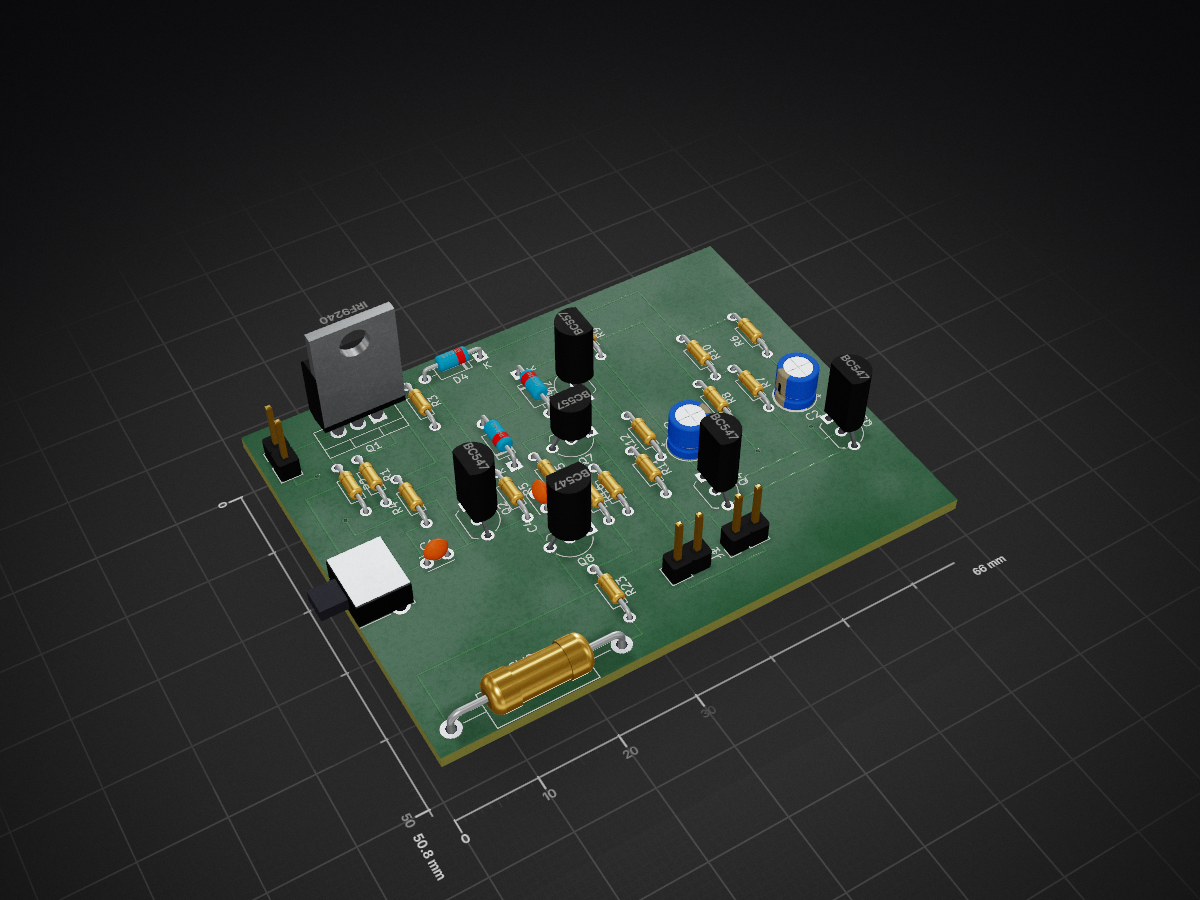
The internet is an open-source printed circuit board by architolk, from the architolk/architolk.github.io repository on GitHub. It is a 2-layer board of 66 × 50.8 mm with 35 parts on 22 nets, routed with 102 tracks and 4 vias.
It is built around the BC547, BC557 and IRF9240. Its parts include 16 resistors, 7 transistors, 4 capacitors, 3 diodes and 3 connectors.


Architolk docs made with Jekyll
This site runs on Jekyll, an opensource static site generating platform.
NB: Current versions of github pages works with ruby 3.2.x and Jekyll 3.9.3 ! Make sure you install THESE versions!
Make sure Ruby is installed, to check if it is, run:
ruby -vFor more information about installing Ruby, refer to the Ruby installation .
Install the Jekyll and bundler gems from the commandline:
gem install jekyll bundlerFor more information about installing Jekyll, refer to the Jekyll quickstart guide
A specific version of jekyll can be installed via:
gem install jekyll -v 3.9.3Some problems may occur if the bundler gem file is updated, but the Gemfile.lock still contains a reference to the old version. This can be solved by:
bundle update --bundlerSometimes other gem packages also need to be updated: see the Gemfile for possible updates (like: bundle update github-pages).
Install Gem dependencies for the project by running:
bundle installTo run the server in your local environment run:
bundle exec jekyll serveGo to http://localhost:4000/ in your browser
Nothing is needed! Just make changes to the source, and everything will be published.
The only reason to use a local server and a local build is for testing, it is not necessary for publication on github.io.
| Qty | Value | Footprint | References |
|---|---|---|---|
| 4 | BC547 | Package_TO_SOT_THT:TO-92L_Inline_Wide | Q2, Q3, Q4, Q8 |
| 3 | 10k | Resistor_THT:R_Axial_DIN0204_L3.6mm_D1.6mm_P7.62mm_Horizontal | R6, R9, R16 |
| 3 | 1N4148 | Diode_THT:D_DO-35_SOD27_P7.62mm_Horizontal | D2, D3, D4 |
| 2 | 1M | Resistor_THT:R_Axial_DIN0204_L3.6mm_D1.6mm_P7.62mm_Horizontal | R2, R20 |
| 2 | 1k | Resistor_THT:R_Axial_DIN0204_L3.6mm_D1.6mm_P7.62mm_Horizontal | R12, R15 |
| 2 | 47k | Resistor_THT:R_Axial_DIN0204_L3.6mm_D1.6mm_P7.62mm_Horizontal | R1, R5 |
| 2 | 47u | Capacitor_THT:CP_Radial_D5.0mm_P2.50mm | C2, C3 |
| 1 | 100k | Resistor_THT:R_Axial_DIN0204_L3.6mm_D1.6mm_P7.62mm_Horizontal | R3 |
| 1 | 1uF | Capacitor_THT:C_Disc_D3.0mm_W2.0mm_P2.50mm | C1 |
| 1 | 2.2k | Resistor_THT:R_Axial_DIN0204_L3.6mm_D1.6mm_P7.62mm_Horizontal | R23 |
| 1 | 220k | Resistor_THT:R_Axial_DIN0204_L3.6mm_D1.6mm_P7.62mm_Horizontal | R10 |
| 1 | 220n | Capacitor_THT:C_Disc_D3.0mm_W2.0mm_P2.50mm | C4 |
| 1 | 330 | Resistor_THT:R_Axial_DIN0204_L3.6mm_D1.6mm_P7.62mm_Horizontal | R11 |
| 1 | 33k | Resistor_THT:R_Axial_DIN0204_L3.6mm_D1.6mm_P7.62mm_Horizontal | R8 |
| 1 | 560k | Resistor_THT:R_Axial_DIN0204_L3.6mm_D1.6mm_P7.62mm_Horizontal | R4 |
| 1 | 68k | Resistor_THT:R_Axial_DIN0204_L3.6mm_D1.6mm_P7.62mm_Horizontal | R7 |
| 1 | BC557 | Package_TO_SOT_THT:TO-92_Inline_Wide | Q7 |
| 1 | BC557 | Package_TO_SOT_THT:TO-92L_Inline_Wide | Q6 |
| 1 | Battery | Connector_PinHeader_2.54mm:PinHeader_1x02_P2.54mm_Vertical | J2 |
| 1 | IRF9240 | Package_TO_SOT_THT:TO-220-3_Vertical | Q1 |
| 1 | LED connector | Connector_PinHeader_2.54mm:PinHeader_1x02_P2.54mm_Vertical | J1 |
| 1 | NC | Resistor_THT:R_Axial_DIN0414_L11.9mm_D4.5mm_P20.32mm_Horizontal | SW2 |
| 1 | NO | Button_Switch_THT:SW_Tactile_SKHH_Angled | SW1 |
| 1 | Signal | Connector_PinHeader_2.54mm:PinHeader_1x02_P2.54mm_Vertical | J3 |


dotnet/iot
This repo includes .NET Core implementations for various IoT boards, chips, displays and PCBs.

robsonsmartins/usbflashprog
A memory device programmer (Flash/EPROM/E2PROM) board and software, connected to PC by USB port.


telec16/modular-synth
Little side project, don't expect much updates.

nodep/NovaBox
Circuit and PCB design of simple Bluetooth stereo receiver and amplifier


It measures 66 × 50.8 mm and has 2 copper layers, 1.6 mm thick.
35 parts, built around the BC547, BC557 and IRF9240. The full list of its parts is on this page, with links to each part's symbol and footprint where PCBKit's library has them.
From the architolk/architolk.github.io repository on GitHub, at the commit this page was made from: the board is assets/kicad/the-internet/the-internet/the-internet.kicad_pcb and its schematic assets/kicad/calendar/calendar/calendar.kicad_sch. PCBKit opens the board in the browser, with nothing to install.
Its repository states no licence, so its author keeps all rights: ask architolk before reusing the design.