
2 layers40 × 22.8 mm

57-key 40% + numpad keyboard: Bluetooth/USB-C, hot-swap MX, RMK/Vial, and a built-in USB sound card (3.5 mm headset jack). Generated from source with KiCad.
Lira is an open-source printed circuit board by AndreaGiulianini, from the AndreaGiulianini/lira repository on GitHub, published under the MIT licence. It is a 2-layer board of 334.6 × 100.2 mm with 233 parts on 146 nets, routed with 1,588 tracks and 346 vias.
It is built around the E73-2G4M08S1C, CM108B and TPS7A0233DBV, with the CH334P, MCP73831 and 1N4148W among its other parts. Its parts include 64 diodes, 41 switches, 37 capacitors, 25 resistors and 6 ICs. It belongs with the audio and music and keyboards and input boards and the nRF52 and nRF5x boards of this library.


[!WARNING] This keyboard has never been built. It is a design only: no prototype of either version (wireless on branch
main, wired on branchrp2040) has ever been ordered, assembled or powered on, and nothing here has been tested on real hardware. The circuit, PCB, case and firmware are generated and checked automatically and reviewed on paper, but passing those checks does not make a working board: there may be mistakes that only a real prototype would reveal. Do not put it into production, sell it or order it in quantity. If you build one anyway, treat it as an untested design: order the minimum quantity and expect to debug it yourself.
A 40% keyboard in the KBDfans Agar Mini layout, with a numpad on the left and a split 3u + 3u spacebar. Bluetooth + USB-C, hot-swap MX switches, RMK firmware with Vial, and a built-in USB sound card (3.5 mm headset jack at the back: headphones and microphone, with a headphone amplifier; on only in USB mode). It also works without a battery, from the cable alone. 3D-printed case inspired by the Apple M0110 (1984), top mount: the plate is screwed to the top frame and the PCB hangs from the switches, so no printed part has to hold the PCB flat.
Two versions of the same keyboard, one per git branch, with the same layout, plate and sound card, and the same case and keymap apart from the battery pocket and the Bluetooth keys:
| Branch | Version | Microcontroller | Power |
|---|---|---|---|
main (this one) | wireless: Bluetooth + USB-C | Ebyte E73 module (nRF52840) | LiPo battery, or the cable alone |
rp2040 | wired: USB-C only | Raspberry Pi RP2040 + 16 MB QSPI flash | the cable, no battery |
The sound card only works over the cable (there is no audio over Bluetooth), so if the headset jack is what you want, the wired version is simpler and cheaper to build: no battery, no SWD probe, Economic assembly at JLCPCB.
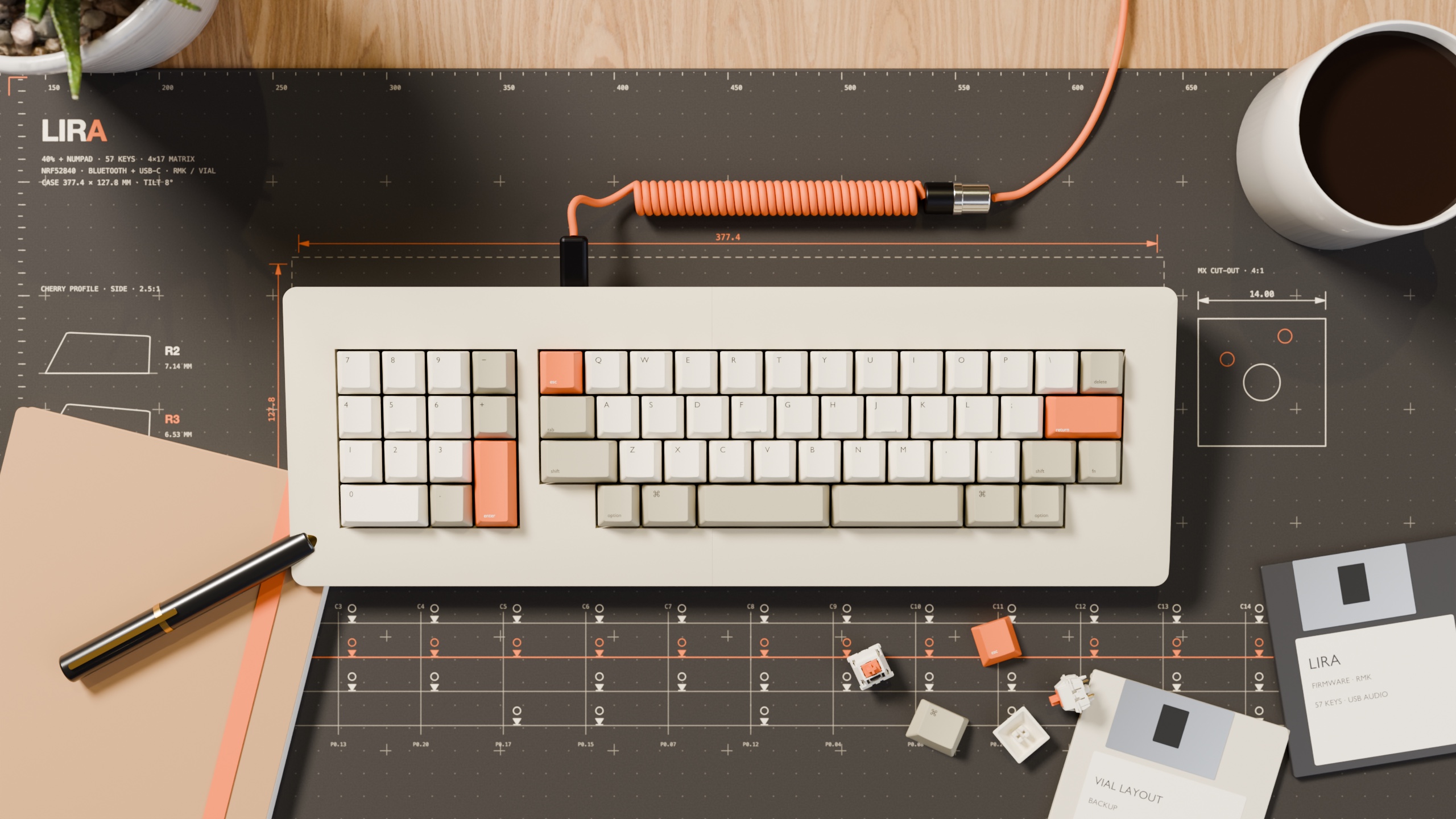
None of the ideas here are mine: this board is a combination of things other people made, plus the one thing I always wanted and could not buy — a headset jack on a keyboard.
production/5-schematic-and-checks/differences-from-bluemicro840.txt).Thanks to all of them.
| Folder | What it contains |
|---|---|
production/ | Everything to build the 57-key keyboard: files for JLCPCB, plate, case to print, firmware, pictures |
guide/ | Complete guide: ordering from JLCPCB, what to buy, first programming, printing and assembly |
source/ | The code that generates everything: edit only here, then regenerate |
production/ is self-contained: it holds everything needed to build the keyboard (the bootloader too; the KiCad files use the footprint libraries in source/lib/)
and has its own README listing the files and what to do with them:
production/
├── README.md                what's inside and what to do with it
├── 1-pcb-jlcpcb/            gerber-pcb.zip, bom.csv, cpl.csv
├── 2-plate/                 the plate: JLCPCB (FR4 gerbers), laser cut (DXF) or 3D printed (2 STL)
├── 3-case-3d-print/         the 4 STL pieces (+ step/)
├── 4-firmware/              .uf2 firmware, .hex bootloader, vial.json
├── 5-schematic-and-checks/  schematic (PDF) and the results of the automatic checks
├── kicad/                   PCB, plate and schematic to open in KiCad
└── images/                  layout, Blender renders: on a desk, every side, exploded, PCB
production/is rewritten on every regeneration: do not edit it by hand.
Everything below is checked on paper and in software, not a tested board (see the warning at the top).
The circuit, PCB, case and firmware are generated and checked automatically on every build:
production/5-schematic-and-checks/differences-from-bluemicro840.txt;erc-kicad.txt, consistency-check.txt, datasheet-checks.txt);fit-check.txt).These checks reduce the risk; they do not replace a prototype. The guide, §8, lists what to verify on the first board.
| Item | Quantity |
|---|---|
| M2 heat-set inserts (for a 3.2 mm hole, length 3 mm) | 6 (top frame: the plate's ears) |
| M2 × 5 mm socket-head screws (DIN 912) | 6 (plate to top frame) |
| Short M3 heat-set inserts (Ø ~4.5 mm, length 3 mm, for a 4.0 mm hole) | 11 (top frame) |
| M3 × 12 mm socket-head screws (DIN 912) | 8 (front and sides) |
| M3 × 20 mm socket-head screws (DIN 912) | 3 (back: through the PCB's holes and the plate's tabs) |
| Ø 3 × 14 mm alignment pins (steel rod or 3 mm filament) | 4 |
| Ø 12 mm rubber feet | 4 |
| 1 mm double-sided foam tape (holds the battery) | one 55 × 37 mm piece |
| Long 2.5 mm hex key (some M3 screw holes are 21 mm deep) and a 1.5 mm hex key (M2) | 1 + 1 |
#C8C2A0 and #D5D0B4 (Pantone 453 was the original).BED in
source/case/gen_case.py and regenerate.Edit only source/ (for example layout.py for the keys, case/gen_case.py for the case), then:
cd source
make all            # regenerates everything (about 25 minutes on an M4, most of it the Blender renders)
make pcb            # or a single step: see source/README.md
Technical details in source/README.md.
MIT — that covers everything in this repository that I made.
The firmware is built on RMK and the embassy crates (MIT / Apache-2.0) and is configured with Vial (GPL-2.0, used, not bundled).
Bundled third-party parts keep their own terms and are not relicensed by the above: source/tools/KeyV2
(GPL-3.0, a git submodule), the bootloader (Adafruit, MIT, containing Nordic's S140 SoftDevice under Nordic's licence), Nordic's MPSL / SoftDevice Controller libraries linked into the firmware (Nordic 5-clause licence), the kiswitch footprints and 3D models under source/lib/ (CC BY-SA 4.0), and the
vendor symbols/models (KiCad, LCSC). The Lyra and the KBDfans Agar Mini
are cited as inspiration only — no files from either are included here.
| Qty | Value | Footprint | References |
|---|---|---|---|
| 57 | 1N4148W | D_SOD-123 | D1, D2, D10, D11, D12, D13, D14, D15, D16, D17, D18, D19, D20, D21, D22, D23 +41 |
| 10 | 1uF | C_0603_1608Metric | C102, C108, C110, C118, C123, C126, C129, C130, C135, C136 |
| 8 | M2 | MountingHole_2.2mm_M2 | H1, H2, H3, H4, H5, H6, H7, H8 |
| 7 | 100nF | C_0603_1608Metric | C109, C112, C114, C115, C117, C119, C137 |
| 6 | 10k | R_0603_1608Metric | R103, R104, R120, R121, R122, R123 |
| 6 | 10uF | C_0603_1608Metric | C101, C111, C113, C120, C121, C122 |
| 4 | 100k | R_0603_1608Metric | R101, R112, R117, R125 |
| 4 | 1k | R_0603_1608Metric | R102, R107, R116, R118 |
| 4 | 4.7uF | C_0603_1608Metric | C103, C107, C116, C127 |
| 4 | 600R@100MHz | L_0603_1608Metric | L101, L102, L103, L104 |
| 3 | 100pF | C_0603_1608Metric | C124, C125, C128 |
| 3 | 10nF | C_0603_1608Metric | C104, C138, C139 |
| 3 | PESD5V0 | D_SOD-323 | D105, D106, D107 |
| 3 | case bolt | MountingHole_3.2mm_M3 | HB1, HB2, HB3 |
| 2 | . | SW_Hotswap_Kailh_MX_1.00u | SW47, SW51 |
| 2 | 10M | R_0603_1608Metric | R105, R106 |
| 2 | 18pF | C_0603_1608Metric | C105, C106 |
| 2 | 2.2uF | C_0603_1608Metric | C133, C134 |
| 2 | 22 | R_0603_1608Metric | R110, R111 |
| 2 | 5.1k | R_0603_1608Metric | R108, R109 |
| 2 | B5819W | D_SOD-123 | D101, D104 |
| 2 | SI2301CDS | SOT-23 | Q1, Q2 |
| 2 | TPS7A0233 | SOT-23-5 | U3, U9 |
| 2 | option | SW_Hotswap_Kailh_MX_1.00u | SW52, SW57 |
| 2 | space | SW_Hotswap_Kailh_MX_3.00u | SW54, SW55 |
| 2 | stab 2u | Stabilizer_Cherry_MX_2.00u | ST37, ST50 |
| 2 | stab 3u | Stabilizer_Cherry_MX_3.00u | ST54, ST55 |
| 2 | ⌘ | SW_Hotswap_Kailh_MX_1.25u | SW53, SW56 |
| 1 | + | SW_Hotswap_Kailh_MX_1.00u | SW21 |
| 1 | , | SW_Hotswap_Kailh_MX_1.00u | SW46 |
| 1 | -6 dB | SolderJumper-2_P1.3mm_Open_RoundedPad1.0x1.5mm | JP3 |
| 1 | 0 | SW_Hotswap_Kailh_MX_2.00u | SW50 |
| 1 | 1 | SW_Hotswap_Kailh_MX_1.00u | SW34 |
| 1 | 1 | R_0603_1608Metric | R126 |
| 1 | 1.2k | R_0603_1608Metric | R114 |
| 1 | 12MHz | Crystal_SMD_3225-4Pin_3.2x2.5mm | Y2 |
| 1 | 1M | R_0603_1608Metric | R113 |
| 1 | 2 | SW_Hotswap_Kailh_MX_1.00u | SW35 |
| 1 | 2.2k | R_0603_1608Metric | R115 |
| 1 | 2N7002 | SOT-23 | Q3 |
| 1 | 3 | SW_Hotswap_Kailh_MX_1.00u | SW36 |
| 1 | 32.768kHz | Crystal_SMD_3215-2Pin_3.2x1.5mm | Y1 |
| 1 | 33k | R_0603_1608Metric | R124 |
| 1 | 3V3 | TestPoint_Pad_D1.0mm | TP3 |
| 1 | 4 | SW_Hotswap_Kailh_MX_1.00u | SW18 |
| 1 | 5 | SW_Hotswap_Kailh_MX_1.00u | SW19 |
| 1 | 6 | SW_Hotswap_Kailh_MX_1.00u | SW20 |
| 1 | 7 | SW_Hotswap_Kailh_MX_1.00u | SW1 |
| 1 | 8 | SW_Hotswap_Kailh_MX_1.00u | SW2 |
| 1 | 9 | SW_Hotswap_Kailh_MX_1.00u | SW3 |
| 1 | ; | SW_Hotswap_Kailh_MX_1.00u | SW32 |
| 1 | A | SW_Hotswap_Kailh_MX_1.00u | SW23 |
| 1 | B | SW_Hotswap_Kailh_MX_1.00u | SW43 |
| 1 | C | SW_Hotswap_Kailh_MX_1.00u | SW41 |
| 1 | CH334P | WCH_QFN-16-1EP_3x3mm_P0.5mm_EP1.8x1.8mm | U5 |
| 1 | CM108B | LQFP-48_7x7mm_P0.5mm | U6 |
| 1 | D | SW_Hotswap_Kailh_MX_1.00u | SW25 |
| 1 | E | SW_Hotswap_Kailh_MX_1.00u | SW8 |
| 1 | E73-2G4M08S1C | WIRELM-SMD_E73-2G4M08S1C | U1 |
| 1 | F | SW_Hotswap_Kailh_MX_1.00u | SW26 |
| 1 | G | SW_Hotswap_Kailh_MX_1.00u | SW27 |
| 1 | GND | TestPoint_Pad_D1.0mm | TP4 |
| 1 | H | SW_Hotswap_Kailh_MX_1.00u | SW28 |
| 1 | I | SW_Hotswap_Kailh_MX_1.00u | SW13 |
| 1 | J | SW_Hotswap_Kailh_MX_1.00u | SW29 |
| 1 | JS102011SAQN | SW_SPDT_CK_JS102011SAQN | SW101 |
| 1 | K | SW_Hotswap_Kailh_MX_1.00u | SW30 |
| 1 | L | SW_Hotswap_Kailh_MX_1.00u | SW31 |
| 1 | LED red | LED_0603_1608Metric | D103 |
| 1 | LED white | LED_0603_1608Metric | D102 |
| 1 | M | SW_Hotswap_Kailh_MX_1.00u | SW45 |
| 1 | MCP73831 | SOT-23-5 | U2 |
| 1 | N | SW_Hotswap_Kailh_MX_1.00u | SW44 |
| 1 | O | SW_Hotswap_Kailh_MX_1.00u | SW14 |
| 1 | P | SW_Hotswap_Kailh_MX_1.00u | SW15 |
| 1 | PJ-320D-4A | Jack_3.5mm_KoreanHropartsElec_PJ-320D-4A_Horizontal | J3 |
| 1 | Q | SW_Hotswap_Kailh_MX_1.00u | SW6 |
| 1 | R | SW_Hotswap_Kailh_MX_1.00u | SW9 |
| 1 | RESET | TestPoint_Pad_D1.0mm | TP5 |
| 1 | S | SW_Hotswap_Kailh_MX_1.00u | SW24 |
The 202 most common of 233 parts.

sequoia-hope/ultraroute
PCB autorouting experiments around copperroute: route jobs, leaderboards, board morphing

jackw01/scanlight
A better light source for scanning color negative film

PacketChat/MonkeyBadge
This repository contains the hardware design files, badge code, and backend infrastructure code for the HushCon Winter 2023 badge.

RafaeloxMC/mp3
Oooh, an MP3 player! I wanted to build this myself to be able to distance from my phone and still listen to music (if you want to read my full thoughts, see the section below)!

martinberlin/H-C3-029-eink
This is a joint project between Larry Bank and Fasani Corp with the purpouse to make an easy and unexpensive nRF52 BLE badge with a SPI 2.9", a QWIIC connector, and on board RTC


RetiredBill/Max17841UartPCB
Small printed circuit board based on Maxim MAX17841B chip for talking to MAX17843 chip based designs
It measures 334.6 × 100.2 mm and has 2 copper layers, 1.6 mm thick.
233 parts, built around the E73-2G4M08S1C, CM108B, TPS7A0233DBV and CH334P. The full list of its parts is on this page, with links to each part's symbol and footprint where PCBKit's library has them.
From the AndreaGiulianini/lira repository on GitHub, at the commit this page was made from: the board is production/kicad/lira.kicad_pcb and its schematic production/kicad/schematic/lira.kicad_sch. PCBKit opens the board in the browser, with nothing to install.
Its repository publishes it under the MIT licence: you may reuse it on that licence's terms (keep the author's notice, and for a copyleft licence share your changes alike).