4 layers66 × 90 mm

 Amir-Vered/Bench
Wi-Fi upload dock for Arduino
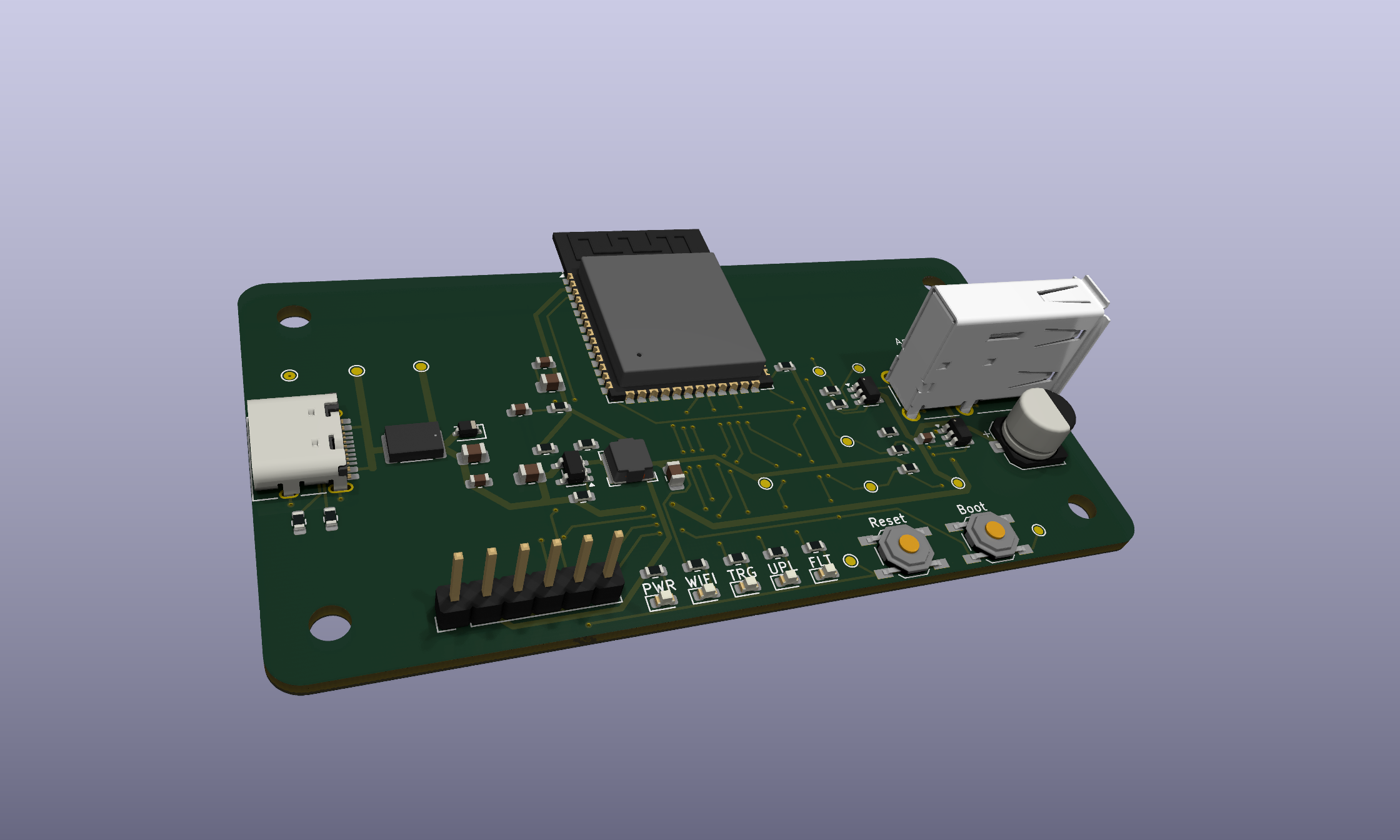
Bench is an open-source printed circuit board by Amir-Vered, from the Amir-Vered/Bench repository on GitHub, published under the CERN-OHL-P-2.0 licence. It is a 2-layer board of 85 × 45 mm with 58 parts on 63 nets, routed with 316 tracks and 115 vias.
It is built around the ESP32-S3-WROOM-1-N8R8, TLV62569DBVR-TP and TPS2553DBV, with the USBLC6-2SC6 among its other parts. Its parts include 17 resistors, 9 capacitors, 4 ICs, 3 connectors and 1 diode. It belongs with the ESP32 boards of this library.






Project Goals • System Overview • Diagrams • Hardware • Software • License
Bench... and it's not made out of wood?
Here's the pitch:
TL;DR wires are annoying, let's put Bench in the middle of the Arduino workflow.
I love Arduino, it's perfect for prototyping your projects before making your PCBs. But, idk about you, the most annoying thing to me is the fact that the board is tied to my laptop. And it's not a graceful connection, no, these wires are some of the most stale twisted things you've ever used, especially the uni lab ones. This gets even worse when you're using a desktop computer. But what if we put a device in the middle?
Enter: Bench.
Bench is a wifi upload dock for Arduino (built primarily for the Uno R3 because it's the one I use most). Compile your sketch, run a command, and boom, it uploads to your device somewhere else. No more wire, Arduino dev becomes a little less life-draining.
This is a simple little project, but it's open source, and I hope you find some use out of it. Feel free to leave issues, fork, or really do whatever you want with it.
My goals for this project were to:
Let's get into the details.
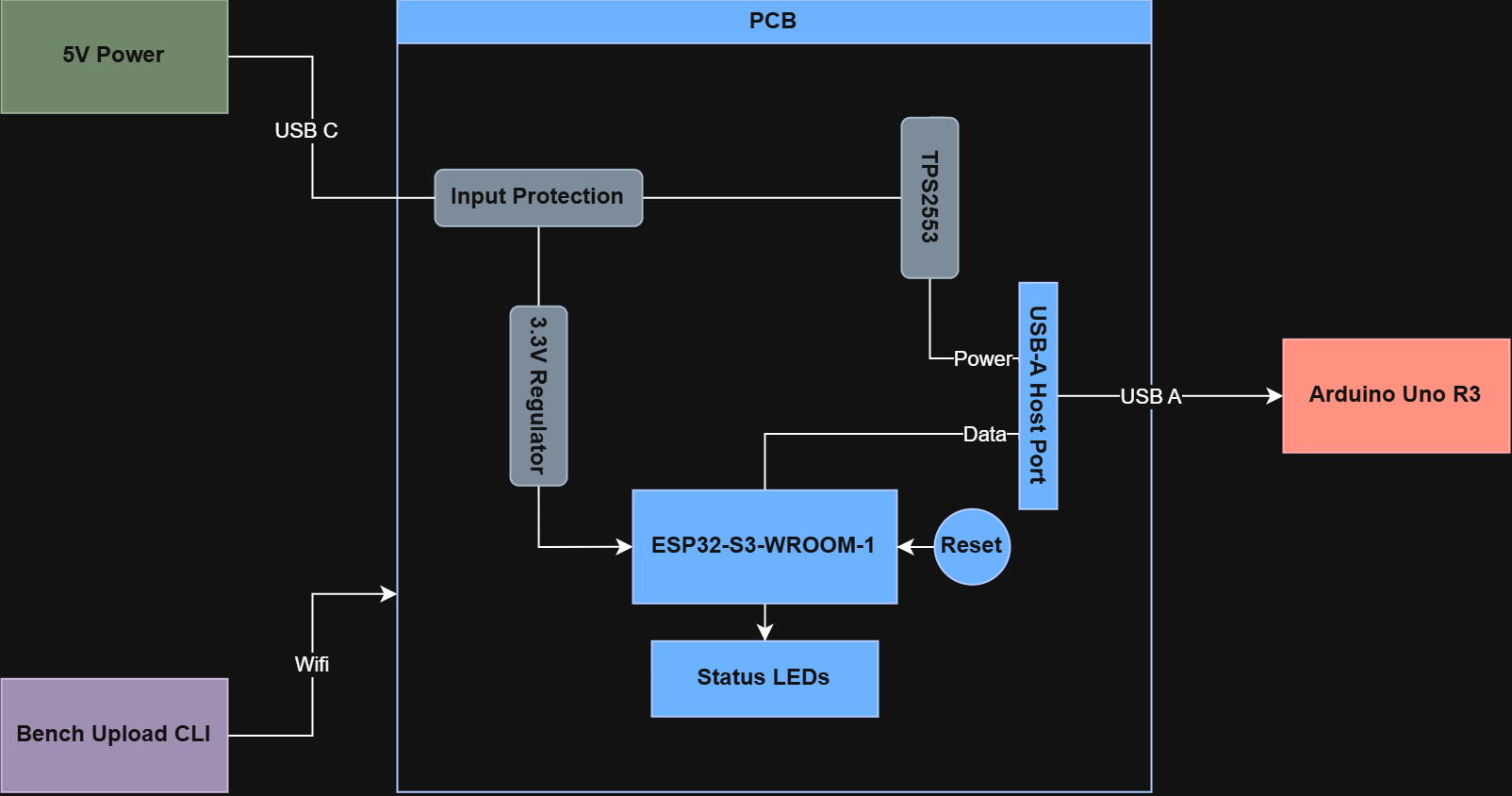
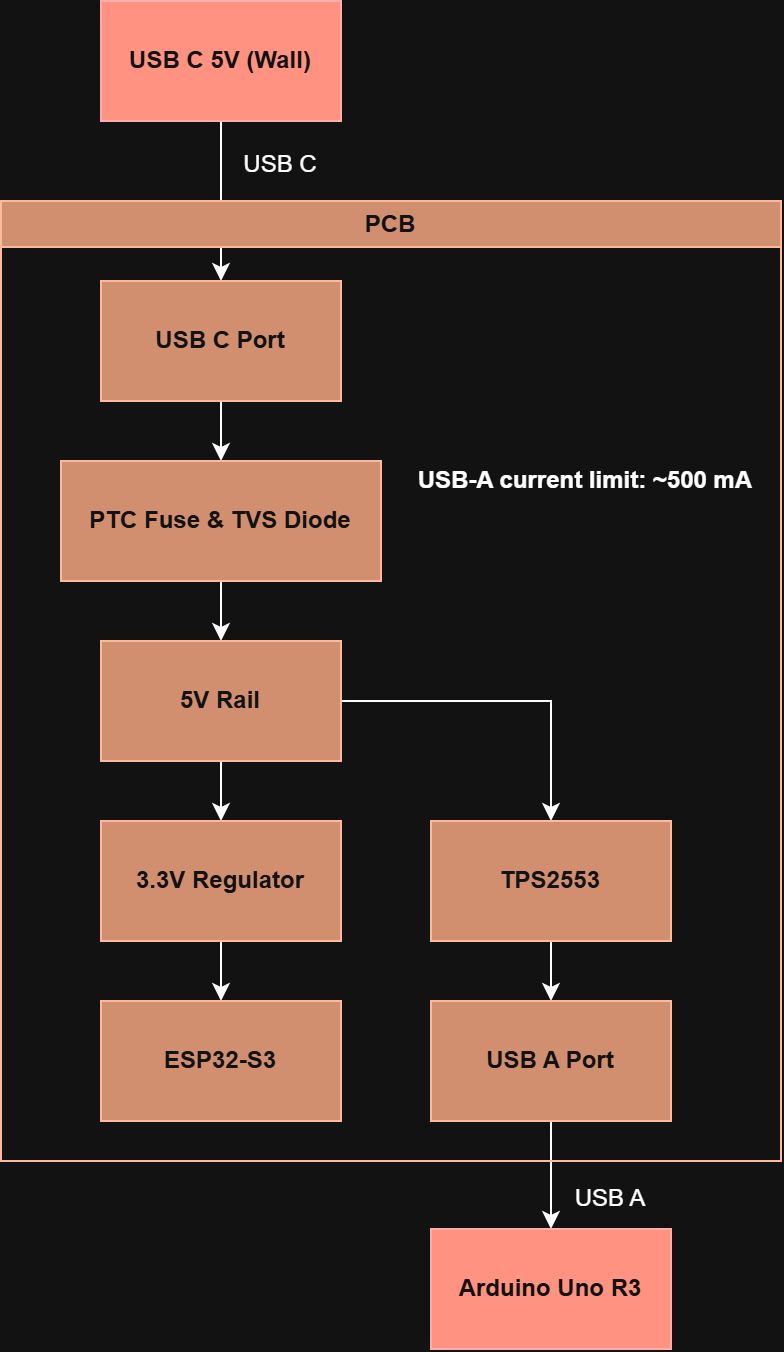
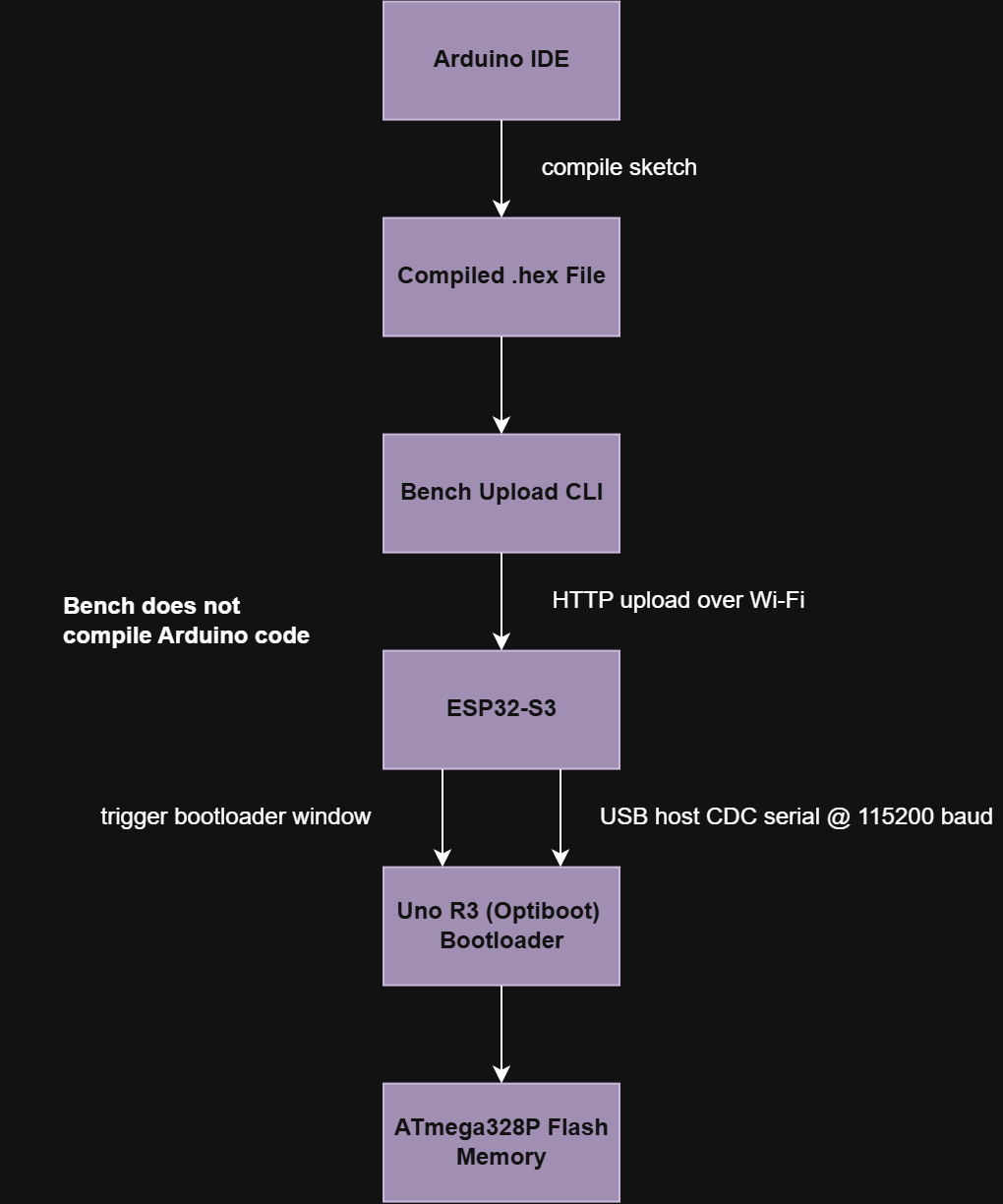
At a high level:
.hex file..hex file to Bench over Wi-Fi.Bench does not compile Arduino code on-board; compilation happens on the laptop.
bench/
├── hardware/
│   ├── kicad/
│   └── exports/
├── software/
│   ├── mock/
│   │   └── bench-mock-server/
│   ├── cli/
│   │   └── bench-upload/
│   └── firmware/
│       └── bench-fw/
├── media/
│   ├── diagrams/
│   ├── renders/
│   └── screenshots/
├── LICENSE-SOFTWARE
├── LICENSE-HARDWARE
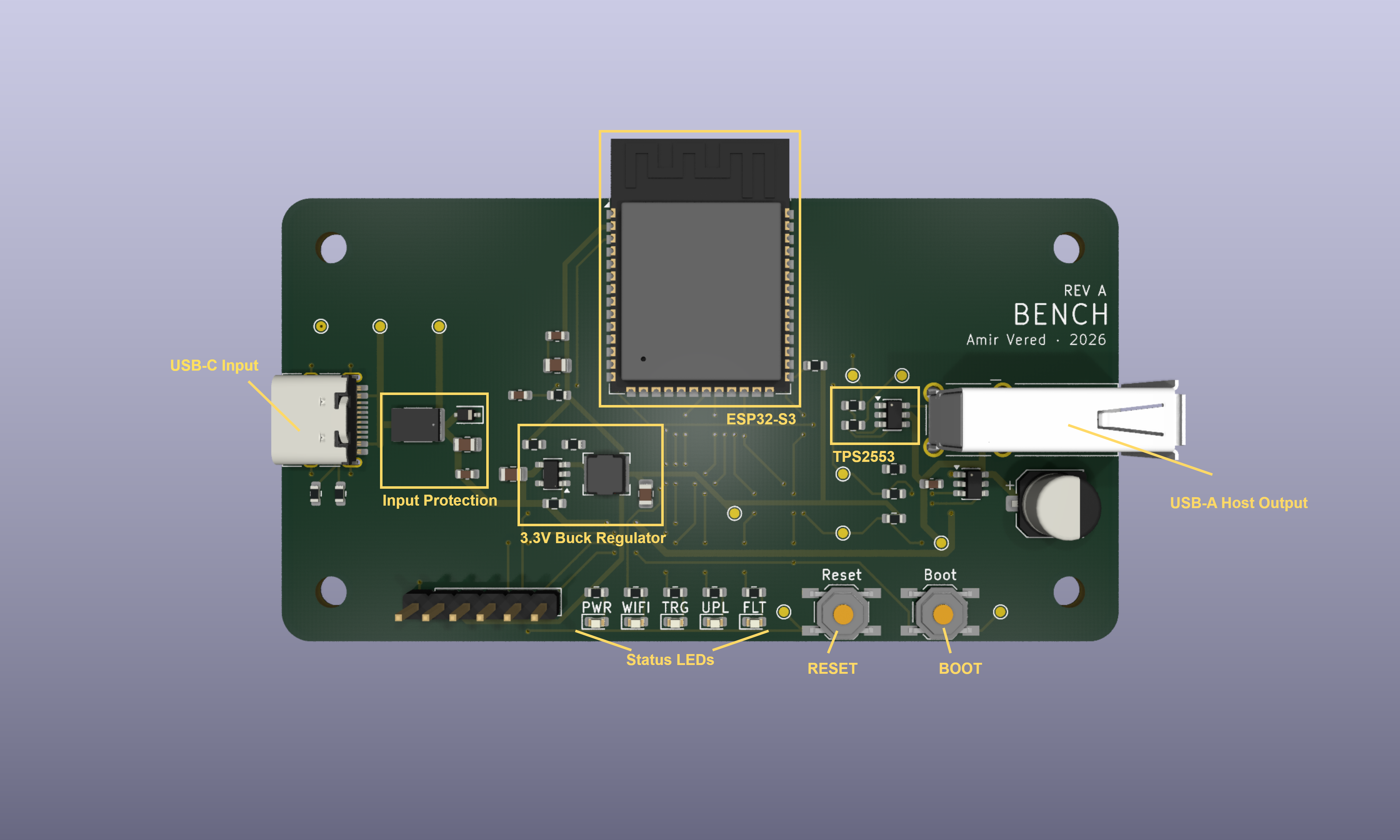
└── README.mdBench is built around the ESP32-S3-WROOM-1.
Major hardware blocks include:
Bench includes three software components:
software/
├── mock/
│   └── bench-mock-server/
├── cli/
│   └── bench-upload/
└── firmware/
└── bench-fw/The mock server simulates a Bench device on a local computer. It is used to test the CLI without Bench hardware.
cd software\mock\bench-mock-server
python -m venv .venv
.venv\Scripts\Activate.ps1
python -m pip install --upgrade pip
python -m pip install -e .
bench-mock --port 8080
Test the mock server:
http://127.0.0.1:8080/api/v1/statusThe Bench Upload CLI runs on the laptop, and can communicate with the firmware or mock server.
cd software\cli\bench-upload
python -m venv .venv
.venv\Scripts\Activate.ps1
python -m pip install --upgrade pip
python -m pip install -e .Check Bench status:
bench status --device http://localhost:8080Upload a precompiled Intel HEX file:
bench upload --hex path\to\sketch.ino.hex --device http://localhost:8080Upload without target reset:
bench upload --hex path\to\sketch.ino.hex --no-reset --device http://localhost:8080Upload without verify:
bench upload --hex path\to\sketch.ino.hex --no-verify --device http://localhost:8080Compile an Arduino sketch with Arduino CLI, then upload:
bench upload path\to\Blink --fqbn arduino:avr:uno --device http://localhost:8080The firmware is an ESP-IDF project for the ESP32-S3.
cd software\firmware\bench-fw
idf.py set-target esp32s3
idf.py build
Wi-Fi settings are configured locally with:
idf.py menuconfigThen open:
Bench Configurationand set:
Wi-Fi SSID
Wi-Fi passwordCurrent firmware includes:
GET /api/v1/statusPOST /api/v1/target/powerPOST /api/v1/target/resetGET /api/v1/logsPOST /api/v1/uploadGET /api/v1/upload/{job_id}The firmware builds successfully for ESP32-S3, but I haven't had the chance to test it on hardware, so be careful.
Bench firmware and the mock server expose the same main HTTP API shape.
GET  /api/v1/status
POST /api/v1/upload
GET  /api/v1/upload/{job_id}
POST /api/v1/target/power
POST /api/v1/target/reset
GET  /api/v1/logs
Primary upload states:
idle
receiving
opening_target
bootloader_sync
uploading
verifying
success
failed
fault
Primary error codes:
INVALID_HEX
NO_TARGET
POWER_FAULT
USB_OPEN_FAILED
BOOTLOADER_TIMEOUT
UPLOAD_FAILED
VERIFY_FAILED
POWER_DISABLEDBench Rev A is a complete prototype, but I haven't had the chance to fabricate it yet.
I'm confident in my hardware and software design, but the firmware, well, let's just say it was my first time programming an ESP32-S3... 😅
Something else pretty cool about this project is the documentation. I've created a video, a post on my website, this repo, and so much more, with full diagrams and explanations. It's been part of my goal to build more in public, and this is one of the projects I'm most proud of so far. My chess board (ICB, 1/26-6/26) was awesome, but its docs were scattered. Bench is hopefully the start of a more cohesive online doc cycle, stay tuned for more.
In terms of future Bench additions, if there is a Rev B, expect:
| Qty | Value | Footprint | References |
|---|---|---|---|
| 5 | 1k | Resistor_SMD:R_0603_1608Metric | R11, R12, R13, R14, R15 |
| 4 | 0.1uF | Capacitor_SMD:C_0603_1608Metric | C2, C5, C7, C9 |
| 4 | 10uF | Capacitor_SMD:C_0805_2012Metric | C1, C3, C4, C6 |
| 3 | 100k | Resistor_SMD:R_0603_1608Metric | R4, R5, R9 |
| 3 | 10k | Resistor_SMD:R_0603_1608Metric | R6, R7, R10 |
| 2 | 22R | Resistor_SMD:R_0603_1608Metric | R16, R17 |
| 2 | 5.1k | Resistor_SMD:R_0603_1608Metric | R1, R2 |
| 1 | 120uF | Capacitor_SMD:CP_Elec_6.3x5.8 | C8 |
| 1 | 1A hold | Fuse:Fuse_1812_4532Metric | F1 |
| 1 | 2.2uH | Inductor_SMD:L_Bourns-SRN4018 | L1 |
| 1 | 453k | Resistor_SMD:R_0603_1608Metric | R3 |
| 1 | 59k | Resistor_SMD:R_0603_1608Metric | R8 |
| 1 | Boot | Button_Switch_SMD:SW_SPST_TL3342 | Boot |
| 1 | ESP32-S3-WROOM-1-N8R8 | RF_Module:ESP32-S3-WROOM-1 | U2 |
| 1 | J_ESP_PROG | Connector_PinHeader_2.54mm:PinHeader_1x06_P2.54mm_Vertical | J2 |
| 1 | LED_FAULT | LED_SMD:LED_0603_1608Metric | FLT |
| 1 | LED_PWR | LED_SMD:LED_0603_1608Metric | PWR |
| 1 | LED_TARGET | LED_SMD:LED_0603_1608Metric | TRG |
| 1 | LED_UPLOAD | LED_SMD:LED_0603_1608Metric | UPL |
| 1 | LED_WIFI | LED_SMD:LED_0603_1608Metric | WIFI |
| 1 | Reset | Button_Switch_SMD:SW_SPST_TL3342 | Reset |
| 1 | TLV62569DBVR | Package_TO_SOT_SMD:SOT-23-5 | U1 |
| 1 | TPS2553DBV | Package_TO_SOT_SMD:SOT-23-6 | U4 |
| 1 | TP_3V3 | TestPoint:TestPoint_Pad_D1.0mm | TP2 |
| 1 | TP_5V_PROTECTED | TestPoint:TestPoint_Pad_D1.0mm | TP1 |
| 1 | TP_ESP_BOOT | TestPoint:TestPoint_Pad_D1.0mm | TP10 |
| 1 | TP_ESP_EN | TestPoint:TestPoint_Pad_D1.0mm | TP11 |
| 1 | TP_GND | TestPoint:TestPoint_Pad_D1.0mm | TP5 |
| 1 | TP_TPS_EN | TestPoint:TestPoint_Pad_D1.0mm | TP9 |
| 1 | TP_TPS_FAULT | TestPoint:TestPoint_Pad_D1.0mm | TP8 |
| 1 | TP_USB_A_VBUS | TestPoint:TestPoint_Pad_D1.0mm | TP4 |
| 1 | TP_USB_D+ | TestPoint:TestPoint_Pad_D1.0mm | TP7 |
| 1 | TP_USB_D- | TestPoint:TestPoint_Pad_D1.0mm | TP6 |
| 1 | TP_VBUS_IN | TestPoint:TestPoint_Pad_D1.0mm | TP3 |
| 1 | TSD05 | Diode_SMD:D_SOD-323 | D1 |
| 1 | USBLC6-2SC6 | Package_TO_SOT_SMD:SOT-23-6 | U3 |
| 1 | USB_A | Connector_USB:USB_A_Wuerth_614004134726_Horizontal | J3 |
| 1 | USB_C | Connector_USB:USB_C_Receptacle_HRO_TYPE-C-31-M-12 | J1 |
The 54 most common of 58 parts.
It measures 85 × 45 mm and has 2 copper layers, 1.6 mm thick.
58 parts, built around the ESP32-S3-WROOM-1-N8R8, TLV62569DBVR-TP, TPS2553DBV and USBLC6-2SC6. The full list of its parts is on this page, with links to each part's symbol and footprint where PCBKit's library has them.
From the Amir-Vered/Bench repository on GitHub, at the commit this page was made from: the board is hardware/kicad/Bench.kicad_pcb and its schematic hardware/kicad/Bench.kicad_sch. PCBKit opens the board in the browser, with nothing to install.
Its repository publishes it under the CERN-OHL-P-2.0 licence: you may reuse it on that licence's terms (keep the author's notice, and for a copyleft licence share your changes alike).

calicopizzadelivery/sbc-development-baseboard
Baseboard for remote management of an attached SBC: K64 MCU as USB HID to the target and Ethernet to the workstation, six switched USB-A ports, isolated SPDT relays, level-shifted console, switched target power

heresiarch/esp32-wifi-eth-gateway
This is proof of concept of a Wifi to Ethernet Gateway with ESP32


mikagosz/FanCtrl3
USB-powered controller for three 4-pin PWM fans, driven by the CPU temperature of a Proxmox VE host - KiCad, MicroPython, OpenSCAD

ssbingo/samba-solar-track
Samba Solar Track – Solarnachführung mit Sturmschutz: Handbuch, Platine und Gehäuse für den Nachbau (10,1-Zoll-Version)

xdylanm/modular-system-psu
A PSU for a modular Eurorack system, featuring +/-12V and 5V rails, USB-C input, and a regulated USB-A output.

jlcjak/astra_piNas
Six-layer CM5 Lite dual-NVMe carrier with PCIe switch, Ethernet, microSD, USB-C PD and PoE. Review design; fabrication hold documented.