

2 layers38.1 × 20.3 mm

 Agilack/pmod10
This repository holds multiple PMOD modules projects
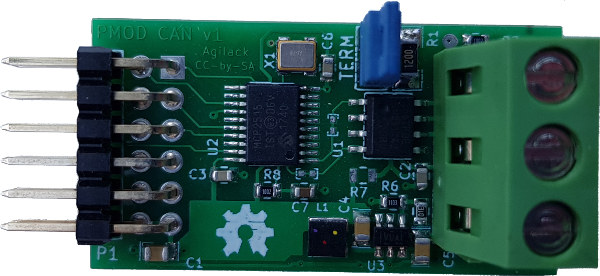
Pmod can is an open-source printed circuit board by Agilack, from the Agilack/pmod repository on GitHub. It is a 2-layer board of 38.1 × 20.3 mm with 27 parts on 28 nets, routed with 235 tracks and 22 vias.
It is built around the MCP2562-H/P and TLV61220DBV. Its parts include 8 resistors, 7 capacitors, 3 ICs, 3 connectors and 1 inductor.
This repository contains multiple projects of PMOD modules. All of them are used for communications.
This module is a peripheral interface to connect a CAN bus.
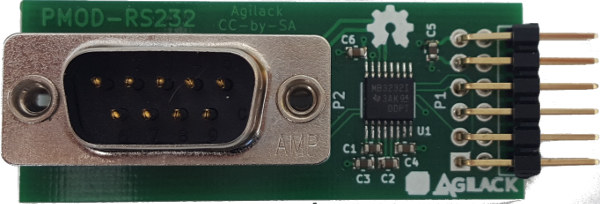
This module is a RS232 interface. The PMOD side is a type4a interface and the other side is a DB9 male connector. The module contains a level shifter (basically a MAX3232) to allow interfacing RS232 signal levels on a board with TTL levels.
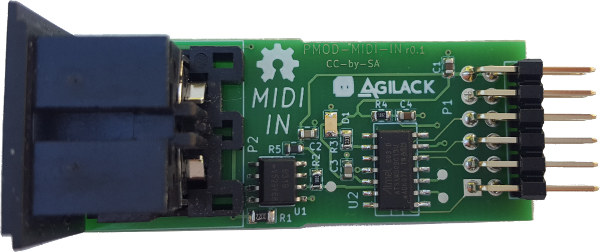
This module can be used to connect a MIDI device to a board with PMOD interface. The MIDI port is an input, so only instruments that send datas can be connected (tested with a keyboard)
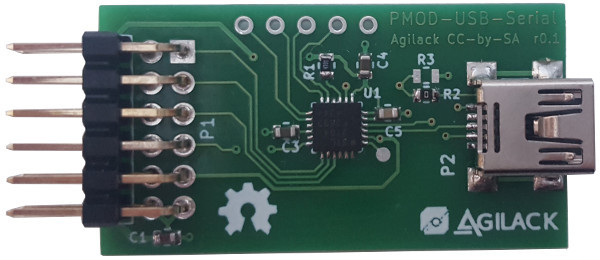
This module is an usb-serial adapter (PMOD peripheral). Based on a Silicon Labs chip, no specific driver is required to use it on most OS.
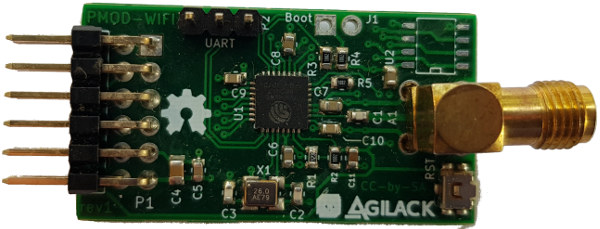
This module is a Wifi interface (PMOD peripheral). Based on the very popular espressif chip (ESP8285 or ESP8266)
All electronics parts are released under Creative Commons Attribution Share Alike 3.0 license.
All firmwares and softwares included with modules are realeased under GNU General Public Licence v3 (GNU GPLv3)
| Qty | Value | Footprint | References |
|---|---|---|---|
| 4 | R | comm-can:SMD0603 | R2, R5, R6, R8 |
| 3 | 100nF | comm-can:SMD0603 | C2, C3, C6 |
| 3 | 10uF | comm-can:SMD0805 | C1, C4, C5 |
| 3 | CONN_1 | comm-can:TP_SMD | TP2, TP3, TP4 |
| 2 | 0 | comm-can:SMD0402 | R3, R4 |
| 1 | 0 | comm-can:SMD0603 | R7 |
| 1 | 4,7uH | comm-can:I_EPL3010 | L1 |
| 1 | 8MHz | comm-can:Q_DFN3225 | X1 |
| 1 | C | comm-can:SMD0603 | C7 |
| 1 | CONN_3 | comm-can:CONN_MC000035 | P2 |
| 1 | JUMPER | comm-can:CONN_2 | J1 |
| 1 | MCP2515-ST | comm-can:TSSOP20 | U2 |
| 1 | MCP2562 | comm-can:SOIC-8E | U1 |
| 1 | PMOD | comm-can:CONN_PMOD-Male | P1 |
| 1 | R | comm-can:SMD1206 | R1 |
| 1 | TLV61220 | comm-can:SOT23-6 | U3 |
| 1 | VAL** | comm-can:logo-ohw | logo_ohw |


peterisza/mobilecg
MobilECG II is an open source clinical grade Holter ECG. For more information, please visit http://mobilecg.hu.


measurify/example-soccer
This thesis project aims to develop a complete system for collecting and data classification in the sport of football, specifically for autonomous recognition of shooting, passing and stopping.


corygrant/CANBoard
Hardware - CAN enabled small input / output expansion board. Switch panels, steering wheel buttons/knobs, etc.
It measures 38.1 × 20.3 mm and has 2 copper layers, 1.6 mm thick.
27 parts, built around the MCP2562-H/P and TLV61220DBV. The full list of its parts is on this page, with links to each part's symbol and footprint where PCBKit's library has them.
From the Agilack/pmod repository on GitHub, at the commit this page was made from: the board is comm-can/prj-kicad/pmod-can.kicad_pcb. PCBKit opens the board in the browser, with nothing to install.
Its repository states no licence, so its author keeps all rights: ask Agilack before reusing the design.