4 layers175.6 × 122.1 mm

 A4091/A409210
A4092 SCSI-2 Host Controller
Flipper is an open-source printed circuit board by A4091, from the A4091/A4092 repository on GitHub. It is a 2-layer board of 73.5 × 18.4 mm with 2 parts on 24 nets, routed with 72 tracks and 0 vias.
It belongs with the retro computing and games boards of this library.
The A4092 is a modern re-implementation of Dave Haynie's classic A4091 Zorro III SCSI controller for the Commodore Amiga. It retains a lot of the proven architecture and the NCR/LSI 53C710 SCSI controller at its core, while replacing obsolete and unobtainable components with modern equivalents that are more readily available today.
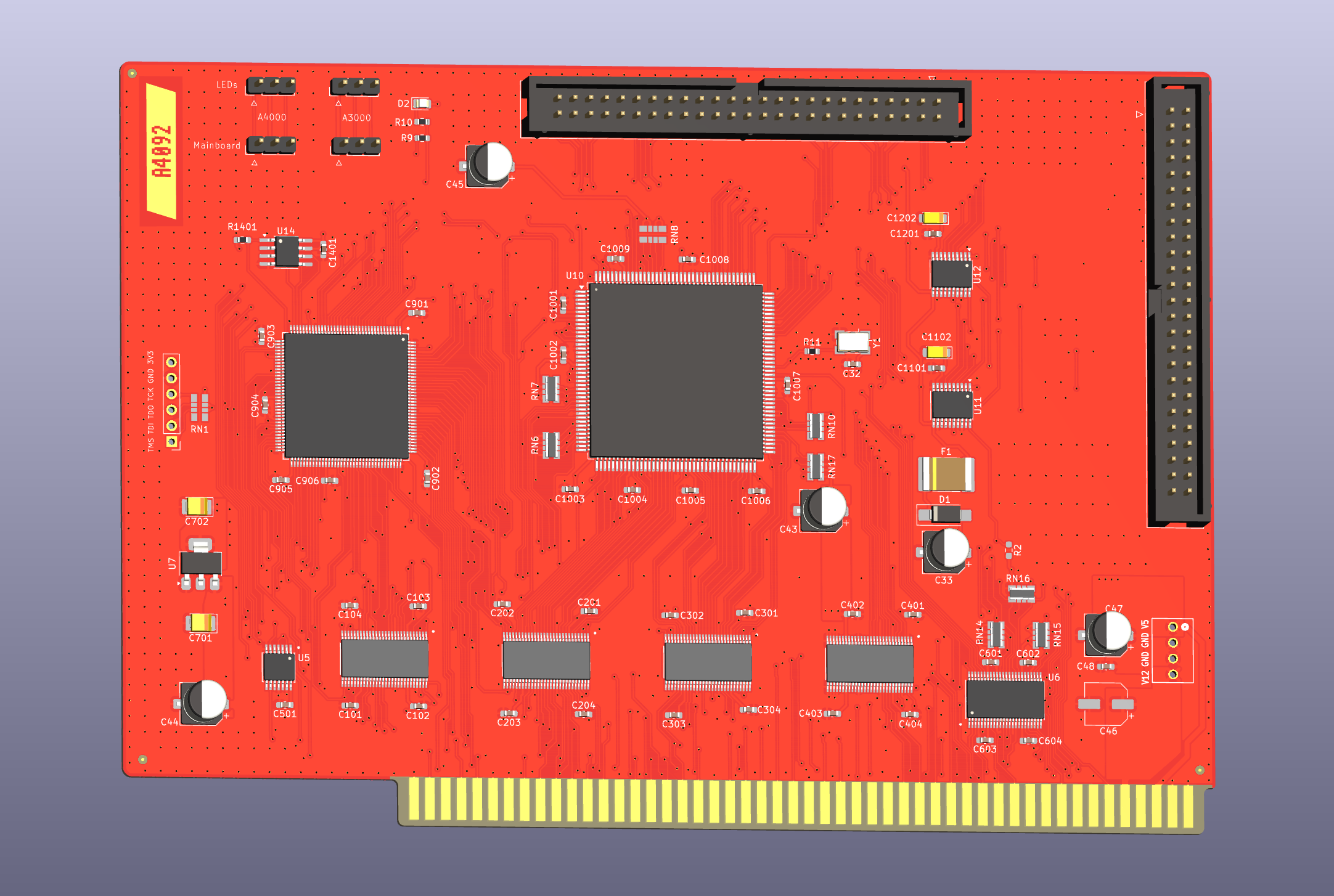
And also as a real PCB (REV A):
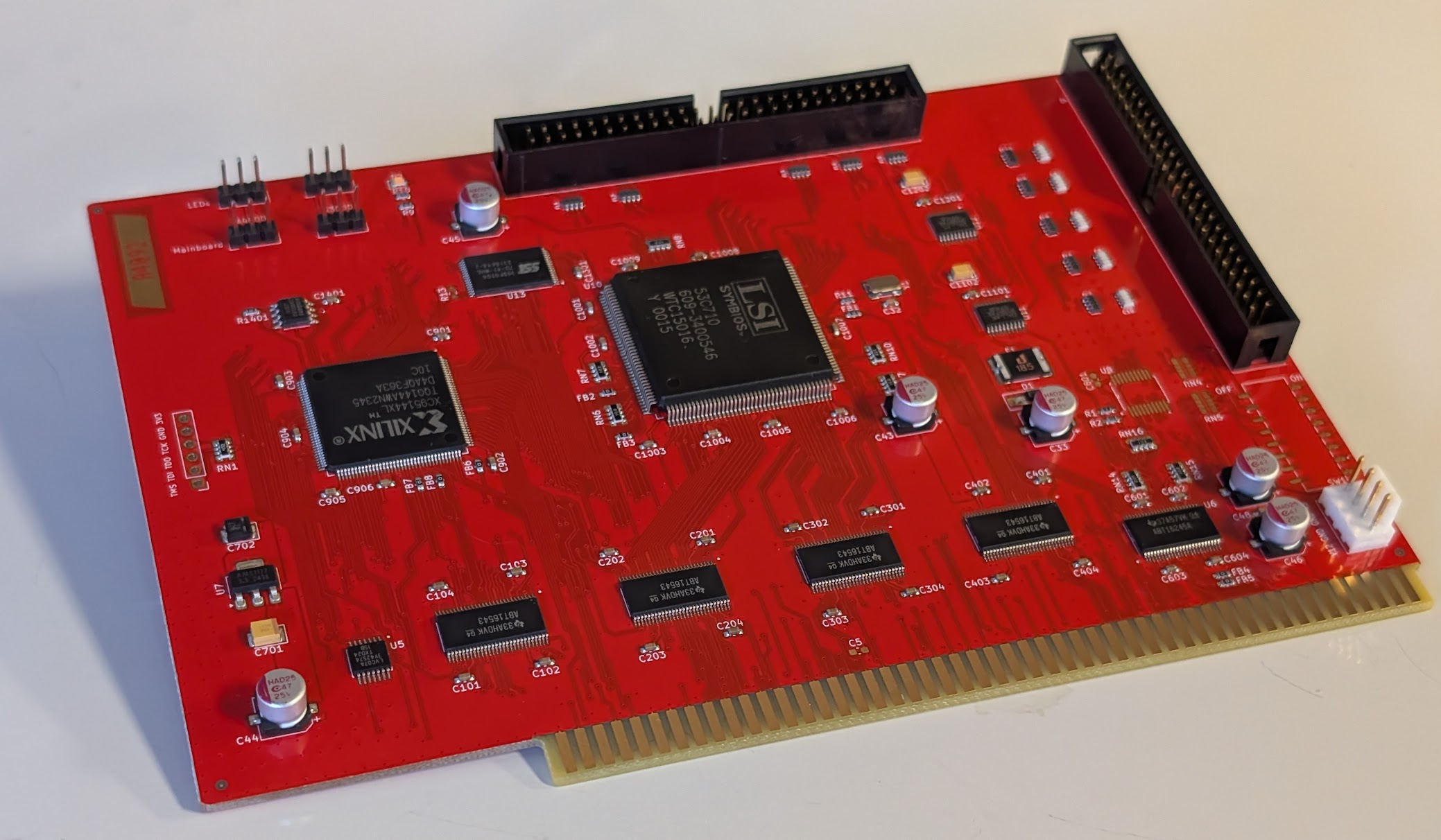
The original A4091 used eight discrete GALs (ATF22V10 and similar) programmed with WinCUPL to implement all bus interface, AutoConfig, address decoding, arbitration, and SCSI control logic. The A4092 consolidates all of this into a single Xilinx XC95144XL CPLD. This brings several advantages:
The parallel EPROM used for the A4091's boot ROM has been replaced with SPI Flash memory. Firmware updates no longer require a UV eraser and a dedicated EPROM programmer — the flash can be reprogrammed in-system.
Where the original A4091 used through-hole, PLCC and SOIC packages, the A4092 uses TSSOP and other modern surface-mount packages (such as 0603 passives). This reduces the board footprint, improves signal integrity and aligns with current PCB assembly capabilities.
The A4092 is designed to be manufactured with services like JLCPCB or PCBway, using (mostly) components that are in current production and readily sourced. No hunting for NOS parts or pulling chips from donor boards.
The AutoConfig logic — previously spread across multiple GALs — is now integrated into the CPLD alongside the rest of the glue logic, resulting in a cleaner and more maintainable design.
The A4092 is not a redesign — it is a re-implementation. The core architecture is unchanged:

| Qty | Value | Footprint | References |
|---|---|---|---|
| 2 | Conn_02x25_Odd_Even | Connector_IDC_local:IDC-Header_2x25_P2.54mm_Vertical_Plug | J1, J2 |


hzeller/rpi-rgb-led-matrix
Controlling up to three chains of 64x64, 32x32, 16x32 or similar RGB LED displays using Raspberry Pi GPIO


adamws/kicad-kbplacer
KiCad plugin for automatic keyboard's key placement and routing

Luos-io/luos_engine
Open-source and real-time orchestrator for cyber-physical-systems, to easily design, test and deploy embedded applications and digital twins.

NVNTLabs/switch2-SDEX2M2
Micro SD Express to M.2 NVME Adapter for Nintendo Switch 2

BlueSCSI/BlueSCSI-v2
BlueSCSI v2/Ultra - an open source, open hardware, SCSI emulator using the Pi Pico PR2040 and Pico 2 RP2350

ohmtech-rdi/eurorack-blocks
Software to Hardware Prototyping for Eurorack using C++, Max/Gen~ or Faust

It measures 73.5 × 18.4 mm and has 2 copper layers, 1.6 mm thick.
2 parts. The full list of its parts is on this page, with links to each part's symbol and footprint where PCBKit's library has them.
From the A4091/A4092 repository on GitHub, at the commit this page was made from: the board is Kicad/Flipper/Flipper.kicad_pcb and its schematic Kicad/A4092/A4092.kicad_sch. PCBKit opens the board in the browser, with nothing to install.
Its repository states no licence, so its author keeps all rights: ask A4091 before reusing the design.