4 layers63 × 51 mm
 ZackHarrington/PCB-Projects
My personal PCB projects and libraries
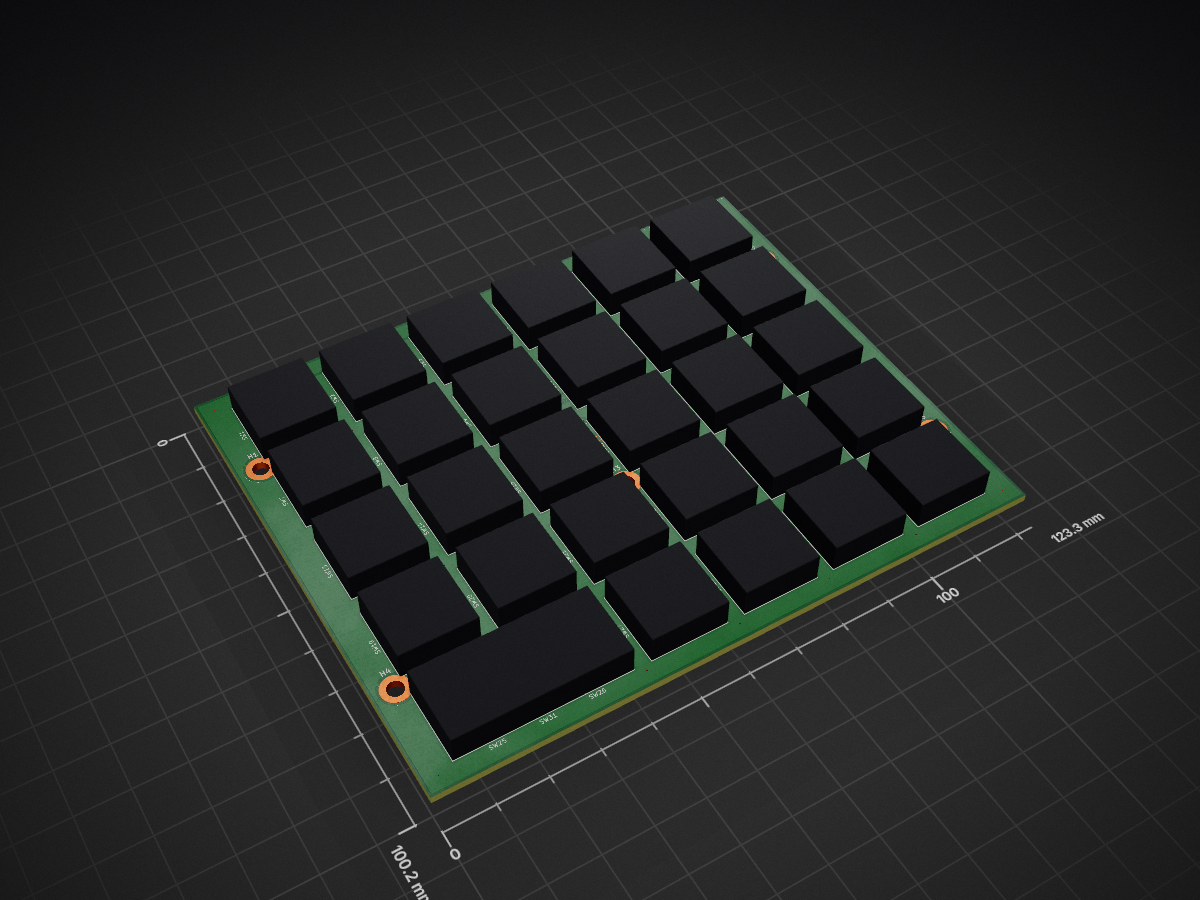
Greek Keyboard is an open-source printed circuit board by ZackHarrington, from the ZackHarrington/PCB-Projects repository on GitHub. It is a 2-layer board of 123.3 × 100.2 mm with 160 parts on 104 nets, routed with 612 tracks and 81 vias.
It is built around the ATMEGA32U4, BAT54L and 10UF 10V, with the BSS316N among its other parts. Its parts include 43 resistors, 31 diodes, 31 switches, 9 capacitors and 2 ICs. It belongs with the keyboards and input boards and the AVR (ATmega, ATtiny) boards of this library.


This repository holds all my personal Autodesk Eagle (now Fusion 360 and KiCAD) projects and libraries
Projects:
Libraries:
Design Blocks:
Note: I'm still in the process of finalizing the documentation for each project
| Qty | Value | Footprint | References |
|---|---|---|---|
| 38 | 470Ω±1% | Harrington-Resistors:1608-SEM | R1, R2, R10, R11, R12, R13, R14, R15, R16, R17, R18, R19, R20, R21, R22, R23 +22 |
| 31 | BAT54L | Harrington-Diodes:SOT-23-3 | D1, D2, D10, D11, D12, D13, D14, D15, D16, D17, D18, D19, D20, D21, D22, D23 +15 |
| 31 | MX-Brown | Harrington-Switches:MX-1-Pole | SW1, SW2, SW10, SW11, SW12, SW13, SW14, SW15, SW16, SW17, SW18, SW19, SW20, SW21, SW22, SW23 +15 |
| 31 | White | Harrington-Diodes:1608 | DS1, DS2, DS10, DS11, DS12, DS13, DS14, DS15, DS16, DS17, DS18, DS19, DS20, DS21, DS22, DS23 +15 |
| 5 | 0.1uF±5% | Harrington-Capacitors:1608-SEM | C3, C4, C5, C6, C7 |
| 5 | MountingHole_Pad | MountingHole:MountingHole_3.2mm_M3_ISO7380_Pad_TopBottom | H1, H2, H3, H4, H5 |
| 4 | TestPoint | TestPoint:TestPoint_Pad_D1.0mm | TP1, TP2, TP3, TP4 |
| 2 | 22pF±5% | Harrington-Capacitors:1608-SEM | C8, C9 |
| 2 | 22Ω±1% | Harrington-Resistors:1608-SEM | R31, R32 |
| 2 | 5.1kΩ±1% | Harrington-Resistors:1608-SEM | R34, R35 |
| 1 | 10kΩ±1% | Harrington-Resistors:1608-SEM | R33 |
| 1 | 10uF±10% | Harrington-Capacitors:2012-SEM | C2 |
| 1 | 1uF±10% | Harrington-Capacitors:1608-SEM | C1 |
| 1 | 8MHz±25ppm | Harrington-Oscillators:ABLS-ABRACON | Y1 |
| 1 | ATmega32u4 | Harrington-ICs:TQFP44 | U2 |
| 1 | BSS316N | Harrington-Transistors:SOT-23-3 | Q1 |
| 1 | RED | Harrington-Diodes:1608 | DS32 |
| 1 | SIGNATURE | Harrington-Aesthetics:SIGNATURE | U1 |
| 1 | USB-C | Harrington-Connectors:USB-4105 | J1 |


open-dynamic-robot-initiative/open-motor-driver-initiative
Open-source drive for brushless motors, following the open dynamic robot initiative

OipRDDinoSaric/Complex-system-for-powering-digital-circuits-and-analogue-circuits-susceptible-to-noise
Designing and soldering a PCB. Programming a PIC microcontroller. Measuring typical parameters of the switching regulators and the linear voltage regulator.


DennisRathgeb/doppler-radar-detector
24 GHz CW Doppler + FMCW radar detector: STM32F429 + ESP32 + TouchGFX live UI, CMSIS-DSP FFT, FastAPI backend, YOLOv8 angle-of-arrival sensor fusion desktop app. ZHAW PM4 team project.


JQIamo/AOD_protector
The protection circuit for the acousto-optic deflectors used for tweezers

It measures 123.3 × 100.2 mm and has 2 copper layers, 1.6 mm thick.
160 parts, built around the ATMEGA32U4, BAT54L, 10UF 10V and BSS316N. The full list of its parts is on this page, with links to each part's symbol and footprint where PCBKit's library has them.
From the ZackHarrington/PCB-Projects repository on GitHub, at the commit this page was made from: the board is Greek-Keyboard/Design-Files/Greek-Keyboard/Greek-Keyboard.kicad_pcb and its schematic Greek-Keyboard/Design-Files/Greek-Keyboard/Greek-Keyboard-LEDs.kicad_sch. PCBKit opens the board in the browser, with nothing to install.
Its repository states no licence, so its author keeps all rights: ask ZackHarrington before reusing the design.