
2 layers22.2 × 46.4 mm
C64-Switchless Quad Kernal Switcher
bwack/C64-Switchless-Multi-Kernal-27C256-adapter
Kernal switcher for the C64/C64C/C128
14 parts112
 Vincent-Stragier/Creactif-electroLAB1
Documents utilisés lors des séances Créactif! dispensées par l'electroLAB.
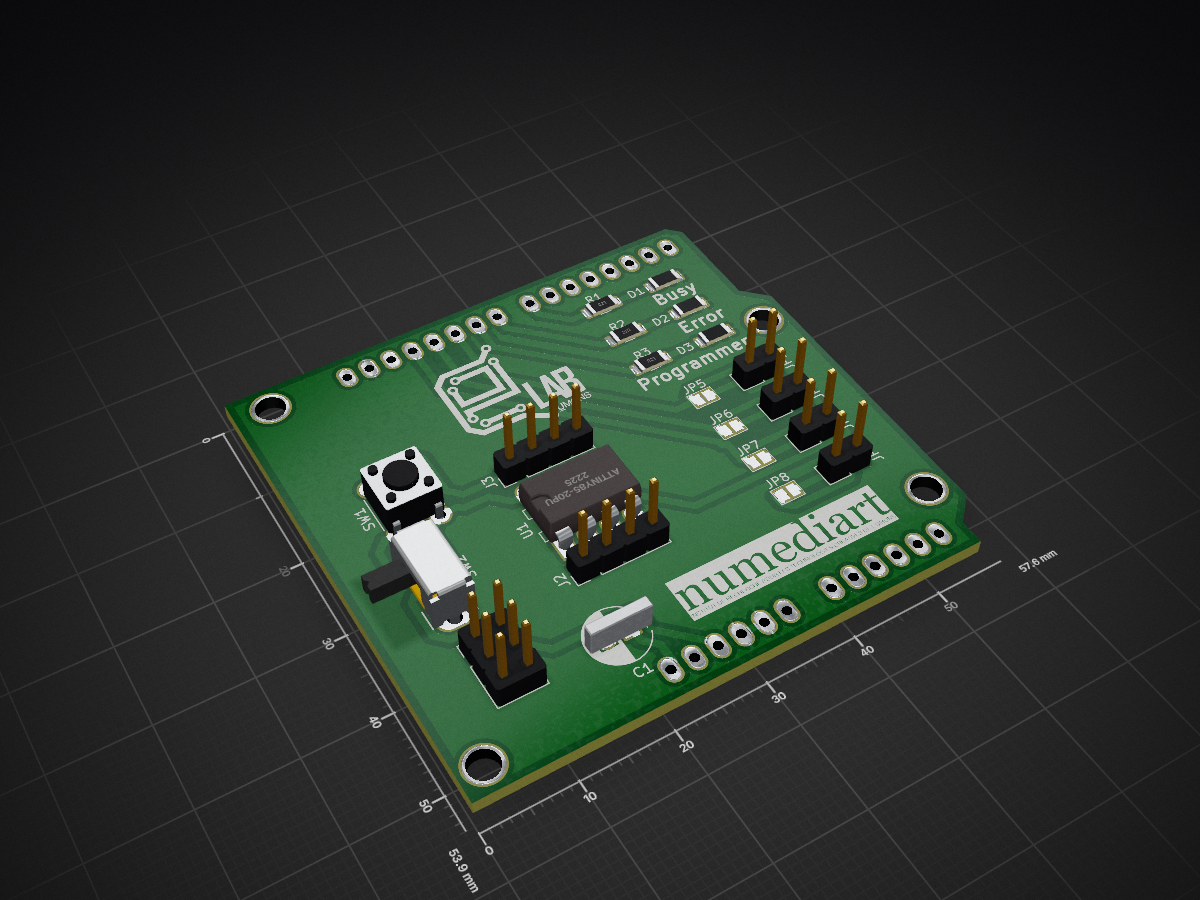
ATtiny85 Arduino programmer is an open-source printed circuit board by Vincent-Stragier, from the Vincent-Stragier/Creactif-electroLAB repository on GitHub, published under the MIT licence. It is a 2-layer board of 57.6 × 53.9 mm with 24 parts on 36 nets, routed with 217 tracks and 0 vias.
It is built around the ATTINY85-20PU. Its parts include 3 resistors, 3 diodes, 3 connectors, 2 switches and 1 capacitor. It belongs with the interfaces and adapters boards and the AVR (ATmega, ATtiny) boards of this library.
Documents utilisés lors des séances Créactifs! dispensées par l'electroLAB.
Dans ce Git, vous retrouverez nos slides, nos projets et nos codes sources.
Historiquement, nous donnions des séances relatives à la conception d'une matrice de LED et une autre relative à la miniaturisation de vos projets. Depuis la fin de l'année 2022, nous dispensons deux séances relatives à la matrice de LED et deux portant sur l'utilisation des ordinateurs monocartes Raspberry.
Dans les deux premières séances (Matrice de LED), l'objectif est de comprendre comment le mutiplexage fonctionne et implémenter une sorte de pilote afin d'afficher des pixel arts ou des animations en pixel art.
Anciennement, une dernière séance (Miniaturisation avec l'ATtiny), était consacrée à l'utilisation de l'ATtiny 85 afin d'apprendre à miniaturiser les projets à base d'Arduino.
Depuis 2022, nous essayons d'introduire à nouveau les ordinateurs monocartes de Raspberry Pi (Séances Raspberry Pi). Le contenu est assez réduit à l'heure actuelle (installation du système d'exploitation, prise en main de SSH et de Raspberry Pi OS, interaction avec les broches, etc.).
Deux séances sont données pour l'atelier sur la matrice de LED :
Des codes exemple sont disponibles (deux projets Arduino et un projet Platformio sont proposés).
La miniaturisation des projets Arduino à l'aide de l'ATtiny 85 présentée en une séance. Les slides sont disponibles ici.
Les séances relatives aux ordinateurs monocartes Raspberry Pi portent sur l'installation du système d'exploitation, la connexion en SSH ou via VNC, l'utilisation de différentes commandes dans le terminal (via VNC ou SSH), l'interaction avec les broches (via le système de fichiers, C++ ou Python) et réalisation d'un petit projet d'interface graphique.
Les slides sont disponibles ici.
En outre, par simplicité un guide de démarrage rapide est disponible ici.
| Qty | Value | Footprint | References |
|---|---|---|---|
| 4 | Jumper | Pin_Headers:Pin_Header_Straight_1x02_Pitch2.54mm | JP1, JP2, JP3, JP4 |
| 4 | Jumper | Jumper:SolderJumper-2_P1.3mm_Open_Pad1.0x1.5mm | JP5, JP6, JP7, JP8 |
| 3 | 220 | Resistors_SMD:R_0805_HandSoldering | R1, R2, R3 |
| 2 | Conn_01x04_Female | Pin_Headers:Pin_Header_Straight_1x04_Pitch2.54mm | J2, J3 |
| 1 | 10µ | Capacitors_THT:CP_Radial_D6.3mm_P2.50mm | C1 |
| 1 | ARDUINO_SHIELD | KiCad_empreintes:ARDUINO_SHIELD_040pins | SHIELD1 |
| 1 | ATtiny85-20PU | Housings_DIP:DIP-8_W7.62mm_LongPads | U1 |
| 1 | Conn_02x03_Counter_Clockwise | Pin_Headers:Pin_Header_Straight_2x03_Pitch2.54mm | J1 |
| 1 | LED-GREEN | LEDs:LED_0805_HandSoldering | D3 |
| 1 | LED-ORANGE | LEDs:LED_0805_HandSoldering | D1 |
| 1 | LED-RED | LEDs:LED_0805_HandSoldering | D2 |
| 1 | LOGO | KiCad_empreintes:LOGO_eLAB_c=16.90mm | G*** |
| 1 | LOGO | KiCad_empreintes:logo_numediart_N_(13,6mm_5mm) | G*** |
| 1 | SW_Push_Open | Buttons_Switches_THT:SW_PUSH_6mm | SW1 |
| 1 | SW_Push_SPDT | Buttons_Switches_THT:SW_CuK_OS102011MA1QN1_SPDT_Angled | SW2 |
bwack/C64-Switchless-Multi-Kernal-27C256-adapter
Kernal switcher for the C64/C64C/C128

plusvic/simplebus2-intercom
General description of the Simplebus2 protocol used by some Comelit's intercoms. Hardware for retransmitting Simplebus2 messages over UART.

osmocom/osmocom-analog
Software Implementation of analog cellular telephony systems like NMT, TACS, IMTS, A/B/C-Netz; mirror of https://gitea.osmocom.org/cellular-infrastructure/osmocom-analog

strickyak/jerboa-attiny85-mod-synth
Modular Synthesizer using an ATtiny85 chip for each module.


Hack-a-Day/Remoticon_KiCad_Blender
support files for the 2020 Remoticon KiCad to Blender > PCB renders workshop

It measures 57.6 × 53.9 mm and has 2 copper layers, 1.6 mm thick.
24 parts, built around the ATTINY85-20PU. The full list of its parts is on this page, with links to each part's symbol and footprint where PCBKit's library has them.
From the Vincent-Stragier/Creactif-electroLAB repository on GitHub, at the commit this page was made from: the board is Séance_ATtiny85/Projet_Kicad/ATtiny85_Arduino_programmer_v1.0.1/ATtiny85_Arduino_programmer.kicad_pcb. PCBKit opens the board in the browser, with nothing to install.
Its repository publishes it under the MIT licence: you may reuse it on that licence's terms (keep the author's notice, and for a copyleft licence share your changes alike).