2 layers108 × 95.3 mm
Blue Wizard
wizarddata/Blue-Wizard-Mod
Bluetooth Controller for the Kinesis Advantage line of keyboards using the BlueMicro firmware
47 parts38

 TUDelft-SPC-Lab/spcl_midge_hardware1
Hardware design files for the SPC lab MIDGE wearable devices for in-the-wild social data collection.
Rythm badge tudelft is an open-source printed circuit board by TUDelft-SPC-Lab, from the TUDelft-SPC-Lab/spcl_midge_hardware repository on GitHub, published under the MIT licence. It is a 2-layer board of 35 × 47 mm with 42 parts on 62 nets, routed with 276 tracks and 18 vias.
It is built around the BMD-300-A-R, ICM-20948 and NTS0104BQ, with the TP4057 and 10118194-0001LF among its other parts. Its parts include 18 capacitors, 7 ICs, 5 resistors, 5 connectors and 3 diodes. It belongs with the lEDs and displays boards of this library.


Welcome to the Hardware repository of the Social Perceptive Lab for the MIDGE badge.
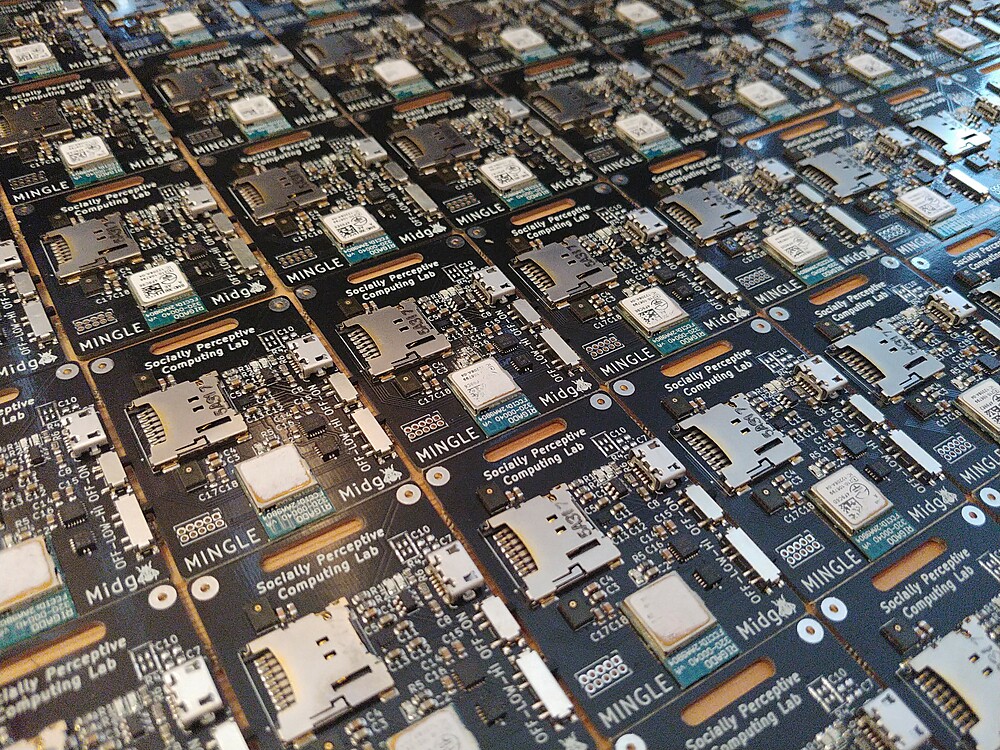
The Midge badge is a 55x35mm wearable PCB for in-the-wild social data collection. It features
Learn more about the project itself here.
Learn more about the firmware and software here.
Wearable badges are a cheap, convenient way to record high-fidelity signals from individuals in social interaction. We have the need for such a device in the SPC lab because we study the social dynamics of small crowds (~25-100 people) interacting during an event. Conference badges allow us to equip every participant to record individual audio, body movement signals and proximity information, all at a relatively low cost per device.
Cell phones can be useful in sensing crowds but differences in the sensors, fidelities and recording options / software available to different cell phone models are an issue for analysis. If cell phones are to be provided by the scientist, then cost becomes an issue in comparison with wearable badges.
Wrist wearables can be effective at capturing hand movements. While we could have designed our device with a wrist form factor, we think the badge form is more convenient to use and its position on the chest allows it to more reliably capture proximity and overall body movement through acceleration.
The open-source Rhythm Badge was designed with office environments in mind, where the goal was the collection of longitudinal data about a team over days or weeks. Proximity information and a low-frequency microphone allowed it to reconstruct the social network of team members. On the other hand our goal was to computationally analyse interactions both at the group and individual level from social signals (speech, movement, proximity) of subjects. This required higher fidelity sensors and a new device design.
This project is unique because it improves upon the state-of-the-art wearable sensors measuring face-to-face human social interactions. The improvement points are catered towards more fine-grained and flexible capturing of data. For instance, the choice between high and low frequency audio capturing mode is provided at data acquisition and the experimenters can freely choose the frequency best suitable for them (for example, whether they have high-frequency audio for transcription or privacy-preserving low-frequency audio for detecting speech activities). Additionally, the inclusion of the on-board digital motion processor directly provides orientation estimation with the newly included full 9-DOF inertial motion unit (IMU). This allows future applications (e.g., real-time F-formation detection) to be built directly on top of the outputs of the DMP. The above design considerations and implementation exemplify the uniqueness and new advantages that Midges offer.
The design of the Midge is complete and 100 devices have been created. The device was successfully used for the ConfLab dataset. There it was used to record audio (1250Hz), IMU data (56Hz) and proximity data (1Hz) for 48 data subjects in the same space in a computer science conference. It has also been used to make smart drinking glasses and in several master and bachelor thesis.
The development of the device was contracted to Ioannis Protonotarios for the Socially Perceptive Computing Lab at Delft University of Technology. Ioannis took as base the latest release of the MIT Media Lab's Rhythm badge and implemented both hardware and software changes and updates. Testing of the device was done in conjunction with Socially Perceptive Computing Lab members. The whole process took 3 years and two iterations of the device's hardware. Additional hardware, firmware and software improvements have been developed by the SIPLab-EdgeAI at the Costa Rica Institute of Technology and the Embedded Systems Group at Delft University of Technology.
Absolutely. Some of the contributions that we currently find most important in our application setting (sensing of small crowds) are: Improvements to audio sensing. Although our Midge was an improvement over the Rhythm badge in quality of audio sensing, audio quality is still an issue. Especially, the front-facing microphones of the device introduce significant cross-contamination. Potential solutions include exploring beam-forming, directional microphones or addition of headset support. Software improvements. There is significant room for improving the software of the device. The hub, which serves as monitoring and control centre for all connected Midges is especially relevant. The current command-line interface would benefit from being replaced by a user-friendly web-based interface that displays the status of connected midges and allows for quick bulk actions like eg. disabling sensors, starting/stopping recordings, etc.
Currently we are not aware of specific problems with the PCB, all functions work correctly (battery charging, cut-off switches, SD card, audio recording, IMU recording, status LEDs). If you do find a problem, please open an issue in the github repository.
| Qty | Value | Footprint | References |
|---|---|---|---|
| 7 | 100nF | Capacitor_SMD:C_0603_1608Metric | C1, C9, C10, C14, C15, C16, C18 |
| 7 | 1uF | Capacitor_SMD:C_0603_1608Metric | C6, C7, C8, C11, C12, C13, C17 |
| 3 | 10uF | Capacitor_SMD:C_0603_1608Metric | C2, C3, C5 |
| 3 | MP34DT05-A | custom_libs:MP34DT06 | U2, U3, U7 |
| 2 | 10M | Resistor_SMD:R_0603_1608Metric | R1, R2 |
| 2 | 2k | Resistor_SMD:R_0603_1608Metric | R5, R6 |
| 1 | 10118194-0001LF | digikey-footprints:USB_Micro_B_Female_10118194-0001LF | J1 |
| 1 | 1k? | Resistor_SMD:R_0603_1608Metric | R4 |
| 1 | 503182-1852 | 503182-1852:MOLEX_503182-1852 | J3 |
| 1 | ? | Capacitor_SMD:C_0603_1608Metric | C4 |
| 1 | AP7345D | Package_DFN_QFN:X2-DFN1612-8 | U4 |
| 1 | BAT+ | Connector_Wire:SolderWirePad_1x01_Drill1.2mm | J4 |
| 1 | BAT- | Connector_Wire:SolderWirePad_1x01_Drill1.2mm | J5 |
| 1 | BMD-300-A-R | digikey-footprints:Bluetooth_Module_BMD-300 | MOD1 |
| 1 | CHRG_LED | LED_SMD:LED_0603_1608Metric | D1 |
| 1 | ICM-20948 | ICM-20948:QFN40P300X300X105-24N | U5 |
| 1 | LED_Small | LED_SMD:LED_0603_1608Metric | D3 |
| 1 | LOGO | rythm_badge_tudelft:fly | G*** |
| 1 | NTS0104 | QFN50PX250X300X100-15N:QFN50PX250X300X100-15N | U6 |
| 1 | OFF-LOW-HI | Button_Switch_SMD:SW_SP3T_PCM13 | SW2 |
| 1 | OFF-ON | Button_Switch_SMD:SW_SPDT_PCM12 | SW1 |
| 1 | STDBY_LED | LED_SMD:LED_0603_1608Metric | D2 |
| 1 | SWD | Connector_PinHeader_1.27mm:PinHeader_2x05_P1.27mm_Vertical | J2 |
| 1 | TP4057 | Package_TO_SOT_SMD:SOT-23-6 | U1 |
wizarddata/Blue-Wizard-Mod
Bluetooth Controller for the Kinesis Advantage line of keyboards using the BlueMicro firmware


jayis1/hardware-design-lab
Full-cycle hardware device designs — each device in its own subfolder with architecture, schematics, PCB layout, and software stack

antmicro/jetson-agx-thor-baseboard
Open hardware baseboard for Nvidia Jetson Thor AGX T5000 System on Module

antmicro/cm4-baseboard
Experimental baseboard supporting System on Modules with Raspberry Pi CM4/CM5 pinout
It measures 35 × 47 mm and has 2 copper layers, 1.6 mm thick.
42 parts, built around the BMD-300-A-R, ICM-20948, NTS0104BQ and TP4057. The full list of its parts is on this page, with links to each part's symbol and footprint where PCBKit's library has them.
From the TUDelft-SPC-Lab/spcl_midge_hardware repository on GitHub, at the commit this page was made from: the board is Hardware_Design_v1/PCB/KiCad/rythm_badge_tudelft.kicad_pcb. PCBKit opens the board in the browser, with nothing to install.
Its repository publishes it under the MIT licence: you may reuse it on that licence's terms (keep the author's notice, and for a copyleft licence share your changes alike).