4 layers120.1 × 144.3 mm

 Studio-Fug/yapnr5
Yet-another-place-and-route engine for PCBs.
Board B is an open-source printed circuit board by Studio-Fug, from the Studio-Fug/yapnr repository on GitHub, published under the AGPL-3.0 licence. It is a 6-layer board of 134 × 189 mm with 87 parts on 49 nets, routed with 1,085 tracks and 1,949 vias.



Yet another place and route engine for printed circuit boards.
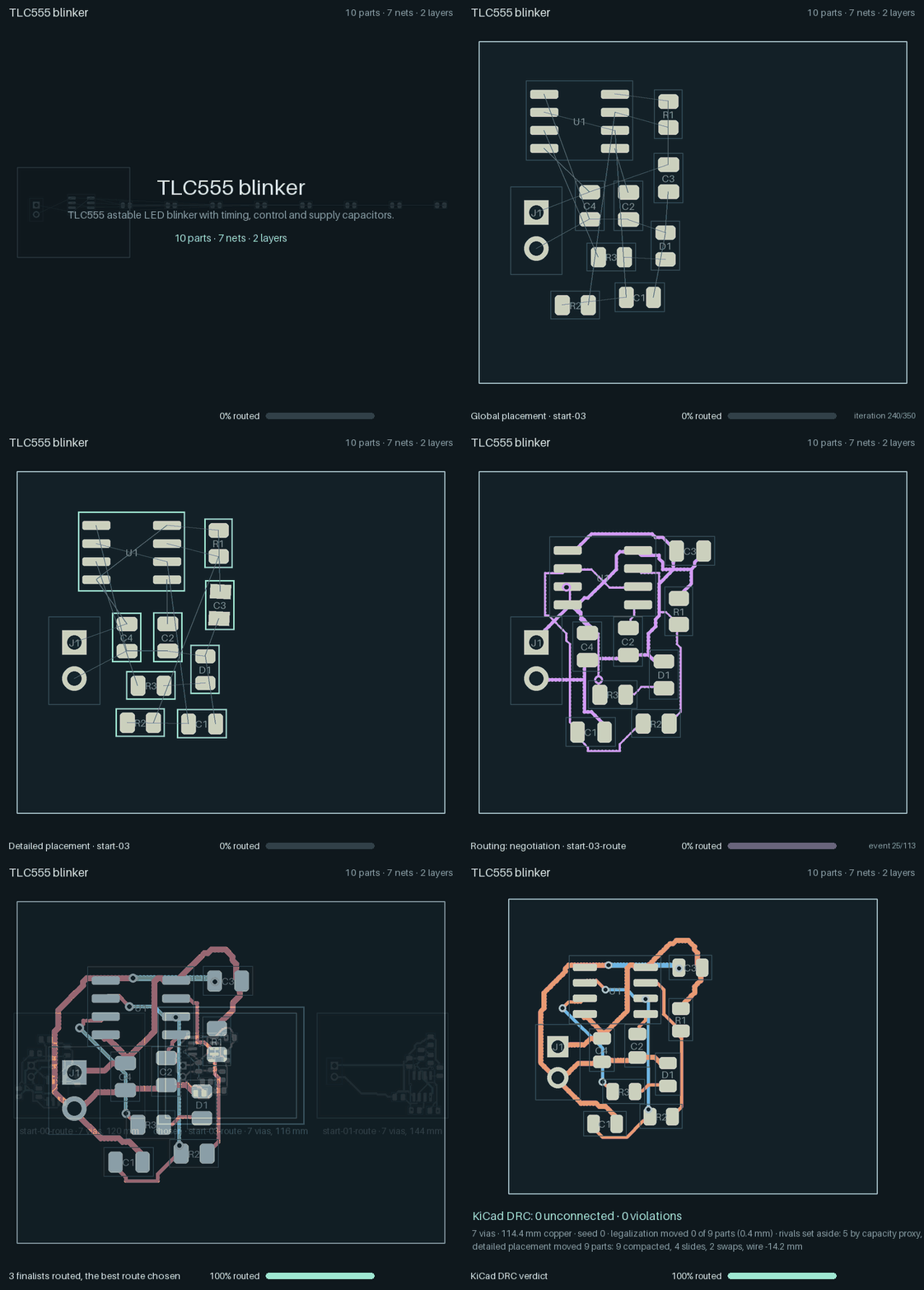
The 555 flasher (a TLC555 astable blinker, 10 parts, 2 layers) from the
regression ladder: from unplaced footprints to 100 % routed, with the
placement starts and routes it was chosen from, then the gloss pass (the copper it replaces in
red, its new copper in green), ending on KiCad's clean DRC verdict. Recorded with the opt-in
compact placement and gloss
(PNR_COMPACT=1, PNR_GLOSS=1; both off by default).
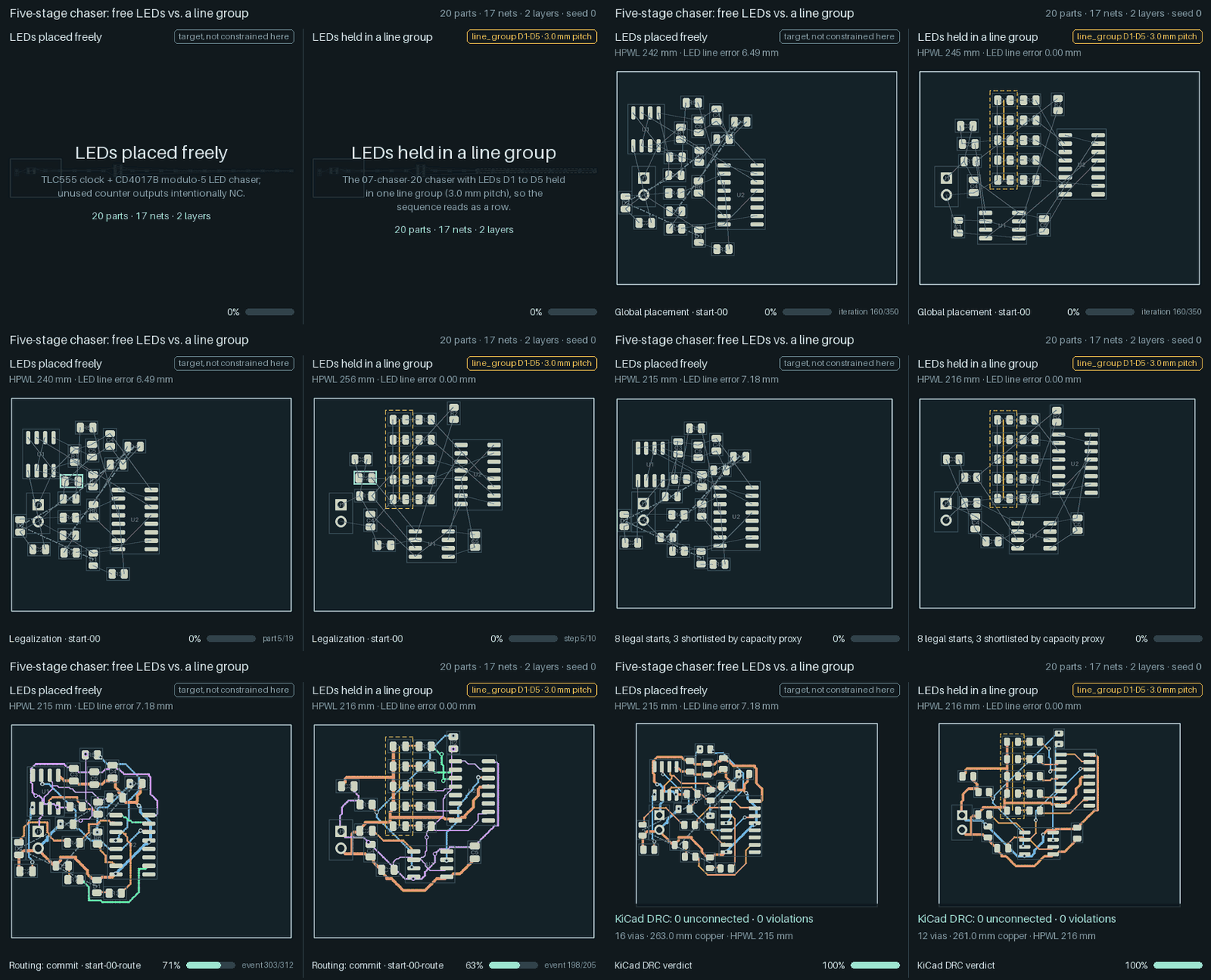
Left: LEDs placed freely. Right: the same chaser with its LEDs held in a line group; compact placement keeps each LED's series resistor flush beside it, and the placer moves and turns the whole row. Both with compact placement and gloss, as above.
yapnr places components and routes copper for KiCad boards. It uses a mechanical, Monte-Carlo-driven search: hierarchical block synthesis, power-first placement, native KiCad routing and DRC in the loop, and electrical contracts (current, pairs, plane access) declared next to the design.
The engine is being migrated here from the Splanc repository,
where it was developed to lay out the Splanc Mini board. The migration plan and progress are in
docs/ and WORKLOG.md.
The papers and open-source projects it builds on are listed in
Foundations and references.
Alpha: this repository holds the build, CI and documentation scaffolding, a command-line stub, the
migration plan, and the engine imported from Splanc at its original
paths under hardware/: its committed history and its newer, uncommitted state
(manifest). The package restructuring follows. KiCad 10 only.
With Bazelisk installed as bazel:
bazel run //:yapnr -- --version   # the CLI
bazel run //:doctor               # environment report
bazel test //...                  # unit tests and repository checks
bazel run //docs:build            # documentation -> docs/site/html/
See DEVELOPERS.md for setup (including the headless KiCad copy on macOS) and CONTRIBUTING.md for the contribution policy.
ghcr.io/studio-fug/yapnr bundles KiCad 10, CPython 3.11 with CPU-only torch, and yapnr, for
linux/amd64 and linux/arm64, so running yapnr needs Docker and nothing else:
docker run --rm ghcr.io/studio-fug/yapnr:edge doctoredge follows main; release tags (X.Y.Z, X.Y, latest) start with v0.1.0. See
docs/containers.md for projects, UID mapping, resource limits and Apple
Silicon, and docs/releases.md for versioning and releases.
Copyright (C) 2026 Kevin Balke. Licensed under the GNU Affero General Public License v3.0 or later
(AGPL-3.0-or-later); see LICENSE. Third-party material is listed in
THIRD_PARTY.md.
Ask your agent “Please use Studio-Fug/yapnr to design X” and have it read
AGENTS.md. Start yapnr agent chat in an interactive container;
the execution guide covers authentication, resource
limits, resumption and the open assembly-validation gates.
| Qty | Value | Footprint | References |
|---|---|---|---|
| 52 | TestPoint_PTH | TestPoint_PTH | X1, X2, X10, X11, X12, X13, X14, X15, X16, X17, X18, X19, X20, X21, X22, X23 +36 |
| 32 | SMA_EdgeLaunch_SMA-J-P-H-ST-EM1 | SMA_EdgeLaunch_SMA-J-P-H-ST-EM1 | JB01L, JB01R, JB02L, JB02R, JB03L, JB03R, JB04L, JB04R, JB05L, JB05R, JB06L, JB06R, JB07L, JB07R, JB08L, JB08R +16 |
| 1 | Anchor | Anchor | X56 |
| 1 | Microsection | Microsection | X55 |
| 1 | MouseBites | MouseBites | MB1 |


JX5S/DP_aux_emulator
Board for modifying traffic on DP-aux. Specifically, board is made for correcting false information provided by the PSVR2 making it not work on PC. Except for DP-aux, it is a passive extension of USB-C.


mmosko/Zx50
This is the primary CPU board for the Zx50 8-slot passive backplane system. It hosts the Z80 microprocessor (running at 5 MHz to 10 MHz) and acts as the master controller for the primary bus.


roshan0282/ttsky-asic-rayforge
Tiny Tapeout is an educational project that aims to make it easier and cheaper than ever to get your digital and analog designs manufactured on a real chip.

CatspersCoffee/S100-Boards
S-100 bus boards designed and built: Z80 and 80386 CPU cards, SRAM/DRAM memory, CPLD/FPGA I/O and SPI boards, an 18-slot backplane and bus terminator.

zeankundev/boards
A collection and an archive of KiCad projects I made. Contains projects from 2023 - 2024.

dhruv1859/CARVantaBAC
🧬 CARVanta Next-Generation Precision Oncology & AI CAR-T Cell Platform Interactive 3D Biological Digital Twin • 3D Neural Bridge • Sentinel HYDRA Biosensor
It measures 134 × 189 mm and has 6 copper layers, 1.55 mm thick.
87 parts. The full list of its parts is on this page, with links to each part's symbol and footprint where PCBKit's library has them.
From the Studio-Fug/yapnr repository on GitHub, at the commit this page was made from: the board is examples/rf-coupons/JLC06161H-7628/board-B.kicad_pcb. PCBKit opens the board in the browser, with nothing to install.
Its repository publishes it under the AGPL-3.0 licence: you may reuse it on that licence's terms (keep the author's notice, and for a copyleft licence share your changes alike).