
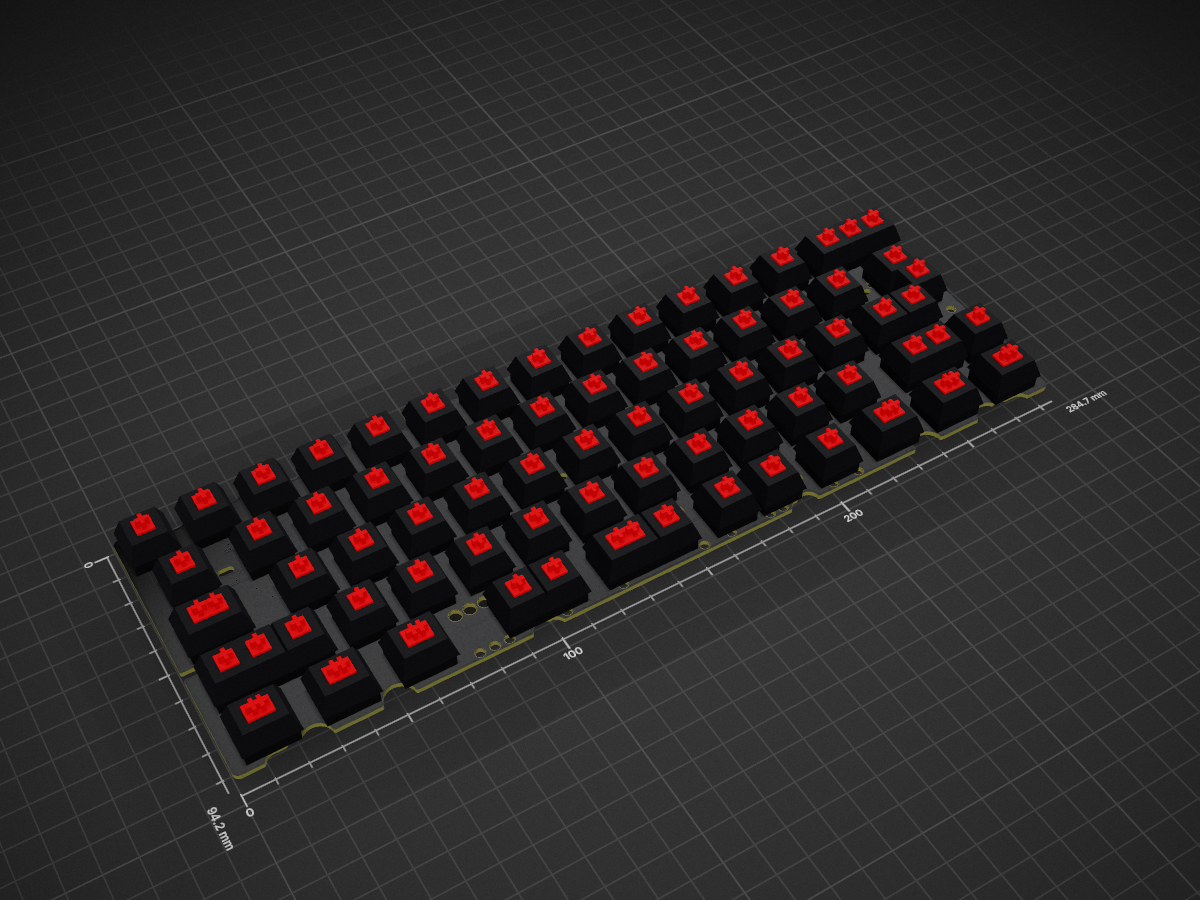
2 layers284.7 × 94.2 mm
Uni60 Hotswap
ShentoBento/Universal_PCBs
A collection of Universal QMK Compatible PCBs, prioritizing layout selection, board compatibility, connector options
197 parts
 ShentoBento/Universal_PCBs
A collection of Universal QMK Compatible PCBs, prioritizing layout selection, board compatibility, connector options
Uni60 Solder is an open-source printed circuit board by ShentoBento, from the ShentoBento/Universal_PCBs repository on GitHub. It is a 2-layer board of 284.7 × 94.2 mm with 202 parts on 122 nets, routed with 759 tracks and 70 vias.
It is built around the USBLC6-2SC6. Its parts include 72 diodes, 9 capacitors, 6 connectors, 3 ICs and 2 switches. It belongs with the keyboards and input boards and the STM32 boards of this library.
note: this was a draft written by AI, its got a ton of errors and is pending manual changes Open-source, QMK/VIA-compatible keyboard PCBs designed to fit as many cases as possible.
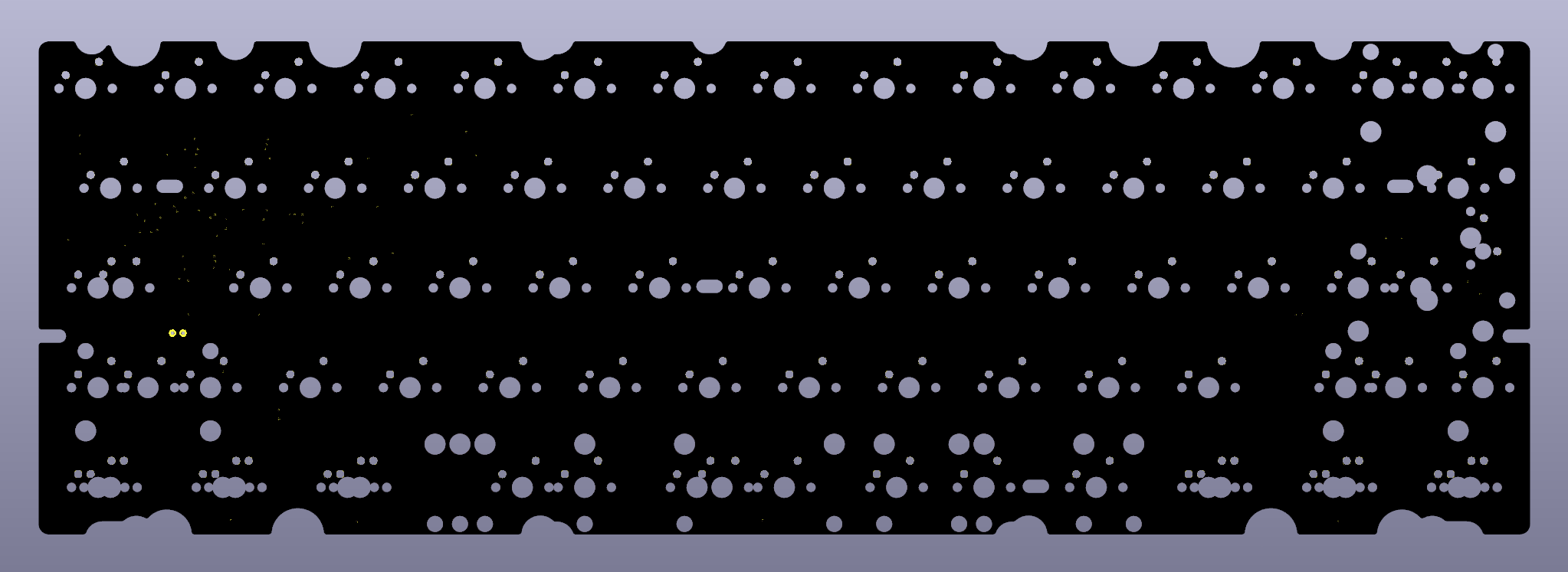
Most custom keyboard cases are designed around one specific PCB. The boards in this repo work the other way around. Each one is built to drop into as many cases of its form factor as possible, by supporting a wide range of layouts and matching the connector and mounting positions that different cases expect.
| Board | Form factor | Type | Status | Firmware |
|---|---|---|---|---|
| Uni60 Solder | 60% | Solder | Completed 50 unit GB, Sep 2026 | Uni60/Solder |
| Uni60 Hotswap | 60% | Hotswap | In development | — |
Each board's folder has its own README with full specs, layout diagrams and ordering files.
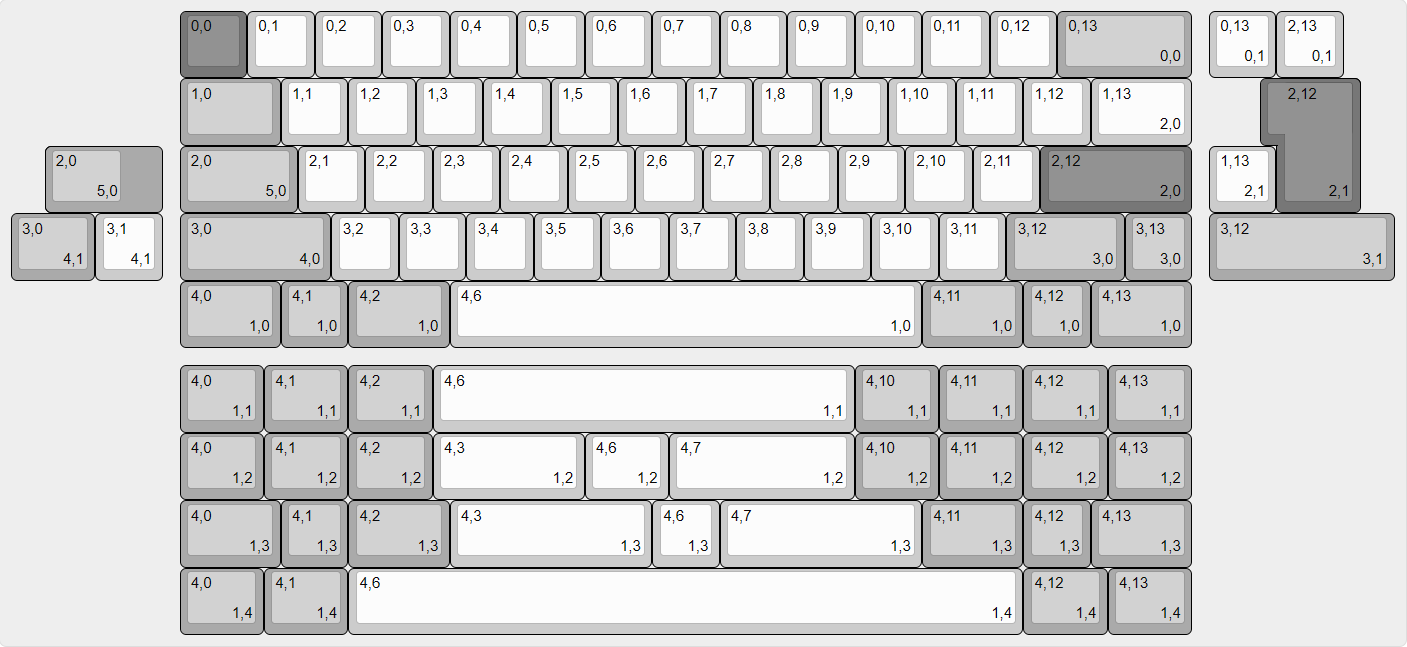
Layouts. Each board supports the common layout variations for its size. The Uni60 covers ANSI and ISO, split backspace, split left and right shift, stepped caps, and five bottom rows: 6.25u, 7u, 10u, 2.25u/1.25u/2.75u split, and 3u/1u/3u split.
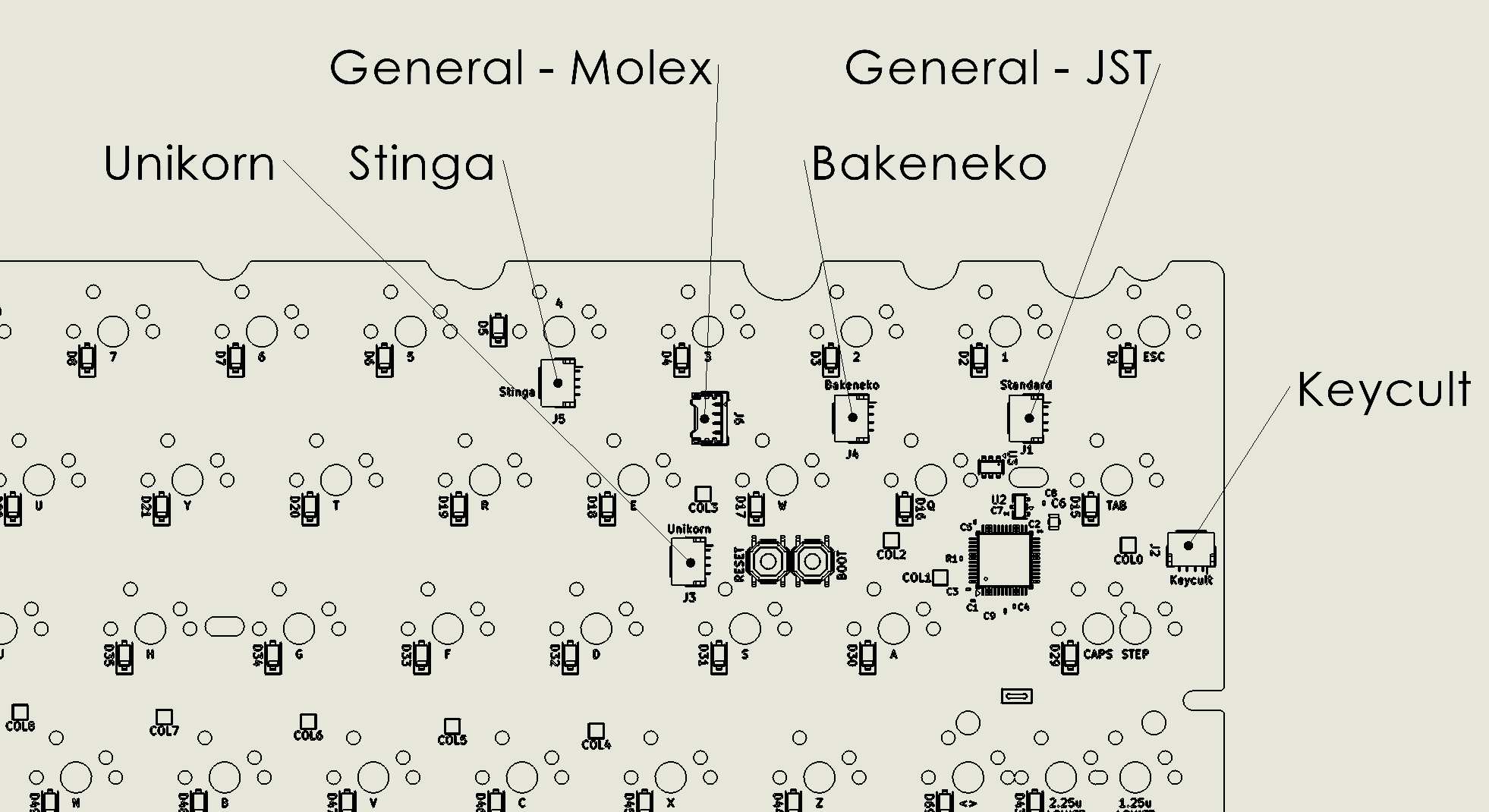
Connectors. Enthusiast cases route the USB daughterboard cable through a channel, and that channel sits in a different place in nearly every case. A tall JST-SH connector anywhere else bottoms out on the case floor. So the Uni60 has five daisy-chained JST-SH positions that line up with common channel locations. Keep the one your case uses and clip or desolder the rest. There's also a Molex Pico-EZmate connector, which sits lower than the switch pins and fits any case.
Outline and mounting. The board outline is drawn to suit as many cases as possible. It includes tray-mount holes between keys, with the switch matrix routed around them.
Universal_PCBs/
├── Uni60/
│   ├── UNI60_Solder/              complete: KiCad project, production files, images
│   └── UNI60_Hotswap/             in development
└── shentobento_kicad_library/ shared symbols, footprints and 3D modelsshentobento_kicad_library/ with relative paths, so the projects open on any machine with no library setup..kicad_pro file in KiCad 10 or newer.production/ folder (gerbers, BOM, positions). If you change the design, regenerate them with the JLCPCB Fabrication Toolkit plugin.Keyboard footprints and symbols are derived from marbastlib by ebastler, licensed under CERN-OHL-P v2. See shentobento_kicad_library/LICENSE-marbastlib.txt; modifications are logged in shentobento_kicad_library/NOTICE.md. Generic footprints come from the KiCad standard libraries.
Designed by Andrew Shentu (@ShentoBento) · LinkedIn
| Qty | Value | Footprint | References |
|---|---|---|---|
| 72 | 1N4148 | shentobento:D_SOD-123 | D1, D2, D10, D11, D12, D13, D14, D15, D16, D17, D18, D19, D20, D21, D22, D23 +56 |
| 67 | MX_SW_solder | shentobento:SW_Alps_MX_1u | KC_<>1, KC_0, KC_1, KC_2, KC_3, KC_4, KC_5, KC_6, KC_7, KC_8, KC_9, KC_A1, KC_B1, KC_BKSP1, KC_BKSP2, KC_BSLS2 +51 |
| 14 | TestPoint | shentobento:TestPoint_Pad_1.5x1.5mm | COL0, COL1, COL2, COL3, COL4, COL5, COL6, COL7, COL8, COL9, COL10, COL11, COL12, COL13 |
| 9 | MX_SW_solder | shentobento:SW_Alps_MX_1.25u | KC_LALT_1.25U1, KC_LCTL_1.25U1, KC_LGUI_1.25U1, KC_LSFT2, KC_MENU1, KC_RALT_1.25U1, KC_RCTL_1.25U1, KC_RGUI_1.25U1, KC_SPLIT_FN_1.25U1 |
| 5 | 100nF | shentobento:C_0201_0603Metric | C1, C2, C3, C4, C5 |
| 5 | Conn_01x04 | shentobento:JST_SH_1x04 | J1, J2, J3, J4, J5 |
| 4 | MX_SW_solder | shentobento:SW_Alps_MX_1.5u | KC_BSLS1, KC_LCTL1, KC_RALT1, KC_TAB1 |
| 2 | 1uF | shentobento:C_0201_0603Metric | C7, C8 |
| 2 | SW_Push | shentobento:SW_Push_Reset_Bootloader | SW1, SW2 |
| 1 | 0.1uF | shentobento:C_0201_0603Metric | C9 |
| 1 | 10k | shentobento:R_0201_0603Metric | R1 |
| 1 | 10uF | shentobento:C_0805_2012Metric | C6 |
| 1 | Conn_01x04 | shentobento:Molex_Pico-EZmate_78171-0004_1x04-1MP_P1.20mm_Vertical | J6 |
| 1 | MX_SW_solder | shentobento:SW_Alps_MX_1.75u | KC_CAPS1 |
| 1 | MX_SW_solder | shentobento:SW_Alps_MX_1.75u_STP_1.25 | KC_STEP1 |
| 1 | STM32F072CBTx | shentobento:MCU_STM32F072CBTx | U1 |
| 1 | TestPoint | shentobento:TestPoint_Bridge_Pitch2.0mm_Drill0.7mm | GND1 |
| 1 | USBLC6-2SC6 | shentobento:SOT-23-6 | U3 |
| 1 | XC6206PxxxMR | shentobento:SOT-23-3 | U2 |
The 190 most common of 202 parts.
ShentoBento/Universal_PCBs
A collection of Universal QMK Compatible PCBs, prioritizing layout selection, board compatibility, connector options


TalismanDesign/PocketMage_PDA
An E-Ink PDA device using the ESP32 S3.


shorepine/tulipcc
The Tulip Creative Computer and AMYboard - portable Python synthesizers


LeoDJ/FW-EC-DongleHiderPlus
Framework Expansion Card that includes a USB hub to hide a bare dongle inside and still have a USB-A port externally
It measures 284.7 × 94.2 mm and has 2 copper layers, 1.6 mm thick.
202 parts, built around the USBLC6-2SC6. The full list of its parts is on this page, with links to each part's symbol and footprint where PCBKit's library has them.
From the ShentoBento/Universal_PCBs repository on GitHub, at the commit this page was made from: the board is Uni60/UNI60_Solder/Uni60_Solder_KiCad/Uni60_Solder.kicad_pcb and its schematic Uni60/UNI60_Hotswap/Uni60_Hotswap_KiCad/Uni60_Hotswap.kicad_sch. PCBKit opens the board in the browser, with nothing to install.
Its repository states no licence, so its author keeps all rights: ask ShentoBento before reusing the design.