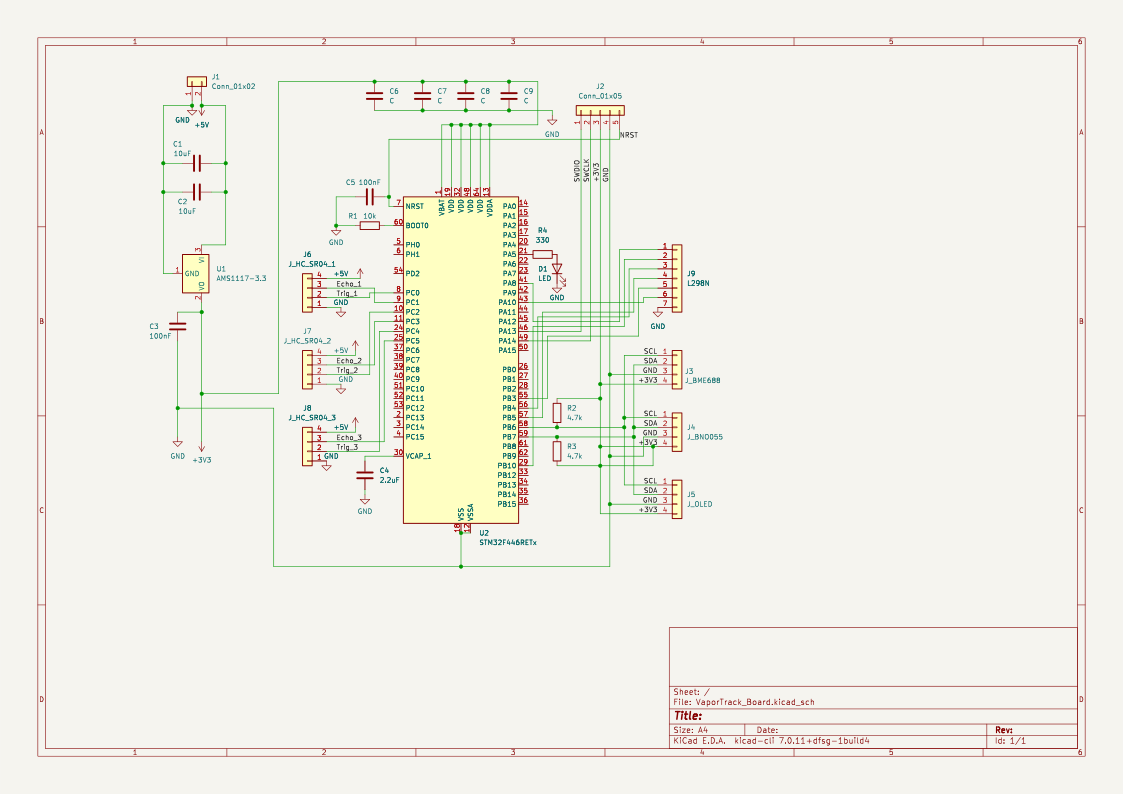
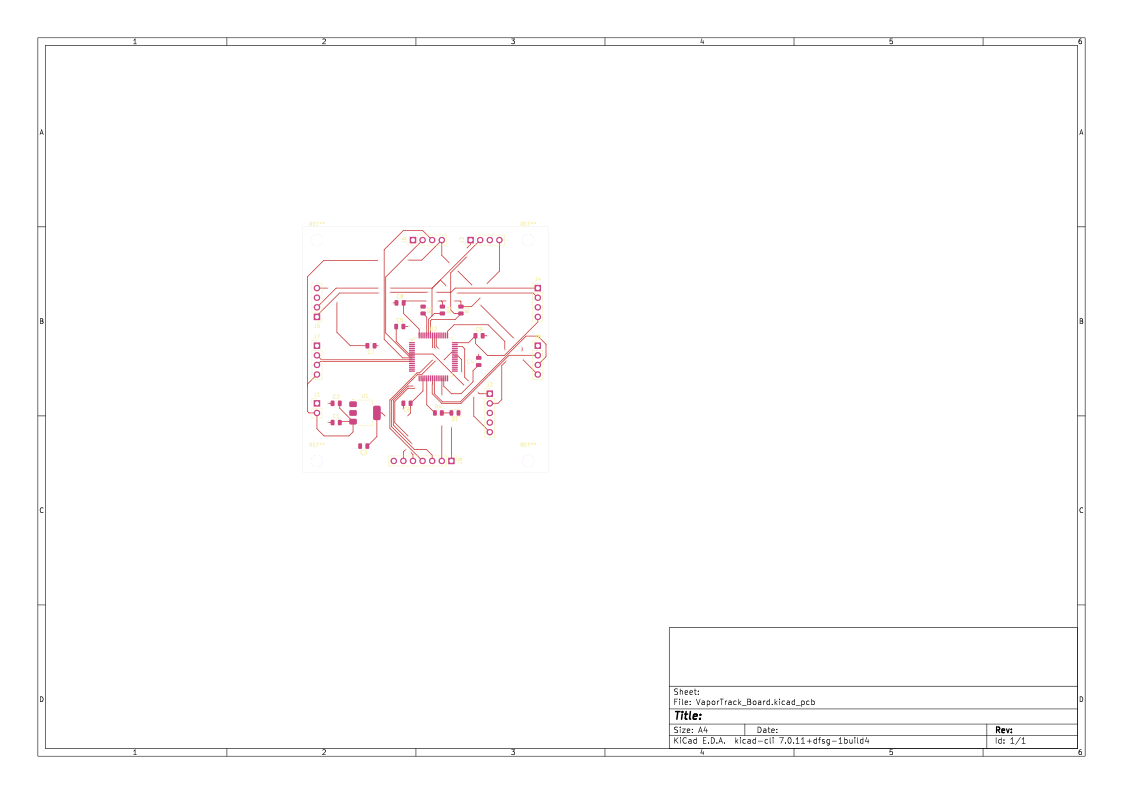
VaporTrack Board is an open-source printed circuit board by Samuel-Habib, from the Samuel-Habib/VaporTrack repository on GitHub, published under the MIT licence. It is a 2-layer board of 65 × 65 mm with 29 parts on 57 nets, routed with 269 tracks and 60 vias.
It is built around the L298N and AMS1117-3.3. Its parts include 9 capacitors, 9 connectors, 4 resistors, 2 ICs and 1 diode. It belongs with the robots and motor control boards and the STM32 boards of this library.
VaporTrack is an autonomous robotic rover powered by an STM32F446RE (ARM Cortex-M4F @ 180 MHz) running FreeRTOS. The rover characterizes spatial volatile organic compound (VOC) gas distributions in indoor environments, computes 2D spatial gradients ($\nabla G = [\partial G/\partial x, \partial G/\partial y]$) via weighted planar least-squares regression, and tracks plume sources while executing reactive obstacle avoidance using a 3-sensor ultrasonic array.
[!NOTE]
Ground Isolation & Noise Mitigation:
The motor return current path through the L298N is tied to the central battery ground tab to prevent high-current switching noise from inducing ground bounce on the 3.3V analog and I2C lines. Echo pins PC1, PC3, and PC5 on the STM32F446RE are true 5V-tolerant (FT) inputs, allowing direct interface with 5V HC-SR04 echo signals without resistive voltage dividers.
4. Hardware Pinout Map
Signal Name
STM32 Pin
Function / Alternate Function
Electrical Characteristics
Notes
I2C1_SCL
PB6
AF4 (I2C1)
Open-Drain, 4.7 kΩ pull-up
Shared I2C bus clock (BME688, BNO055, SSD1306)
I2C1_SDA
PB7
AF4 (I2C1)
Open-Drain, 4.7 kΩ pull-up
Shared I2C bus data line
ENA (Left PWM)
PA8
AF1 (TIM1_CH1)
Push-Pull, 20 kHz PWM
Left motor bank duty cycle (ARR=8999)
ENB (Right PWM)
PA10
AF1 (TIM1_CH3)
Push-Pull, 20 kHz PWM
Right motor bank duty cycle (ARR=8999)
IN1
PB10
GPIO Output
Push-Pull, Low Speed
Left motor forward control
IN2
PB4
GPIO Output
Push-Pull, Low Speed
Left motor reverse control
IN3
PB5
GPIO Output
Push-Pull, Low Speed
Right motor forward control
IN4
PB3
GPIO Output
Push-Pull, Low Speed
Right motor reverse control
USS_FRONT_TRIG
PC0
GPIO Output
Push-Pull, High Speed
Front ultrasonic 10 µs trigger pulse
USS_FRONT_ECHO
PC1
GPIO Input (FT 5V-tolerant)
Floating / Internal Pull-down
Front echo pulse width measurement
USS_LEFT_TRIG
PC2
GPIO Output
Push-Pull, High Speed
Left ultrasonic 10 µs trigger pulse
USS_LEFT_ECHO
PC3
GPIO Input (FT 5V-tolerant)
Floating / Internal Pull-down
Left echo pulse width measurement
USS_RIGHT_TRIG
PC4
GPIO Output
Push-Pull, High Speed
Right ultrasonic 10 µs trigger pulse
USS_RIGHT_ECHO
PC5
GPIO Input (FT 5V-tolerant)
Floating / Internal Pull-down
Right echo pulse width measurement
STATUS_LED
PA5
AF1 (TIM2_CH1)
Push-Pull PWM
Activity heartbeat LED (duty $\propto$ motor drive)
5. Software Architecture & FreeRTOS Tasks
The application runs 6 prioritized, decoupled FreeRTOS tasks. Inter-task communication follows a producer-consumer snapshot model: sensors update a shared state struct protected by a FreeRTOS mutex (g_sensor_mutex), and consumer tasks copy local snapshots to eliminate torn reads without holding the bus.
In addition, access to the shared physical I2C1 bus (hi2c1) between SensorTask (reading BME688 and BNO055) and DisplayTask (flushing 1024-byte framebuffer to SSD1306) is serialized using a dedicated FreeRTOS mutex (g_i2c_mutex). To prevent bus starvation during BME688 gas sensor heating, the driver splits forced-mode triggering and data readout: SensorTask initiates the measurement, yields CPU execution via osDelay(160) while the heater stabilizes, and acquires g_i2c_mutex again only when measurement registers are ready to fetch.
Translates navigation velocity commands to TIM1 PWM compare values and GPIO directions.
SensorTask
250 ms
osPriorityAboveNormal (32)
512 words (2 KB)
Triggers BME688 forced-mode gas read and polls BNO055 Euler heading in NDOF mode.
NavTask
150 ms
osPriorityAboveNormal (32)
512 words (2 KB)
Dead-reckoning position integration, state machine updates, and obstacle avoidance overrides.
USSTask
100 ms
osPriorityNormal (24)
256 words (1 KB)
Sequentially fires HC-SR04 triggers using TIM4 1 MHz counter with 1 ms inter-ping decay gaps.
MapTask
500 ms
osPriorityNormal (24)
512 words (2 KB)
Logs spatial samples and solves 2D planar weighted least-squares system for $\nabla G$.
DispTask
500 ms
osPriorityBelowNormal (16)
512 words (2 KB)
Formats telemetry strings and flushes 1024-byte framebuffer to SSD1306 OLED over I2C.
6. Gas Mapping & Gradient Localization Theory
Standard plume-tracking approaches rely on instantaneous concentration thresholds (if gas > threshold -> move forward). In indoor environments, turbulent eddies and diffusion create local pockets of high concentration, causing naive rovers to stall or oscillate. VaporTrack uses a two-pass planar spatial gradient estimation:
1. Spatial Sample Acquisition
As the rover maneuvers, it logs discrete coordinate tuples:
$$S_i = (x_i, y_i, \theta_i, G_i)$$
Where $(x_i, y_i)$ is dead-reckoned position derived from heading $\theta_i$ and differential wheel displacement.
Because the BME688 metal-oxide semiconductor (MOX) sensor's raw resistance $R_{\text{gas}}$ drops when reducing VOC vapors interact with its heated sensing layer, the rover converts raw resistance into relative conductance $G_i$ ($\mu\text{S}$):
$$G_i = \frac{10^6}{R_{\text{gas}, i}}$$
This inversion guarantees that $G_i$ increases proportionally with gas plume concentration, allowing standard gradient ascent to naturally steer toward the gas source without sign inversion.
2. Weighted Planar Least-Squares Regression
In the localization phase, the rover models the local gas distribution in a neighborhood of radius R as a first-order planar surface centered at (x, y).
D = Sum(dx^2)*Sum(dy^2) - Sum(dx*dy)^2

b = (Sum(dx*G)*Sum(dy^2) - Sum(dy*G)*Sum(dx*dy)) / D
c = (Sum(dx^2)*Sum(dy*G) - Sum(dx*dy)*Sum(dx*G)) / D
3. Gradient Ascent Steering
The estimated gradient vector gives the direction of steepest concentration change:
text
Grad(G) = [b, c]
target_heading = atan2(c, b)
The rover computes heading error $e_\theta = \theta_{\text{target}} - \theta_{\text{current}}$ and applies differential steering proportional to $e_\theta$. When $|\nabla G|$ drops below the planar detection threshold and $G$ exceeds the plume peak threshold, the rover transitions to NAV_STATE_SOURCE_FOUND.
Obstacle Preemption: If dist_front_cm < 20.0 cm or either side sensor detects an obstacle < 15.0 cm, the rover immediately halts forward movement and transitions into NAV_STATE_OBSTACLE_AVOID.
Escape Maneuver: The rover pivots away from the closer side until clearance exceeds 40.0 cm, then restores the previous state to resume gradient navigation.
# Flash using CMake target (via st-flash)
cmake --build build --target flash

# Or flash binary directly with st-flash
st-flash --connect-under-reset --reset write build/vapor_track.bin 0x08000000

# Or using OpenOCD
openocd -f openocd.cfg -c "program build/vapor_track.elf verify reset exit"
10. Bench Calibration & Verification
IMU Heading Calibration: On power-up, the rover remains stationary for 3 seconds to let the gyroscope calibrate, then executes a slow rotational pivot. The OLED displays CAL S:<sys> G:<gyro> M:<mag>. Once mag >= 2 and gyro == 3, calibration locks.
Ultrasonic Ranging Verification: Each channel can be probed on PC1, PC3, and PC5 with a logic analyzer. A 10 µs pulse on trigger generates an echo high pulse between 116 µs (2 cm) and 23.2 ms (400 cm).
VOC Sensor Response Verification: Exposing the BME688 to an isopropyl alcohol vapor source causes the MOX sensor resistance $R_{gas}$ to drop sharply from ~150 kΩ to < 10 kΩ. The OLED reflects real-time $R_{gas}$ drops and computes gradient vector arrows on the display.
Motor Differential Trim: If the chassis drifts slightly under equal PWM duty cycles due to motor gearbox variance, adjust NAV_SPEED_CRUISE offsets in Core/Inc/navigation.h.
11. License
This project is licensed under the MIT License - see the LICENSE file for details.
El SDA se conecta al pin 33 del ESP32 y el SCL al pin 36 de ESP32, cabe resaltar que en la placa no quedaran orificios para la pantalla, unicamente los pines para hacer la conexión.
ECNG 4504 (AUC, Spring 2026): autonomous maze-learning & solving robot — MCU (Arduino), Python BLE host app, KiCAD/docs, team deliverables. Single monorepo per course charter.
Manual wheelchair turned electric! This wheelchair uses electronic components such as modules and a PCB to make this wheelchair much for user interactive (and helps make life easier when you can't walk).
It measures 65 × 65 mm and has 2 copper layers, 1.6 mm thick.
What parts does the VaporTrack Board use?
29 parts, built around the L298N and AMS1117-3.3. The full list of its parts is on this page, with links to each part's symbol and footprint where PCBKit's library has them.
Where can I download the VaporTrack Board KiCad files?
From the Samuel-Habib/VaporTrack repository on GitHub, at the commit this page was made from: the board is hardware/VaporTrack_Board.kicad_pcb and its schematic hardware/VaporTrack_Board.kicad_sch. PCBKit opens the board in the browser, with nothing to install.
Can I use the VaporTrack Board design in my own project?
Its repository publishes it under the MIT licence: you may reuse it on that licence's terms (keep the author's notice, and for a copyleft licence share your changes alike).