4 layers
AFE single channel
RobertGawron/GammaSpectrometer
Device for quantitative analyze energy spectra of gamma-ray sources. Allows to study what radioactive isotopes in what quantities are present in measured sample.
29 parts16MIT

 RobertGawron/GammaSpectrometer16
Device for quantitative analyze energy spectra of gamma-ray sources. Allows to study what radioactive isotopes in what quantities are present in measured sample.
GammaSpectrometer is an open-source printed circuit board by RobertGawron, from the RobertGawron/GammaSpectrometer repository on GitHub, published under the MIT licence. It is a 4-layer board of 100 × 100 mm with 326 parts on 313 nets, routed with 264 tracks and 86 vias.
It is built around the ICE40HX4K-TQ144, AD8139ARD and CH340X, with the MX25L1606EM1I-12G, SI53340-B-GMR and TPS62932DRL among its other parts. Its parts include 148 capacitors, 106 resistors, 26 ICs, 2 connectors and 1 diode. It belongs with the fPGA and programmable logic boards and the FPGA and CPLD boards of this library.


Gamma Spectrometer allows for the quantitative measurement of the amount of different isotopes in an analyzed sample.
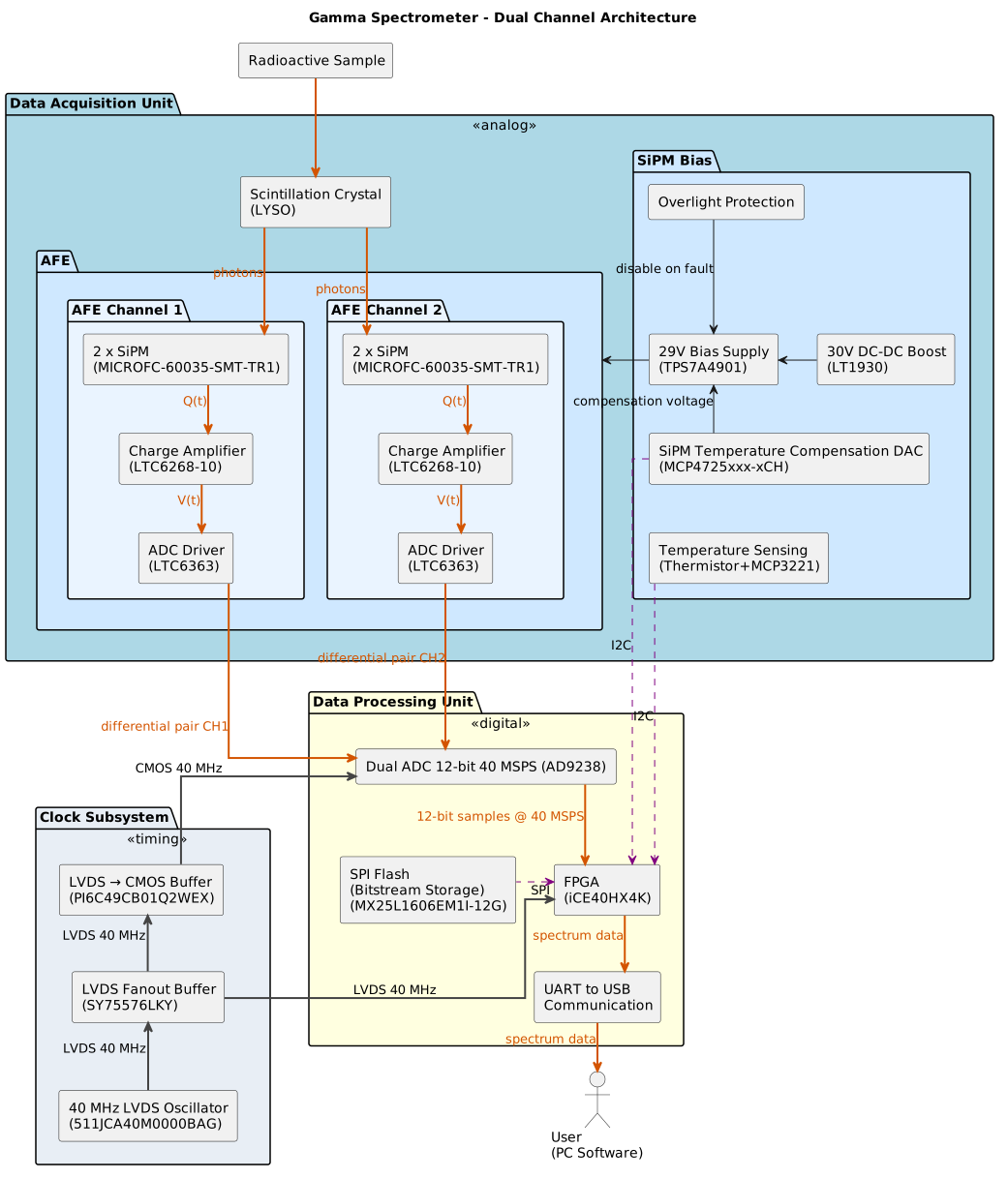
It consists of a scintillator (a material that converts gamma particles into photons) and a photomultiplier that multiplies those photons and converts them into electric current pulses. By measuring the amplitude of these pulses, it is possible to calculate the original energy of the gamma ray that produced the pulse.
Sampling data over time and plotting its histogram reveals which radioactive isotopes are present in the measured sample and their respective ratios.
Conventional gamma spectrometers commonly use vacuum photomultiplier tubes (PMTs). These require high-voltage supplies in the kilovolt range, are mechanically fragile, and are sensitive to magnetic fields.
In this project, a Silicon Photomultiplier (SiPM) is used instead. The SiPM operates at significantly lower bias voltage (tens of volts rather than kilovolts), is mechanically robust, compact, and insensitive to magnetic fields. These characteristics simplify the power supply design and mechanical integration.
Traditional spectrometers implement CR-RC shaping networks and peak detection entirely in analog hardware. This approach is cost-effective but offers limited flexibility, as parameter changes require hardware modification.
In this system, pulse shaping and peak detection are performed digitally after high-speed sampling. This increases flexibility and allows signal processing parameters to be modified in firmware without hardware changes. The trade-off is higher performance requirements for the ADC and the need for an FPGA rather than a microcontroller, which increases overall system cost.
Hardware design analysis is performed using LTspice for circuit simulation and a Jupyter-based framework for numerical post-processing. These tools are used to validate the interaction between the SiPM, the analog front-end, and the system timing behavior before to PCB design. The goal is to verify theoretical models, evaluate noise and bandwidth limitations, and confirm that design requirements are satisfied.
Tools: KiCad.
Target FPGA: iCE40.
The project is developed using a completely open-source FPGA toolchain containerized in Docker.
The analog frontend requires a metal chassis for protection from electromagnetic interference and external light sources.
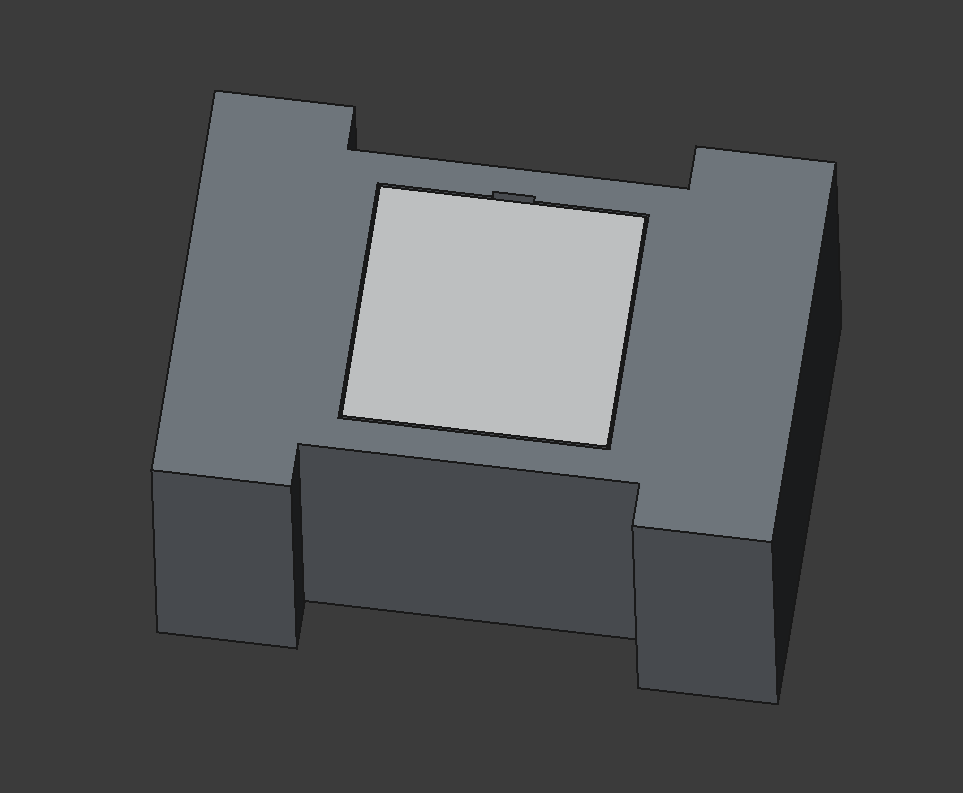
The scintillator crystal is mounted inside using a 3D-printed stand.
The crystal and SiPM are optically coupled using optical gel to minimize light pulse reflections at the interface
Tools: OpenSCAD and FreeCAD.
Picture below shows a render of the holder for the scintillator crystal.
The development environment is containerized using Docker to avoid polluting the host machine with all the necessary software. The only two software tools that are not containerized are LTspice and KiCad.
| Qty | Value | Footprint | References |
|---|---|---|---|
| 77 | C | Capacitor_SMD:C_0805_2012Metric | C1201, C1202, C1203, C1204, C1205, C1206, C1207, C1208, C1209, C1210, C1402, C1403, C1404, C1405, C1406, C1407 +61 |
| 64 | R | Resistor_SMD:R_0805_2012Metric | R1201, R1202, R1203, R1204, R1205, R1206, R1207, R1401, R1402, R1403, R1404, R1405, R1406, R1407, R1408, R1409 +48 |
| 32 | 22R | Resistor_SMD:R_0805_2012Metric | R203, R204, R205, R206, R207, R208, R209, R210, R211, R212, R213, R214, R215, R216, R217, R218 +16 |
| 30 | TestPoint | TestPoint:TestPoint_Pad_D1.0mm | TP201, TP401, TP403, TP404, TP405, TP406, TP1401, TP1402, TP1403, TP1404, TP1405, TP1601, TP1602, TP1603, TP1604, TP1605 +14 |
| 26 | 100n | Capacitor_SMD:C_0805_2012Metric | C201, C211, C212, C213, C214, C215, C216, C225, C227, C229, C1301, C1303, C1805, C1808, C1901, C1902 +10 |
| 17 | 1u | Capacitor_SMD:C_0805_2012Metric | C103, C107, C217, C218, C221, C222, C234, C301, C303, C411, C418, C513, C526, C801, C1804, C1807 +1 |
| 10 | 10n | Capacitor_SMD:C_0805_2012Metric | C104, C108, C415, C421, C525, C528, C1302, C1304, C1806, C1809 |
| 8 | 10u | Capacitor_SMD:C_0805_2012Metric | C202, C203, C219, C220, C224, C226, C228, C230 |
| 6 | 100p | Capacitor_SMD:C_0805_2012Metric | C422, C423, C424, C522, C523, C524 |
| 5 | SolderJumper_3_Bridged12 | Jumper:SolderJumper-3_P1.3mm_Bridged12_RoundedPad1.0x1.5mm | JP901, JP902, JP903, JP904, JP906 |
| 4 | 100R | Resistor_SMD:R_Array_Convex_4x0612 | RN403, RN404, RN503, RN504 |
| 4 | MICROFC-60035-SMT-TR1_SiPM | GammaSpectrometer:MICROFC-60035-SMT-TR1_SiPM | U403, U404, U504, U505 |
| 3 | LT3042 | Package_SO:MSOP-12-1EP_3x4.039mm_P0.65mm_EP1.651x2.845mm_ThermalVias | U1401, U1402, U1403 |
| 2 | 100R | Resistor_SMD:R_0805_2012Metric | R1902, R1903 |
| 2 | 150p | Capacitor_SMD:C_0805_2012Metric | C420, C521 |
| 2 | 1R | Resistor_SMD:R_0805_2012Metric | R201, R202 |
| 2 | 1k | Resistor_SMD:R_Array_Convex_4x0612 | RN401, RN501 |
| 2 | 2k | Resistor_SMD:R_0805_2012Metric | R404, R508 |
| 2 | 2k2 | Resistor_SMD:R_0805_2012Metric | R1802, R1803 |
| 2 | 2n2 | Capacitor_SMD:C_0805_2012Metric | C410, C512 |
| 2 | 510R | Resistor_SMD:R_0805_2012Metric | R103, R1901 |
| 2 | 620R | Resistor_SMD:R_Array_Convex_4x0612 | RN402, RN502 |
| 2 | AD8139 | Package_SO:SOIC-8_5.3x5.3mm_P1.27mm | U406, U503 |
| 2 | LTC6268xS6-10 | Package_TO_SOT_SMD:TSOT-23-6 | U405, U502 |
| 1 | 511JCA40M0000BAG | Oscillator:Oscillator_SMD_IDT_JS6-6_5.0x3.2mm_P1.27mm | U801 |
| 1 | AD9238 | Package_QFP:LQFP-64_7x7mm_P0.4mm | U201 |
| 1 | AP2112K-1.2 | Package_TO_SOT_SMD:SOT-23-5 | U903 |
| 1 | AP2112K-2.5 | Package_TO_SOT_SMD:SOT-23-5 | U904 |
| 1 | AP2112K-3.3 | Package_TO_SOT_SMD:SOT-23-5 | U902 |
| 1 | CH340X | Package_SO:MSOP-10_3x3mm_P0.5mm | U1801 |
| 1 | D_Schottky | Diode_SMD:D_PowerDI-123 | D501 |
| 1 | ICE40HX4K-TQ144 | Package_QFP:TQFP-144_20x20mm_P0.5mm | U101 |
| 1 | ISL21010CFH325Z-T7A | Package_TO_SOT_SMD:SOT-23 | U302 |
| 1 | LT8330IS6 | Package_TO_SOT_SMD:TSOT-23-6 | U501 |
| 1 | MX25L1606EM1I-12G | Package_SO:SOP-8_3.76x4.96mm_P1.27mm | U1201 |
| 1 | NCP163ASN330T1G (3v3) | Package_TO_SOT_SMD:TSOT-23-5_HandSoldering | U901 |
| 1 | RFShield_TwoPieces | GammaSpectrometer:BUD_CU-470_Shield | J301 |
| 1 | SI53340-B-GMR | Package_DFN_QFN:QFN-16-1EP_3x3mm_P0.5mm_EP1.9x1.9mm | U802 |
| 1 | TPS62932 | Package_TO_SOT_SMD:SOT-583-8 | U905 |
| 1 | TPS7A49 | Package_SO:Texas_DGN0008B_VSSOP-8-1EP_3x3mm_P0.65mm_EP2x3mm_Mask1.88x1.98mm_ThermalVias | U1601 |
| 1 | USB_B_Micro | GammaSpectrometer:USB_Micro-B_Molex-105017-0001_Extra_Mechanical_Pads | J1801 |
| 1 | Untitled | GammaSpectrometer:ScintillatorCrystalHolder | U301 |
RobertGawron/GammaSpectrometer
Device for quantitative analyze energy spectra of gamma-ray sources. Allows to study what radioactive isotopes in what quantities are present in measured sample.


arjepsen/Pedalboard-integrated-audio
A custom Raspberry Pi Compute Module 5 guitar-processing platform with integrated low-latency audio and a separate ESP32-S3 user-interface board.

engstad/AstroCam
My hobby project is to create a camera suitable for astronomy pictures. Here you can follow my work. It is slow going, since I don't have much time to allocate for this. So don't expect too many updates.


It measures 100 × 100 mm and has 4 copper layers, 1.6 mm thick.
326 parts, built around the ICE40HX4K-TQ144, AD8139ARD, CH340X and MX25L1606EM1I-12G. The full list of its parts is on this page, with links to each part's symbol and footprint where PCBKit's library has them.
From the RobertGawron/GammaSpectrometer repository on GitHub, at the commit this page was made from: the board is 03_SubsystemDesign/ElectronicHardware/Hardware/GammaSpectrometer.kicad_pcb and its schematic 03_SubsystemDesign/ElectronicHardware/Hardware/ADC.kicad_sch. PCBKit opens the board in the browser, with nothing to install.
Its repository publishes it under the MIT licence: you may reuse it on that licence's terms (keep the author's notice, and for a copyleft licence share your changes alike).