2 layers167.4 × 104.8 mm

 Pernotto/circuits-birrino
Small dual relay esp32
Esp32BeerTemp is an open-source printed circuit board by Pernotto, from the Pernotto/circuits-birrino repository on GitHub, published under the CERN-OHL-S-2.0 licence. It is a 2-layer board of 91 × 34.5 mm with 58 parts on 69 nets, routed with 583 tracks and 62 vias.
It is built around the ESP32-C3-WROOM-02-H4, DS2484R+T and TXS0102DCU, with the CL10A106KP8NNN, LL4148 and RCLAMP3328P among its other parts. Its parts include 20 resistors, 10 capacitors, 7 ICs, 6 connectors and 5 transistors. It belongs with the home automation and IoT boards and the ESP32 and RISC-V boards of this library.


A KiCad hardware project for fermentation temperature control: an ESP32-C3 module drives two isolated relay outputs (heat/cool) from 1-Wire (DS18B20) temperature sensors, runs ESPHome firmware, and is powered indifferently from USB-C or an auxiliary 5V input.
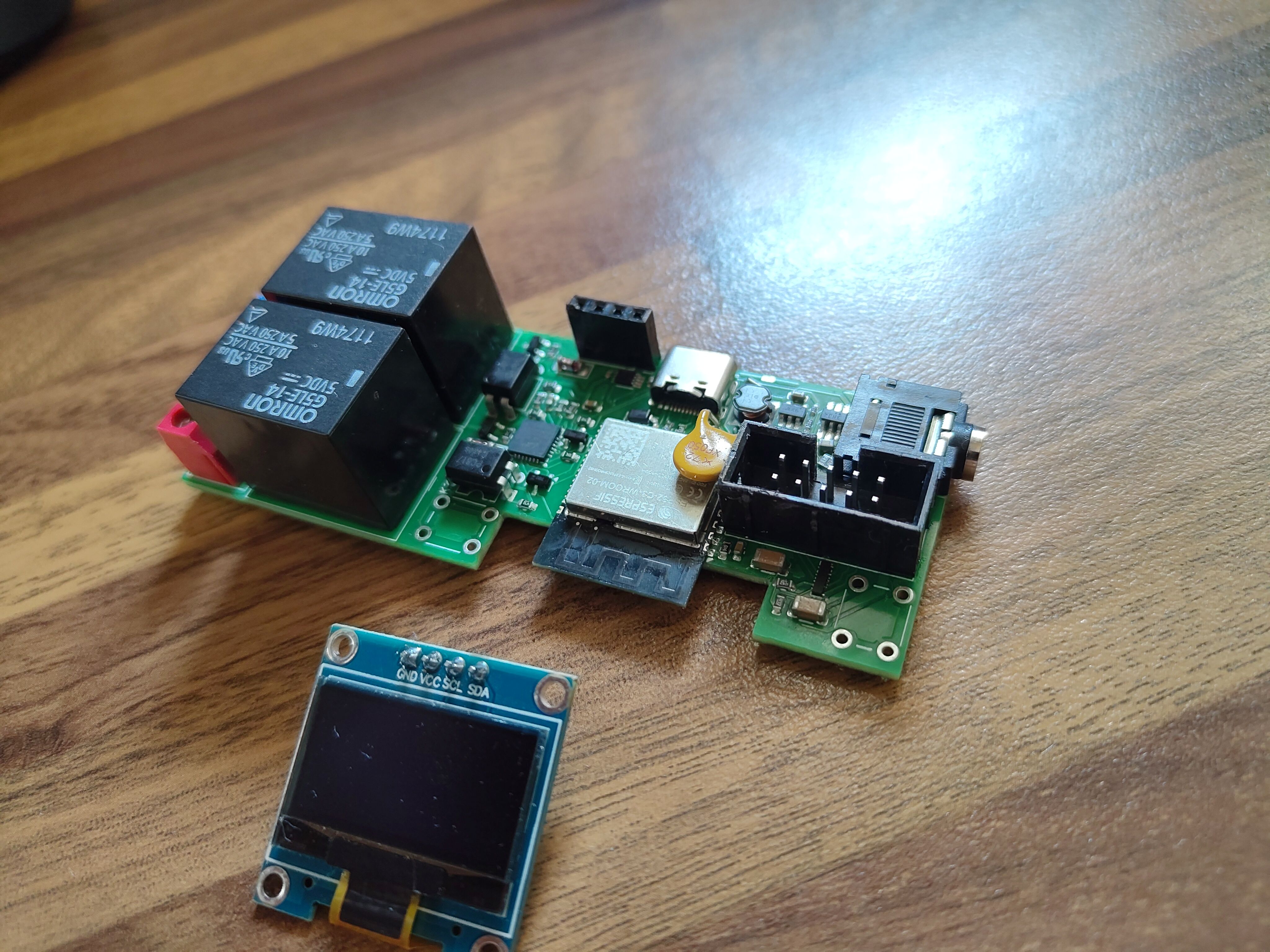
enclosure/)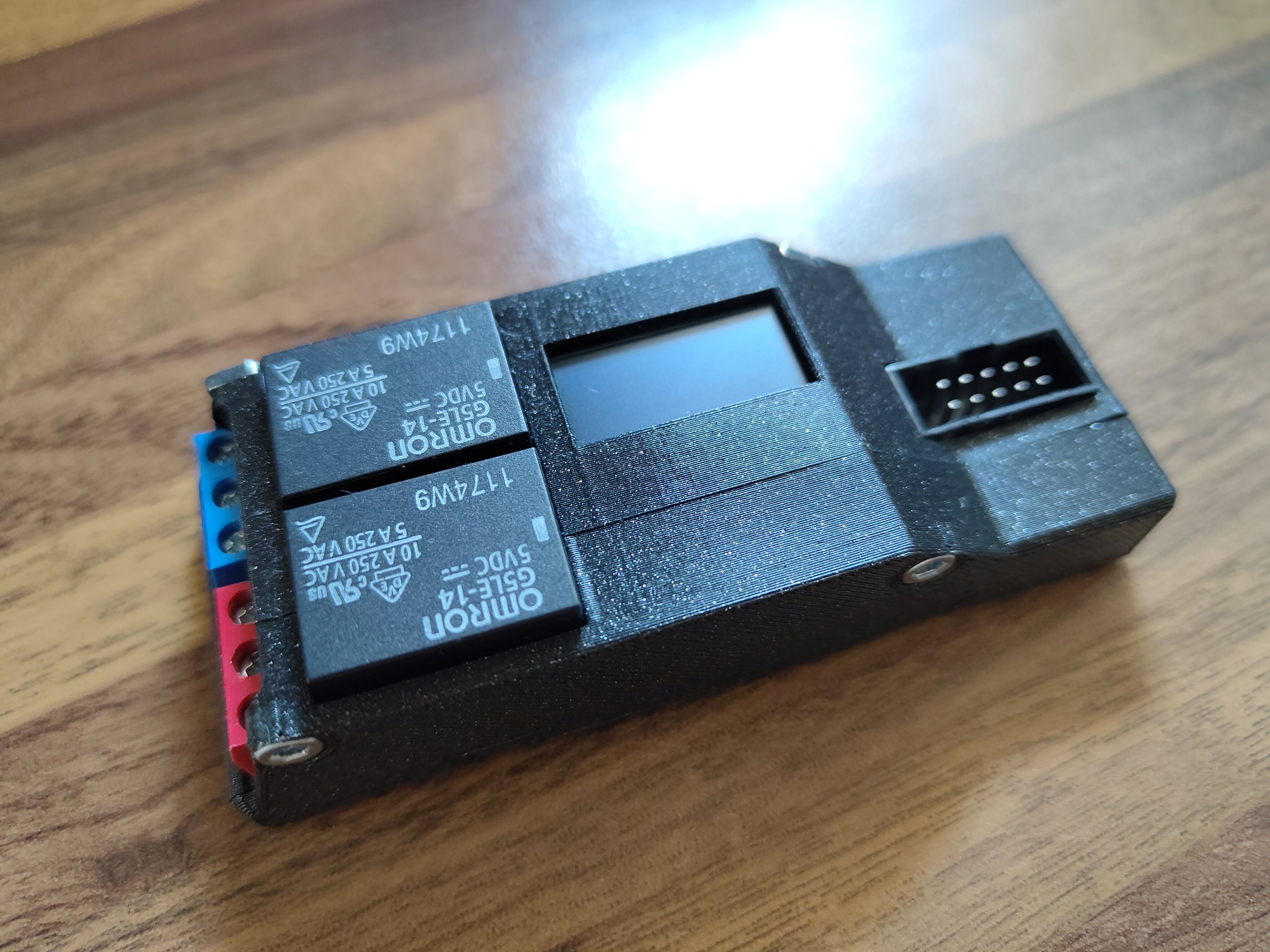
Esp32BeerTemp.kicad_pro   KiCad project
Esp32BeerTemp.kicad_sch   Schematic
Esp32BeerTemp.kicad_pcb   PCB layout
symbols/, footprint/      Project-specific KiCad libraries
bom/ibom.html             Interactive BOM (open directly in a browser, no KiCad needed)
firmware/esphome.yaml     ESPHome configuration (secrets via !secret, not included)
enclosure/                3D-printable enclosure (.3mf)
docs/images/ Photos / rendersEsp32BeerTemp.kicad_pro in KiCad 10.firmware/esphome.yaml with ESPHome; supply your
own secrets.yaml with wifi_ssid / wifi_password.enclosure/Cover-Front.3mf and enclosure/Cover-Back.3mf.Hardware design files (schematic, PCB layout, footprints, enclosure) are
licensed under CERN-OHL-S v2. The firmware configuration
(firmware/esphome.yaml) is licensed under MIT.
| Qty | Value | Footprint | References |
|---|---|---|---|
| 7 | 10k | Resistor_SMD:R_0603_1608Metric | R1, R6, R7, R8, R12, R14, R16 |
| 5 | 2N7002 | Package_TO_SOT_SMD:SOT-23 | Q1, Q2, Q3, Q4, Q5 |
| 4 | 1uF | Capacitor_SMD:C_0603_1608Metric | C1, C5, C6, C7 |
| 2 | 0.1uF | Capacitor_SMD:C_0402_1005Metric | C2, C4 |
| 2 | 100uF | Capacitor_SMD:C_1206_3216Metric | C3, C11 |
| 2 | 10uF | Capacitor_SMD:C_0603_1608Metric | C8, C10 |
| 2 | 24k | Resistor_SMD:R_0603_1608Metric | R9, R17 |
| 2 | 470 | Resistor_SMD:R_0603_1608Metric | R3, R4 |
| 2 | 4k7 | Resistor_SMD:R_0603_1608Metric | R2, R5 |
| 2 | 5.1k | Resistor_SMD:R_0603_1608Metric | R18, R19 |
| 2 | Conn_01x03_Socket | TerminalBlock_Phoenix:TerminalBlock_Phoenix_MKDS-1,5-3_1x03_P5.00mm_Horizontal | J4, J5 |
| 2 | LL4148 | Diode_SMD:D_MiniMELF | D1, D2 |
| 2 | PC817 | Package_DIP:DIP-4_W7.62mm | U3, U4 |
| 2 | SANYOU_SRD_Form_C | Relay_THT:Relay_SPDT_Omron-G5LE-1 | K1, K2 |
| 2 | SW_Push | Button_Switch_THT:SW_PUSH_6mm | SW1, SW2 |
| 1 | 100k | Resistor_SMD:R_0402_1005Metric_Pad0.72x0.64mm_HandSolder | R15 |
| 1 | 120 | Resistor_SMD:R_0603_1608Metric | R20 |
| 1 | 1k | Resistor_SMD:R_0603_1608Metric | R11 |
| 1 | 2.2uH | Inductor_SMD:L_Ferrocore_DLG-0403 | L1 |
| 1 | 453k | Resistor_SMD:R_0402_1005Metric_Pad0.72x0.64mm_HandSolder | R13 |
| 1 | 51k | Resistor_SMD:R_0603_1608Metric | R10 |
| 1 | CP2102N-Axx-xQFN28 | Package_DFN_QFN:QFN-28-1EP_5x5mm_P0.5mm_EP3.35x3.35mm | U6 |
| 1 | Conn_01x04_Socket | Connector_PinSocket_2.54mm:PinSocket_1x04_P2.54mm_Vertical | J3 |
| 1 | Conn_02x05_Counter_Clockwise | MaxFootprints:PinHeader_2x05_P2.54mm_Zoccolo | J1 |
| 1 | DS2484 | Package_TO_SOT_SMD:TSOT-23-6_HandSoldering | U5 |
| 1 | D_Schottky | Diode_SMD:D_SOD-123 | D3 |
| 1 | ESP32-C3-WROOM-02 | RF_Module:ESP32-C3-WROOM-02 | U1 |
| 1 | Polyfuse | MaxFootprints:C_Disc_D7.5mm_W2.5mm_P10.00mm | F1 |
| 1 | RCLAMP3328P | Package_DFN_QFN:UDFN-9_1.0x3.8mm_P0.5mm | D4 |
| 1 | SJ1-3524N | Custom:Jack_3.5mm_CUI_SJ1-3524N_Horizontal_edit | J2 |
| 1 | TLV62568DDC | Package_TO_SOT_SMD:SOT-23-6 | U8 |
| 1 | TXS0102DCU | Package_SO:VSSOP-8_2.3x2mm_P0.5mm | U2 |
| 1 | USB4215-03-A_REVA | MaxFootprints:GCT_USB4215-03-A_REVA | J6 |

eihli/morse-mesh
This is the current hardware source for future Morse Mesh revisions. It is a professionally reviewed redraw of the frozen, fabricated v1 board, not a pin-compatible replacement: notably, KEYIN moved from v1 PA0 to v2…

elrir01/AudioPico
This board receive audio from a BT source like a phone and outputs via a DAC the audio. It's an old project of mine but I've decided to publish it just now, so the full description is not ready and will be updated in…

vyrubaev/TV-Lift-Controller
TVLift Controller is an intelligent controller for TV lift and lower mechanisms, based on the ESP32 microcontroller.


the78mole/km271-wifi
A piece of hardware to be installed in a Buderus Logamatic 2107 to provide control and status over WiFi

j3270/1-Wire-Wing-pcb
Feather Wing PCB supporting 1-Wire via a DS2484 I2C to 1-Wire master, or selectable jumper for micros that support 1-Wire natively and bit-banging.
It measures 91 × 34.5 mm and has 2 copper layers, 1.6 mm thick.
58 parts, built around the ESP32-C3-WROOM-02-H4, DS2484R+T, TXS0102DCU and CL10A106KP8NNN. The full list of its parts is on this page, with links to each part's symbol and footprint where PCBKit's library has them.
From the Pernotto/circuits-birrino repository on GitHub, at the commit this page was made from: the board is Esp32BeerTemp.kicad_pcb and its schematic Esp32BeerTemp.kicad_sch. PCBKit opens the board in the browser, with nothing to install.
Its repository publishes it under the CERN-OHL-S-2.0 licence: you may reuse it on that licence's terms (keep the author's notice, and for a copyleft licence share your changes alike).